Monday, February 07, 2005


Gray Guy (previously Dorian Gray), son of Stuff and Muk. 1971-1990. Posted by Hello
Last of the catblogging for now...

Cat Blogging:The noble Muk, 1970-1990 Posted by Hello

Thursday, January 20, 2005


It's called cat blogging, the latest Internet craze. I don't have any current photos to post, so here's one from long ago: her name was Stuff, 1970-1988. Posted by Hello

Wednesday, January 12, 2005


Steelers fans exiled in Ohio/Pgh Post Gazette photo Posted by Hello
Steel City in Exile

Come on, tell the truth: you've missed the sports stories at good old Blue Voice.

The story linked below about the Pittsburgh Steelers is in the New York Times---a story like the ones written twenty years ago, one of them by me---talking about what its sports teams represent to an economically hard-pressed Pittsburgh with an uncertain future.

The main difference I detect is that this economic bleeding has gone on for so long, or in any event recurred, that the Pittsburgh Post Gazette regularly publishes stories and photos about Pittsburghers in exile, members of Steelers Nation. They also publish lists sports bars all other the country where Steelers fans gather. There are none closer to me than San Francisco, but there are at least four down there, including one called Pittsburgh's Pub.

I guess I'm one of those exiles. I have fond memories of the city, which was a great place to live in many ways. There aren't many cities in the U.S. that are more, well, livable (it was voted such around the time I wrote my story.)

As for the Steelers, this could really be their year. They should down the New York Jets with authority this weekend. Their likely toughest opponent would be the NE Patriots. Even though they beat them once this year, the Patriots are a tested playoff team. But you can't bet against the Steelers with any confidence this year. And they are awfully fun to watch.

We've been waiting for this year since 1980. I loved this story (although the guy who was more interested in the Steelers prospects than his diagnosis of lung cancer gave me a little pause...)

The New York Times > Sports > Pro Football > Pittsburgh: A Big Happy Company Town

Sunday, January 02, 2005


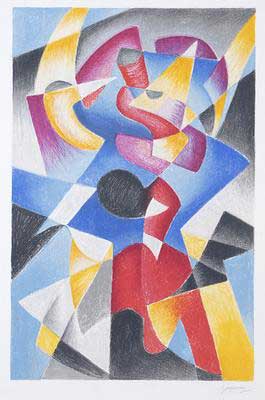
by Gino Severini; happy new year! Posted by Hello
The Year Ends

The year ends in winter, in the time of sleep and stories. What will be the stories of 2004?

I pause to look back at a pretty full year of my stories, beginning in the San Francisco Chronicle with "Buddha by the Bay" in January and the Wiyot vigil story in February. Then two highly contrasting multi-book review essays (one on a series based on dialogues between the Dalai Lama and scientists, the other on several books on war and terrorism) and 3 or 4 other reviews in the Chronicle Sunday Book Review in '04 (after 10 or so in 2003 and 7 or 8 in '02) and a couple of Sunday Insight pieces (not as many as in 03 but more than '02). The year also included an op-ed in the Los Angeles Times and was capped this late summer with a feature in the New York Times, page 1 of the Arts section. A long piece in News from Native California, and a pretty interesting interview article in the Humbolt State University alumni magazine in the fall, with a short piece in Native Peoples and for a British magazine on Buddhism awaiting publication shortly.

So together with lots of blogwords and unpublished pieces, a short play, revision of a long one, some fiction and even a poem or two, and of course the perennial book proposals, it was a year of some volume. I'm basically proud of the work, happy to have gotten compliments on some of it, particularly by those directly involved in the stories (you know, like Michael McClure on the Buddhism story, and Leonard Nimoy on the Star Trek piece in the Times.)

Yet so far all my published jabber hasn't materially changed how '05 begins. I had hoped that my run of work in five separate sections of the SF Chronicle might get me an invitation to draw a salary, but none was forthcoming---even when I asked. Word from inside was that the Chron is chronically overextended financially and saddled with some contracts they wish they could drop (sort of like the 49ers) and the morale among even those who are salaried is low. (The joke was, I'm told, that when a meeting was called to discuss the low morale, most people were too depressed to show up.) Last week I was told there is no freelance budget at all, except I guess for book reviews and maybe Insight. So no more Chronicling. I still have some hopes involving the NY Times and (separately) Star Trek.

I'm finding that blogging is a lot of fun but way too time consuming, so I may have to lower the volume there if I'm going to get projects accomplished that may wind up being legacies of a kind. The only kind I'll leave, I suppose. I will be working this month and for several months forward on launching and maintaining the This North Coast Place blog, my Cultural Trust project. But like most January firsts, the new year is entirely free of recognizable income-generators.

As for the stories we share, not many good ones, eh? The Tragedy of November, the tsunami of December. And hereabouts the loss this summer of our beloved Tess the cat, who I still think about and miss every day, usually at bedtime. Sometimes when I got into bed, she would sit on my chest to be petted into such a state of bliss that she didn't want to move when I was ready to turn over on my stomach to sleep, so if I turned very slowly and carefully, she just sort of rode the move, and wound up on the other side, on my back, where she would sleep.

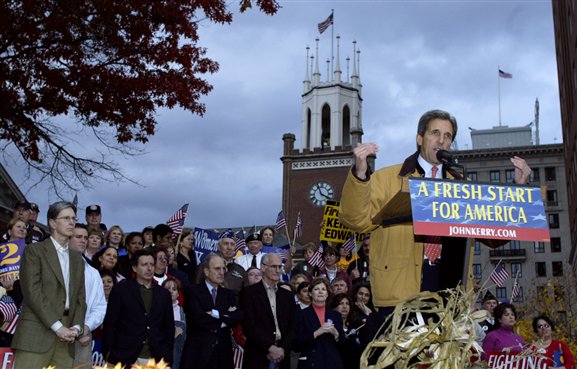
Prior to the Tragedy of November, I got involved in politics again this year in a haphazard way. A couple of speeches on behalf of Kerry, one to the county Democrats, one where I found myself debating an actual presidential candidate, the Green Party's David Cobb (who lives nearby in Eureka.) Elected as a Kerry delegate to the national convention, but couldn't afford to go. Then there's the "Fresh Start" saga, which still lacks definitive information. Still, it was a weird rush to see the Democratic candidate speaking behind the words I pleaded that his campaign adopt as their slogan. I read that one of Kerry's official consultants made $5 million in the campaign. That's about $5 million and fifty dollars more than I made.

Then at the very end of August, my first Star Trek convention since 1975. I met Gene Roddenberry at the first one, and at this one, Nichelle Nichols introduced me to Neil Armstrong, and I shook hands with the first human to set foot on another world. So now I've shaken hands with JFK, Roberto Clemente and Neil Armstrong. Not bad.

I worked on several projects for Humboldt State University this year, which felt like a good match of my skills and interests with their needs and purpose. I can imagine myself on the right university campus.

Margaret had a busy but pretty good year, becoming Ombudsperson at HSU, seeing a couple of her plays performed, adding to her skills and knowledge in various ways. Her children are healthy, as are my sisters and their children and grandchild, and so are we. Whatever else '05 brings, we hope that much stays the same.

exposed again Posted by Hello
Filmed Grace

We seem to see a lot of movies during these late December into January weeks. Not a lot compared to what I used to see (at one point in my life, about 10 a week) but compared to the rest of the year. It's partly due to Margaret's vacation from school, so our viewing time at night gets extended from the usual one hour, and partly because we had movie cards for the local cinema, and the films have to be seen within the calendar year ending on December 31.

It's also partly due to the fact that I no longer feel bound to see lots of movies when they first come out, for real or imagined professional reasons, as I once did. I also don't like as many movies, possibly because they aren't as good. As for the better foreign and independent films, I don't often find their subjects (young love, tortured relationships) as worth dwelling on as I might have in the past. You know, been there, done that, don't remind me.

But I can still be persuaded by a big bag of popcorn, so we started at the Minor Theatre by seeing "Sideways," probably the most relentlessly anti-Hollywood-film ever made. It's the story of very unattractive people (except for one, Virginia Madsen, who I had a feeling was a talented actor even in her youthful bloom when all she had to do--- and all she was allowed to do-- was to be stunningly beautiful). They wear very unattractive clothes, go to unattractive places (as well as attractive places photographed to look unattractive) and do unattractive things.

It's an intelligent film, a pretty well told story, and of course, with very "real" characters, which I guess was the point. So yes, the anxious, jilted teacher desperate for his break as a writer, and the washed-up actor who still takes an actor's point of view on life, are pretty dead-on, and in the case of the writer, quite uncomfortably so. But not only don't I want to see a movie so relentlessly ugly, I would really hate to live those ugly lives in that ugly world. None of them have the slightest sense of style. They are aesthetically underprivileged. Surrounded and imbued by such slovenliness, they can't help but be miserable. And I can't help but be miserable watching them. The fact that this is very recognizable and realistic is exactly zero compensation. Between "Sideways" and, say, "Shall We Dance" (the Fred Astaire version), there has to be some ground to live on.

We then did several nights of DVDs, which I selected from a depressing and depleted field at the video store. The only thing they seemed to have in common was that we hadn't seen them. But they turned out to have several common threads running through at least two. "Cold Mountain" (Nicole Kidman, Jude Law, Renee Zellweger who won best supporting actress Oscar, directed by Anthony Minghella) and "Malena" (from 2000, directed by Giuseppe Tornatore, of "Cinema Paradiso" fame) concerned women waiting for their men at war in dangerous communities. "Cold Mountain" and "Beyond Borders" (Angelina Jolie) involved women in love with men they hardly knew, and whose single conjugation produced a child that survived one of the dead parents.

They were all quite good, if also quite long, and with too much graphic violence for Margaret. The directing was excellent, and the cinematography and music were exceptional for all three. I came away with greater admiration for the actors I knew of, and for the Italian actors I hadn't seen before in "Malena" (which at times seemed like an Italian version of a Truffaut film.) Angelina Jolie is another actor known primarily for her beauty who always seemed to me to have some substance (and the same could be said of Jude Law, actually), and she was not only quite good in "Beyond Borders," but it was a fine commitment at this point in her career to do a feature film which showcased the worldwide human tragedies-the starvation, devastating illness, homelessness and violence---caused by warring. Then to see the Civil War devastation in "Cold Mountain," and see how little has changed except the scope. Nicole Kidman also strikes me as a brave actor with special skills and versatility who perhaps doesn't get as much credit for that as does, say, Renee Z.

I've said this before, perhaps in this blog, but I am a huge fan of DVDs. Not only is the picture and sound so much better for me, but I love the commentaries, the interviews and documentaries. "Cold Mountain" included a concert of music and readings. So much so that while Margaret went off to use her last film on the movie card, I stayed home to watch DVDs of movies I was screening for a couple of projects I'm working on. Alone, I watch the movie with the audio commentary and subtitles. I don't get everything of anything that way, but enough of something. I was asked by the New York Times for ideas on how to cover the upcoming Episode III of the Star Wars saga, so I watched the DVDs of I and II (which both were somewhat different from the theatrical releases.) “The Phantom Menace” DVD has a remarkable documentary on the making of that film: not the usual after-the-fact summary that looks like an extended trailer, but film shot as the movie was being made. In some ways it’s better than the movie it is about. My favorite line in the whole DVD package was from George Lucas. He was listening to someone explain that if they used one process it would cost “only” about a million dollars more than another process. George shook his head sagely and in a quiet voice he said, “A million saved is a million earned.” I often say that myself.

One of these films (for a different project) didn't have commentaries, but watching the 1950s George Pal version of "War of the Worlds" was pretty remarkable anyway, because I watched it on my laptop and listened through earphones. I saw that movie when it first came out, and several times since, but I heard more this time than ever, if only the carefully layered background chatter.

But the unquestioned hit of the vacation watching so far has to be not a movie, not a DVD movie, not a DVD movie about a DVD movie, but a television series on DVD: Northern Exposure.

It’s hard to believe but Northern Exposure had its first run at the same time as Twin Peaks, and Star Trek The Next Generation (NE and Next Gen were both nominated for Emmys as best dramatic series the same year). Seeing the first season on DVD reminded me of how my Jungian education more or less began with Northern Exposure and Next Gen. And that Northern Exposure was the first TV series to take Native contemporary life seriously (as seriously as any other kind of life, that is), at a time I was first exploring it.

It was also on at the time that Margaret and I met. So we got the DVDs of the eight first season episodes (it started as a midseason replacement.) The DVDs themselves are unadorned; just a few deleted scenes besides the episodes, but the episodes (great color and sound, and of course no commercials) are enough. If this wasn’t the greatest TV series ever, it has to be in the top 5, absolutely the top 10. We just started watching season 2, with more interesting deleted scenes, too. But there are only 7 more episodes on these DVDs. There were more than 100 over 5 years, so we’re hoping the DVD elves are hard at work.

On New Year's Eve we watched Mickey Lemle's documentary on Ram Das, "Fierce Grace." It was both a sobering and inspiring way to mark the end of one more year, since it deals not only with the life of a leader of My Generation, but how this spiritual leader had to learn to cope with the effects of a stroke. And there was wily old Huston "Mr. Comparative Religion" Smith, as respectable as they come these days, talking about his LSD trips. And Wavy Gravy, being wavy. And all those sixties and seventies kids, dancing around in circles and looking ecstatic, likely with a little help from their friendly drugs. And then all those 21st century people---old ones, young ones, very young ones---dancing around in circles to various sweet versions of Hare Krishna music, looking ecstatic. But now they've earned it. It's clearly beautiful now, so maybe we can let ourselves recognize: maybe it really was beautiful then, too, after all.

Sunday, December 19, 2004


Peaceful Holidays Posted by Hello
Postcard from the Dead Novel Office

The impulse to play elder in the last post was prompted by a number of things, but this is one of them: some comments by Paul Theroux in a review of a biography of Graham Greene in the New York Times Book Review from October, which emerged from the pile in recent weeks.

"It is impossible now for any American under the age of 60 or so to comprehend the literary world that existed in the two decades after World War II, and especially the magic that fiction writers exerted upon the public."

It was the first time that the phrase "60 or so" seemed to apply. The "two decades" would mean until 1966, say. At age 20, I'd had maybe five years of absorbing that magic, which included novelists from earlier in the century (Joyce, Sinclair Lewis, Hemingway, Faulkner, Fitzgerald, Virginia Woolf, Kafka), plus more recent novelists (Mailer, Bellow, Styron, Roth, Updike, Flannery O'Connor) as well as giants of the 19th and 18th centuries. That after several years of falling regularly under the spell of novels, good and not so good, starting with the likes of Joe Archibald and John R. Tunis (boys sports), "Franklin W. Dixon" (Hardy Boys mysteries) and science fiction by Milton Lesser, Richard Marsten and Robert Heinlein (one of Heinlein's---Have Space Suit---Will Travel, I reread recently with great pleasure.)

The magic continued for my generation later in the 1960s, well into the age of movies and television, with Kurt Vonnegut, Joseph Heller, Doris Lessing, Ralph Ellison,Walker Percy, Malamud, John Barth, etc. as well as Kerouac, Henry Miller and William Burroughs, the underground of the 50s. Then Gabriel Garcia Marquez opened a new window of magic and mystique.

Novelists were important at least to me for most of my life. Theroux suggests that their mystique was at least partly due to their relative invisibility. Even into the 1960s, except for jacket photos, the occasional photos in magazines and very occasional television interviews, they were the distant magicians behind the words.

Some of these writers "who enjoyed that sort of fame as conspicuous absentees...have lived on into this age of intrusion," he writes, "where publishers conspire with bookstores to bully writers into the open and make them part of the selling mechanism."

"Invisible, they were the more powerful for seeming forever everywhere. These writers bewitched the imaginations of those of us who grew up in that period of glamour and solitude, and who wished to be writers ourselves."

That sounds familiar. My imagination was bewitched, and I wished to be a novelist. The mystique was part of it; the mystique of James Joyce, for example, was very strong, and Richard Ellman's biography of him traveled with me in the 60s, as near and dear as a bedside Bible.

I guess I am surprised to read how antique this apparently is. I know that the age of reading and writing is supposedly over, due to new media. But my dreams of writing novels coexisted with dreams of writing songs and plays and screenplays. I identified with Fitzgerald, but also with the Beatles and Dylan, and then Truffaut and Godard and Richard Lester . In fact my great dream as I left college was to produce a novel-in-a-box: a real print novel, accompanied by related recorded music and visuals, perhaps even a little movie, described in the novel. The kind of thing that these days is quite possible. (The closest I actually came was as co-editor of my college literary magazine. Our final issue in 1968 was a magazine-in-an-envelope: a print magazine of fiction and poems, two vinyl records, and 8x11 photographs and reproductions of student artworks.)

The novel remained vital in my life for many years, as I added heroes like Pynchon, DeLillo, Calvino, Kundera... In the 1990s I discovered Native American fiction, and so added Leslie Marmon Silko, Linda Hogan, Louise Erdrich, Thomas King and others. Though I read other contemporary novelists of various nationalities, the American Jim Harrison was the one that stuck.

And there are many more novelists I admire for what they say about literature and what they've done to keep literature vital, even if I am not particularly absorbed by their novels. (I might even like their short fiction better.) There are also many new novelists I've read with pleasure and admiration, but they don't mean the same thing to me, perhaps because they are younger.

I believed in the novel as the quintessential literary form, so full of potential that nearly every culture on earth has produced at least one great novel and great novelist. I used to quote with relish the statement of Marquez I found in an interview: "Some say the novel is dead. But it is not the novel. It is they who are dead."

Now the literary novel does seem tangential. It seems the greater energy and moment is going into genre fiction, such as detective novels and science fiction. It's not that the writing has declined so much in quality, but perhaps in scope. I don't know really. But I don't think it is entirely to be blamed on other media.

The lack of time to read, perhaps, though reading is still important to some people. I remember listening to a woman in an adult education class whose home life was so noisy and frenzied that she had to go outside and read in her car. But she did.

There is perhaps more to Theroux's point than a comment on mystique, which he suggests declines with exposure. The real mystique of the novelist is in creating the magic in the novel that we as readers recognize, because we were spellbound.

But something has undoubtedly happened at just about the time that novelists (along with other writers) felt they had to be part of the promotional machinery. The way books are sold has damaged the novel somehow, perhaps by placing it in the same category as promoting movies and TV shows, as well as soap and prescription drugs. Movies require huge promotion because they must make great amounts of money, because they cost great amounts of money. Novels don't cost very much really. Just a decent and somewhat secure life for the novelist, which wouldn't pay for the special effects in a cheap horror movie. Maybe not even the catering.
Novels still supply movies and television with stories, and even when they do, the novels can themselves be unlike the movie, or any movie. Novels can still be novels. They can still bring the multidimensional news.

But even though novelists must do the bookstore signings and the morning radio shows, they don't have all that much celebrity (except perhaps in the bookish cities like New York, San Francisco, Seattle and Portland.) Perhaps they are sinking back into the obscurity that nurtures mystique. And maybe you won't have to be pushing 60 to want to be a novelist like them.

Friday, December 17, 2004


No, it's not Karl Rove watching GW and Cheney---or is it? Posted by Hello
Say Kids, What Time Is It?


Winter solstice is icumen in. Story time.

Have I said this before? You know at my age...at my age we repeat ourselves. Sure, short-term memory. But at my age repeating it until you get it right seems more important than something else new and goony.

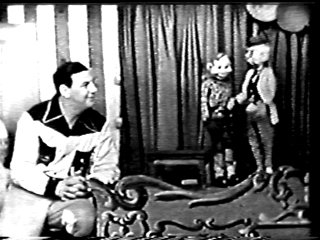
Yes you start out being Howdy Doody and you end up looking like Mr. Bluster. And if Clarabell is your hero the whole time---you don't have any idea what I'm talking about, do you? Gather the kids around for another story by the Old Ranger. (No, not the Lone Ranger. I know the difference, thanks. Do you? )

It's nice to fill this with allusions almost nobody will get. Or is that the cynicism of age? Yeah, the good old days. They had Joyce and Pound. We had Neil Simon and that King fella. Sherman King was it? Bernard? I can't remember. Wrote those long spooky books I never read. Liked a couple of the movies though. That one with Anthony Hopkins. No, not that one. Hearts in Atlantis, yeah, that was it. Where was I? Was I rambling?

Stephen, that's it. Stephen King.

So, kids, let me pass on the fruits of my experience. Ready? It won't take long, believe me.

1. To stay warm in the cold, wear a scarf and a hat. Coats are good, but the essentials to feeling warm are a scarf and a hat. The French have been on to this for some time.

2. The best thing you can do for your day is to drink a full glass of water first thing in the morning. You'll live longer.

3. The best thing you can do for your car is to let it warm up a few minutes before you drive it. Your car will live longer.

4. Now we're in the neighborhood of bitter lessons. Let's not stay here too long, okay? Success in the world entirely depends on the enthusiasm of others. Especially others with power, which means either the right other at the right time, or lots and lots of others voting for you with money (or I suppose votes, if that's your thing.) A very hard lesson, I assure you. For an introvert, even harder.

That's about it. Or anyway, all that I can remember at the moment.

So now is the winter of our discontent, or to quote that other poet, it's not dark yet, but it's getting there. I suppose this so-called civilization has been simultaneously falling apart and reaching for new heights for a long time, but the reaching part seems to be losing out to the falling apart part. This last election may signal the fast stage decline, like a falling object looks to be floating down until it's a few feet off the ground and then, whoosh, womp. I'm trying not to project my personal prospects on the world, but as bad as they might be, they don't look so bad alongside this country's. At least it's unlikely I'll wind up killing a lot of innocent people.

Just before I left Pittsburgh---I've told you this one, right?---well, listen to it again. Just before I left Pittsburgh I was selling about half of my record collection to a used record dealer (probably should have sold the other half, too. My record player doesn't work, and new ones are now luxury items.) The dealer was about my age. One of those 60s type rock albums must have inspired some mention of global heating, the environment going to hell, fundamentalist fascism, nuclear annihilation or maybe all of them. Anyway he said something like, well, looks like by the time the shit hits the fan we'll be gone.

I laughed. I'd made the same damn calculation. Yeah, the world is ending but probably not till mid 21st century, by which time I will have lived my life in relative freedom and prosperity, with fish still in the ocean,a few trees left in a few forests and some air somewhat fit to breath.

Well, thanks to GW Bush and his hypnotic evil laying a numb pall of "partial-birth abortion" and "reality TV" (two expressions that are as completely nonsensical as privatized social security) upon the land, which in my worst nightmare I couldn't have imagined in 1996, it's all speeding up. (Actually that's not quite true. I imagined it in 1989, in a novel that not only predicted somebody very much like Bush in the White House, but also a national siege protected by something I called Homeguard. An unpublished novel naturally.)

The apocalypse coming up fast, by design apparently, so no time for horsing around. Time to pony up. Time for horseshit until the cows come home, and the chickens come home to roost. Funny about those farm metaphors and barnyard epithets, or epitaphs as my spell check wants me to say, when none of us have been on a farm since childhood. Because there aren't any. But then, they're in the Bible, so very contemporary. The earth is 6,000 years old, haven't you heard? What I don't understand is why they don't also insist it's flat and the center of the universe, which is also in the Bible.

Where was I? I've got one more thing to say to you kids. What the hell are you doing? You've got an insane immoral war going on! You've got this toxic moron in the White House who is sinking you into terminal debt to profit his fat ass pals. Now you've got voting rights being taken away from African Americans, as well as others, right out there in the broad daylight of Ohio, not to mention Florida and Pennsylvania and so on, and not a peep.

I'd like to think My Generation would have made all the noise we did even if we weren't being drafted. Some of us were marching for Civil Rights before the draft entered into the equation on the war. But maybe we would have given up before we did, which was when we were exhausted. Then the world got disco and it's been downhill from there. Anyway, we only made so much noise because we were a big big generation. The noisemakers were a small percentage, at least until the early 70s, but impressive in numbers.

But you guys. All I see on the political blogs is, why isn't Kerry doing something about this! Why isn't Clinton! What would Oprah do? And I tell them: forget about daddy. Everybody's looking for daddy to do it for them, and daddy can never do enough. Daddy Kerry issues a statement, then why doesn't he sue in court? Daddy Kerry sues in court, then why doesn't he go on TV?

You can't count on daddy politician or mommy officeholder or daddy media star or mommy talk show host. The kids have to do it themselves. Again. We did.

If there is a grassroots effort, then leaders have to take notice. Political leaders are never the first to commit. JFK knew the Democrats would lose the South for generations if they supported Civil Rights. It took 300,000 of us marching on Washington in 1963 to provide political cover and to convince the world that the time had truly come.

It was a test of leadership. LBJ failed it in 1968 when we marched on the Pentagon. Nixon failed it in 1971 when we marched behind John Kerry and Nixon circled the buses around the White House. But JFK invited the leaders of the 1962 march to the White House that very day. Then he took the chance.

New leaders emerge from that kind of movement. If you've got smart people who can talk, new media voices emerge, too. There's so much on these blogs about people power and net power. But they're still looking for daddy.

I said some of this on one of those political blogs. Somebody's comment agreed with me, said taking it to the streets is the thing to do, now if only somebody like Jesse Jackson would get behind it... Uh huh. I think I'll go back to talking to myself on my own blog.

All those marches against the war in Iraq didn't stop anything, but they did change the debate in the Democratic primaries. But since the election a shell-shocked quiescence has settled over the land. Maybe it's finals week, I don't know. But daddy isn't going to do it for you. And by the way, neither is granddad. Although being one sounds like it could be fun.

Friday, November 26, 2004

I've recently confirmed that my memo on why the Kerry campaign should adopt the slogan, "A Fresh Start," was forwarded to the upper echelons of the Kerry campaign by a person of importance known to them, in June. More than that I don't know yet, but I'm intrigued. My high level contact has promised to find out more.

The reason I bring this up is---well, check out the Kerry photo below.

Monday, November 15, 2004


Blue President Posted by Hello

Jung Posted by Hello

Friday, November 12, 2004

Change

The postelection reaction continues, composed of analyses, harranges, acid jokes, hopeful statistics and expressions of sadness, emptiness, fear and despair. There are numbers, maps, riddles, conspiracy theories, exhortations, and bitter litanies flying through cyberspace--- even a poem, posted on T. Goddard's Political Wire:
The election is over, the results are now known.
The will of the people has clearly been shown.
We should show by our thoughts, our words and our deeds
That unity is just what our country needs.
Let's all get together. Let bitterness pass.
I'll hug your elephant.
You kiss my ass.

Some rose to even greater eloquence, though we readers of the SF Chronicle have come to expect it of columnist Jon Carroll. He reminded those inclined to flee the country or otherwise give up the fight that "The same people are underserved as were underserved on Nov.1. The need for courage and compassion and hard work is as great as it ever was. If you quit now, the bastards have won....We are political players in the most powerful nation in the world, and that is a responsibility." You can find the rest of this column here:
JON CARROLL

Despair and deep sadness still hover and the consequences of the election will continue to devastate: the Iraqi children and the American Marines dying in Fallujah, the polar bears dying in the Arctic, the suffering that will ensue in a million lonely ways, when pain goes untreated for want of health care, and the politically deluded as well as the disenfranchised struggle for their uncertain survival.

There is also plenty of anger. More than one politico has advised that it's time to play just as dirty as the opponents. One analyst pointed to an attack ad in which the Republicans portrayed their congressional opponent literally as the devil, with graphic suggestion of the apocalyptic consequences of his election. This Democrat's advice was not just to go negative but to get vicious, because it works.

There is undeniable emotional satisfaction as well as some political sense in unrelenting attack. If the Republicans want total war, let's see if they can take it. But then, it's the appeal to only emotions that in itself is scary. Do you defeat the enemy by becoming the enemy?

For some it is the losing, and the manner of it that fuels anger: the cheating and lying that put the triumphant smirk back on the dopey face of the man we are ashamed to call this country's choice for president. The disasters, ineptitude and stupidities of this administration are writ so large in such garish colors, yet they won. (Or did they? There's just enough evidence of fraud, tampering and suppression to seriously doubt whether George W. Bush actually got more votes, especially in Ohio and Florida, than did John Kerry.)


In any case, we know our society needs to change, and there are lots of people doing that work. Awhile back, I wrote about what I called the Skills of Peace. I started out exploring a variety of subjects, efforts, people that seemed to me to contribute to dealing with conflict and creating peace on various levels. I came to see that there were three essential divisions: the political skills (which also meant economic, sociological, history etc., anything that applied to the world, nations, regions, and large groups), communication skills for all of these large groups, and also for small groups and relationships; and skills applied within individuals (spiritual, psychological.) In other words, the outer worlds, the inner worlds, and the interfaces (communications.)

I managed to get a little of all these into a single magazine piece, though it was the psychological that got the shortest shrift. In some ways it was the hardest to quickly identify as a skill area. People understood that Peace Studies equipping students with geopolitical knowledge is pertinent, and so are various methods of communication, especially if the purpose is mediation or resolving conflict. Readers also understood the search for inner peace through meditation or religious study or even philosophy.

But it was a harder sell to include the relevance of psychological concepts as tools, and their use as skills of peace. Yet to me this is equally essential. We've seen what politics alone can and can't do. Spiritual quests alone don't do much for Iraq. But as an added skill in conceptualizing geopolitical problems and their contributing factors, in judging right and wrong actions, and in communicating, it seems to me psychology---specifically Jungian psychology and its derivatives---offers essential tools.

Jung offers a wealth of tools and insights, but I believe that if people learned only a few, and worked with them, the improvement would be enormous. If every school taught the basics of the conscious and the unconscious, the personal and collective shadow, and the tendencies towards projection, inflation and denial, we would be on the way to a better world. More to the point, to one with a better chance of surviving more or less intact.

But what does this have to do with politics? Let me quote the opening of Jung's essay, originally titled "The Present and the Future," and published in English as "The Undiscovered Self." Jung wrote this in the mid 1950s, responding to the specific history of World War II and the then-current Cold War: the ongoing gathering of the world into two camps ostensibly based on ideology, fueling the nuclear arms race and threatening Armageddon at any moment.

"Everywhere in the West there are subversive minorities who, sheltered by our humanitarianism and our sense of justice, hold the incendiary torches ready, with nothing to stop the spread of their ideas except the critical reason of a single, fairly intelligent, mentally stable substratum of the population.

One should not overestimate the thickness of this stratum. It varies from country to country according to national temperament. Also, it is regionally dependent on public education and is subject to the influence of acutely disturbing factors of a political and economic nature. Taking plebiscites as a criterion, one could on an optimistic estimate put its upper limit at about forty percent of the electorate."

"Rational argument can be conducted with some prospect of success only as the emotionality of a given situation does not exceed a certain degree. If the affective temperature rises above this level, the possibility of reason having any effect ceases and its place is taken by slogans and chimerical wish-fantasies. That is to say, a sort of collective possession results which rapidly develops into a psychic epidemic."

Individuals can arise as leaders and participants whose "views and behavior, for all their appearance of normality, are influenced unconsciously by pathological and perverse factors....Their mental state is of a collectively excited group ruled by affective judgments and wish fantasies. In a milieu of this kind they are the adapted ones, and consequently they feel quite at home in it. They know from their own experience the language of these conditions, and they know how to handle them. Their chimerical ideas, sustained by fanatical resentments, appeal to the collective irrationality and find fruitful soil there; they express all those motives and resentments, which lurk in more normal people under the cloak of reason and insight."

Around the same time, Jung gave one of his few lengthy filmed interviews---for a professor in Houston, Texas no less. Probably the most quoted part of it is this:

"Nowadays particularly the world hangs on a thin thread... Nowadays we are not threatened by elemental catastrophes. There is no such thing as an H-Bomb [in nature]; that is all man's doing. We are the great danger. The psyche is the great danger. What if something goes wrong with the psyche? And so it is demonstrated in our day what the power of the psyche is, how important it is to know something about it. But we know nothing about it. Nobody would give credit to the idea that the psychical processes of the ordinary man have any importance whatever."

But even the most cursory glance at this election shows that importance, as well as the legacy of ignoring the psyche. America has never taken the psyche seriously; even its psychology has been dominated by mechanistic behaviorists who insist that designing better drugs is the beginning and end of their job. A still conspicuous victim of this ignorance is the Vietnam veteran.

The first conventional idiocy is that everything we think is under our conscious control is under our conscious control. The second is that the world is divided between good people and bad people, and the good people are thoroughly good, while the bad people are uniformly evil. Not many people would admit that they believe this, but their actions suggest they do.

Most of us recognize, though perhaps we don't admit, that we are prey to compulsions that may arrive with their own delightful rationalizations and excuses attached. And we may even admit that there is good and bad in all of us, though in a very profound way, we can't let ourselves really believe this. It would mean that we aren't totally good, which in our either/or way of thinking, means that I am bad.

When America supported the Vietnam war, all soldiers were good and the enemy people, which included all protestors, were evil. When the majority of Americans got conflicted about the war, and then the U.S. pulled out and our soldiers hadn't won the war, the returning soldiers were abandoned. (I include myself among those who ignored them at first, though for different emotional reasons.) America's shame (for losing, for all the awful killing and the atrocities, for the uselessness of it all) was projected onto the soldiers.

Those soldiers got no help in dealing with their return, and the war was a forbidden subject for decades. The Wall seemed to help heal the veterans and the country, but it wasn't enough, apparently. Because the Republicans found they could exploit (and finance) their residual resentment, and a small group of Vietnam veterans---led by a man who had been Republican political operative for decades, and others who were exposed as bad officers in an historian's biography of John Kerry---not only engaged in character assassination based on demonstrably false charges, but acted out a classic projection in insisting that Kerry had accused all Vietnam veterans of engaging in heinous war crimes, when he had done no such thing.

But our establishment media---from our most august newspapers to the cable news channels of ill repute---doesn't even have the vocabulary to begin to discuss this. And on this politically exploited psychological tangle the election may have turned.

The greatest danger of fundamentalist Christianity isn't that it injects religion into the political dialogue. Between the scientifically-based, purportedly value-free rationalism and moral relativism of the blue state, and the dogmatic, anti-intellectual, intolerant fundamentalism of the red state, lies the psyche as Carl Jung described it. Psyche is one of the Greek words for soul, and Jung believed that religion (which he saw as an attitude and an experience, not a creed, set of dogmas or practices) is as essential to humanity as reason.

The real political danger isn't religion, it is dogmatism, linked with the belief that one group knows the truth and is wholly good, while others believe falsely, and among them are the wholly evil.

Nor is the problem stupidity, or ignorance of what every scientific rationalist knows. It is ignorance of the psyche, and a willful blindness to its workings and its effects, based perhaps on one dogma or another. It is a failure to take responsibility for ourselves, for our own psyche, and to give it over to some church, or some voice on the radio, or some determinist theory.

The Jungian view of the psyche (not exclusive to Jungians certainly) is that there is both good and evil in all of us. That some evil resides in our unconscious, in what Jung called the shadow. Now at least some Christians believe we all have the capacity to sin, that there is sinfulness in our natures, but they believe they can be redeemed of sin either by being born again, or by belonging to the right church of chosen people, or by following their rules of righteousness, or seeking forgiveness in prescribed ways. They don't see how the shadow shapes how they see things.

The Jungian view is that we can't face seeing certain things about ourselves, so we project those exact qualities on others. We think of ourselves as generous, but are afraid to give away too much, but we feel guilty about it. So we project that feeling onto someone else: we criticize them for being selfish. Is that person actually selfish? Maybe, maybe not, but projection invariably exaggerates: you see the bad more powerfully, because in some unconscious way you feel very bad that there might be some bad in you.

Projecting from the shadow is a normal part of our relationships, in marriage, the workplace, the community, and in our dreams. Everyone does it. The crucial difference is in accepting and understanding that this happens, and checking ourselves---asking ourselves the question, am I projecting in this situation? Because the shadow has the energy of the unconscious, most of the time we trick ourselves into believing we are justified. But getting those feelings out of the shadow and into the light of consciousness is a crucial task.

There is no shame in having a shadow. The unconscious is a completely vital part of us. (Jung believed it was the source of our creativity.) But people can't consciously control what they deny or don't understand, and so they continue to be ruled by the shadow aspect of the unconscious.

But what does that have to do with politics? According to Jung, the individual who withdraws his own shadow projection from his neighbor is doing work of immense immediate political and social importance.

Says Jungian Marie-Louise von Franz, "If more people don't try to reflect, and take back their projections, and take the opposites back into themselves, there will be total destruction."

But there is another level in Jungian thought, which pertains to the section of "The Undiscovered Self " quoted above. Jung believed that in addition to each of us possessing a personal unconscious, there is a collective unconscious that we all inherit. And just as we have a personal shadow, there is in any given time and place a collective shadow: a collection of unwanted tendencies too awful to admit. There are times as well when this collective shadow leads to collective projections.

In Nazi Germany, von Franz said, people fell into a collective shadow through their personal shadows---through personal greed perhaps, or feelings of inferiority, they rationalized Hitler and what Germany had to do, to rule inferior people perhaps, or return itself to greatness, take its rightful share of the spoils, and destroy the evil nations thwarting its destiny. Only a perverse and powerful collective shadow could apply an ugly residual racism to a need for identity and national pride and transform it all into a vicious, inhuman and systematic genocidal frenzy. Taken separately, German grievances against other nations had some validity. Taken more moderately, its aspirations might have been constructive. But the energy of an unleashed collective shadow created a monstrous paradigm, which built up over years before reaching a climax with Hitler's rule. What people would normally SEE as monstrous became rationalized as ultimately good, partly because they believed it, and in the atmosphere created by the force of the collective shadow, it felt good.

"In our most private and most subjective lives we are not only the passive witnesses of our age and its sufferers, but also its makers," said Jung in 1934. "We make our own epoch."

The power of projection, for instance, can be seen in the fear of terrorism. In rhetoric and behavior, the Christian Fundamentalists and the Islamic Fundamentalists are mirror images; they are each other's shadow. Yet our media would never suggest that the fear of terrorism is predominantly psychological. But how could it be seen as anything else? Most Americans travel daily at speeds exceeding 60 miles an hour, in vehicles that crumple and kill the occupants when they encounter each other at a fraction of that speed. Drivers, riders and pedestrians, we are all in proximate danger on the street, every day. But most people don't sit in a corner petrified at the possibilities of accidents. On the other hand, even if an individual knew that a suicide attack would take place on New York City on a specific day, the chances that any individual would be at that place at that time is minute. And of course, nobody would have that kind of information, so the odds of being in the particular part of the particular city at that moment must rival the odds of getting struck by lightning while sleeping. 9-11 has become such a symbol because there has only been one 9-11. It is the psychological response to the images, the associations, the fantasies and the projections, that gives terrorism its power.

Note that the only places where Americans experienced 9-11 deaths went to Kerry, while those who voted with their fears were among the most remote. Note that millions of people in heterosexual marriages vote their fear of homosexual unions, which have no impact whatever on their marriages, which are likely not trouble-free (for few if any marriages are.) How much easier it is to fulminate over others than deal with conflicting emotions in the morass of one's own life. Or to project objectless anger over one's economic plight on some symbolic evil, some distant and indistinct alien.

This should remind us not only of the importance of knowing the psyche, but of all that we think, feel and do in making change. So some of us may do the world some good by going to Canada and liberating something stifled within, just as others stay and engage in political debate and action. Those who have retreated these past days into music or Star Trek (I've done both, I'm afraid) or art and drama, may also be performing necessary work, or at the very least, necessary play.

Just as this world needs people willing to battle traffic and idiot bosses, it needs people walking the wilderness in solitude. The world needs people connecting with reality and real people to make a better future, and people connecting with fantasy and unreal people, to summon the archetypes for a better future. We probably all need to talk a little more to the animals, plants, rooms, skies, electronic devices and pots and pans that make our time on this planet possible and good. And don't forget to give that shadow a good--but safe---workout (Robert A. Johnson's little book, "Owning Your Own Shadow" is a good place to start.)

Wednesday, November 10, 2004

so long, Florida Coast; goodbye, polar bears

Poetic justice for the Bushes, maybe, though Jeb will be long gone before global heating wipes out the Florida coast. But what have the polar bears done to deserve extinction? Yet more evidence on the onrushing consequences of global heating...

Arctic Melting Fast; May Swamp U.S. Coasts by 2099

Friday, November 05, 2004

These are post-election notes relevant to the election day post which follows.

After a hopeful weekend, a frenzy of election day activity, and even a first flurry of very promising exit poll numbers, everything slowly fell apart. David Gergen, counsel to Republican and one Democratic president, commented as the hoped-for Kerry victory was slipping away, that his university students were going to be devastated, they would not be able to understand this.

How could they understand it when it doesn't make any sense? Beyond that recognition is the intensity of effort and commitment many of them gave. Young people worked for Kerry and voted for Kerry in record numbers. In Ohio, some stood in line for up to ten hours just to cast their votes.

I got an email from a young Kerry activist in California that is well worth quoting. I won't name her because I haven't yet solicited her permission, but this was an email sent to a number of Kerry supporters. Read it in conjunction with the story that follows.

I feel like I’ve been punched in the chest. Like I did after September 11th. Like I did when my mother died.But it’s not because of any self absorbed pity for us having put so much blood sweat and tears into this campaign. It’s because John Kerry should be President of the United States. And America will realize that only when it’s too late. John Kerry is a man of integrity, grace, strength and maturity. He embodies the America of my dreams and distant memories.

I was honored and deeply transformed by participating in the massive mobilization to get this man elected. I was also honored and deeply transformed by working with, and getting to know and love all of you, my compatriots. Your dedication, humor, professionalism and goodness reassures me that this nation cannot and will not suffer for long. She will once again be a beacon to all who want to be shown the light. But it is up to us.

I truly believe that in order to see our vision for this country realized, we must stay unified, energized, organized and positive. There is much work to do both locally and nationally, politically and culturally, physically and spiritually.

Take the month to mourn, rest and regroup. Spend Thanksgiving truly giving thanks for a fight well fought, and a man worth fighting for.Then, I invite all of you to join me as we look to the future and begin that work. We here in Southern California will keep our structure, though we will shift our focus. To those elsewhere, please keep in touch, let me know how you are staying engaged. What groups you recommend, people you believe in that may need support as they run for office, issues and news that needs to be investigated and exposed. Help communicate our values and reframe the debate with those who have been misled by a political and media machinery that is broken and needs to be replaced. Continue to give of your talent, time, money and networks so the foundation upon which we stand will be the only dry, solid, high ground left when the flood comes. Thank you again, and God bless us all.

Tuesday, November 02, 2004

The Future of Hope


We get hope in various ways from various places, inside and outside, in good times and bad. But there's often learning involved, and models. Something that we've seen work in the real world, and someone we could observe in some way, if even from a distance, and perhaps if even through a glass too brightly.

I'm reminded of this because in my meager campaigning efforts, I made some calls to swing states through the Kerry "phone corps" organized on the campaign website. I talked to a woman in Florida (I think it was), whose fifteen year old son was on the volunteer list, and my call to him hadn't been the first. She was a Kerry activist herself, and her son was involved in a political campaign for the first time, though she seemed to feel he wasn't ready for canvassing and phone banking activities. But John Kerry had sparked his interest.

I was fourteen when I got involved in my first political campaign, for John F. Kennedy. It was in a way the last of the old fashioned campaigns, and the first of the new media-dominated ones. I participated in what would be the last election eve campaign parade for many years in Greensburg, Pa. I imagine they've revived them now. John Edwards was speaking there yesterday.

It wasn't called a swing state in 1960. Greensburg was a pretty reliably Republican town inside a heavily Democratic county and region. We lived outside the city limits, in Democrat country. Unions were powerful, and though the tiny city hall was Republican, the big county courthouse was Democrat.

Now I'm out here in California, in a town where there are five Green candidates for city council, one of them named Harmony Groves, another Phoenix Fyre; three unaffiliated, one Democrat, and no Republicans. California was the key to Kennedy’s election, but this year nobody has even visited, certainly not in this little town. We're not a swing state. My sleepy little hometown of Greensburg was one of the first stops for John Kerry and John Edwards after Edwards was selected as the v.p. candidate.

But I know that in Greensburg now, as in Florida now and in Greensburg then, some young people are focusing their hopes on John Kerry, even as they are learning to define what they hope for. If he wins, as JFK did, they will be invested in learning even more. For instance, how to make their hopes happen. And what happens to hopes as they meet the present.

My hope is that they get that chance this time. The 1960 campaign was really formative for me, as was the thousand days of JFK's presidency. It happened to coincide with my experiences in high school forensics, in the system of extemp speaking and debating in competitions. I learned quite a bit from those experiences in those few years.

So in honor of all that, and in hopes that things will turn out well for John Kerry, I want to reproduce a column I wrote for the In Pittsburgh weekly in 1988, about those hopes on an election night when they were cut short.


Young Hearts

For awhile, there was hope. As the sky darkened to dusk beyond the glass wall of the Dukakis headquarters in Chatham Center [Pittsburgh], staffers started hearing about heavy turnouts and early strength in the key states.

The news sent another pulse of energy through the last hours of effort, as staffers collecting numbers from key precincts dispatched their troops---many of them college, high school and junior high students---to where they were most needed. Some volunteers had been up all night hanging leaflets on doors that said "Good morning! Vote Today/Dukakis-Bentsen." They'd been on the phones at the United Steelworkers phone bank, or canvassing and passing out flyers, knocking on doors and stopping people on the street, or simply standing at major intersections waving signs at passing cars. They returned for new instructions to this temporary office, where the message boxes for staffers were white Styrofoam cups tacked to a room divider. They picked at the wilting cold cuts and the pasta salad in the makeshift kitchen, then grabbed their maps and headed out again. For most of them, this was their first campaign.

I was fourteen when John F. Kennedy ran for President. That was my first campaign. I learned about primaries when he ran in Wisconsin; I learned poverty's name when he ran in West Virginia. I thrilled to my first roll-call of the states as I watched the 1960 Democratic Convention, and I taped his acceptance speech on a clunky cut-rate reel-to-reel: "But the New Frontier of which I speak is not a set of promises----it is a set of challenges. It sums up, not what I intend to offer to the American people, but what I intend to ask of them. It appeals to their pride, not their pocketbook---it holds out the promise of more sacrifice instead of more security..." This was the speech that Vice-President Nixon thought was over the heads of the American people.

I went to the local "Citizens for Kennedy" headquarters. The director there may have been the first adult in the public world to take me seriously. He gave me a copy of Kennedy's book, "The Strategy of Peace," which I still have. I handed campaign literature to strangers outside supermarkets and on the street. Once my two best friends and I were sent by bus to a nearby town, Kennedy posters affixed to our persons, front and back, and we stuck leaflets in doors in the pouring rain. I'd read those pamphlets---I was prepared to discuss the issues with anyone. I'm sure we won a few votes---we were so young and enthusiastic, and so completely devoted. And so soaking wet.

Around 8:30 pm, the young Dukakis volunteers began returning from the polls and streamed into the Hyatt ballroom, under the big banner that said, "The Best America is Yet To Come." By then the staffers already knew the score, and their eyes had that peculiar shining---part tears, part defiant excitement. I asked Peg McCormick, the western Pennsylvania campaign director and CMU professor, what effect a Bush victory might have on the young. "If I were sixteen years old and George Bush was President, I wouldn't have excitement about the future---and that's what this is all about, it's the future, it's for them."

I asked the same question of Margaret-Anne McKibben, who teaches some of these high school students. "It could be emotionally devastating," she said. "It's like first love. You believe it with all your heart. And that's why these kinds are here---they really care. They believed that if you work hard, it'll happen. And all these young hearts---they really did work hard."

I stayed up all night to watch the election returns, because it all came down to California. After a few hours sleep, I awoke in mid-morning to watch JFK read, in a voice thick with a morning cold, Nixon's concession telegram. My candidate had won. I had relatives in Washington and I took my first long bus trip alone to visit them on Inaugural weekend. We watched the parade on Friday, toured the monuments on Saturday, and on Sunday we went to the Georgetown church where JFK was known (by me) to go. We lucked out. We sat several pews behind him, and on his way out, the brand new President of the United States---my President---shook my hand.

When I was 15 I knew the names of everyone in the Kennedy cabinet (with a little time, I can recite them still.) I knew his speeches, filled with allusions to philosophers and statesmen; speeches about courage, commitment and moral responsibility, challenging the country to look beyond their immediate present to the future they created with every decision they made. I watched his press conferences, filled with fact and wit. I knew details of his programs---the minimum wage increase, the Peace Corps, the Alliance for Progress in Latin America---and I followed his battles with a reluctant Congress. I learned about the many facets of leadership, as I learned about the world. The next time I was in Washington was for the great Civil Rights march, but I never thought of this as opposing him. He understood dissent. He was my President. I imitated him in my extemp speeches. I played touch football, and learned to like Boston clam chowder, and to aspire to be educated and seek after greatness.

I was 16 when I watched the world almost end in the Cuban Missile Crisis. (When we came back to homeroom one day, someone had drawn a big mushroom cloud on the blackboard, ha ha.) I read and listened to everything about those events, and learned about decision-making, about strategy and the interplay of personalities, and about different kinds of strength. Then came the nuclear test ban treaty, and I learned what the presidency could be as a force for good, from a President who was so obviously learning and expanding his horizons every day, as I was.

I was 17 when my President was shot to death in Dallas. Kennedy had appealed to our youth with his sense of urgency, and held out to us the opportunity to make a difference, to move forward and not just fight to keep from slipping back; to get at what he always called the unfinished business of America. That sense of urgency filled those three years, the only three years in my conscious lifetime when I looked to a President for leadership. Then the man he defeated for his party's nomination became President and escalated the Vietnam war; then the man he had defeated in the general election became President and prolonged it, and lied and cheated and subverted the Constitution. The nightmare had begun.

That was 25 years ago, as a spate of television documentaries will remind us this month, interspersed with the dopey grin of George Bush, a President-elect whose campaign makes him impossible for me to respect; and the vice-president-elect of the United States of America, Dan Quayle. To me, the history of the presidency since JFK has been a prolonged insult, a black comedy, a tragedy of the absurd, starring twisted or ineffective men.

Even several of the Dukakis staffers from out of state were very young, just out of college. Reagan had been President for more than a third of their lives. Vibrant, intelligent and eager, they've never had a President to emulate, to respect. But there was no overwhelming pall of gloom in the ballroom as the networks made their fatal projections. It wasn't like Boston in 1972, when McGovern workers sat stunned in front of TV monitors, and the ballroom was empty and as quiet as a tomb. The Dukakis kids ran to the TV sets in the four corners of the room to cheer the good news they got, including the fruits of their own efforts: a 120,000 vote plurality in Allegheny County. They talked about catching up on sleep and laundry, and took snapshots of each other, and cherished the bonds they'd made and the feelings that only those who have fought together know. They found what strength and hope they could in each other.

But still...two college students watched Lloyd Bentsen speak to his supporters in Texas. "Mike Dukakis and I waged a campaign that's worthy of the American people," Bentsen said. "Too bad the American people weren't worthy of the campaign," one of them said. "The American people suck," said the other. This was their first campaign. The first one (she's a freshman) said it will be her last. The second (a junior) said she'll be back.

At one point, when Teddy Kennedy was being interviewed, I turned and looked at those who were watching the TV---there was something special in the eyes of the older ones. They remembered.

The young campaigners listened to comments from the podium by Peg McCormick, and County Comissioner Pete Flaherty, and United Steelworkers President Lynn Williams, all of whom took pains to tell them of the progress and the contribution they'd made, and gently urged them not to be discouraged. And when the ballroom became quiet and everyone clustered in the four corners to hear Mike Dukakis make his concession speech from Boston, he also singled out his young supporters, and urged them to realize the satisfaction of working to help others and---a specific Kennedy echo---of making a contribution. He called politics " a noble profession." In Boston, the crowd started chanting, "92!" In the ballroom here, a young voice shouted, "Don't give up!"

When Mike and Kitty Dukakis disappeared from the screen, Kenny Blake's band played again, and the young staffers and volunteers clustered together and hugged and said goodbye. Then they danced. And then the music stopped.
* * * *

Now the young Lieutenant Governor in the Dukakis administration is the repository of the hopes of young hearts like those in 1988 and 1960. Our hope is that as a result of their efforts, the music won't stop so soon. It'll still be playing on Inauguration Day.