Showing posts with label Beatles. Show all posts

Monday, June 02, 2025

Now We're 64: From 2011


It's 1/1/11 and the first official baby boomers turn 65 this year, including me.  There's a wearily and maddeningly cliched piece on the subject on the front page of the New York Times. Here's the online link, but don't bother unless you click on to the comments as well. There you will see the hostility behind the supposed irony of the piece expressed directly as generational resentment, with the promise of generational war. But more often you'll also see booming self-defense, a lot wittier and more trenchant than the piece itself.

One would have to be a fool not to note the practical considerations of this milestone--the relationship to Medicare and Social Security being paramount for many. Whatever the historical circumstances of our generation, we have lived these lives in these times, and it's everybody's right once they actually reach this age to think about every possible aspect of this past and our lives, as well as our relationship to the present and future.

Turning 65 is a milestone, but so is being 64 ( which I still am for another 6 months)--at least for the Beatles generation.  When that song came out on the Sergeant Pepper album in the early summer of 1967, I was weeks short of age 21.  Sixty-four seemed impossible old, as it probably did to the slightly older than me, Paul McCartney. 

 The illustration above comes from about 1969, probably in Rolling Stone, purporting to show the Beatles as old men. It scared the hell out of me, but I put it up on the inside door of my room at the University of Iowa the semester I was at the Writers Workshop there, though I was mostly trying not to be sent off to kill or/and be killed in Vietnam. I suppose it was to scare myself into making good use of my time then, to not wait to accomplish something. Time's winged chariot sort of thing.

(But being disappointed that we didn't accomplish more in our lives is according to the Times piece another characteristic of our "self-absorbed" generation. Maybe this guy should have been in the car with me when I was 20, listening to an older farmer in Illinois talk about how little he'd done with his life. Regret--or as Richard Ford put it, "searing regret"-- is not exactly a boomer invention.)

Today of course this image means other things. First, most obviously, is that two of the Beatles didn't live to get that old. A second might be that the surviving two don't actually look like that. We do have a different sort of 60s (the age, not the decade), and gauging that is part of our task now.

Still, we are acutely aware that we're not here for all that much longer. And of what we may face between here and there. This image of the boomer generation holding all the cards is less than laughable, it looks like part of the problem. We're watching pensions disappear for those who predicated their lives on earning them. We're watching medical care costs skyrocket and insurance falter. And that generational resentment added to a more general callousness. A resentment that seems to hold a lot of projection. No, we probably can't expect much, not even what used to be called decency. We're dealing with the luck of the draw at each significant moment.

And the idiocy of our drug-dependent, for-profit and perversely regulated health and care systems puts us in the way of cruelty masked as care. Another Times piece today--the one with the most hits--is about "new" approaches to caring for Alzheimer's patients. Care that is little more than common sense: well-lit rooms are more cheerful, especially when they allow old eyes to see. Instead of drugs and feeding tubes, give them food they like, with good feelings attached. Chocolate works better than Xanax.

Care along the lines of Beatitudes--what a great name, too--is proving more effective and also costs less. It helps patients and caregivers. And it's loving. I'm sure everybody who reads this piece sees its wisdom. But when chocolate is substituted for Xanax, drug companies don't make outrageous profits. Thoughtful and courageous administrators and caregivers may cost more than minimum wage workers--although rules (by for-profits as well as government) probably prevent even badly paid caregivers from doing what they know is better. So while the Beatitudes approach may spread, there's a lot of power likely to be marshaled against it.

While it did take a certain creativity to discover that emotional memory may last even in those whose cognitive memory is eroded or short-circuited, it also takes the kind of close attention that family members give, as well as formed the basis for many of the insights of early psychology--Jung for instance. Today psychology is all about drugs and administering clever little tests to undergraduates and making big claims for the findings.

Paying close attention to others is not the opposite of paying close attention to yourself. It can be part of the same process. For example, a writer who doesn't precisely divulge her age--and how could you, at Salon--offers an observation that older people are nicer to each other, and she offers an opinion as to why that is, which is, if I might summarize it thus, we know to what extent we're all bullshit.

To which I'd add, we know to what extent we're all vulnerable. But there's another reason, an additionally heartening one. I saw my uncle at my niece's wedding last month. He's now in his late 70s, and he told me (as he did the last time I saw him, more than a year before) that he thinks about my mother a lot. She was his oldest sister, there was about 14 years difference in their ages. He says he doesn't remember a lot anymore, but he remembers her acts of kindness. It reminded me of the last conversation I had with his other older sister, my aunt, who was the middle child. In talking about her father, she remarked on how kind he was.

So kindness is remembered. And we can all accomplish kindness, and so be remembered for that.

Thursday, November 23, 2023

Beatles Now and Then


On November 2, a new song recording by the Beatles was released, the product of three recordings over 50 years or so: a demo cassette tape that John Lennon made at home in the mid-1970s (latest guess I've heard or seen was 1977, just three years before he was killed), then an aborted attempt to make the song into a Beatles record by Paul, George and Ringo in the mid-1990s, during the time they crafted "Free As A Bird" and "Real Love" from another Lennon tape, and now the final version created this year of 2023.

Technology that filmmaker Peter Jackson developed for the Get Back TV film (Machine Assisted Learning, or MAL--named for the Beatles longtime road manager) made it possible recently to extract Lennon's voice from the piano and extraneous noise on the 70s cassette, which was one of the problems that led to the song being abandoned in 1995.  But George had recorded a guitar track before they gave up on it, so that was available for this recording.  With Paul playing bass and slide guitar, and Ringo on the drums, this song--now titled "Now and Then"--includes all four Beatles.  Since there are no known recordings of new songs with both John and George (who died in 2001), this is in effect--and officially--the last Beatles song.  

The song was first played on BBC radio, and became available on vinyl, together with the Beatles first release, "Love Me Do."  The official version appeared on YouTube with just the plain blue and gray box, with the song's title in white.  Although John's demo has been unofficially available, I'd never heard this particular song before.

The first thing that got to me was the clarity and vitality of John Lennon's voice.   At a time when death seems all around, this was less a revival than a resurrection.  The melody is enchanting, and the production is seamless.  I liked the quickly neglected 90s songs more than many others did, but this is a contemporary Beatles record--part now, and part then. 

The song itself has been edited from the demo version (partly because John hadn't finished the lyric), given a slightly faster tempo, and generally gets the Beatles treatment, with guitar solo and a string orchestra section.  Paul and Ringo do new vocals but high harmony backgrounds by George, Paul and John are taken from previous recordings, notably "Because" on Abbey Road.  There is one entire section of the demo that was dropped (which furnished its bootleg title, "I Don't Wanna Lose You,") that's now the center of online debates among Lennon enthusiasts.  There were probably technical reasons for this as well as musical ones, but the song is given a classic Beatles shape, and I love it.

On November 3, the official music video by Peter Jackson was released.  It contained a few images never seen before, but that isn't its main contribution.  Jackson crafted these few minutes to celebrate the Beatles career but most tellingly, he does so in the context of this song.  "Now and Then" can seem to be a wistful meditation on a delicate love relationship, perhaps a lost love (The interrupted relationship with Yoko is an obvious possibility.) But the video presents it as a commentary on the bond among the Beatles themselves, estranged as they were for a time in the 1970s. (Though throughout that decade, two or three or even all four of them continued to work together on solo projects, and the big break between John and Paul was largely healed by the late 70s.)

Instead of just intercutting clips from the past with some shots of the 2023 and 1995 recording sessions, Jackson created dazzling combinations in which Beatles from different eras interacted with each other, and even versions of themselves from another time, just as memory is part of the present.  The video suggests the power of playing together over time, with the visceral effect of presence even in absence.  Now and then exist together. 

 (Another layer is added with the brief shot of Giles Martin, co-producer of this record and son of George Martin, who produced all the Beatles records.  In this shot he even looks like his father.)

The video starts with the reality: Paul and George working out guitar for the song in 1995.  While John's voice is heard, the first images aren't of him but the gauge that measures the sound level, moving with his vocal.  He's present through the machines.  And yet...

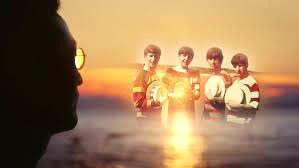
To get inside the song, the first image of him is a kind of silhouette, in which a scene of sunset (or sunrise) on the sea is reflected in his glasses, and a mirage appears of the four very young Beatles clowning around.  The first time today's Ringo and Paul sing the chorus, after the lines "Now and then, I miss you," we see a clip of John and George in semi-hysterics during the Shea Stadium concert.  Soon we see the surviving Beatles bookended by a Sgt. Pepper era George and John in a white suit, the band together again.

Then the dizzying combinations of all four of them in different times, mostly playing together (suggesting a higher octane version of the subtly surreal baggage car scene in A Hard Day's Night, and some scenes in Help!) The images of young Lennon are so bright and full, though Jackson presents only John the cut-up and clown, rather than his more intense or gloomy or distant moments.  In fact, the others are also seen frequently being silly. (Even present-day Paul gets in the act, mocking his shot playing bass, with a mugging young McCartney behind him.)

The video ends with a series of images that go backward in time to the four as young boys, and then the famous early 60s black-and-white bow from the stage with the bright Beatles sign behind them.  Then their images disappear and the light goes dark.  

(It's the last Beatles song, but unlikely to be the last Beatles release. A number of remixed albums are in the works, and I look forward to some machine-learning magic applied to those 1995 vocals, and a new tech update to the accompanying videos.) 

The song soon became a Number 1 hit in the UK, breaking the record for the time between number ones by any artist or group (54 years) and the record for the most time between an artists first number one and the most recent (60 years.)  The record also hit number 1 on the Billboard digital songs, and broke into the top ten on the Billboard US charts.  The song is included on the newly reissued  Blue album, which together with the Red album, feature the latest remixes of Beatles hits and standards, just in time for Christmas. 

Clearly there is a lot going on in Peter Jackson's mesmerizing video, so I suggest that in addition to watching it, you also listen to the song with no visual accompaniment, as I did the first day of its release, to feel its full effect. Either way, joy and tears, now and then. 

Inevitably, the song applies to us as listeners, for however long the Beatles have been part of our lives.  For me there was a time I thought of them every day.  I needed their rhythms to face everyday life. These days I think of them only now and then, and I miss them. But I know they will be there for me.  

Tuesday, September 20, 2022

Beatles: Let It Back

 
During recording for the Abbey Road album (which commenced almost immediately after the "Get Back" sessions), George Martin couldn't make it to the studio one Saturday.  The Beatles were working on the songs "Oh, Darling" and "Octopus' Garden" (both of which were first heard during those "Get Back" sessions.)  Martin got engineer Jeff Jeratt to substitute.  He'd never worked with the Beatles before. 

 As Jeratt recalled for Mark Lewisohn in his The Beatles Recording Sessions 1962-1970, Martin warned him, "There will be one Beatle there, fine.  Two Beatles, great.  Three Beatles, fantastic. But the minute the four of them are there, that is when the inexplicable, charismatic thing happens, the special magic that no one has been able to explain.  It will be very friendly between you and them but you'll be aware of this inexplicable presence."

Jaratt added: "Sure enough, that's exactly the way it happened.  I've never felt it in any other circumstances, it was the special chemistry of the four of them which nobody since has ever had."

Peter Jackson's long video chronicle of the Get Back sessions in 1969, streaming on Disney Plus and now on DVD and Blu-Ray, is not only a saturation in Beatles history and process, but a unique view of a rare time, when all four Beatles were in the studio together every day for a month, something that likely hadn't happened since their early albums, if it had ever happened before at all.  The result is an engrossing, mystifying and sometimes exhilarating eight hours, which for me verges on the addictive.

After completing what's known as the White Album in October 1968 (official title: The Beatles), the Beatles decided to have themselves filmed in the recording studio to be made into a TV special.  At first they were going to do White Album songs, but then decided it would be more interesting to show them creating new songs, rehearsing them, and then performing them in a live show...somewhere.  The day after New Years in 1969, they began.

Until now, all that officially resulted from these sessions were the feature film Let It Be and the album of that title, both released in 1970.  By the time they came out, the Beatles as a band effectively no longer existed.  The movie in particular became known as the story of them breaking up.  

About a half century later, the Beatles' still-existing company called Apple, still had the original 16 mm footage of all the hours filmed that month, plus audio tapes that ran even when the cameras didn't.  Peter Jackson, director of the Lord of the Rings films, jumped at the chance to try to construct a new something or other out of that footage.  When he started watching it (he would say repeatedly to interviewers), he was astonished: the Beatles didn't look like a dour group who hated each other.  They were often affectionate, and often having fun. The sessions had tensions but also a lot of joy.  Sometimes in subtle ways, they showed the earned closeness of a band of self-selected brothers, who had made magic together for nearly a decade, and still could. Some four years later Jackson delivered Get Back, an eight hour selection for Disney to run in three segments, and eventually, for Apple to issue as three DVDs.

Apart from doing it at all, Peter Jackson earns high praise for doing two basic things.  First, he used today's technology to "restore" the visuals and the sound.  I'm guessing that in fact the visuals look even better than the original 16 mm film, although 16 can look pretty damn good.  The sound of the music probably needed less work, but the real contribution was to clean up the sound so that the conversations etc. can be heard.  

Second, Jackson structured the film chronologically, which in itself changes the impressions often created by the Let It Be movie, which was directed by the guy who filmed all those hours, Michael Lindsay-Hogg.   Let It Be has the barest sense of chronology.  It's basically a collection of scenes.  It also looks terrible.  Even when it first came out, blown up to 35 mm, it was grainy and dark.  Surviving versions are often further edited and panned-and-scanned.  The one I have on VHS looks like a series of extreme close-ups shot during a blackout.  My fading memory of seeing it a couple of times in theatres, however, supports the idea that close-ups or one and two shots predominated.  Jackson's film has a larger sense of space.  We get the full studio and the full band. 

But even as a chronology of that month and of these sessions, Jackson's film isn't complete.  Important events outside the studio aren't mentioned, both in terms of background (the Beatles finances were a mess, and Apple was going broke) and specific events.  For example, early in the month, George Harrison suddenly gets up and leaves, quitting the group.  It's a big dramatic moment, and Jackson's film does a great job of showing the other Beatles' responses.  Then a few days later, Harrison comes back, inexplicably cheerful.  Jackson's film doesn't even try to suggest why Harrison left, except to show a painful conversation with McCartney that the Let It Be film also shows part of.  (Some Beatles scholars however suggests George and John Lennon had an off-camera tiff earlier that day, which precipitated George leaving.)  But what Jackson's film doesn't mention is that the day before George quit, his wife Patti left him.  And then she returned at about the time he rejoined the group.  He seemed to remain in a very good mood from then on, very committed to the band.

Apart from leaving out external events (including alleged drug use), Jackson leaves out parts of some conversations, skipping sentences and even moving the order of statements within the same conversation.  I know this because Beatles scholars on YouTube play the original audio tapes, which became available long before Jackson's Get Back was released.   So while this is a huge improvement in understanding what actually happened in these January 1969 sessions, Jackson's film isn't quite as complete or straightforward as it might seem.

Get Back tells a story that seems to be basically accurate.  The initial idea was to make use of the otherwise empty building of the British film company, Twickenham Studio, because Apple had leased it for the month in preparation for the making of The Magic Christian feature film, that was scheduled to begin shooting there in February.  That movie starred Peter Sellars and Ringo Starr, so that was another reasons the Beatles had to finish this musical adventure in January--Ringo would be unavailable.

But the Beatles were miserable at Twickingham. They were in a huge, cold room in the London winter, showing up in the morning at a time they would normally still be asleep, and unaccustomed to making music in a studio that early. The sound in the room was awful. They had to deal with every moment being filmed, as well as still photographers roaming around them constantly.  Director Lindsay-Hogg was badgering them about where they would do the live show.  They couldn't agree.

Harrison's departure seemed to change the game.  The other three Beatles met with him and all agreed they weren't going back to Twickingham, they weren't doing a TV show but the footage could be used for a feature film (they owed their studio one anyway) and they weren't going out of the country for a live show (which is what their director wanted.)   George helped organize the equipment needed to record in the Apple headquarters basement.

The mood lightened immediately when they got there, where a a homey space was created that they all liked.  Though the film shows a disconcerting amount of jamming and fooling around, they got down to working out songs.  This is the stuff that I really like, and I suppose anyone who has been in a musical group, especially one working with original songs, will recognize the process, even if this is on a whole other level. I love artistic process movies.  I love Sting's Bring On The Night.  So even what may seem tedious to others tends to delight me.

But several songs are getting bogged down, with several of the Beatles realizing they need another player, someone to do keyboards live.  Then one day, Billy Preston just shows up to say hello--he has known them since they were all teenagers playing dubious clubs in Hamburg.  (In fact, George Harrison had been talking him up to the others, and invited him to "drop in.")

 They ask him to sit in on the song they're working on ("I've Got A Feeling"), and immediately everything starts to fall into place.    Billy Preston provides the musical spark to several songs that completes them, and gets the juices going.  One of the early highlights of the series is watching Paul McCartney working out the basics of "Get Back" from scratch. Then we see the lyrics gradually change from an anti-racist protest song (anyone remember Enoch Powell?) to the words we know.  Billy Preston's keyboards finally completes it.  He remained part of the group through the rest of the sessions.  His work on "Get Back" has been praised, but he's equally essential to "Don't Let Me Down."  

Throughout we hear each of the Beatles bringing in songs (several times, something they had written the night before), and everyone gets interested.  Most of these songs, and others they are working on, will appear (we know now) either on their next album, the incomparable Abbey Road, or, more hauntingly, on their post-Beatles solo albums.  The explorations of George Harrison's song "Something" are especially fascinating.  The musical accompaniment for once comes easily, and that great tune is there.  But Harrison has almost no lyrics to what will eventually be known as one of the greatest love songs of all time.  It sounds so heartfelt, but for months, George didn't know what "something in the way she moves" attracts me like.  

Of the songs that eventually do make it on the
Let It Be album, one of the most troublesome is "Two of Us."  It was the song Paul and George argued about at Twickingham.  For weeks the group is never satisfied with it, no matter how many times they do it--and they do it a lot.  Paul and John sing it to each other in posh London accents, Scottish accents, Bob Dylan accents, and eventually sing it without moving their lips, like two crazed ventriloquists.  But it is Paul getting tired of playing the electric bass and picking up an acoustic guitar that gets the song going, as a kind of skiffle or folk song, with Ringo's tasty drumming and George playing bass notes on his electric guitar.

Yoko Ono has been a constant presence sitting silently beside John (in Let It Be she seems ominous; in Get Back, pretty neutral. Both she and George Harrison's second wife Olivia are listed as producers for the Get Back series.)  By the third and fourth week of the sessions, the studio opens up.  Paul's girlfriend Linda Eastman (who was shown as present once at Twickingham) brings her six year old daughter Heather to the Apple studio, and Heather's interactions with John, George and Ringo as well as Paul, and her imitation of a Yoko vocal, are highlights. (Paul and Linda would marry a week before John and Yoko. Paul soon adopted Heather as his daughter.)   Patti Harrison and Ringo's wife Maureen also visit the studio, and most of them listen to a day's recordings in the control room together.  These are some of the most affecting scenes.

But the Beatles can still never agree on a live show, and until the last moment, aren't sure if they will do their now famous rooftop concert.  Jackson intercuts the entire concert (just five songs, some repeated).  He included more street reaction than did Let It Be, so Jackson has the narrative of the police officers arriving, being diverted and finally ascending to the roof, all in split screens.  The Beatles road manager finally tries to turn off George's amp, but he curtly turns it back on and they finish the song. 

 Each time I've seen these scenes I've gotten a different impression. Sometimes the street interviews were mindless distractions.  Other times they were overpowered by the energy of the music.  Once I marveled at the reaction of people on adjacent rooftops and the street.  There's no telling how well they could hear (a segment in the Beatles Anthology suggests the sound wasn't really very loud on the street), but they show little emotion.  I couldn't help thinking of the contrast with the years of screams and fainting.  On the other hand, the people complaining about their music and the police showing up could have been straight out of A Hard Day's Night.  That much didn't change.

I was surprised then by how briefly Jackson treats the final day, in which the Beatles alone in the studio record the acoustic "Two of Us" and the two McCartney piano numbers, now classics: "The Long and Winding Road" and "Let It Be."  The movie Let It Be presented full versions of both songs, but without context, it reinforced that movie's narrative of a dominating McCartney, and the others literally (in this scene) sitting at a lower level, playing supporting parts.  In context, it was just the most efficient way to do the final recordings of these two songs, at the end of an exhausting month.  However, it would have been nice to hear more of them.  ( For my money, the best cut of "Let It Be" on film is in the Beatles Anthology.)  

What about the Beatles themselves?  Paul McCartney is neither the authoritarian monster and central villain that the Let It Be movie casts him to be (though his beard and black suit don't help), but neither is he the genial and articulate statesman of interviews.  Emotionally he seems all over the place--capable of far-seeing insights and long monologues of near nonsense. He comes off as a paradox at times.  For example, who was the most actively opposed to doing the rooftop concert? And who looked like he was having the best time doing it?  McCartney, both. 

John Lennon is always the class clown, but he's also very quiet and subdued for long stretches, though when they play in the Apple basement he's right there, energetic and engaged.  There are moments when both McCartney and especially Lennon are pretty open about their fears and insecurities, past and present.  Paul is uncomfortable in his role and worried about the band's direction.  On the music itself, he worries that his classic ballads drag too much.  John is contrite for showing up late and not being at his best. (This may be the result of his reputed occasional heroin use, or he's just sick.  It's the flu season and both Paul and Ringo also complain of being ill at different times.) John is realistic about the limits of his own guitar work, though I was surprised to see that he did the guitar solos on "Get Back," and some of the jams show he had more lead guitar skills than I would have guessed.

George Harrison appears all black or all white, sour or sunny, and in Martin Scorsese's biographical film about him, that's how Ringo describes him: either saint or sinner, nothing in between.  It wouldn't be until Abbey Road and his own All Things Must Pass album (the most successful of all the immediate post-Beatles releases), that the quality of his songwriting was fully revealed, along with his unique, haunting and supple voice.  Just before the Get Back sessions, he had spent six months producing other artists, and his production of All Things Must Pass (despite what Spector did to it) is musically remarkable.  In that sense, he never really had a "solo" career.  He was the instigator of the Traveling Wilburys in the early 90s, which he formed (Olivia  Harrison said in the Scorsese film) because he missed being in a group.  He missed the Beatles. 

Ringo Starr was the backbone of the Beatles sound, and the glue that held the Beatles together. Though he's not heard saying much in this series, it's partly because he does his job so well.  A lot of Beatles songs sound simple until you get into their structure.  For instance, George comes in with a song, "I, Me, Mine," best known now for its eloquent lyrics, that he was inspired to write by seeing a grand waltz performed on a TV movie.  Most of the song is in waltz time (John and Yoko actually waltz to it), though it breaks into a four-four rocker, and back again.  Other songs are replete with even more subtle complications, and Ringo has to engineer these time-jumps seamlessly. 

Even so, Ringo has a nice scene doing a comic take to the delight of Heather McCartney, and also when he brings in the basic idea for "Octopus' Garden"--  George (the other non-Lennon-McCartney songwriter) immediately starts working with him to extend it, soon charming everyone and interesting the other Beatles in developing it.

Transcending all other impressions of this series is this magic opportunity to spend this much time with these four extraordinary people, all of them still in their twenties, as this extraordinary group.  Though this experiment was artificial in that it wasn't how the Beatles made their records anymore, it did bring them together every day over an extended period for the last time.  In the decade to come, as they went their separate ways (though different combinations of them collaborated), they all had periods of depression or despondency, and they all at times had serious drug and/or alcohol problems; two marriages ended, and they all endured tragedies.  John Lennon was weeks past his 40th birthday when he was shot dead.  These hours in the studio, during which they often revisited their past music as well as shaping new songs, seem like a time out of time.

With the benefit of hindsight, we do see suggestions of what would soon break up the band.  We also see the Beatles' luck start to change.  In the beginning they happened to find the right manager, the right producer, and then the right film director to help them blossom.  But this film makes a joke of their association with "Magic Alex," the supposed electronics genius they hired who is exposed as a total and expensive charlatan.  Not so funny is reference to John Lennon meeting Allen Klein, and his glowing account of Klein's knowledge and business acumen.  Eventually, Lennon convinced George and Ringo to make Klein (then managing the Rolling Stones) the group's manager.  Paul saw through Klein, and the resulting conflict was the proximate cause for the Beatles to break up.  Klein did get them more money, but his nefarious schemes eventually turned John and especially George against him.  They all dumped him, and he became an active nemesis for awhile, until more money changed hands.  

Also at about this time, John and George brought legendary producer Phil Spector into their efforts, and Spector's production of the long delayed Let It Be album did not go over well.  Eventually, McCartney backed a re-release that stripped it of Spector's effects, for the album Let It Be Naked. 

Yet, just weeks after the rooftop concert, the Beatles began recording again, this time with their producer of all previous records, George Martin, and did so at their EMI studios on Abbey Road, for their last, transcendent album.  And in the end...  

Thursday, March 25, 2004

Concert for George

Finally got around to watching the tape of the PBS airing of the concert for George Harrison held at the Royal Albert Hall a year after his death. It was quite a moving experience. Musically, we tend to hear only the most familiar Beatles tunes on the radio and, all too often, as elevator music and mall Muzak. It's easy to forget what amazing music it is, which is evident when other musicians try to play it. They come close, they make something different with their own interpretations, but often they can't quite measure up. Harrison's songs---and not just the basic melody or chords---are deceptive in their apparent simplicity but actual complexity, especially how he and the Beatles built them as recorded songs. Everybody thinks they know “Here Comes the Sun” as a nice little tune, but the construction of it as a recorded song is amazing, as the struggles they had on stage made clear.

In some ways I'm glad that I let Lennon and McCartney overshadow Harrison's music---especially his post-Beatles work---in my experience, because now I have the privilege of discovering its depth and wisdom and musicality. Since there's been no one new who really gets to me for a long time, George's music is a real treasure. Not only is it "new" in this way for me, but I can follow a process of aging and maturing in his work, which is far more personal than, say, McCartney's (except for certain songs, like "Tug of War." And Lennon never made it past 40.) Again this music is so rich that it repays repeated exploration.

But George's music alone doesn't account for how affecting this concert was. It was at once an elegy for my generation and an affirmation of continuity to the next generations. Though Eric Clapton was the organizer and musical director of this multi-artist ensemble, and provided two of the best musical moments (his solos on the Ravi Shankar piece written especially for this event, and on "When My Guitar Gently Weeps") the show was centered on the appearance of the two surviving Beatles. Apparently this was the first time that Ringo Starr and Paul McCartney had appeared together on stage since the Beatles last performed in 1969, which is hard to believe. Ringo sang one of his two best songs he cut as a solo artist, which he wrote with George Harrison (the other was a song he wrote with John Lennon, "I Am the Greatest,") and as he noted, the song had specific new meaning to the event. With a photo of George high at the back of the stage, Ringo sang: "All I have is a photograph/I know you're not coming back, anymore..." Paul sang a song George wrote and recorded as a solo artist, which is a specific and meaningful tribute to him apart from the Beatles, and he began a ukelele version of "Something" (apparently George had become fond of the ukelele in recent years) which Clapton ended powerfully as a full bore rock song.

As one reviewer noted, this was also probably the last time Paul and Ringo will appear together. Most of the musicians on stage had gray hair, and another story of the event referred to Bill Wyman, the former Rolling Stone, being present in the audience, a shriveled old man. Most of the musicians on the stage don't have many years of performing left, and probably many of them don't perform much anymore except as nostalgia acts. So it turned out to be an elegy by a generation of musicians for their generation of musicians, and for my generation that lived our lives by this music.

Ringo's son Zack was in the audience, as was one of Paul's daughters; John Lennon's musician sons by different mothers were nowhere to be found (I searched the Internet to find out why but they weren't mentioned in any account I found.) But on stage for the whole show was George Harrison's son Dhani, strumming a big acoustic guitar and singing backups. He looks almost exactly like George at his age of 21. At times it was eerie, as when Paul and Dhani did harmonies at the same microphone. It was seeing the past and the present alive at the same time.

Ravi Shankar did not play, but his son did, and his daughter, who is the first female sitar player in India, a beautiful young woman who also conducted the orchestra of Indian and western musicians performing Ravi's composition. And by coincidence, I watched this a day or so after seeing and hearing Sam Taylor, the son of James Taylor and Carly Simon, essentially playing a young James Taylor in the 1960s, on "American Dream." He played and sang a Beatles tune, "In My Life," and sounded exactly like James. He looks quite a bit like him, too. It's amazing how strong the genes of musical geniuses can be.

And this above all I celebrate-the continuity of accomplishment and talent at a very high level. As we leave the stage, it is good to know that our music and our work is renewed and continued by the capable next generation, carrying on, with all the beauty and strength of youth that we no longer have.

At times I regret not having had children, but frankly on the list of regrets it is so overwhelmed by others that would have made that possible, that it is not one of the unrealized fantaises I think about often---only sometimes when I feel a twinge as I pass a parent interacting beautifully with a child. I was so many levels removed from these possibilities being realized, that the conditions that would have made this desirable were never really there. But I'm glad that George Harrison had a son, that Ravi Shankar had a daughter. I've accomplished really nothing important in my life, so there is no legacy to continue. Their legacy is strong, and it is fulfilling to me that their legacy continues, their talent and temperament, etc. continues through their genes as part of the human mix. My regrets about children are only selfish, concerning the experiences I didn't have. I wouldn't have provided children with much to help them through this challenging world. (I suspect this is a legacy I got from my father, who I think did sometimes regret having children for just this reason.)

Arguably our fates at this age are more or less settled, no matter what illusions we need to keep going. That our youth is gone is inarguable, so as much as I fantasize George Harrison as a brother I can fantasize Dhani Harrison as a son, as a renewal of some of what I cherish. I hope he does great things for his generation and those that follow. One of the few benefits of getting older is that you can admit your guiding fantasies, since nothing you do can matter much anymore, and what are they going to do to you now for having them? Not much, compared to what you’re in for. All things must pass. But some things pass down, and if they’re good, it makes looking at the book of life a little easier.

Friday, September 19, 2003

Elders

People keep dying. Older than me, some younger, well known names. Known to me if not to you, for example, was John Henry Redwood. Known as an actor, some on screen, mostly on stage, he's been a developing playwright for the past decade or so, and a good one. Also a great person. A big man with a big heart and a big smile. I met him in Pittsburgh when the Pittsburgh Public Theatre put on one of his first plays. He was very interested in the craft of it. Actually we may have met when he was in an August Wilson play there. It's been awhile: I remember a patio party at someone's house where he and I sneaked off for a minute to check the Lakers playoff score---and Magic Johnson was playing then.

Anyway, he died recently. Not as heralded as John Ritter or Edward Teller or Warren Zevon or even Sheb Wooley (of Flying Purple People Eater fame), but a man whose presence and talent in this world will be missed. We will be lesser for his absence.

Which got me to thinking, not very originally, that we ought to honor people when they're still alive to hear it. I've picked some Elders I wish to honor. Some aren't in fact very much elder to me in years, but certainly in achievement.

Norman Mailer. He seemed to have retired during the Clinton years but Bush has brought Norman stormin back. Sure he's flawed in big ways, but he's a huge talent, and someone who has given me key thoughts and prompts over many years. I wasn't all that crazy about his book on the Pentagon march, though in 1968 that a writer with his credentials (and military novel) could write about anti-Vietnam and anti-draft youth with such conviction was important. His novel, "Why Are We in Vietnam?" was riveting. I loved his defense of Henry Miller when he was a notorious target of Womens Lib in the early 70s. For good or ill he's carried the torch for the heroism of writing and especially the aspirations of the novel during my lifetime.
Yet besides the example of his engagement and standards he tried to uphold, I'll remember specific things he said or wrote almost as asides. "Totalitarianism is the interruption of mood." I heard him say that on a talk show (talk shows used to have actual writers on them) and it blew me away. Later I found it in one of his books, Advertisements For Myself I think. It's still a very profound personal and political formula for me.
And an offhand comment in his prose-as I recall he was narrating that someone had apologized for not having read one of his books and he said he understood entirely-that a book and a reader have to be ready for each other. That too is a guiding light to me. It says so much about books and life, and about how we continue to have new and illuminating experiences, how books speak to us in the course of our lives, they are there as resources for us, and how even the books are treasures at the end of the hard roads of life, a kind of payoff in wisdom and light and depth for all that we've seen and felt and been subjected to.
I wonder if his more recent work has spoken to young people at the time. I haven't read him in recent years. Maybe I'm just not ready yet.

Robert Bly. Another writer with flaws, perhaps more lovable ones, but not entirely. But I doubt there's been anyone more important to poetry in America in the past sixty years. He's been at the forefront from the sixties on, with his personality and enthusiasms and in recent decades his transparency, his honesty and courage. He still gets dogmatic once in awhile but that's the kind of flaw that integral and forgivable and lovable. His powers of promotion have brought many wonderful poets to wider attention. He's kept that up, from Neruda in the early 70s to Machado and Rumi and more. He's been close friends at different times with two of the best poets of the age, James Wright and William Stafford.
He's taken a lot of heat about the men's movement from people who have entirely distorted what's he said and what he's done. I respect him as an elder and I will always listen to what he has to say. He's written some fine poems, and he has done more than anyone to revive the performance of poetry, except perhaps Allen Ginsberg (who took up the squeezebox at about the time Bly took up his stringed instrument.) He's one of the connecting points between so many important places in our culture and consciousness.

Bill Moyers. Bly was but one of the voices of our age that Bill Moyers introduced to millions of people. The range and quality of his work over the years is nothing short of astounding. I have transcripts of his programs and books from his various programs and series' going back to the sixties. Political, imaginative, artistic, thoughtful life in these decades would be so much poorer without him. Even today, his PBS series "Now" is virtually alone on television as a quality news program of relentless probity, leavened by intelligent enthusiasms in art and thought. Bill Moyers is really the hero of the television age.

Leslie Marmon Silko. She's not much older than me, but she's an elder in many ways in what she knows and writes. She's the most profound and political of the many excellent Native American novelists, poets and nonfiction writers. Her generation that came of age in the 60s with an explosion of writing turns out not to have been an anomaly. American Indian writers remains vital, and beats new paths. But the continuing energy of this generation's writers, especially Silko and Linda Hogan, still inspires me.

Doris Lessing. A writer who would never let anyone else define her. "The Golden Notebook" made her a feminist heroine, but she refused to be limited or defined by any political agenda. Her science fiction novels are amazing in their conception, though she got little credit for them-puzzling both mainstream fiction adherents and s/f fans. I don't find her much of a stylist, but her energy and intelligence propel you forward. She must be a model for other strong women writers like Margaret Atwood and Ursula LeGuin. Atwood has a takes no prisoners intelligence, yet she's witty and civilized, and she sure can write (some of her short stories in particular are outstanding.) LeGuin is heroic as well, although she's offended me with some of her sexist talk, but like Lessing she's her own person, and quite forthright-and often right.

Maxine Hong Kingston. Again, an elder in example and inspiration, but not elderly. Her new book is courageous, not for what she's endured or even done, but in her honesty with herself, and honest attempt to tell us the truth. But not only that: it is the textures of her telling that ultimately are the most inspiring. I'll bet she's a great teacher, and I'm glad that her books are so popular on campuses. She believes in literature, in story, imagination; her new book unites the world of literature with the attempt to unite inner and outer peace-for example, by using meditation in her workshops with war veterans.

I need to add two or three more---there are many more, of course, but I can't neglect these: James Hillman , the most important of the post-Jungians, who lately has turned his attention to the subject of elders and aging. I just listened to the audiobook version of his print book (which I read when it came out), The Force of Character. It is a great listen as well as the usual rivetting and admirable read. He quotes another elder who has valuable and inspiring things to say about aging, Theodore Roszak. I've written about both these men and their work in this and other blogs.

Then there is Paul Newman , who acted in important movies as a young man, in middle age and in his later years. Then he parlayed his fame into a business that simultaneously offers good, healthy and tasty products and helps support good causes and artists. He's been a model in so many ways for so long, that his few lapses---that oil company commercial, and the promo suggesting that "Washington Week in Review" is something more than the march of cliches by timid journalists mouthing conventional wisdom very occasionally enlivened by new information or analysis---are easily forgiven. Now he's helping to bring Thorton Wilder to TV. He's been admirable in many ways, in his personal trials as well as modest in his triumphs, and so it's fitting to end this tribute to all elders with him.

Finally there's someone who exemplifies the elder perhaps best of any I can think of, and that's Gary Snyder. A poet of mythic power, whose life and work have forged crucial links important to the future, in his pioneering synthesis of Buddhism, Native American worldview, practical ecology and much more. His prose works such as The Practice of the Wild, The Old Ways, "Four Changes" and the interviews and essays in The Real Work and A Place in Space are essential as any body of work created in my lifetime. He is the elder teacher of our time, who introduces, connects and interprets knowledge as a guide on our individual, collective and planetary journeys.

I hope all of these people are around for a long time. But in my life they've been inspirations and so I testify to this, while others can still take advantage of their live presence.

Wonderful

Things are still pretty unsettled in my little world. But I've got two moments that I'd have to classify as wonderful, and both happened on the same day.

The first was a small and so far solitary personal victory. For something like five or six years now, I've had this little musical play that I wrote---a play for (I figure) junior high age kids, about smoking. It's a musical, and I wrote songs for it. I really liked it, but I've had to pick my battles-those things I tried to steel myself to send out into the world of rejection, misunderstanding, envy and heartbreak. Some of those items perhaps deserved not to be published or produced or whatever, but when you start out and believe in what you've done or at least the potential of it, you have to go forward and see what happens. But I have to be selective, not really just in terms of what I think is the quality of what I've done, but in the kind, the quality and the quantity of shit I'm inviting. For example, I can expect a nonfiction book proposal to get at least a little respect from somebody, since I've published a nonfiction book, and I'm an Author and a Freelance Writer. But if I try springing a musical play for kids-look out! Blank stares, or just total blankness. Cause you see I'm not a career playwright, I don't have my PhD in Advanced Dramatury nor have I workshopped and networked nothing but plays plays plays for ninety years---let alone musical playwright OR kids writer. In this world you write childrens books about stamps, and that's your identity for life.

And not only is the rejection more likely, it's harder to take, because I'm also insecure, for the same reason---I've got no track record. Maybe it really is shit. But I never believed this play or the music was shit. However, I could never get a recording that represented the music to my satisfaction. Because I couldn't afford the time or the money to do it, and there wasn't anyone else interested and able to help make that happen.

Then technology sort of caught up. Several years ago I got an inexpensive four track recorder. I had an electronic keyboard-not a great one, but not a real cheapo either. I composed the songs on that keyboard, with all that instrumentation, using presets in my own way. Over the course of a couple of years, when I could stand to spend all that time and belief, I recorded the songs. Actually I recorded the three songs people who heard them liked best, and they did seem like the obvious "hits"to me, too. And I recorded short versions of the other songs, just to indicate how they would go in the script. This wasn't easy.

Then I had to listen to all the takes, choose the best ones, redo several vocals, sometimes whole songs. And then, I didn't have the equipment to mix these recordings to my satisfaction. By then the programs to mix on the home computer were coming along, and so were the computers. Finally I found a program cheap and easy enough to use just to make a decent CD. It took hours more, and two computers, but just when it looked like---or rather it sounded like---it was never going to happen, it did happen. I now have a CD that sounds pretty good. Not perfect but (as we used to say) good enough for this band. It's musically okay and gets the idea of the song across. So finally, after all this time, this much exists, and that's about as wonderful as it's been in such things.

The second wonderful thing also has to do with music and technology and specifically, this laptop. On it I watched and listened to the DVD of "A Hard Day's Night" I borrowed from the library. You know how many times I've seen this movie in theatres? I stopped counting at 20. Then came the video restoration (which I have) and now the DVD. And it's the best yet. Moments as terrific as some moments in the theatre. But as an overall viewing and listening experience, better.

You can now see all the flaws that the big screen hid, but you can also see all the little subtle things. And mostly it's the presence. The immediacy. A combination of the visual image and the music through the earphones. (A lot of Beatles stuff at a certain point was in true stereo, which makes earphones worse than useless for me, since I can hear only in one ear, and therefore only half of the song---the drums and the backup vocals, or switch to the lead vocals while the rhythm cuts out-very frustrating, torture really.) But this is mixed so I get stereo through both earphones. (Something I picked up from the recording program was what added echo/reverb sounds like, and so I could identify that reverb was added to the songs the Beatles play in the concert in the end, so the music sounds like it's being played live in a hall---though of course in that hall the music wasn't heard at all, just the screaming.)

It's a nice DVD package, with interviews with everybody they could find, including the woman who did makeup, but those Brits talk so well that even all these bits were interesting and fun. I can't figure out why they didn't include the "I'll Cry Instead" footage they added in the video version, but other than that, it's a fine two DVD set. But the movie-that the thing. That's the wonderful thing.

I remember long ago---1969 to be exact---I was walking with a college friend in Berkeley, and I happened to mention Wallace Stevens' statement that the purpose of art was to make people happy. My friend, a philosophy major on a heavy political and psychological trip, laughed at me. I doubt if that's why many artists do it, he said.

Kurt Vonnegut said something like that in his novel Timequake. "I say in speeches that a plausible mission of artists is to make people appreciate being alive at least a little bit. I am then asked if I know of any artists who pulled that off. I reply, 'the Beatles did.'"

They didn't do it alone in this movie, and finding the right people at the right time and inspiring them was part of their genius, their success when it worked, and their bad times when it didn't. They rescued Richard Lester from making commercials for the rest of his life, and he turned out to be a very fine director, with several of the best films of the 60s and early 70s. They inspired the camera people, the editors, the other actors, etc. In some ways, this movie is like Shakespeare for the 60s-full of clichés, because the lines became part of the culture. I could recite the times even in recent years that people have quoted from this movie. Yet I had forgotten some of the funny bits.

I've got to take the DVD back to the library tomorrow, so as soon as I post them, I'm going to watch it again.

Sunday, December 15, 2002

The Inner Beatle

A Paul McCartney concert was broadcast on one of the TV networks in prime time recently. I didn't see it all, but I gather it was from his most recent U.S. tour, perhaps selected from several shows.

I was impressed by one thing I did see: the audience. Unlike some other concert films (the famous Simon and Garfunkel appearance in New York's Central Park which was recently rebroadcast on PBS, for instance) there were lots of shots of audience members while Paul and his new band were performing. Not wide pans of screaming and waving figures, but shots of individuals. That's perhaps partly in deference to the Beatles' first film, A Hard Day's Night, which also focused on individuals in the audience reacting-screaming, crying, moaning, jumping joyfully up and down, swooning, mooning and so on, to wonderful effect.

It still seems especially appropriate during Beatles songs. They don't scream anymore, though they do cry---more because of the songs and the lyrics (to "Let It Be" for example) than because they're overwhelmed by a Beatle's presence. But mostly they sing.

As far as America was concerned, the Beatles existed for maybe six years, from 1964 or so until the end of the decade, from "She Loves You" to "The Long and Winding Road." But their music-and some of the music made by each member since the Beatles broke up-has been essential to lots of people in several generations now. And it's not just one generation introducing another to this music. I remember visiting some college friends in the 1980s whose son had seen "Ferris Bueller's Day Off" with that great "Twist & Shout" parade scene, and at first he thought the Beatles were a new group. Several generations have discovered the Beatles on their own.

So as Paul sang his Beatles songs, the camera found many individuals in the audience, of all ages and races and genders, transported not just by listening but by singing along, or at least lip- synching the lyrics. And clearly, it was more than audience participation. You could see it in their faces: though the only person who actually looked like a Beatle was Paul, they were all Beatles inside.

That was the secret of the Beatles. Girls swooned, women were turned on; they wanted the Beatles. But boys and men wanted to be the Beatles. There's even a line like that in a short film I saw in the late 1960s I'm convinced is the fabled "Amblin'"-Steven Speilberg's first film, the one he named his company after. A young woman picks up a young male hitchhiker and takes him to a secluded cabin. As they sit before the fire she asks him what he wants to do with his life. He shrugs and says he wants to be a Beatle.

We are who we pretend to be; or more properly, we are some ongoing mixture of what we were born with, what happened in our lives, and an amalgamation of everyone we pretend to be.

The first way we learn is by imitation. Kittens learn to kill mice by watching their mothers. The Haida woodcarver learns by imitating a master. Humans probably learned to sing by listening to birds and animals.

Imitation deepens with admiration. Observing, we identify. Later we may enact what we observed, and become who we imitate. This is very probably how dance and narrative began: enacting the animals.

Our era gives us thousands of fully enacted stories in books, pictures and especially on screens of our choosing. We identify; we experience vicariously. It is another way we learn, and another way we become. For the length of a movie, we are the hero. We are the bard and the star, the singer, the words and the music, for the length of the song.

Now when they hear those songs, everyone can get in touch with his or her inner Beatle. That part of them that wants to sing their heart, the "crosscurrents of wit and pain" as somebody once described the Beatles music, that swirl from their lives.

For those moments, you can see they are transformed. It doesn't matter what they look like on the outside. They become what they see and hear, and for a moment they experience a communion not only with the real Beatle up there, but with something otherwise hidden, partly formed and unexpressed but important, essential, in themselves.