Showing posts with label 60s. Show all posts

Thursday, November 23, 2023

Beatles Now and Then


On November 2, a new song recording by the Beatles was released, the product of three recordings over 50 years or so: a demo cassette tape that John Lennon made at home in the mid-1970s (latest guess I've heard or seen was 1977, just three years before he was killed), then an aborted attempt to make the song into a Beatles record by Paul, George and Ringo in the mid-1990s, during the time they crafted "Free As A Bird" and "Real Love" from another Lennon tape, and now the final version created this year of 2023.

Technology that filmmaker Peter Jackson developed for the Get Back TV film (Machine Assisted Learning, or MAL--named for the Beatles longtime road manager) made it possible recently to extract Lennon's voice from the piano and extraneous noise on the 70s cassette, which was one of the problems that led to the song being abandoned in 1995.  But George had recorded a guitar track before they gave up on it, so that was available for this recording.  With Paul playing bass and slide guitar, and Ringo on the drums, this song--now titled "Now and Then"--includes all four Beatles.  Since there are no known recordings of new songs with both John and George (who died in 2001), this is in effect--and officially--the last Beatles song.  

The song was first played on BBC radio, and became available on vinyl, together with the Beatles first release, "Love Me Do."  The official version appeared on YouTube with just the plain blue and gray box, with the song's title in white.  Although John's demo has been unofficially available, I'd never heard this particular song before.

The first thing that got to me was the clarity and vitality of John Lennon's voice.   At a time when death seems all around, this was less a revival than a resurrection.  The melody is enchanting, and the production is seamless.  I liked the quickly neglected 90s songs more than many others did, but this is a contemporary Beatles record--part now, and part then. 

The song itself has been edited from the demo version (partly because John hadn't finished the lyric), given a slightly faster tempo, and generally gets the Beatles treatment, with guitar solo and a string orchestra section.  Paul and Ringo do new vocals but high harmony backgrounds by George, Paul and John are taken from previous recordings, notably "Because" on Abbey Road.  There is one entire section of the demo that was dropped (which furnished its bootleg title, "I Don't Wanna Lose You,") that's now the center of online debates among Lennon enthusiasts.  There were probably technical reasons for this as well as musical ones, but the song is given a classic Beatles shape, and I love it.

On November 3, the official music video by Peter Jackson was released.  It contained a few images never seen before, but that isn't its main contribution.  Jackson crafted these few minutes to celebrate the Beatles career but most tellingly, he does so in the context of this song.  "Now and Then" can seem to be a wistful meditation on a delicate love relationship, perhaps a lost love (The interrupted relationship with Yoko is an obvious possibility.) But the video presents it as a commentary on the bond among the Beatles themselves, estranged as they were for a time in the 1970s. (Though throughout that decade, two or three or even all four of them continued to work together on solo projects, and the big break between John and Paul was largely healed by the late 70s.)

Instead of just intercutting clips from the past with some shots of the 2023 and 1995 recording sessions, Jackson created dazzling combinations in which Beatles from different eras interacted with each other, and even versions of themselves from another time, just as memory is part of the present.  The video suggests the power of playing together over time, with the visceral effect of presence even in absence.  Now and then exist together. 

 (Another layer is added with the brief shot of Giles Martin, co-producer of this record and son of George Martin, who produced all the Beatles records.  In this shot he even looks like his father.)

The video starts with the reality: Paul and George working out guitar for the song in 1995.  While John's voice is heard, the first images aren't of him but the gauge that measures the sound level, moving with his vocal.  He's present through the machines.  And yet...

To get inside the song, the first image of him is a kind of silhouette, in which a scene of sunset (or sunrise) on the sea is reflected in his glasses, and a mirage appears of the four very young Beatles clowning around.  The first time today's Ringo and Paul sing the chorus, after the lines "Now and then, I miss you," we see a clip of John and George in semi-hysterics during the Shea Stadium concert.  Soon we see the surviving Beatles bookended by a Sgt. Pepper era George and John in a white suit, the band together again.

Then the dizzying combinations of all four of them in different times, mostly playing together (suggesting a higher octane version of the subtly surreal baggage car scene in A Hard Day's Night, and some scenes in Help!) The images of young Lennon are so bright and full, though Jackson presents only John the cut-up and clown, rather than his more intense or gloomy or distant moments.  In fact, the others are also seen frequently being silly. (Even present-day Paul gets in the act, mocking his shot playing bass, with a mugging young McCartney behind him.)

The video ends with a series of images that go backward in time to the four as young boys, and then the famous early 60s black-and-white bow from the stage with the bright Beatles sign behind them.  Then their images disappear and the light goes dark.  

(It's the last Beatles song, but unlikely to be the last Beatles release. A number of remixed albums are in the works, and I look forward to some machine-learning magic applied to those 1995 vocals, and a new tech update to the accompanying videos.) 

The song soon became a Number 1 hit in the UK, breaking the record for the time between number ones by any artist or group (54 years) and the record for the most time between an artists first number one and the most recent (60 years.)  The record also hit number 1 on the Billboard digital songs, and broke into the top ten on the Billboard US charts.  The song is included on the newly reissued  Blue album, which together with the Red album, feature the latest remixes of Beatles hits and standards, just in time for Christmas. 

Clearly there is a lot going on in Peter Jackson's mesmerizing video, so I suggest that in addition to watching it, you also listen to the song with no visual accompaniment, as I did the first day of its release, to feel its full effect. Either way, joy and tears, now and then. 

Inevitably, the song applies to us as listeners, for however long the Beatles have been part of our lives.  For me there was a time I thought of them every day.  I needed their rhythms to face everyday life. These days I think of them only now and then, and I miss them. But I know they will be there for me.  

Monday, April 24, 2023

TV and Me: Viewing the 60s

 Television and I grew up together.  This is our story.  Latest in a series.

By the 1960s TV news was growing up, at least to some extent.  The Camel News Caravan disappeared in 1956, replaced by the Huntley-Brinkley Report, which became the dominant evening news broadcast on television (though for awhile, the sponsor’s name appeared prominently on the set.)

  With this competition, CBS replaced Douglas Edwards at the evening news desk in 1962 with Walter Cronkite, who had co-anchored the network’s 1960 political conventions coverage with Murrow.  About a year later it became the first half hour network news (fifteen minutes had been the norm), with NBC soon following, and fledgling ABC several years later.  Cronkite remained the CBS anchor until 1981, with his familiar closing: "And that's the way it is."  According to polls, he became the most trusted news voice in America, and his on-air analysis of why the Vietnam war was failing legitimized mainstream opposition; "losing Cronkite" and hence much of America allegedly became instrumental in President Lyndon B. Johnson's decision not to seek re-election.  

 The early 60s team of Huntley-Brinkley (Chet Huntley reporting from New York, David Brinkley from Washington) was famous for David Brinkley’s unconventional speech pattern and wry takes on the news, and for the “Goodnight Chet,” “Goodnight David” sign-offs.  The first Telstar communications satellite linking television transmissions from the US and Europe in 1962 led not only to an outstanding hit record by the Toranados, but a celebratory TV program with participants from all the networks—allowing Walter Cronkite to say for once, “Goodnight, David.”

 I was a big Huntley-Brinkley fan, and later when I did the late night news on our college radio station with an expected audience of near zero, I liked to amuse our station engineer by re-writing and reading wire service news stories with the cadence and inflections of David Brinkley.  Beginning with NBC’s coverage of the 1960 Democratic convention, NBC was my first choice network for news, the rest of that fateful decade.  

Grissom, Shepard, Glenn:
first 3 Americans in space
One continuing news story of the 1960s was the US manned space missions.  Launches of the first US manned spaceflights were covered live on television, and Americans learned to say "A-OK" and call the launch a "lift off" instead of the "blast off" of Saturday morning science fiction.  I watched Alan Shepard and Gus Grissom on their sub-orbital flights, and then John Glenn’s three orbits of the planet, all described and shown (within fairly primitive technical limits) on live television as they happened.  Later in the decade the Apollo missions were covered extensively, and the first human step upon ground not on Earth was seen (more or less) as it happened when Neil Armstrong stepped off the lander onto the Moon.  


The Kennedy presidency, it was said, was the first television presidency.  The first-ever televised debates of the 1960 campaign helped him get to the White House, and his televised press conferences became viewing sensations, demonstrating his knowledge of detail and his ready wit and ironic humor.  Kennedy sat for long, thoughtful televised interviews, with single reporters or groups of them in year-end retrospectives.  In these he talked about the institutional and practical limits of presidential power, and the challenges ahead—seminars in themselves.

 I absorbed every scrap and pixel of information I could about the Kennedy administration when I was in high school in the early 60s, and almost felt I was part of it. (I can still recite the members of the JFK cabinet, but not of any administration since.)  I had a world affairs column in the high school paper and maintained a world news bulletin board in a classroom. It soon became impossible to ignore that world anyway.

  Thanks to an official of the local political arm of the AFL-CIO who my friend Clayton’s father knew, we got to attend President Kennedy’s only speech in Pittsburgh in October 1962, officially as ushers.  Part of our responsibility was to alert Secret Service agents of anyone acting suspiciously. 

A few days later, President Kennedy saw surveillance photos of Soviet offensive missiles in Cuba, and I was soon watching the Cuban Missile Crisis unfold on television, along with the rest of the country.  In school one day I was reprimanded for being late to class, because I had stayed beside a radio to ascertain whether Russian ships were going to fire on American ships quarantining Cuba, giving us perhaps hours or even minutes before we would be engulfed in nuclear war.

 Months later in June 1963 I proudly watched coverage of JFK giving his American University speech, which proposed the first break in the escalation of nuclear weapons, the Limited Nuclear Test Ban Treaty, with an eloquent case for the necessity of pursuing peace. Then the very next night I watched his powerful nationally televised  address from the Oval Office on racial justice (carried by all three networks), introducing the legislative ideas that would eventually become the law of the land in the Civil Rights and Voting Rights acts.

 And then one November Friday afternoon in 1963 we heard principal Father Sheridan’s voice announce over the public address that President Kennedy had been shot. After the next school period I was walking up the steps from gym class held outdoors, having almost forgotten about it, or convinced myself I would learn that he would be all right, when a student going down to the locker room told me that the President was dead.  That day I knew my life and the world around me would not be the same as it might have been, and I wasn’t wrong. 

To an extent it would be nearly unimaginable now, the entire nation was in shock.  There was nothing on television that weekend except coverage of the assassination, the capture of the suspect Lee Harvey Oswald, the preparations and then the funeral, with retrospective footage of JFK.  I watched it all, almost every waking moment.  I couldn’t even be pulled away on Sunday to go to church with my family, and so it happened that I was watching a live picture as Oswald was being transferred.  I jumped when I saw what I thought was a gun, but I saw then it was a microphone (you can see it in this screenshot.)  A moment later, a man rushed into the badly lit black and white picture, the crackling sound of gunshots, a glimpse perhaps of Oswald grimacing and crumpling, then rushed away, before I could be sure of what I saw.  What I’d seen, however obscurely, was a man murdered on live television.

 Until then I’d accepted television as a given part of my ordinary living.   But that weekend in November 1963 solidified it as a participant, wanted or not, in major moments of what turned out to be my life.

 By this time, I had served my short and tempestuous turn as the freshman editor of the monthly high school newspaper (at least Edward R. Murrow might have approved of me) and had joined speech club. After a couple of years doing my best JFK style ex temp speeches on various topics (lugging file folders of clippings and index cards down hallways of schools where we competed), I went on to debate, partnering with my friend Mike Krempasky. We won two district championships in our senior year.

  Because of all this, I was subscribing to and reading a lot of news and political issues magazines, and haunting the periodical room at the Greensburg library, with occasional forays to the college libraries at Seton Hill and St. Vincent.  As well as keeping up with TV news, commentaries and documentaries.

 I was reading in other areas, following my nose in areas of classic and contemporary literature. But these concerns with current events were regular activities. These interests and passions regarding the issues that TV news programs discussed to some degree, influenced some of the non-news television shows I watched in the early to mid 1960s.

 Once I started high school my viewing was more sporadic and limited—I had more homework, debate research and preparation and other extracurricular activities, and the semblance of a so-called social life (mostly related to school—football and basketball games, school dances, band concerts.) The speculative and melancholy mooning over girls took up their own infinities of time. So there were shows I watched when I found myself with the time and inclination, but there were others that I made sure to watch. 

There were two courtroom shows that featured characters that would become all but unknown in television thereafter: idealistic defense lawyers, fighting for justice. The Defenders is the better known, starring E.G. Marshall and Robert Reed, and written by Reginald Rose, a veteran of live drama anthologies.  It ran from 1961 to 1965.

 The other is more forgotten now as it was obscure even then: The Law and Mr. Jones managed just two seasons (1960-62) starring James Whitmore as a modest fighter for the rights of the little guy, espousing principles he quoted from Lincoln, Olivier Wendell Holmes and other greats.  I didn’t know anyone else who watched this series, and so it was my personal nurturance.

 For a year or so, The Defenders and The Law and Mr. Jones were both on, along with an early evening commentary show by Howard K. Smith, one of Edward R. Murrow’s protégés at CBS who was fired for expressing outrage at the conspiracy he’d uncovered between Birmingham, Alabama police chief Bull Connors and the KKK to beat up Black civil rights protestors. He moved over to ABC, where this commentary program was broadcast.  I made sure to see it, and its tenor seemed to fit into the same context as those two courtroom shows.


Beyond the courtroom, the struggle for social justice was waged by social worker Neil Brock, played by George C. Scott in East Side /West Side.  It ran for only one season, beginning in the fall of 1963, but I saw every episode every Monday night.   I was not only inspired and excited by the passion that Brock/Scott brought to injustices and inequities behind the tragic consequences he had to deal with as a social worker, but I learned a lot as well. His partners in these efforts were played by Elizabeth Wilson and the very young Cicely Tyson (the first Black woman in a featured TV role, a few years before Nichelle Nichols.) James Earl Jones was among the guest stars.

 Late in the series, Brock caught the eye of an ambitious liberal Member of Congress in the JFK mold (played by Linden Chiles), and Brock is persuaded he could do more good if he worked in his legislative office.  But the process is full of compromise and too slow.

Cicely Tyson, Scott, Elizabeth Wilson
  As far as I can recall, things were unresolved until CBS cancelled the show, sending the real life Scott on an epic drunk (according to someone who had worked on the show I met years later.)  I met Elizabeth Wilson in the 1980s and told her of my admiration for the show.  Also in the 80s, I saw George C. Scott in a production he also directed of a Noel Coward play, Design for Living at the Circle on the Square theatre in New York.  I was seated on the aisle in the top row of the steeply raked auditorium, and Scott made his entrance from just behind me—before I saw him, he shouted his first line directly in my ear. I was so stunned I missed most of the first act.

 The coincidence of these three shows in particular (The Defenders, East Side/West Side and The Law and Mr. Jones) during my junior and senior years of high school, when I was engaged daily with some of the same issues in interscholastic debate, were important to who I was becoming.  Shows like those, that explore real issues and model responses to them, are always rare.  The later years of Boston Legal came the closest to the approach of those lawyer shows, and to my knowledge there’s never again been anything like East Side/West Side.  One series much later that dealt with social issues but from the perspective of reporters was Lou Grant, which also renewed that Monday at 10 p.m. appointment.

 Viewing this combination of news, documentary and these shows concerning the law and social justice, together with whatever impressions I’d absorbed from those topical dramas from the Golden Age 50s, all informed the scripts I wrote that won National Scholastic Magazine awards, the ones that got me my college scholarship.  One of those scripts may have been a courtroom drama but the one I more specifically recall involved Senate hearings.  (Of course, of all the nonsense I saved from those years, these scripts are absent.)   

Nancy Ames
A somewhat related show came soon after. I had already assembled some friends to enact my own audio scripts of topical satire into a tape recorder when suddenly (in January 1964, when I was still in high school) there was a television show that did it all in a big way: That Was the Week That Was, a weekly satire on the news and culture, introduced by a song about that week’s events to the theme tune, sung by Nancy Ames, on occasion her blond hair swinging as she gently propelled her rotating office chair. 

 David Frost was the host, bringing a British edge to the satire by a group of regulars, which included Buck Henry and Phyllis Newman.  Burr Tillstrom (Kukla, Fran and Ollie) provided Emmy-winning puppetry, guest comedians included Nichols and May, Woody Allen and Mort Sahl; Comden and Green provided their music, and Tom Lehrer sang his subversive songs—so wildly popular later on campuses and record albums—such as “The Dance of the Liberal Republicans” and of course my favorite, “The Vatican Rag:” Genuflect, genuflect, genuflect.  Other guests included Roscoe Lee Brown, Steve Allen, Elliot Gould, Ann Bancroft, Alan Alda and Kim Hunter.   

Mostly my viewing was catch as catch can: watching Perry Mason and The Fugitive with the family, or a western (my favorites were Have Gun, Will Travel and Maverick, but only when James Garner was appearing.)  The family watched the Dick Van Dyke Show sitcom, which I liked when I saw it occasionally, and even more in syndicated reruns every afternoon in the summer.  Though I appreciated some of its formal deadpan humor, I never took to The Many Loves of Dobie Gillis. Bob Denver's Maynard G. Krebs was funny, but I didn't dig him as a representative beatnik. I liked Tuesday Weld and Zelda.  I just really didn't like the character of Dobie.


 The one sitcom I made sure to see was
Hennesey, staring Jackie Cooper as a peacetime Navy doctor at a San Diego base (1959-1962.)  It was gentle, human and humane humor, with a sweetly jaunty opening theme (which I can still reproduce.)  My old Dumont favorite Roscoe Karns was Hennesey’s irascible superior officer, and I had a crush on Abby Dalton, who played his nurse and love interest, and in the last season, his wife.

 These were my teenage years, so in addition to everything else I was listening to the latest music on the radio, following the top ten and the “Wax to Watch” on KQV.  I watched American Bandstand after school, and Dick Clark’s Saturday night show, as well as a local Pittsburgh version, “Dance Party” on Saturday afternoons hosted by disc jockey Clark Race. I once saw him so apparently enthused by the Marvellettes dancing and lip-synching to their new record, “Please Mr. Postman,” that he had them repeat it twice more. (These scenes take on a question mark with the revelations a few years later of payola.) 

By now - after 1957-- television had videotape, and programs were often, as they said, “pre-recorded.”  In addition to live interviews with kids and guests, and live dancing, the music shows of Dick Clark and imitators featured singers and bands miming to their records, before and after which teenagers danced to other records, and some of them were selected to rate a new record.  Their responses were almost always so much the same—“It has a good beat.  You can dance to it.  I give it an A”—that they might as well have been separately pre-recorded and inserted.  TV was moving farther and farther from live performance.   

 In the later 50s I had watched Your Hit Parade with my family, in which a half dozen regularly appearing singers did versions of that week’s hits.  It had been an important radio show, at one time featuring Frank Sinatra.  But after 1956 or so, half the fascination was noting the struggles that regulars like Dorothy Collins, Snooky Lanson and Giselle Mackenzie were having with rock and roll tunes, until the program, like an old soldier, finally faded away.

  The early 60s made a few attempts at live pop music programs but I wasn’t grabbed by any of them.  For a year or so there was Hootenanny to feature the folk music boom, but it never had very prominent acts.  Years later I learned the reason: the show was incredibly still obeying the Blacklist fears of folk performers like Pete Seeger, and because of that, the stars of the day like the Kingston Trio and Peter, Paul and Mary refused to appear. 

There were a few shows that everyone I knew at school watched and would talk about.  One was The Twilight Zone, especially its first few years. I can recall several of those shows even now, as probably others who saw them can.  Nuclear apocalypse was a frequent theme.

  Later there was 77 Sunset Strip, with its finger-snapping theme song, Kookie the hip parking lot attendant, and some decent detective stories with stars Efrem Zimbalist, Jr and Roger Smith.

 But in my high school there was one show that was wildly popular, at least among the students I knew, even though watching it would seem imprudent if not impossible, because it didn’t end until one in the morning.  

 It was the latest iteration of the Steve Allen late night show. No one disputes any longer that Steve Allen created the template for late night shows with the program he refined for local New York City audiences that NBC broadcast nationally as The Tonight Show in 1954.  At the same time he hosted a Sunday prime time variety show, which by the early 60s had moved to Monday and then Wednesday nights.  When that show ended, he immediately returned to late night. 

This show was produced through Westinghouse Broadcasting, and it so happened that its flagship station was KDKA-TV in Pittsburgh (the former Dumont affiliate as WDTV), so we had the opportunity to see it.  It was broadcast from an old vaudeville theatre in Los Angeles, rededicated as the Steve Allen Playhouse.

 I was too young for the Steve Allen Tonight Show (or for his successor Jack Paar), but I was a big fan of his Sunday show.  The Westinghouse late night show was even wilder.  Allen was a bundle of intellectual energy with a surrealistic edge. Sitting at his desk sipping orange juice, he theorized that some words were innately funny, because of their sound.  Three of his candidates were “smock,” “fern” and “creel.” Thereafter he might punctuate whatever he was doing by suddenly shouting “Schmock! Schmock” like wild bird cries, or seriously ask a guest, “How’s your fern?”  His fascination with words led him to play Mad Libs (filling in the blanks of a narrative with random words, and then reading the result) with his audience.

  Jay Leno later called Steve Allen the first modern comedian without vaudeville ties and schtick, but as this show proved he was also adept at creative and outrageous physical comedy as well as satirical skits and wisecracking commentary befitting the best vaudevillians.  One of his regular offbeat guests was the health food advocate Gypsy Boots, who entered by swinging across the stage on a vine.  

What Steve Allen could do that no other late night host did was play piano with his band and musical guests (mostly jazz)--and he did this frequently.  He was also a composer, and would challenge audience members to give him three or four numbers corresponding to notes on the keyboard, and he would use them to compose a song on the spot.

 When I interviewed him in the early 1990s in Los Angeles I referred to this game, though I suggested he used letters.  He corrected me, saying he used numbers. Until we were backstage at the 40th anniversary Tonight Show (his last appearance, as it turned out) when he was chatting with comedian Phil Hartman who referred to the same bit, and also thought it was letters—so a thoroughly confused Allen mumbled, sometimes numbers, sometimes letters.  But much later I realized the source of my mistake—I had borrowed the bit in high school to dazzle female classmates, substituting letters in their names that matched keys for numbers to compose a rudimentary tune on the piano. 

The show was so popular with my contemporaries who really shouldn’t have been up that late that the class ahead of mine selected the Steve Allen Show as the theme of their class variety show, with Jerry Celia at a desk wearing his Steve Allen glasses, orchestrating the music and mayhem, including the patented Gypsy Boots entrance. 

This iteration of Steve Allen’s show—and a late 60s revival—were often cited as inspirations for the next generation of late night comics, including David Letterman, who shamelessly stole many of Steve Allen’s bits—that is, the ones Johnny Carson wasn’t already doing on the Tonight Show. I  remember as well that late 60s revival, being home from college in the summers and waiting all day to watch it in the silence of late night. 

 In the fall of 1964 I went off to Knox College in Illinois (carrying with me the Kenyon Hopkins album of his jazz compositions for East Side/West Side, and an LP of Steve Allen leading a jazz band, Steve Allen at the Roundtable.)  

While there I won a national college writing prize, again with a television script, but I never had a TV set.  I occasionally watched something on the big console in the student union (Star Trek, the Monkees) and caught some reruns in the summers (those same shows plus Get Smart, The Man From U.N.C.L.E), but during the school year there was far too much else to do, and other claims on my attention.

 Ironically perhaps, this was also when I became besotted with the writing of Marshall McLuhan, who proclaimed that television heralded an entirely different view of reality.  His insistence that the importance was not in the programs but in the medium itself was new to me, and pretty much everyone else.

 The only television show I associate with college was a few months of gatherings at a student apartment (either James Campbell’s or Bob Mizerowski’s) to watch the campy Adam West Batman series, after which we went out on the lawn to toss around a Frisbie (then also new and hip.)  Most of network television seemed dismal: the vast wasteland.

 Television’s potential power began to be felt immediately in the 1950s, but as television grew, it was the decade of the 1960s that opened more eyes to its still unfathomed cultural, societal and political influences and impacts.  John F. Kennedy was said even at the time to be the first television President, and Vietnam was the first television war (or “living room war” as it came to be called.) 

 But the profound and even shocking effects on political life and power became more striking and more ominous in 1980 when Ronald Reagan, known nationally as the genial host of television’s General Electric Theatre and Death Valley Days (brought to you by Twenty Mule Team Boraxo) was elected President.  Before that, Reagan at least had two terms of government experience as governor of California. But in 2016, a man with no governing experience on any level was elected President, his self-created caricature of an image having been burnished and elaborated on a nationally popular television reality show.  There’s a detailed study to be made comparing his campaign and presidency played on television, with the radio rise and reign of Adolf Hitler.

 Before the decade was out, television would make me witness to Vietnam and the antiwar demonstrations I didn’t attend personally, student uprisings on other campuses, and the out-of-body moment when we heard LBJ announce he would not run for President again (which at the time seemed to promise an antiwar candidate.)  

And more than a witness to horrors of Martin Luther King’s assassination aftermath, and especially Robert Kennedy—the speech in Los Angeles after he won the last and biggest primary of all, and hours later the news of his being shot, then many hours, days and nights, of the deathwatch, then the funeral and the funeral train. The coverage became surreal as reporters tried to find interviewees and so on to fill the time while Robert Kennedy's life was still in question, and one of the remaining unknowns was the alleged assassin Sirhan's first name.  I watched NBC's Sander Vanocur, on the brink of physical and emotional exhaustion, try to report the breaking news answer with objective gravity: his first name was Sirhan.  He was Sirhan Sirhan.

Then that summer the Democratic Convention and televised police riot in Chicago, cops smashing clubs on protesters, with witnessing crowds then chanting (for the first time): The whole world is watching!

 Even without these associations, I was more repelled than attracted by television in those years.  In the later 60s, as countercultural pursuits emerged to absorb my attention and alter my focus, television programs seemed even more out of it.  Laugh-In and The Smothers Brothers Comedy Hour were of some interest, but at least for a time, it seemed that while I’d grown up with television, I’d now outgrown it.  But there would be more to it than that. 

Monday, March 20, 2023

TV and Me: Early 1960s Growing Up With the News


Television and I grew up together.  This is our story.  Latest in a series.

Even the idea of 1960 was exciting.  It was the first turn to a new decade I’d consciously experienced.  Plus the newspapers and television were making it a big deal.  I saw a long TV documentary with a solemn-voiced narrator called “The Fabulous Fifties” that I taped with my father’s audio reel-to-reel tape recorder, and listened to several times after seeing it.

But it was the coming decade that promoted excitement.  Even the number itself—“60” being a pretty fast speed for an automobile.  There was a sense that it was a real change, the beginning of the future.

It was in some sense the beginning of mine—by the fall I would enter high school.  But in a larger (if related) way, it was associated with the rise of Senator John F. Kennedy and his campaign for President, at least for me and many others.  Kennedy represented youth (at 43 the youngest presidential candidate in history), new ideas, and the energy he called vigor (or “vigah” in his New Englandish accent.)  Republicans may have felt the same way about their likely candidate, Richard Nixon, who was himself only 46.  Both were contrasts to the 70 year old incumbent, Dwight D. Eisenhower, the victorious General of World War II, a generation in the past.

All through the year I followed the tense primary campaigns of Kennedy and Senator Hubert Humphrey, his closet rival for the Democratic nomination, especially in Wisconsin and West Virginia. I had first taken notice of national politics during the 1956 conventions, especially when I saw my mother watching the voting for a vice-presidential nominee.  The presidential nominee, Adlai Stevenson, had left it up to the convention, and Senator Kennedy was in the running.  That interested my mother because he was Catholic, and no Catholics since Al Smith lost in 1928 had gotten this far.  Once it was clear he would lose, I watched Kennedy give a gracious speech in favor of the eventual nominee, Estes Kefauver.  I remembered him thereafter.

So I avidly watched the Democratic convention in July 1960, the floor demonstrations for candidates and the last minute push to nominate Stevenson for the third time, before Kennedy won on the first ballot.  Then his acceptance speech outdoors in the Memorial Coliseum in LA, where he first talked about the New Frontier—not a set of promises, he said, “but a set of challenges.”  That was intensely inspiring and exciting. I tape-recorded that speech with the microphone in front of the TV and listened to it many times.

 That fall I organized some classmates into a Teens for Kennedy club, and we did some minor work for Citizens for Kennedy at their office, handed out some leaflets, once in the pouring rain with my two friends Clayton and Mike, who were also with me whooping it up during the election eve torchlight parade—possibly the last in a long tradition in Greensburg.

I was in high school for his November election day victory (staying up nearly all night with the returns on TV, catching the official victory in mid-morning), and in January 1961 I took a bus through a snowstorm to visit relatives in Washington for his Inauguration.  I knew what church Kennedy went to, and with some luck and pluck, attended the same Mass as the new President two days after the Inaugural, becoming one of the first ordinary American citizens to shake his hand as President.

 All of this meant I had more incentive to be reading the newspapers regularly (the Greensburg Tribune Review, which I had been delivering on several paper routes between 6th grade and the summer before high school) and the Sunday Pittsburgh Press.  I was reading more closely the weekly magazines we got: Life, Look, Saturday Evening Post, Time and Newsweek. Most of all, I was watching television news programs and documentaries.

But then, I had always watched the news—why not? In the beginning the news was just another program to me, all fascinating to some degree. 

 And at Pittsburgh’s only station WDTV, the news was literally just another program—one of many 15, 10 and even 5 minute shows done live in the same studio for hours of each day when the networks weren't sending their limited menu of shows.  Programs set up on each of the studio’s four walls, and the camera moved from one to the next.  They all employed simple backdrops—even the news reporter stood at a podium with just a curtain behind him.

 And like any other program of the time, the sponsor was prominently identified, so these reporters—Dave Murray, Carl Ide, Ray Scott etc.—stood behind a podium signed by Duquesne Light (an electric company) or Fort Pitt Beer. And “the weather girl” wore a negligee because the sponsor sold mattresses.

 Like everything in local TV, how newscast operated was improvised on the fly, and if it worked, institutionalized.  I interviewed one of Pittsburgh most iconic news names, Bill Burns, when he was still on the air in 1980.  He began in 1953. For his first news shows, he went out to get the stories, came back and edited the film, wrote the script, and delivered the news.  For years I watched him do the noon news; when I interviewed him he was co-anchoring the local evening news with his daughter, Patti Burns.

 Another Pittsburgh TV reporter I watched do the noon news (for Town Talk Bread), was Bob Tracey, otherwise a radio announcer with an education in acting.  I met him in the early 90s, when he’d returned to acting for local theatres, one of which was doing a reading of a play I wrote. He was part of the cast--playing the news coming from the TV. In my play the television was a kind of character, with increasingly bizarre news reports inflecting the action. Besides hearing stories about the wild days of early TV news, I had the singular experience of hearing Bob Tracey's voice that had spoken to me through the TV when I was a child, reading these surreal reports I’d written in that same news cadence. (He went on to appear in several Hollywood films.) 

The biggest name in daily national news for much of the 1950s was John Cameron Swayze, who did NBC’s evening news.  (Even on this level, the sponsor was prominent—the name of the show was the Camel News Caravan, sponsored by Camel cigarettes.) His opening remains indelible: Ladies and gentlemen, and good evening to you—this is John Cameron Swayze, downtown. On the other hand, absent from my memory is his reported closing: “That’s the story, folks—glad we could get together.” That might be followed by a mention of his sponsor.

 Even though he wasn’t identified with a daily newscast, the biggest name in television news programs in the 1950s was Edward R. Murrow.  By most accounts, he essentially invented national television news and imbued it with disciplines and ethics, encouraging its practice as independent professional journalism (so there was soon no more Camel News Caravan or reporters pitching products.) 

 Literally born in a log cabin at Polecat Creek, North Carolina, and saddled with the name of Egbert Roscoe by parents who were Quakers and farmers, Murrow had a rural upbringing.  The family moved to a homestead in Washington state, where he participated in high school debate, played for the county champions basketball team and worked in a logging camp.  A student leader, he attended Washington State College where he became “Edward,” and came under the tutelage of the most significant mentor of his life, Ida Lou Anderson, his speech teacher.  His speech in favor of students learning more about world affairs won him the presidency of a national student organization.

 After graduation he held a series of administrative jobs with educational nonprofits in New York City before being hired by CBS radio as director of talks and education in 1935.  He joined CBS news also as an administrator, and as political crisis grew in Europe he was sent there to urge Europeans of note to broadcast to America on the network.  So as Hitler began making his first moves towards war, Edward R. Murrow had no formal journalism education or experience, and apparently hadn’t yet been near a microphone.

 But CBS had few correspondents in Europe, and responding to an emergency situation, Murrow had nobody to put on the air but himself. Broadcast news would never be the same. 

Murrow achieved his first sustained fame with his London broadcasts during the Blitz.  He was known for his vivid descriptions of what he observed.  His words were sent to America by shortwave radio, augmented for broadcast by CBS.  He began each broadcast with the words “This is London,” and ended them with something Londoners said to each other in hope of surviving the next bombardment: “Goodnight, and good luck.”  His former speech teacher suggested the opening, and encouraged him to continue the sign-off phrase—which he did for every radio and TV broadcast thereafter.

 Murrow's broadcasts from Europe earlier, and then from London were the first real time reports from overseas that Americans had ever heard. They were immensely popular. Still later, Murrow went on bombing runs from London to Germany, describing them as they happened, the bombs bursting below like “sunflowers gone mad.”  In 1945 He and his colleagues were the first American reporters to enter the Buchenwald concentration camp. In a voice of restrained anguish and anger, he was the first to describe the visible consequences of the Holocaust there. 

Back in the US in the early 1950s, Murrow eventually made the reluctant transition to television with the See It Now program. As was happening in early local TV, Murrow and his CBS colleagues were inventing the form of the news program as they did them.  Such experiments as interviewing ordinary people about race or ground soldiers in Korea during that ugly war in the early 1950s became standards by which later news reporting was measured.

 This pioneering program was the first to film the eye of a hurricane from inside a B-52 (with Murrow likening the sea below to an unseen giant ruffling a rug), and covered ordinary midwestern citizens, white and black, working to hold back a raging river.

 See It Now had a vast viewership, as did a lighter interview program Murrow did called Person to Person, in which he sat in the studio while CBS cameras were in the celebrity subject’s home, sometimes showing them moving from room to room.  It also was very popular, and innovative in its way.

 The climax of Murrow’s TV career is usually described to be the See It Now broadcasts in which he took on Senator Joseph McCarthy and the Communist witchhunt which together with the related blacklists had a stranglehold on American life.  It helped to end McCarthy’s career, if not McCarthyism itself. 

 I was too young in 1954 to understand the McCarthy situation, but I do remember watching See It Now (probably after the sudden prominence of quiz shows forced it out of weekday prime time to 5 p.m. on Sundays in 1956.) I also remember Person to Person, and the unique figure of Edward R. Murrow.

 In 1959 and the sixties, I was an avid viewer of CBS Reports, an hour long program that was See It Now’s direct successor, with some hours in the first two years featuring Edward R. Murrow.  And I specifically remember seeing the last one he did, broadcast in November 1960, called “Harvest of Shame,” witnessing and detailing the tragic lives of migrant farmworkers.  (CBS Reports also had that great theme music, a bit of Aaron Copland's reworking of "Simple Gifts" for "Appalachian Spring.")

 Migrant farmworkers in 1960 looked different than today’s.  There were some Mexicans legally brought in to work in West Coast orchards and fields, but the documentary mainly followed the migrants who began in Florida, were herded into trucks and buses to follow the crops north as they ripened ending in the summer in New Jersey.  These migrants were Black and White American citizens.  The documentary showed their poverty, horrific living conditions and poor diets, and contrasted their transport with the refrigerated trucks that carried the produce they picked, and the trucks that carried livestock, obeying stringent regulations of how often the animals were fed and rested. 

Migrants who got to New Jersey for a longer harvest season might enroll their children in (segregated) schools for the summer.  The documentary interviewed two or three children: one boy wanted to be a dentist, a girl wanted to be a teacher.  But Murrow informs us, neither will likely come close to these goals.

 Migrant children were as trapped as their parents in this treadmill of deprivation, forced to work in the fields at an early age.  Perhaps one in five hundred would finish grade school, Murrow said, and one in five thousand high school.  And there was no documented case, he said, of a child of a migrant worker graduating college.

  I have always remembered that one moment from this program: Murrow saying that no migrant child was known to have gone through college.  In my memory this assertion was accompanied by footage of a flight of birds.  That part of the memory didn’t make sense, but when I watched the program again recently, I saw that the flight of birds indeed did appear but a few moments later, when Murrow noted that the federal government spends more on migratory wildlife than on the education of migrant children.

  But I can understand why I conflated this image with the words about no migrant child ever completing college. I was looking forward to the possibility of going to college, which I viewed as being my first flight upwards to the possibilities for my own life. That migrant children were doomed never to have this opportunity frightened and saddened me deeply, and opened my eyes anew to the evils of injustice.

 It was documentaries like this one, plus coverage of the Kennedy campaign in the West Virginia primary, as well as my own observations on my paper routes in my own home town, that sensitized me to the presence of poverty. They led me a few years later to read Michael Harrington’s book on poverty, The Other America, which also deeply affected JFK. (Even before reading the book, I read Dwight MacDonald's long review in the New Yorker, which suggested that Harrington had even underestimated the percentage of the poor.)  In 1963 Kennedy reputedly told aides that the themes of his 1964 reelection campaign would be further steps beyond the limited nuclear test ban treaty, and addressing poverty.  This was the initial impetus for what became the War on Poverty in the LBJ years.

 Similarly, TV news and documentaries of the Civil Rights movement (I remember watching live coverage of the confrontation between Justice Department officials and Alabama governor George Wallace at “the schoolhouse door,” in which Wallace made his speech and backed away, allowing the first Black students to be enrolled in the university) merged with reading (especially James Baldwin essays) and personal experience, all resolved me to take the freedom train down to Washington and participate in the now famous (but then controversial) March on Washington for Jobs and Freedom in 1963, where I heard Martin Luther King deliver his famous "I have a dream" speech.

 So television (along with reading and actual experience) contributed to both my fascination with politics and political issues on an intellectual level, as well as to my emotional response and motivation to confront injustice and make it right, make a better future. 

Time has shown that it takes more than televised exposure and political good intentions to right these insidious and recurrent wrongs.  Though the migrant children of today are more likely to be from Latin America and in the US on their own, they are no less caught in the treadmill of low-paying work and no time, money or energy for education.  The Dickensian violation of child labor laws in the US is apparently rampant, with thousands of children in the consumer supply chain.  And after some decades of incremental progress, the current and continuing rise of racism is obvious in any day's news.   

 In the early 60s I watched other documentary programs inspired by Murrow’s example, including the occasional NBC White Paper. There were many reasons that more news documentaries began airing then.  One of the more indirect factors was the quiz show scandal.


 In the mid-1950s a series of big money quiz shows dominated ratings and national attention: The $64,000 Question and its spinoffs on CBS, and Twenty-One on NBC were the most prominent.  But a few years later, rumors and charges that the outcomes had been fixed emerged.  A grand jury was impaneled in New York County, and took testimony.  When a judge sealed the jury’s findings, a congressional investigation eventually revealed widespread cheating and manipulation, resulting in public outcry and cancellations.


 The most dramatic case was that of Charles van Doren, whose run on Twenty-One was extremely popular.  As a result of his quiz show victories he was widely considered an intellectual giant.  I remember him being interviewed on a news program about the International Geophysical Year in 1957 (which I knew about from the little magazine we got in school), and asked if he thought the Russians could launch a space satellite before the scheduled U.S. launches in 1958. No satellite had ever been launched, and no rocket had reached space at that time.  He smiled indulgently and reassured the reporter that the Russian were far behind. Month later, in October 1957, the Soviet satellite Sputnik was circling the globe, well before the US was ready.  He’d been given the wrong answer.

  In 1959 van Doren finally admitted his part in the quiz show cheating.  Twenty-One, looking to increase ratings, chose him as their big winner, mostly for his looks and star quality as well as academic qualifications.  The quiz shows not only provided answers to him and certain other contestants, but told contestants when they were going to lose (so they didn't accidentally give the right answer.) They planned entire arcs or stories for viewers to follow, which they did.

 In September 1960 President Eisenhower signed a law making cheating on quiz shows illegal.  By that time the TV networks made a number of changes, including taking control of programs away from their sponsors, in part leading to fewer shows being sponsored by a single company, with many companies buying bits of commercial time.  Another change was an increase in network-created public service programs, including news documentaries.  

 Another reason for the number of news documentaries was the sense that networks as well as individual stations using the public airways had a responsibility to air public service programs. By our time now in the first quarter of the 21st century, the idea of news as public service has all but disappeared. It's much more about ratings and money.  Similarly, big money quiz shows, absent for decades, are back.  Meanwhile, the so-called reality shows are as shaped and manipulated as any quiz show was in the 50s, with arcs and stories for viewers to follow, which they do.

 The manipulation of reality shows is public knowledge, though I don’t know how many of their fans know.  I also doubt that they’d care. For these shows exist in a media environment in which facts are routinely manipulated and falsified, and it appears that fact and fiction even in so-called news are no longer contradictory terms.  While opinion and ideology rule cable news channels, MSNBC for example may express a point of view in selection of issue and sometimes selectivity of information (though arguably this selection is based on importance rather than ideology), by and large it respects actual facts. That is not the case with FOX and its ilk—making up and selling "facts" while ignoring actual facts are essentially what they do.  This is the information chaos that infects television and the culture, further accelerated and normalized by social media, so the kind of public outrage over quiz show cheating that erupted in the 1950s seems pretty unlikely today.

TV in the 60s continued and concluded next time...

Tuesday, September 20, 2022

Beatles: Let It Back

 
During recording for the Abbey Road album (which commenced almost immediately after the "Get Back" sessions), George Martin couldn't make it to the studio one Saturday.  The Beatles were working on the songs "Oh, Darling" and "Octopus' Garden" (both of which were first heard during those "Get Back" sessions.)  Martin got engineer Jeff Jeratt to substitute.  He'd never worked with the Beatles before. 

 As Jeratt recalled for Mark Lewisohn in his The Beatles Recording Sessions 1962-1970, Martin warned him, "There will be one Beatle there, fine.  Two Beatles, great.  Three Beatles, fantastic. But the minute the four of them are there, that is when the inexplicable, charismatic thing happens, the special magic that no one has been able to explain.  It will be very friendly between you and them but you'll be aware of this inexplicable presence."

Jaratt added: "Sure enough, that's exactly the way it happened.  I've never felt it in any other circumstances, it was the special chemistry of the four of them which nobody since has ever had."

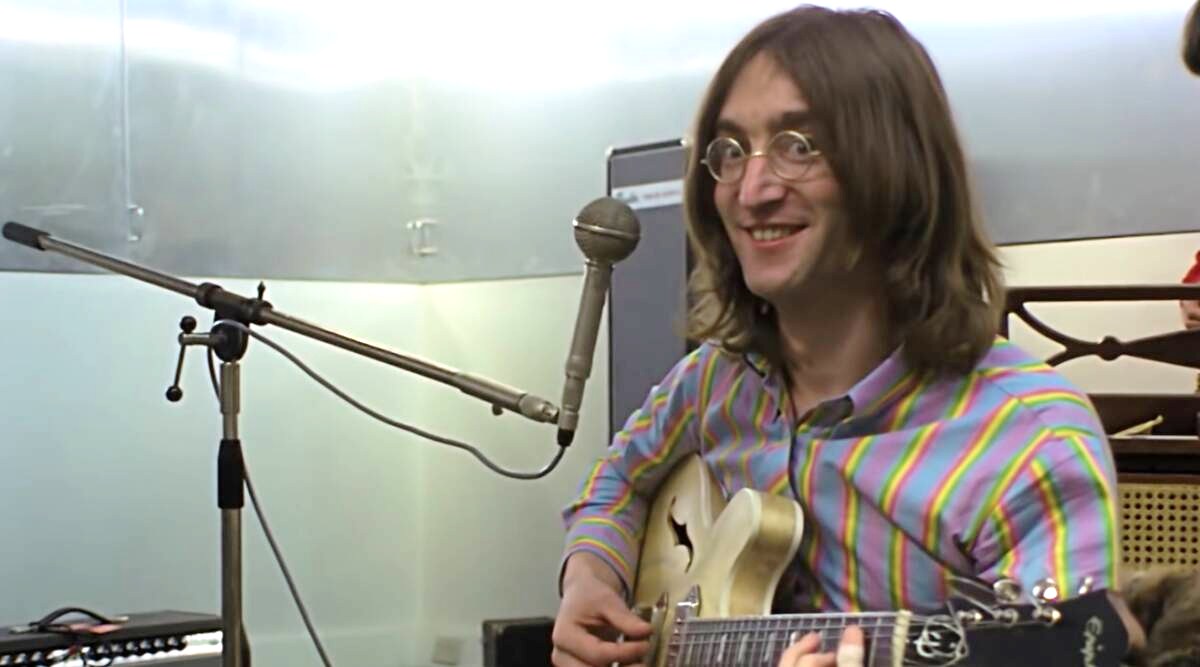
Peter Jackson's long video chronicle of the Get Back sessions in 1969, streaming on Disney Plus and now on DVD and Blu-Ray, is not only a saturation in Beatles history and process, but a unique view of a rare time, when all four Beatles were in the studio together every day for a month, something that likely hadn't happened since their early albums, if it had ever happened before at all.  The result is an engrossing, mystifying and sometimes exhilarating eight hours, which for me verges on the addictive.

After completing what's known as the White Album in October 1968 (official title: The Beatles), the Beatles decided to have themselves filmed in the recording studio to be made into a TV special.  At first they were going to do White Album songs, but then decided it would be more interesting to show them creating new songs, rehearsing them, and then performing them in a live show...somewhere.  The day after New Years in 1969, they began.

Until now, all that officially resulted from these sessions were the feature film Let It Be and the album of that title, both released in 1970.  By the time they came out, the Beatles as a band effectively no longer existed.  The movie in particular became known as the story of them breaking up.  

About a half century later, the Beatles' still-existing company called Apple, still had the original 16 mm footage of all the hours filmed that month, plus audio tapes that ran even when the cameras didn't.  Peter Jackson, director of the Lord of the Rings films, jumped at the chance to try to construct a new something or other out of that footage.  When he started watching it (he would say repeatedly to interviewers), he was astonished: the Beatles didn't look like a dour group who hated each other.  They were often affectionate, and often having fun. The sessions had tensions but also a lot of joy.  Sometimes in subtle ways, they showed the earned closeness of a band of self-selected brothers, who had made magic together for nearly a decade, and still could. Some four years later Jackson delivered Get Back, an eight hour selection for Disney to run in three segments, and eventually, for Apple to issue as three DVDs.

Apart from doing it at all, Peter Jackson earns high praise for doing two basic things.  First, he used today's technology to "restore" the visuals and the sound.  I'm guessing that in fact the visuals look even better than the original 16 mm film, although 16 can look pretty damn good.  The sound of the music probably needed less work, but the real contribution was to clean up the sound so that the conversations etc. can be heard.  

Second, Jackson structured the film chronologically, which in itself changes the impressions often created by the Let It Be movie, which was directed by the guy who filmed all those hours, Michael Lindsay-Hogg.   Let It Be has the barest sense of chronology.  It's basically a collection of scenes.  It also looks terrible.  Even when it first came out, blown up to 35 mm, it was grainy and dark.  Surviving versions are often further edited and panned-and-scanned.  The one I have on VHS looks like a series of extreme close-ups shot during a blackout.  My fading memory of seeing it a couple of times in theatres, however, supports the idea that close-ups or one and two shots predominated.  Jackson's film has a larger sense of space.  We get the full studio and the full band. 

But even as a chronology of that month and of these sessions, Jackson's film isn't complete.  Important events outside the studio aren't mentioned, both in terms of background (the Beatles finances were a mess, and Apple was going broke) and specific events.  For example, early in the month, George Harrison suddenly gets up and leaves, quitting the group.  It's a big dramatic moment, and Jackson's film does a great job of showing the other Beatles' responses.  Then a few days later, Harrison comes back, inexplicably cheerful.  Jackson's film doesn't even try to suggest why Harrison left, except to show a painful conversation with McCartney that the Let It Be film also shows part of.  (Some Beatles scholars however suggests George and John Lennon had an off-camera tiff earlier that day, which precipitated George leaving.)  But what Jackson's film doesn't mention is that the day before George quit, his wife Patti left him.  And then she returned at about the time he rejoined the group.  He seemed to remain in a very good mood from then on, very committed to the band.

Apart from leaving out external events (including alleged drug use), Jackson leaves out parts of some conversations, skipping sentences and even moving the order of statements within the same conversation.  I know this because Beatles scholars on YouTube play the original audio tapes, which became available long before Jackson's Get Back was released.   So while this is a huge improvement in understanding what actually happened in these January 1969 sessions, Jackson's film isn't quite as complete or straightforward as it might seem.

Get Back tells a story that seems to be basically accurate.  The initial idea was to make use of the otherwise empty building of the British film company, Twickenham Studio, because Apple had leased it for the month in preparation for the making of The Magic Christian feature film, that was scheduled to begin shooting there in February.  That movie starred Peter Sellars and Ringo Starr, so that was another reasons the Beatles had to finish this musical adventure in January--Ringo would be unavailable.

But the Beatles were miserable at Twickingham. They were in a huge, cold room in the London winter, showing up in the morning at a time they would normally still be asleep, and unaccustomed to making music in a studio that early. The sound in the room was awful. They had to deal with every moment being filmed, as well as still photographers roaming around them constantly.  Director Lindsay-Hogg was badgering them about where they would do the live show.  They couldn't agree.

Harrison's departure seemed to change the game.  The other three Beatles met with him and all agreed they weren't going back to Twickingham, they weren't doing a TV show but the footage could be used for a feature film (they owed their studio one anyway) and they weren't going out of the country for a live show (which is what their director wanted.)   George helped organize the equipment needed to record in the Apple headquarters basement.

The mood lightened immediately when they got there, where a a homey space was created that they all liked.  Though the film shows a disconcerting amount of jamming and fooling around, they got down to working out songs.  This is the stuff that I really like, and I suppose anyone who has been in a musical group, especially one working with original songs, will recognize the process, even if this is on a whole other level. I love artistic process movies.  I love Sting's Bring On The Night.  So even what may seem tedious to others tends to delight me.

But several songs are getting bogged down, with several of the Beatles realizing they need another player, someone to do keyboards live.  Then one day, Billy Preston just shows up to say hello--he has known them since they were all teenagers playing dubious clubs in Hamburg.  (In fact, George Harrison had been talking him up to the others, and invited him to "drop in.")

 They ask him to sit in on the song they're working on ("I've Got A Feeling"), and immediately everything starts to fall into place.    Billy Preston provides the musical spark to several songs that completes them, and gets the juices going.  One of the early highlights of the series is watching Paul McCartney working out the basics of "Get Back" from scratch. Then we see the lyrics gradually change from an anti-racist protest song (anyone remember Enoch Powell?) to the words we know.  Billy Preston's keyboards finally completes it.  He remained part of the group through the rest of the sessions.  His work on "Get Back" has been praised, but he's equally essential to "Don't Let Me Down."  

Throughout we hear each of the Beatles bringing in songs (several times, something they had written the night before), and everyone gets interested.  Most of these songs, and others they are working on, will appear (we know now) either on their next album, the incomparable Abbey Road, or, more hauntingly, on their post-Beatles solo albums.  The explorations of George Harrison's song "Something" are especially fascinating.  The musical accompaniment for once comes easily, and that great tune is there.  But Harrison has almost no lyrics to what will eventually be known as one of the greatest love songs of all time.  It sounds so heartfelt, but for months, George didn't know what "something in the way she moves" attracts me like.  

Of the songs that eventually do make it on the
Let It Be album, one of the most troublesome is "Two of Us."  It was the song Paul and George argued about at Twickingham.  For weeks the group is never satisfied with it, no matter how many times they do it--and they do it a lot.  Paul and John sing it to each other in posh London accents, Scottish accents, Bob Dylan accents, and eventually sing it without moving their lips, like two crazed ventriloquists.  But it is Paul getting tired of playing the electric bass and picking up an acoustic guitar that gets the song going, as a kind of skiffle or folk song, with Ringo's tasty drumming and George playing bass notes on his electric guitar.

Yoko Ono has been a constant presence sitting silently beside John (in Let It Be she seems ominous; in Get Back, pretty neutral. Both she and George Harrison's second wife Olivia are listed as producers for the Get Back series.)  By the third and fourth week of the sessions, the studio opens up.  Paul's girlfriend Linda Eastman (who was shown as present once at Twickingham) brings her six year old daughter Heather to the Apple studio, and Heather's interactions with John, George and Ringo as well as Paul, and her imitation of a Yoko vocal, are highlights. (Paul and Linda would marry a week before John and Yoko. Paul soon adopted Heather as his daughter.)   Patti Harrison and Ringo's wife Maureen also visit the studio, and most of them listen to a day's recordings in the control room together.  These are some of the most affecting scenes.

But the Beatles can still never agree on a live show, and until the last moment, aren't sure if they will do their now famous rooftop concert.  Jackson intercuts the entire concert (just five songs, some repeated).  He included more street reaction than did Let It Be, so Jackson has the narrative of the police officers arriving, being diverted and finally ascending to the roof, all in split screens.  The Beatles road manager finally tries to turn off George's amp, but he curtly turns it back on and they finish the song. 

 Each time I've seen these scenes I've gotten a different impression. Sometimes the street interviews were mindless distractions.  Other times they were overpowered by the energy of the music.  Once I marveled at the reaction of people on adjacent rooftops and the street.  There's no telling how well they could hear (a segment in the Beatles Anthology suggests the sound wasn't really very loud on the street), but they show little emotion.  I couldn't help thinking of the contrast with the years of screams and fainting.  On the other hand, the people complaining about their music and the police showing up could have been straight out of A Hard Day's Night.  That much didn't change.

I was surprised then by how briefly Jackson treats the final day, in which the Beatles alone in the studio record the acoustic "Two of Us" and the two McCartney piano numbers, now classics: "The Long and Winding Road" and "Let It Be."  The movie Let It Be presented full versions of both songs, but without context, it reinforced that movie's narrative of a dominating McCartney, and the others literally (in this scene) sitting at a lower level, playing supporting parts.  In context, it was just the most efficient way to do the final recordings of these two songs, at the end of an exhausting month.  However, it would have been nice to hear more of them.  ( For my money, the best cut of "Let It Be" on film is in the Beatles Anthology.)  

What about the Beatles themselves?  Paul McCartney is neither the authoritarian monster and central villain that the Let It Be movie casts him to be (though his beard and black suit don't help), but neither is he the genial and articulate statesman of interviews.  Emotionally he seems all over the place--capable of far-seeing insights and long monologues of near nonsense. He comes off as a paradox at times.  For example, who was the most actively opposed to doing the rooftop concert? And who looked like he was having the best time doing it?  McCartney, both. 

John Lennon is always the class clown, but he's also very quiet and subdued for long stretches, though when they play in the Apple basement he's right there, energetic and engaged.  There are moments when both McCartney and especially Lennon are pretty open about their fears and insecurities, past and present.  Paul is uncomfortable in his role and worried about the band's direction.  On the music itself, he worries that his classic ballads drag too much.  John is contrite for showing up late and not being at his best. (This may be the result of his reputed occasional heroin use, or he's just sick.  It's the flu season and both Paul and Ringo also complain of being ill at different times.) John is realistic about the limits of his own guitar work, though I was surprised to see that he did the guitar solos on "Get Back," and some of the jams show he had more lead guitar skills than I would have guessed.

George Harrison appears all black or all white, sour or sunny, and in Martin Scorsese's biographical film about him, that's how Ringo describes him: either saint or sinner, nothing in between.  It wouldn't be until Abbey Road and his own All Things Must Pass album (the most successful of all the immediate post-Beatles releases), that the quality of his songwriting was fully revealed, along with his unique, haunting and supple voice.  Just before the Get Back sessions, he had spent six months producing other artists, and his production of All Things Must Pass (despite what Spector did to it) is musically remarkable.  In that sense, he never really had a "solo" career.  He was the instigator of the Traveling Wilburys in the early 90s, which he formed (Olivia  Harrison said in the Scorsese film) because he missed being in a group.  He missed the Beatles. 

Ringo Starr was the backbone of the Beatles sound, and the glue that held the Beatles together. Though he's not heard saying much in this series, it's partly because he does his job so well.  A lot of Beatles songs sound simple until you get into their structure.  For instance, George comes in with a song, "I, Me, Mine," best known now for its eloquent lyrics, that he was inspired to write by seeing a grand waltz performed on a TV movie.  Most of the song is in waltz time (John and Yoko actually waltz to it), though it breaks into a four-four rocker, and back again.  Other songs are replete with even more subtle complications, and Ringo has to engineer these time-jumps seamlessly. 

Even so, Ringo has a nice scene doing a comic take to the delight of Heather McCartney, and also when he brings in the basic idea for "Octopus' Garden"--  George (the other non-Lennon-McCartney songwriter) immediately starts working with him to extend it, soon charming everyone and interesting the other Beatles in developing it.

Transcending all other impressions of this series is this magic opportunity to spend this much time with these four extraordinary people, all of them still in their twenties, as this extraordinary group.  Though this experiment was artificial in that it wasn't how the Beatles made their records anymore, it did bring them together every day over an extended period for the last time.  In the decade to come, as they went their separate ways (though different combinations of them collaborated), they all had periods of depression or despondency, and they all at times had serious drug and/or alcohol problems; two marriages ended, and they all endured tragedies.  John Lennon was weeks past his 40th birthday when he was shot dead.  These hours in the studio, during which they often revisited their past music as well as shaping new songs, seem like a time out of time.

With the benefit of hindsight, we do see suggestions of what would soon break up the band.  We also see the Beatles' luck start to change.  In the beginning they happened to find the right manager, the right producer, and then the right film director to help them blossom.  But this film makes a joke of their association with "Magic Alex," the supposed electronics genius they hired who is exposed as a total and expensive charlatan.  Not so funny is reference to John Lennon meeting Allen Klein, and his glowing account of Klein's knowledge and business acumen.  Eventually, Lennon convinced George and Ringo to make Klein (then managing the Rolling Stones) the group's manager.  Paul saw through Klein, and the resulting conflict was the proximate cause for the Beatles to break up.  Klein did get them more money, but his nefarious schemes eventually turned John and especially George against him.  They all dumped him, and he became an active nemesis for awhile, until more money changed hands.  

Also at about this time, John and George brought legendary producer Phil Spector into their efforts, and Spector's production of the long delayed Let It Be album did not go over well.  Eventually, McCartney backed a re-release that stripped it of Spector's effects, for the album Let It Be Naked. 

Yet, just weeks after the rooftop concert, the Beatles began recording again, this time with their producer of all previous records, George Martin, and did so at their EMI studios on Abbey Road, for their last, transcendent album.  And in the end...