Saturday, January 13, 2007
R.I.P. Tillie Olsen
Her book of linked short stories, Tell Me A Riddle, is an American classic. In his book, The Call of Stories: Teaching and the Moral Imagination, Robert Coles writes in great detail about how these stories touched so many of his students of all backgrounds, particularly women. Olsen's nonfiction book, Silences, dealt with her own inability to write as well as barriers to other writers who couldn't complete or publish their work, which include censorship and self-censorship. This book became especially valued by women writers. Olsen finally did publish some of the work that had caused her so much trouble, as Yonnodio: From the Thirties. She died on New Year's day in Oakland, CA, a couple of weeks shy of her 95th birthday.
R.I.P. Carlo PontiPonti produced classic Italian films, such as Fellini's La Strada, and later produced other international classics such as Blow-Up, Dr. Zhivago and The Verdict. His divorce to marry to the young starlet he discovered, Sophia Loren, was a 1950s scandal. But they had the last laugh. Ponti died this week at the age of 94, still married to Loren.
Saturday, December 23, 2006
Pema
After we lost our cat Tess, we didn't have a third member of the household for about a year. Then friends who live in a rural area up the mountain from Arcata rescued a young cat. They found her in their barn, starving and dehydrated. They got her healthy again and began looking for a permanent home for her. We visited to see this still scrawny cat, dark gold with golden eyes. She hid from us but when I extracated her from under a bed, she responded to being petted, almost desperately.
She'd been checked by a vet, who said she'd been spayed. Later the theory was that she was one of a group of cats kept outdoors at a nearby farm, some of whom had escaped. They were originally part of a "catch, spay and release" program for cats on their own. We still don't know how she came to be in that barn, or why she was so close to starvation.
We brought her home, and I had my first experience with a feral cat, which is a cat that hasn't been brought up around humans. We named her Pema, after Pema Chodron, the Buddhist nun whose tapes we were listening to at the time. Pema was probably semi-feral, but I learned a lot about what to expect from a book I coincidentally happened on at a used store, which described the experiences at a shelter that had feral and non-feral cats. Feral cats are often very fearful of humans, keep their distance, don't allow themselves to be touched, though they may have close relationships with other cats. Sometimes this behavior changes and they warm up to humans, but sometimes not.
Margaret spent a lot of time with Pema and Pema bonded with her. Margaret became her mother. This time we (Margaret especially) took extra care with her food--it's free of chemicals, etc. and otherwise the best. But for months, Pema kept her distance from me. She wouldn't allow me to touch her, and she generally sped away when I was around, gradually getting a bit more comfortable as long as I kept a distance. This was of course difficult for me, given my relationship with Tess. But I was in charge of Pema's evening meal, and she got used to that.
Eventually she allowed herself to be petted a little. I made sure to rub the area of her neck which would give me her scent, which she would then recognized. Pretty soon she began to seek me out and now she likes to be petted, and rubs herself against my shoes. Unlike Tess, she likes her belly rubbed. But also unlike Tess, she won't allow herself to be picked up by either of us, and she hasn't yet figured out the concept of the lap. But she's getting closer.
She's a smart cat, and she likes to play. She has several "mice" that she alternately bats around, like mice, or licks, like kittens. The other unusual thing about her is that she won't drink from a water dish. We add a lot of water to her canned food which she laps up, as long as the proportion is right. And of course it has to be slightly heated, but not too much. She's gone from a starving cat to a finicky one. But she's comfortable running the household, and she's become a companion to both of us.
I have learned a few things from what Pema learned as a feral cat. She's very hesitant to enter a room without a clear sightline--and beeline--to an exit, and if there are two doors, she prefers that they're both open before she relaxes. Seems like a good idea.
Saturday, July 08, 2006
After You've Gone: The O'Neill Center Blues
Since the late Lloyd Richards left the Eugene O'Neill Center, its centerpiece--the National Playwrights Conference--just hasn't been the same. Partly, one assumes, the turmoil is due to funding setbacks that were already taking a toll in 1991, when I spent a couple of weeks there. And partly it now seems to me because the people running it have lost Lloyd Richards' vision.
This is about the time of year that the conference happens. It's four weeks in July, when a dozen or more playwrights would work with professional directors, dramaturgs, designers and actors, many of them coming up from New York City. (My article about the O'Neill for Smithsonian magazine is reproduced here in somewhat expanded form.)
They've had a couple of artistic directors since Richards' retired, at least one of them leaving under a cloud. Last month--well before Lloyd Richards died--the new artistic director, 31 year old Wendy Goldberg, gave an interview in American Theatre. Her quotes, and some statements in the story which seem to be based on impressions and information the writer got from her, suggests how far the O'Neill has strayed, and for my money, fallen.
For four decades, the O'Neill had a policy of open submissions: anybody could send a script and it would be considered. Without such a policy, it's doubtful that many if not most of the new voices the O'Neill discovered and nurtured would have had a chance, and that seems especially true for its most important discovery: August Wilson.
A few years ago, the new regime tried to change that, and limit submissions to pre-selected playwrights. There was a hue and cry and unsolicited scripts were again considered, though in a narrower time frame, and with conditions that made entering a pretty pricey proposition. Goldberg reinstated open submissions, and though I don't know the exact rules and regs this year, statements that she makes in the interview suggest the situation hasn't really returned to what it was.
"We've had 800 submissions this year, a record amount of plays," Goldberg is quoted as saying. First of all, unless she is judging them by weight, she probably meant "a record number of plays." But even that is simply false, and by quite a lot. There were some 1500 scripts submitted for the 1991 conference, according to Lloyd Richards, and confirmed by others that summer.
There were also 12 playwrights chosen for 1991, although I believe they had previously hosted 14, but budget shortfalls forced both fewer playwrights and an altered schedule--the pre-conference in the spring, during which the playwrights spend a couple of days simply each reading their plays aloud, had to be folded into the summer conference.
But the conference in 2006 will host but eight playwrights, and one of them did not emerge from the regular submissions process. Moreover, this play will be "workshopped" before a scheduled production in Atlanta, something that Richards' resisted. He didn't want the O'Neill to become a venue tied to specific productions elsewhere. The O'Neill was about the playwright and the play, and nothing else.
That clearly is no longer true. Goldberg had done away with the system Richards instituted (and which other places copied) of simple, modular sets and basic production values, and script-in-hand performance, so that playwrights could change things right up to the minute of production, based on what they learned in their creative collaboration with all the others involved. Goldberg says that "each play is different" which is a truism but also signifies the distinct possibility that some plays are going to be favored in light of imminent productions elsewhere.
The critique system Richards set up is also slandered in the article, as some sort of vicious punishment visited upon the victimized playwright. I don't know what they were like in later years, but when I was there, Richards himself made sure these sessions were positive. He spoke before every one of them, about their purpose and how they fit into the larger purpose of the conference.
Through design and through his presence, authority and leadership, Lloyd Richards created a sense of the process as almost sacred, as touching the foundations of theatre and theatrical creativity and collaboration. It's no coincidence that one 1991 actor who did a lot of TV playing cops and criminals (an awful lot of O'Neill actors show up in episodes of Law & Order, a series co-created by an O'Neill playwright) described his participation as "renewing my vows."
The O'Neill was so important to so many people in the theatre, and so treasured, because it was a kind of temporary monastery (with a lot of un-monklike--or nunlike--behavior, to be sure) for the kind of pure creative process that the theatre needs. If it has succumbed to whatever pressures and necessities, or to poor judgment, then theatre will suffer for it, and so will playwrights.
And while a new generation of administrators has every right to their own vision, and certainly a responsibility to respond to today's realities, they might try respecting what made the O'Neill a living legend in world theatre. And the people who created it.
Labels:
August Wilson,
Lloyd Richards,
O'Neill Center,
theatre
Sunday, July 02, 2006
R.I. P. Lloyd Richards
I met Lloyd Richards, and though I spent only a few hours talking with him, I observed him over the course of a couple of weeks, and learned a lot about him from others. I didn't know however that our birthdays were one day apart. I found out just now, reading his obituary in the New York Times. He died on June 29, his 87th birthday.
Richards directed the first New York production of Lorraine Hansberry's A Raisin in the Sun in 1957, arguably the first authentic portrayal of African American life on the American stage. It was a classic when I read it in high school in the early 60s. But in his years of directing and discovering and nurturing playwrights of all races, his most important find was August Wilson, a great American playwright, who created the richest and most sustained expression of African American life in the twentieth century.
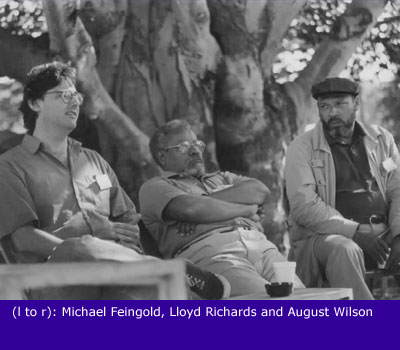
Only hours ago I opened a box of books one of my sisters sent for my birthday--an August Wilson play, an August Wilson essay, and a book on August Wilson (all from my Amazon Wish List.) Richards was instrumental in Wilson's career, and I met them both on the same day (July 1, a day after my birthday in 1991) at the Eugene O'Neill Center summer playwrights conference, where they had begun working together. It was Richards who picked out the manuscript for "Ma Rainey's Black Bottom" from the thousand or so that came to the O'Neill, brought the unknown Pittsburgh playwright to Waterford to work on the play, and then mounted its first productions at Yale and in New York.
Lloyd Richards was the heart and soul of the O'Neill, so important to many American playwrights. He transformed it into a community concentrating on honing and freeing new voices in theatre. He was utterly respected by everyone, for his discipline and gentleness, his rigor and humor, his attentiveness to detail and insistence on communicating the big picture, so everyone knew and shared the same vision of the O'Neill process. It hasn't been the same since he retired from being its artistic director.August Wilson died last year, and so the two giants of African American theatre are gone.
And to think just minutes ago I was ordering the last play I haven't read (apart from the one I just got) in Wilson's titanic ten play cycle, one for each decade of the twentieth century. That cycle is a truly stunning achievement, and Richards was part of getting many of those plays to their staged versions. I was looking forward to reading them all in the order of decades. Then minutes later I happened to read this. Of course, it's not as shocking as August Wilson's death at age 61. But it is another indication of an era passing. These two men have left such an incredible legacy to America and theatre everywhere.
Labels:
August Wilson,
Lloyd Richards,
O'Neill Center,
R.I.P.,
theatre
Thursday, April 27, 2006
The Man Who Loved Movies
This post is personal reminicence, inspired by an issue of the alumni magazine of Knox College, where I was an undergraduate. And if you've arrived here from the Knox site, welcome. This particular site has become a more personal one over the past few years, though it's more about personal obsessions than a day-in-the-life.
For those who were at Knox when I was, you might be interested in a couple of other sites I've just started: 60s Now and the Boomer Hall of Fame.
I post on current events affecting the future on Captain Future's Dreaming Up Daily. If you took astronomy with me, and happen to recall my Captain Space hat, you won't be surprised at that title, nor my Soul of Star Trek blog.
And if you'd like to catch up on my past published writing, some of my favorite magazine and newspaper pieces are at Kowincidence. Now, forward to the past.
I was pleased to see Jay Matson on the cover of Knox Magazine, and to read of the Alumni Achievement Awards to David Axelrod and Bill Barnhart.
Though he identifies himself as a philosophy major, Jay Matson was known on campus foremost as a poet, at least by his senior year, when I was a freshman. We were all in awe of him---his quiet, brooding figure defined “the poet” for me. When Mary Jacobson (who I essentially---or was it existentially?-- adored) told me that my writing had been singled out as promising (for a freshman) by Jay Matson, I felt I had something to live up to.
Then I recall visiting his farmhouse several years later, where a water pipe had burst from the cold, and several rooms were virtual skating rinks. I didn’t see him on my visit to Galesburg in the early 1980s, but I did write about his success transforming historic downtown buildings in my book, The Malling of America.
As the editor of the Knox Student, Bill Barnhart honed his journalistic skills in a tumultuous time on and off campus, and he also had to deal with several unruly columnists, like Skip Peterson, Mark Brooks, Kevin Cameron (unless he was gone already), and me: wild men all.
But the person I want to acknowledge most is David Axelrod. David ran the Cinema Club, which I believe was his invention as well. He chose, booked and exhibited foreign films, pretty much monthly as I recall. This may not sound like a big deal now, but consider this: at the time there were few film courses anywhere in American colleges, and none at Knox (I believe the first at Knox was a filmmaking course given by Richard Alexander of the English department in 1967 or so.) Only a few small theatres in major cities showed foreign films at all (and of course this was before video stores and cable TV.) Movies in general were still considered disposable entertainment.
So beginning with my freshman year, I bought the little card that entitled me to see these movies with strange titles, identified as well by the magic names of the directors: Bergman, Fellini, Godard, Antonioni, Truffaut, Kurosawa… I used to read the titles and names and try to imagine what the movie would be like. When I went to them, sitting in the darkness and staring at these strange apparitions of light, I understood very little of what I saw that first year. But gradually I absorbed their vocabulary, and by the time David graduated, I was a film buff for life.
Although my screenwriting efforts got me no further than an entertaining Hollywood lunch with a William Morris agent (our waitress had been a stand-in for Lillian Gish, who she still resembled), and writing and even directing a few videos for clients, I did wind up writing a lot about film, for various periodicals. This not only involved seeing hundreds of movies but doing interviews on Hollywood sets and on one occasion, spending an hour talking with Francois Truffaut, and exchanging letters afterwards. (I even told him about the scene in which he and Godard—his friend and later New Wave rival—have a shootout, in the last play I wrote and directed at Knox. He laughed.)
The resulting article was in Rolling Stone, called "The Man Who Loved Movies." He liked it, and a piece I did on the (now lost) art of double features, which mentioned a pairing of two of his films. Both of them are reproduced over at kowincidence. (Which was a name given to me, by the way, by the ineffably beautiful Mary Jacobson. (I can see her cringing at my word choice.) I used it for the name of my temporary band for my one and only rock and roll record. But that's another story. )
I’m pretty certain I saw Truffaut’s “Shoot the Piano Player” at Cinema Club, probably my first Truffaut film. I just watched the DVD of it last week, with commentary by Annette Indsdorf, Columbia film professor. I met Annette when she was Truffaut’s translator for his U.S. retrospectives in 1979. Just another link in my life that began with the Cinema Club.
With his dark hair falling in his eyes, David was a personality and a presence at Knox. His off campus apartment featured a homemade reproduction of a Modrian painting (“Broadway Boogie-Woogie”)? rendered with colored tape, as assembled by the rapturously lovely Judee Settipani. I remember him as not saying a lot, and saying it softly (not like some of us loudmouths) but after due consideration, making it count.
I remember some of his pronouncements to this day, and not all of them about film, though this one was: he pointed out to me that the world is not black and white, so black and white movies are inherently abstract. It’s a basic concept now, but at the time it was profoundly new, at least to me, and especially impressive because it seemed to be an insight he’d reached on his own.
The only times I’ve seen him since Knox were in movie theatres: once in Chicago, and once in the mid 1970s at the Orson Welles Cinema in Cambridge, MA. (Actually I ran into him in the adjoining restaurant.) At the time I was practically living at the Orson Welles. I was seeing at least 10 to 20 films a week; once I saw 10 movies in one day. I may be an extreme example, but I’m sure there are others whose lives were enriched by what David Axelrod began, as a student at Knox.
UPDATE: If you're interested in David's more recent activities, his web site is, strangely enough, davidaxelrod.com. Which isn't the no-brainer it might seem to be, because there are lots of David Axelrods out there in cyberspace. So I figure he had to be pretty quick to get that url.
Tuesday, March 07, 2006
The Accidental Brecht-a-thon
Brecht's Mother Courage and Her Children and The Caucasian Chalk Circle
by William S. Kowinski
By sheer coincidence, the Humboldt State University campus hosted two productions of plays by Bertolt Brecht during the same fortnight, with two nights that both plays were staged simultaneously. In late February and early March, HSU may have briefly been the Brecht capital of the world.
But even though it was accidental, this local Brecht-a-thon was not eccentric. The unique ways Brecht’s plays address searing issues that are suddenly central to this moment is a chief reason several of them are being revisited on stages from Los Angeles to New York, where a new adaptation of Mother Courage and Her Children by playwright Tony Kushner will appear this summer, starring Meryl Streep.
This was one of the plays done locally, by the HSU Department of Theatre, Film and Dance. The other was The Caucasian Chalk Circle performed by the Young Actors Guild of the North Coast Preparatory and Performing Arts Academy.
Born 108 years ago this February in Bavaria, Bertolt Brecht studied medicine before working in an army hospital during World War I, where he saw the butchery of war in person. His first poems were published and his first plays produced in the early 1920s.
By 1924 he was becoming a central figure in Berlin theatre, in a particularly frenzied and creative period in Europe and specifically in Germany under the Weimar Republic. Among the intellectual and political currents swirling around him were Dada, Futurism and Marxism, as well as the slowly growing influences of Nazism. It was then he began writing his theoretical essays, and developed his “epic theatre” style, with its use of music, titles and screens. Brecht collaborated with musical composer Kurt Weill in 1928 for his most famous play, The Threepenny Opera.
As a poet he was said to be influenced by Rimbaud, Villion and Kipling, and as a playwright by Shakespeare and the Greek tragedies. Asian mask theatre as well as Bavarian folk plays and fairground entertainments are also mentioned in analyses of his work. By the early 1930s, Brecht’s anti-bourgeois and anti-Fascist politics led him to the Communist Party, and exile from Hitler’s Germany. He escaped first to Scandinavia, where in a feverish few weeks, he wrote what many consider his greatest play, Mother Courage and Her Children.
As the Nazis advanced across Europe. Brecht fled to America in 1941, thanks to the support of a large expatriate German colony in Hollywood (including actor Peter Lorre, who’d worked with Brecht in Berlin) and the sponsorship of Luise Rainer, star of The Good Earth, even though they’d never met.
But when they did take a walk on the beach together, Brecht asked her what kind of a story she would like him to write for her. Rainer suggested he try a story using the “chalk circle”—a kind of King Solomon method for deciding a child’s true mother, apparently from China. Brecht agreed, and eventually wrote The Caucasian Chalk Circle while living in Santa Monica.
Brecht wasn’t very successful in his attempts to write for Hollywood, and though like many other European exiles he felt creatively, culturally and intellectually stifled and alienated there, he did absorb aspects of American culture. He also wasn’t successful in staging plays in America--The Caucasian Chalk Circle was meant for Broadway. But he did meet a young professor teaching in Los Angeles named Eric Bentley, who would become his chief champion in America for the next half century, and with whom he would collaborate.
Brecht had been a Communist since the 1930s, and he returned to Europe the day following his questioning before the House Un-American Activities Committee. Eric Bentley believes it was only due to bureaucratic bungling that Brecht ended up in East Germany rather than West Germany in 1947.
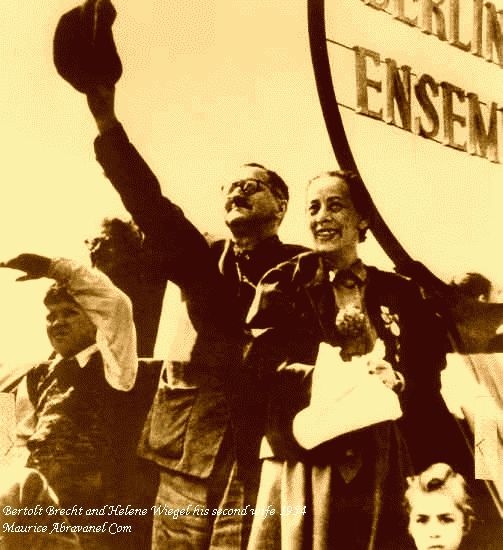
It was in Berlin in 1949 that Mother Courage and Her Children finally had its official premiere, with Brecht directing, and his wife, the actor and director Helene Weigel playing the lead. It was the production and the performance that influenced and outshone all subsequent stagings in Europe and in America.
Though Brecht has long been considered one of the 20th century’s most influential playwrights, in America his plays were not done often, nor very successfully, at least until recent years. There is very little on film that is readily available. Apart from Cold War politics, much of the problem seems to be due to confusion about how to stage his plays, according to his own theories and pronouncements. According to Bentley, Brecht (who died in 1956) could be doctrinaire about staging, and his acolytes even more insistent on purity.
But at other times, even Brecht relented, when it became clear that the theories were getting in the way of the plays. While directors continue to worry if their productions are sufficiently “epic,” and actors wonder how best to create “alienation” in the audience, Brecht is said to have kept this motto above his writing desk: “Simpler, with more laughter.” This may be the moment his plays can be seen for themselves, without the baggage.
Brecht set Mother Courage and Her Children in central Europe during the Thirty Years War of the seventeenth century. After World War I, some Europeans (including H.G. Wells in England) feared the next world war would itself last 20 years or more, and destroy western civilization.
While the unfolding second world war was on Brecht’s mind when he wrote the play, the continuing war in Iraq is much on the minds of those doing the play now, and inevitably on the audiences.
Brecht uses plain language and dark humor to tell the story of a woman trying to eke out an existence selling goods from her cart to armies on the road, while protecting her three grown children from the very war that feeds them. The basic story is fairly simple, and is foretold early in the play by a kind of oracle, like a Greek tragedy. The three children of Mother Courage all die: first, her second son whose execution is partly his mother’s doing; second, her eldest son who is executed for the same acts that had him proclaimed a hero (though by the end of the play she still doesn’t know he’s dead) and lastly, her daughter, who wakens a sleeping town by banging a drum, to warn them of the approaching army.
Commenting on this play’s theme, Brecht said: “War is a continuation of business by other means, making the human virtues fatal even to those who exercise them.” For John Heckel, director of the HSU production, the core question Mother Courage faces is: “How do you remain soulful, how do you retain a sense of nurturance?” in this situation of endless war, feeding and fed by endless greed.
HSU’s “Mother Courage” was presented in the 110-seat Gist Hall Theatre. It is in one of the older buildings on campus, often too warm and stuffy, with the audience looking down on the stage from severely raked rows of seats. However, about half the seats are quite close to the stage.
Though this production sold out every performance (and Heckel mourned the days when plays received 12 performances over three weekends, instead of six over two), he chose this theatre over the larger Van Duzer. Heckel likes to stage large dramas in intimate circumstances. After all, he did both parts of Angels in America here, an amazing and memorable experience.
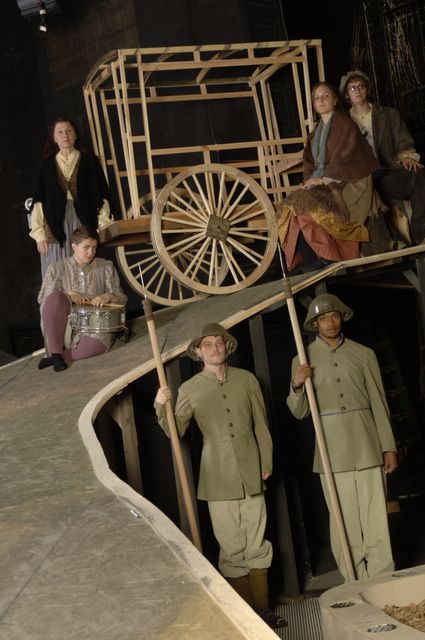
The set (by Jody Sekas) was magnificent, dominated by a raised, serpentine and circular ramp, representing the road (also depicted on a large faded map of central Europe, one of the evocative hangings on either side.) The actors pulled a cart up and down this very steep ramp, anchoring it in various places for the next scene. There was also a small central area (not unlike the mosh pit in the center of the Rolling Stone’s mouth-like ramp stage at the Super Bowl), where some action took place. A working scroll above the stage area reproduced the Brechtian titles, which tell you not only when and where the next scene is, but basically what will happen.
The cart was elaborate, and styled like a circus wagon, a motif echoed in some of other decorative elements, such as the stripes on the army’s tents depicted in a hanging.
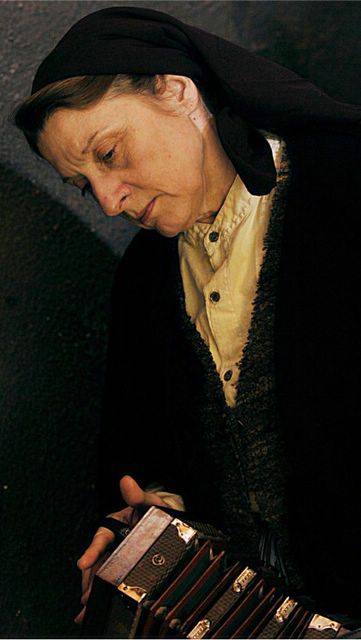
Lila Nelson, a North Coast singer-songwriter, performer and recording artist with experience in theatre as a student here, wrote new music for Brecht’s songs. She also played piano in the accompanying band (guitar, bass, sax and cello.) Her music, folk and country-inflected, brought a distinctly American sound to the production.
Though the singing was uneven (due in part to technical problems and the placing of the band behind the performers which made it difficult for musicians and singers to hear each other well enough), there were outstanding moments. Bernadette Cheyne (HSU theatre professor and actor) as Mother Courage brought a Judy Collins quality to her songs (reminding me that Judy Collins had recorded a Kurt Weill composition), and her powerful rendering of a song about anger was the perfect end to the first act in this production.
With a combination of recitation and singing, Joshua Switzer’s song as the Cook in the second act was a standout, and the soldier’s sternly plaintive song, “A soldier has no time to wait,” was a sober counterpoint to the absurdity going on around him---an important and haunting moment, well conceived and executed. The singing of the young women (Jessica Brown, Renee Carney, Jolie Colby and Missy Hopper) playing peasants caught in the crossfire of death, was soaring and heart-rending, especially in combination with poetic staging, gesture and movement.
I saw the first performance of the second week (Thursday), and the second act on its final night (Saturday.) The text was presented well, and the movement and stage pictures were often striking. By Saturday, the acting was purified, stripped to its essence. On the whole, it was a success. But for me, some of the production’s problems and missed opportunity’s remained.
Subscribe to:
Posts (Atom)