Captain Toothpaste Returns
WHO IS CAPTAIN TOOTHPASTE? asked the bold print on the last page of the Knox Magazine spring 2007 issue. That’s easy. I am.
Or I was in 1968. I cut a record under that name, which was included in an issue of the Knox College literary magazine. The song was called “Nightdove.” Thanks to Knox Magazine, you can hear it yourself, right here. That’s me singing and playing guitar. I also wrote it--my real name is on the label as well, paired with a “J.Rider” as co-author. That was me as well.
I was also the co-editor of the magazine, with Wendy Saul. It was called “The Siwasher” then. Knox College was known as “Old Siwash” from stories written about it using that mythical name. It also turned out to be something of a racial slur which Native Americans found offensive. Our Spring 1968 issue was the last one with that name. Some years later, the school officially dropped references to Siwash, and adopted a new name for its sports teams.
The magazine had followed the same format for the years I was there: student stories, poems and reproductions of art works. After publishing such an issue in the fall, we decided to go multimedia. We broke out of the book with 8x10 reproductions of the work of four photographers, plus an art poster suitable for hanging. We talked a lot about how popular music in the 60s was a vital and representative art form for our generation, so we wanted to include records. We kept to our budget for all this by collecting the usual stories and poems in a booklet with a generic cover. And we put it all—book, photos, poster and two records---in a manilla envelope, with a poem by Howard Partner on the flap.
The record with the hot pink label (both were small but played at 33 1/3 format) featured Rick Clinebell’s rendition of the Joni Mitchell tune, “The Urge for Going,” on one side, and three cuts on the other side: a piano duet of an original work by Karen Janecek, a tune by the Knox folk group, Four in the Morning, and a rock tune by the Bushes.
The record with the yellow label had three tunes by the bluegrass Stoney Hollow Boys: Rick Lindner, Tom Stern and Mark Brooks, all from our class of '68. And on the other side, “Nightdove” by Captain Toothpaste.
Rick Clinebell was our music director. I was about to take the tapes of all the music to a record company in one of the Quad Cities (Davenport?) when he rushed me into a practice room in the Fine Arts Center with his guitar to re-record “Nightdove,” because something was wrong with the original tape. So I played and sang it just once, messed up the lyrics a little, but that was all the time I had. That’s what’s on the record now.
The recording studio where the tapes were turned into masters and then into records was run by an older gentleman and his wife. She loved the name “Captain Toothpaste.” She said she thought of it at night when she brushed her teeth and it made her laugh. While she was telling us this, her husband was at his mixing board, and asked me if I’d like some echo added to my song. I said sure. I was there with Wendy and Barbara Cottral. It was a sunny spring day. Later we had sandwiches at a little airport, watching small planes take off and land.
The print part of that last issue of the Siwasher were stories by Barbara Ann Cottral (now the famous story writer, Barbara Bean) and Jeremy Gladstone, a play by Sherwood Kiraly (now the famous novelist, Sherwood Kiraly), and poems by Nicholas Brockunier, Harvey Sadow (the world famous ceramicist), Wendy Saul (the famous writer,) Anne Maxfield, Bob Epstein, Phil Ralston, Linda Pohle and me. The next fall the magazine became “Catch.” I had a story in that first issue, too.
I don’t really remember but the whole multimedia thing was probably my idea. Influenced partly by Marshall McLuhan, I was fascinated with the idea of creating interrelated works in various media, specifically of publishing a novel that would be packaged with its own movie and soundtrack. It was barely practical then, and of course it’s much more doable now. I did something like it in the mid 1980s, when I recorded two songs (“The Malling of America” and “Mall Rats”) in the studio with musicians and backup singers, etc., to go along with my book, The Malling of America. The songs were a big hit at my speaking engagements for awhile, and actually got some radio play.
The “Captain Toothpaste” identity was very 60s, of course. Although there’s a homage in there to Howdy Dowdy, too, who was sponsored by Colgate toothpaste, creators of Happy Tooth and Mr. Tooth Decay. Also some satire on commercial culture that included the music industry.
Especially with that little echo added, “Nightdove” turned out to be kind of country surrealism. It reflects a lot I was feeling and thinking about at the time, especially in view of the world we were being drafted into a few weeks later.
Of course I’ve long since left such youthful preoccupations and pretensions behind. And I’m much too mature to call myself Captain Toothpaste. These days I’m known to readers of Daily Kos, Soul of Star Trek and everywhere on the Internet as Captain Future.
It is as Captain Future that I was invited to chair a panel this fall at the 40th anniversary Star Trek convention in Seattle, where I met some of my readers, including Walter Koenig (Chekov) and Jonathan Frakes (Riker). I’ve met Leonard Nimoy (Spock), Marina Sirtis (Troi), George Takei (Sulu), Levar Burton (Georgi LaForge) and Nichelle Nichols (Ahura), who introduced me to Neil Armstrong, the first human to set foot on ground not on this Earth. But Captain Future is not all about space. The Climate Crisis on the only world we’ve got is a primary preoccupation of my main site, Captain Future’s Dreaming Up Daily.
But Captain Toothpaste is a part of me, too. Save the nightdove, save the world.
Update 9/9/07: Just got the fall issue of the Knox Magazine, with their follow-up. I don't know why they won't mention blog addresses, especially since they basically got their information from a link to this post. They did add some information about the Stoney Hollow Boys. I don't remember Rick Lindner ever being called "Willy," but they name him and Tom Stern, but also Peter Schramm, former professor of biology, and Ken Pahel, another faculty member, as the string bass player. No mention of Mark Brooks. I distinctly remember him playing a washtub bass, the first I'd ever seen. I wonder whose memory is faulty here. I suppose I can be forgiven for forgetting Peter Schramm, since he failed me in a course which led to my never graduating. It was a course in evolution--pretty ironic, since failing the course selected me as not among the fittest, and doubly ironic because I've written a lot on the subject of evolution since, and have become the go-to guy for reviewing books on it--and science in general--at the San Francisco Chronicle Book Review. I also created the official web page for one of his predecessors, Paul Shepard, one of the most important thinkers of the 20th century, about evolution and so much more.
I also see that our 1967 anti-war poetry reading got into the history of Old Main, and that the post-Kent State/Jackson State takeover of the deans offices in 1970 is described as "peaceful," which it was, apart from the rock band playing in the hall. It was scheduled to be less peaceful, when the college decided to call the cops and have me arrested (or so I'm told.) But we left before then--specifically we declared victory and went home, which was our solution for how to get out of Vietnam.
Though Knox likes to give "credit" for leading that action to former Clinton Chief of Staff John Podesta, it was actually me. He wasn't even my chief of staff! Though they did get the name we called ourselves right--"The Students Are Revolting." I ask you, who else but me would have come up with that? I was reading about Dada at the time--and reading our generation's dadaist, Abbie Hoffman. But more about all that another time.
Monday, April 30, 2007

Monday, April 23, 2007

Shakespeare's Birthday
April 23 is designated as Shakespeare's birthday. It's also the date of his death. There's some factual basis for this date--William Shakespeare was baptized on April 26, when it was the custom for that to happen 3 days after birth. But there's some evidence his family celebrated April 22 as his actual birthday.
However it is parsed, it's appropriate for the greatest known playwright to have his birth celebrated in spring, for the springtime festivals from time immemorial were the wellsprings of theatre. So much of Shakespeare's theatre is related specifically to the festival tradition in England.
Back at Knox College when I was a student, the English and Theatre departments threw a Shakespeare's Birthday party on the closest weekend. When everyone was sufficiently lubricated, scripts would be passed around, and classic scenes performed. I recall doing the Porter scene from Macbeth one year. These festive readings all led up to the main tradition of the party: our shy, older English department chairman (though I suppose he may have been only in his 50s then) would read Romeo in the balcony scene of Romeo and Juliet, with one of an endlessly renewed selection of lovely female students.
The Shakespeare's Birthday party was a rite of spring at Knox, where the winters on the Illinois prairie were long and hard, and spring was short but spectacularly green and beautiful.
One of Shakespeare's greatest plays, As You Like It, begins in a harsh winter and ends in a magical spring. In honor of the day, I've posted extensively on it, over at Stage Matters.
April 23 is designated as Shakespeare's birthday. It's also the date of his death. There's some factual basis for this date--William Shakespeare was baptized on April 26, when it was the custom for that to happen 3 days after birth. But there's some evidence his family celebrated April 22 as his actual birthday.
However it is parsed, it's appropriate for the greatest known playwright to have his birth celebrated in spring, for the springtime festivals from time immemorial were the wellsprings of theatre. So much of Shakespeare's theatre is related specifically to the festival tradition in England.
Back at Knox College when I was a student, the English and Theatre departments threw a Shakespeare's Birthday party on the closest weekend. When everyone was sufficiently lubricated, scripts would be passed around, and classic scenes performed. I recall doing the Porter scene from Macbeth one year. These festive readings all led up to the main tradition of the party: our shy, older English department chairman (though I suppose he may have been only in his 50s then) would read Romeo in the balcony scene of Romeo and Juliet, with one of an endlessly renewed selection of lovely female students.
The Shakespeare's Birthday party was a rite of spring at Knox, where the winters on the Illinois prairie were long and hard, and spring was short but spectacularly green and beautiful.
One of Shakespeare's greatest plays, As You Like It, begins in a harsh winter and ends in a magical spring. In honor of the day, I've posted extensively on it, over at Stage Matters.
Thursday, April 12, 2007

R. I. P.: Kurt Vonnegut, Jr.
He survived Pall Malls for 84 years, and it was a fall resulting in brain injury that led to his death. Kurt Vonnegut has been part of my life and close to my soul since the 1960s, when my fiction writing teacher who'd been his student at the Iowa Workshop got us reading his early novels, just a few months before the world discovered him big time with Slaughterhouse Five. Of contemporary writers, I felt closest in ways I can't explain to two: Vonnegut and Gabriel Garcia Marquez.
His New York Times obit is here.
Vonnegut was one of the voices we clung to in those bitter years of the late 60s. His voice was so distinctive that it was something that writers attached to rhythmic mimickry had to get loose of. No sooner had you broken the habit of writing like J.D. Salinger, Hemingway and Joseph Heller, along came Vonnegut. So it goes.
He was a countercultural voice who came by it honestly; he earned it. His use of science fiction motifs was part of it, especially for me. In later years he took on the appearance as well as the mantle of our 20th/21st century Mark Twain.
I've known so many people who knew him, and I've seen him on various screens and of course read him, so I feel I did know him, in that peculiar way in which he didn't know me from Adam. I encountered him in person at least three times I can recall. He spoke in Pittsburgh, where the U.S. Army had once sent him to study engineering. His speeches, especially at colleges, are legendary--even the ones he didn't actually deliver. They were full of wit and practical wisdom, and lots of provocation of thought and feeling, worth any 20 political or academic talks.
Before that, he passed through my mind as I was walking in Boston one afternoon, idly thinking I might run into him. Late that night, while sitting in an unprestiguous, noisy, overlit restaurant with members of a rock band I was supposed to be writing about (the drummer lamenting the absense of the groupies he had been promised), I glanced across the room and saw Kurt Vonnegut looking at us, and not real kindly. Such a coincidence is common in Vonnegut's fictional universe, where there are "leaks" between worlds and time is permeable. It actually happened to me twice within a short time; the other time I was in O'Hare airport thinking about Paul Simon, and a minute later there he was. It was weird enough to be a little scary, and so it's never happened again.
The last time I remember was in Manhattan. It was on the street and I saw him walking towards me, wearing just a comfortable indoor sweater on a cold coat-and-scarf day. I recognized him and smiled; he looked at me the way I was often looked at in New York--that ' are you somebody I should know?' look--and when he'd concluded I wasn't, he looked away. But I have that picture of him, walking the midtown streets as if from one room of his house to another.
I was talking about a short story of his just the other day. Someone, I forget who, has recently written a satire in which the suggested solution to social security and medical care shortfalls because of aging baby boomers is to kill them--humanely, I assume. Apparently this idea is striking a chord, which doesn't surprise me. Vonnegut wrote about it in the 1950s, in a story called "Welcome to the Monkey House" (also the title of his first story collection.) Because of overpopulation, old people were encouraged to visit their government sponsored Ethical Suicide Parlors. It was a wicked idea, but what makes writers cherish Vonnegut is his imagination, his detail. These Parlors were housed next to Howard Johnsons, their purple roof next to the orange roof of HoJos. They all had Hostesses, stewardess-like young women who humor the old folks but efficiently hurry them along to take their injection and die peacefully in the Barcolounger. You absolutely know that when these places are established, this is what they will be like.
I've only quoted him here once, from a 2006 speech in which he said: “The only difference between Bush and Hitler is that Hitler was elected.” That's Vonnegut in a nutshell: vivid, combative, funny, outrageous, passionate, pushing at the edge but with wit and meaning.
Vonnegut often wrote about Kilgore Trout, his alter ego--a version of who he might well have been if it hadn't been for the sudden success of Slaughterhouse Five, a poor and obscure science fiction writer. In Vonnegut's last novel, Timequake, Kilgore Trout dies. He was 84.
He survived Pall Malls for 84 years, and it was a fall resulting in brain injury that led to his death. Kurt Vonnegut has been part of my life and close to my soul since the 1960s, when my fiction writing teacher who'd been his student at the Iowa Workshop got us reading his early novels, just a few months before the world discovered him big time with Slaughterhouse Five. Of contemporary writers, I felt closest in ways I can't explain to two: Vonnegut and Gabriel Garcia Marquez.
His New York Times obit is here.
Vonnegut was one of the voices we clung to in those bitter years of the late 60s. His voice was so distinctive that it was something that writers attached to rhythmic mimickry had to get loose of. No sooner had you broken the habit of writing like J.D. Salinger, Hemingway and Joseph Heller, along came Vonnegut. So it goes.
He was a countercultural voice who came by it honestly; he earned it. His use of science fiction motifs was part of it, especially for me. In later years he took on the appearance as well as the mantle of our 20th/21st century Mark Twain.
I've known so many people who knew him, and I've seen him on various screens and of course read him, so I feel I did know him, in that peculiar way in which he didn't know me from Adam. I encountered him in person at least three times I can recall. He spoke in Pittsburgh, where the U.S. Army had once sent him to study engineering. His speeches, especially at colleges, are legendary--even the ones he didn't actually deliver. They were full of wit and practical wisdom, and lots of provocation of thought and feeling, worth any 20 political or academic talks.
Before that, he passed through my mind as I was walking in Boston one afternoon, idly thinking I might run into him. Late that night, while sitting in an unprestiguous, noisy, overlit restaurant with members of a rock band I was supposed to be writing about (the drummer lamenting the absense of the groupies he had been promised), I glanced across the room and saw Kurt Vonnegut looking at us, and not real kindly. Such a coincidence is common in Vonnegut's fictional universe, where there are "leaks" between worlds and time is permeable. It actually happened to me twice within a short time; the other time I was in O'Hare airport thinking about Paul Simon, and a minute later there he was. It was weird enough to be a little scary, and so it's never happened again.
The last time I remember was in Manhattan. It was on the street and I saw him walking towards me, wearing just a comfortable indoor sweater on a cold coat-and-scarf day. I recognized him and smiled; he looked at me the way I was often looked at in New York--that ' are you somebody I should know?' look--and when he'd concluded I wasn't, he looked away. But I have that picture of him, walking the midtown streets as if from one room of his house to another.
I was talking about a short story of his just the other day. Someone, I forget who, has recently written a satire in which the suggested solution to social security and medical care shortfalls because of aging baby boomers is to kill them--humanely, I assume. Apparently this idea is striking a chord, which doesn't surprise me. Vonnegut wrote about it in the 1950s, in a story called "Welcome to the Monkey House" (also the title of his first story collection.) Because of overpopulation, old people were encouraged to visit their government sponsored Ethical Suicide Parlors. It was a wicked idea, but what makes writers cherish Vonnegut is his imagination, his detail. These Parlors were housed next to Howard Johnsons, their purple roof next to the orange roof of HoJos. They all had Hostesses, stewardess-like young women who humor the old folks but efficiently hurry them along to take their injection and die peacefully in the Barcolounger. You absolutely know that when these places are established, this is what they will be like.
I've only quoted him here once, from a 2006 speech in which he said: “The only difference between Bush and Hitler is that Hitler was elected.” That's Vonnegut in a nutshell: vivid, combative, funny, outrageous, passionate, pushing at the edge but with wit and meaning.
Vonnegut often wrote about Kilgore Trout, his alter ego--a version of who he might well have been if it hadn't been for the sudden success of Slaughterhouse Five, a poor and obscure science fiction writer. In Vonnegut's last novel, Timequake, Kilgore Trout dies. He was 84.
Thursday, April 05, 2007

The Boomers Are All Right
I posted this at 60's Now. It's one of those posts that blur between the generational (which I what I want to emphasize over there) and the personal (here.) That's probably going to happen a lot as time goes on.
But if you're checking in here from time to time because you're a contemporary, you might want to check out 60's Now and the companion site, the Boomer Hall of Fame. Aside from a number of posts on Saturday Morning Sci-Fi of the 50s, I just added an essay/review about poet/essayist Gary Snyder which recalls his week at Knox College in 1967.
We've been criticized and put down since we were kids, but especially in the 60s. We were too loud, too bold, too earnest, too political, too romantic, too idealistic, too cynical, too crazed by sex, drugs and rock & roll. We protested too much, our music was disgusting, we wanted to change the world but we didn't know how. And so on.
These days (when our awful music is everywhere, forty years later, and we're in the middle of another obscene war that if this country had accepted what we learned from Vietnam never would have happened) we're criticized again, this time by some of our own. Boomers are the self-absorbed, self-indulgent generation that talked big and instead just soaked up big money. We stay in the workforce too long and hog up all the good jobs. And now we're selfish enough to still be alive, so we're going to bankrupt the country and younger generations paying for our Social Security and health care.
Most of this is politicized crap, but the worst part of it is that Boomers themselves are joining in. Self-examination is a good thing. Self-loathing is pointless and in some ways the opposite of self-examination: it's an excuse not to bother. I think most of us understand that a lot of the anger against Boomers is right wing anger about the 1960s. Which is anger against those aspects of society that show more tolerance, more open-mindedness, compassion and idealism.
There are differences between generations, and there are different pluses and minuses between and within them. But this Boomer trashing is preposterous. We're neither the best nor the worst, if there could even be such a thing. It's fashionable to bow to the Greatest Generation but we know them as our parents generation, and they were hardly perfect.
Nor were we or are we perfect--or any other image-- as should be obvious. Here in this space will appear critiques of who we were and who we are, what we did and what we didn't do, what we went through and what we're facing now. But the baseline is this: we're all right. Some of our generation are arrogant, mindless, cruel, clueless, greedy, presumptuous, terminally cynical or perenially deluded. Some of our generation has been very quietly courageous, self-sacrificing, dedicated, compassionate, relentlessly true to their ideals. Most of us have sampled from both bins. Welcome to the human race.
Let's recall that the cultural phenomenon called "the 60s" never involved more than a minority of our age group in a major way. Most of us weren't protestors or hippies. (I mean I was, which is how I know we were a decided minority.) We were just such a huge generation, even a minority of us turned out to be a lot. Most of our generation were always going to have a more or less conventional life, according to the conventions of our time.
Many of us embrace the 60s now, and we should. At the same time, that many of us got a life, raised children and can help our grandchildren, not exactly cause of shame there. (I didn't manage to do any of that, but I admire my contemporaries who did. ) Sure, we all have regrets--or we should--- about overconsumption, about getting sucked in, etc. And some good things turned bad or at least awry. But Boomer self-bashing is more pathetic than any other excess we're supposed to peculiarly own.
Come around here [to 60's Now] if you want to. I hope I can break through my own barriers to discuss the aging issues that confront those of us at the head of the Boom, the first-thirders of 1946 to 1950. But don't expect either cheery nostalgia and self-congratulation all the time, or a fashionable attitude of clever but ultimately cynical self-immolation either. The Boomers are all right.
I posted this at 60's Now. It's one of those posts that blur between the generational (which I what I want to emphasize over there) and the personal (here.) That's probably going to happen a lot as time goes on.
But if you're checking in here from time to time because you're a contemporary, you might want to check out 60's Now and the companion site, the Boomer Hall of Fame. Aside from a number of posts on Saturday Morning Sci-Fi of the 50s, I just added an essay/review about poet/essayist Gary Snyder which recalls his week at Knox College in 1967.
We've been criticized and put down since we were kids, but especially in the 60s. We were too loud, too bold, too earnest, too political, too romantic, too idealistic, too cynical, too crazed by sex, drugs and rock & roll. We protested too much, our music was disgusting, we wanted to change the world but we didn't know how. And so on.
These days (when our awful music is everywhere, forty years later, and we're in the middle of another obscene war that if this country had accepted what we learned from Vietnam never would have happened) we're criticized again, this time by some of our own. Boomers are the self-absorbed, self-indulgent generation that talked big and instead just soaked up big money. We stay in the workforce too long and hog up all the good jobs. And now we're selfish enough to still be alive, so we're going to bankrupt the country and younger generations paying for our Social Security and health care.
Most of this is politicized crap, but the worst part of it is that Boomers themselves are joining in. Self-examination is a good thing. Self-loathing is pointless and in some ways the opposite of self-examination: it's an excuse not to bother. I think most of us understand that a lot of the anger against Boomers is right wing anger about the 1960s. Which is anger against those aspects of society that show more tolerance, more open-mindedness, compassion and idealism.
There are differences between generations, and there are different pluses and minuses between and within them. But this Boomer trashing is preposterous. We're neither the best nor the worst, if there could even be such a thing. It's fashionable to bow to the Greatest Generation but we know them as our parents generation, and they were hardly perfect.
Nor were we or are we perfect--or any other image-- as should be obvious. Here in this space will appear critiques of who we were and who we are, what we did and what we didn't do, what we went through and what we're facing now. But the baseline is this: we're all right. Some of our generation are arrogant, mindless, cruel, clueless, greedy, presumptuous, terminally cynical or perenially deluded. Some of our generation has been very quietly courageous, self-sacrificing, dedicated, compassionate, relentlessly true to their ideals. Most of us have sampled from both bins. Welcome to the human race.
Let's recall that the cultural phenomenon called "the 60s" never involved more than a minority of our age group in a major way. Most of us weren't protestors or hippies. (I mean I was, which is how I know we were a decided minority.) We were just such a huge generation, even a minority of us turned out to be a lot. Most of our generation were always going to have a more or less conventional life, according to the conventions of our time.
Many of us embrace the 60s now, and we should. At the same time, that many of us got a life, raised children and can help our grandchildren, not exactly cause of shame there. (I didn't manage to do any of that, but I admire my contemporaries who did. ) Sure, we all have regrets--or we should--- about overconsumption, about getting sucked in, etc. And some good things turned bad or at least awry. But Boomer self-bashing is more pathetic than any other excess we're supposed to peculiarly own.
Come around here [to 60's Now] if you want to. I hope I can break through my own barriers to discuss the aging issues that confront those of us at the head of the Boom, the first-thirders of 1946 to 1950. But don't expect either cheery nostalgia and self-congratulation all the time, or a fashionable attitude of clever but ultimately cynical self-immolation either. The Boomers are all right.
Monday, February 19, 2007

Regret
In Richard Ford's novel, The Sportswriter, the protagonist observes that "for your life to be worth anything you must sooner or later face the possibility of terrible, searing regret." That idea knocked me back when I first read it, in the mid 1980s, when the Vintage Contemporary version of it cost $6.95. Ford's protagonist was 39 years old, and I was very close to that age at the time.
I didn't want to think about regret, and I wasn't fooled by the sportwriter's belief he had licked it. In the years since then, I've mistakenly recalled this quotation as stating that after a certain age a man can't avoid regret. Well, if Ford doesn't say it, I will.
I used to think regret was an offshoot of Catholic guilt, and maybe associated with the shame of the working class hero who doesn't quite "make it." Maybe so. But there's a non-freakish and maybe even appropriate quality to it. And a certain inevitability, at least for some of us.
Several years ago I was pleased to hear novelist Martin Amis admit that small regrets hit him suddenly every day, to the point that they stop him in his tracks, literally, as he walks down the street, and he involuntarily winces and mutters to himself because of some small memory that emerged with the peculiar force of shame and the pitiless, bottomless thump of regret. I was pleased because I thought I was the only one this happened to.
For it seems there isn’t a day—and on some days (or most often, nights) that I don’t wince, mutter and wish to hide when some memory surfaces that demonstrates my mistakes, idiocy, foolishness, stupidity, arrogance, fear, timidity, etc. Were I more actively suicidal (and this particular means available to me), the fitting method would be to put my head in an oven, for its appropriate combination of ending the farce and hiding my head in shame.
Regrets range from the absurd (maybe if I'd discovered hair conditioners sooner...) to the nearly absurd but poignant (so that's what she meant--she wanted to sleep with me! Why did it take me 25 years for my brain to tell me this?), and the cringe-worthy moments of being a clueless jerk, either arrogant or timid, passive or too aggressive...and so on, ad infinitum. As the years pass, it seems entire eras of my life belong in the "being a jerk" or "being a fool" categories.
Fortunately, I haven't killed or maimed anyone, and since I've never been a husband or father (the source of many regrets, that grab like a hand on the windpipe at odd moments, seeing a child with a father for instance) I also don't have to deal with the death of a child, the failure to support one, the effect on children of a divorce, or just the "what did we do wrong" of a child who turned out badly. But there are times when the regret over not having done things overwhelms such calculation.
My regrets do tend to be of what I haven't done, haven't accomplished; the story of my life I kept faith with that was supposed to have a different middle and ending. And though regrets run the gamut, they often do return to what I haven't written, how I haven't connected.
More recently, as both he and I have gotten even older, I heard Amis on TV tell Charlie Rose that he believes men experience regret, possibly for the first time in their lives, as they get older, and probably have a bad death because of it. Whereas, he believes, women are more likely to come to terms with their lives, and die in peace.
I'm not sure about that, but a fog of regret does permeate my life at times. It particularly comes at times I return to the frenzy (which by other peoples standards probably looks leisurely) of schedules, duties and writing for hire. Much if not all of my writing, both paid and unpaid, seems these days to be shouting down a well. And I face the terrible choice of risking and extending myself each time anyway to do the best writing I can, or the equally terrible alternative of not caring how badly I write, since it doesn’t really matter.
At times like that—when I regard the ruin of the past, the lost energies and time when I could have concentrated on creating something worthwhile and lasting but did not quite do it, rather conned myself into thinking I was doing it; and I regard how my time is being absorbed now, the person I am becoming—the future looks bleak indeed: continuing to diminish myself until I get sick and die.
But there is a little balm to be had in my little corner of the blogosphere. I've been writing and posting on A Blue Voice since August 2002. This was one of my first blogs, and though I have posted more often on newer ones the past couple of years, there's more here than I probably remember.
Thanks now to the new Blogger/Google formats, there's this "label" process that allows these posts to be organized according to content. I've really just started that on this one, with the most recent posts, and then (for the hell of it, hah!) the earliest. The process is very time consuming, especially on this blog, because I have to read or at least skim every post. But it is oddly comforting. I may not have accomplished much in worldly terms, or in earning a vast readership, but I did produce writing that is not half bad, more or less, from time to time.
I don't know if the labels will be useful to anyone else, but I think they will be useful to me. There's a growing list of them to the side--click on one and you get all the posts with that particular label, that topic or reference. Access from organization is what works for me. Who know, I might even be able to grow a book from this, for whatever that might be worth.
I don't know if regret is ever very useful. But at this point it's doubtful. You probably never know when you've made your last move, but once that happens, regret is truly useless. The option that the well-timed regret may serve to move you towards just isn't there. Whatever road you're on, is the road you're on.
Saturday, January 13, 2007


R.I.P. Tillie Olsen
Her book of linked short stories, Tell Me A Riddle, is an American classic. In his book, The Call of Stories: Teaching and the Moral Imagination, Robert Coles writes in great detail about how these stories touched so many of his students of all backgrounds, particularly women. Olsen's nonfiction book, Silences, dealt with her own inability to write as well as barriers to other writers who couldn't complete or publish their work, which include censorship and self-censorship. This book became especially valued by women writers. Olsen finally did publish some of the work that had caused her so much trouble, as Yonnodio: From the Thirties. She died on New Year's day in Oakland, CA, a couple of weeks shy of her 95th birthday.

 R.I.P. Carlo Ponti
Ponti produced classic Italian films, such as Fellini's La Strada, and later produced other international classics such as Blow-Up, Dr. Zhivago and The Verdict. His divorce to marry to the young starlet he discovered, Sophia Loren, was a 1950s scandal. But they had the last laugh. Ponti died this week at the age of 94, still married to Loren.
Saturday, December 23, 2006

Pema
After we lost our cat Tess, we didn't have a third member of the household for about a year. Then friends who live in a rural area up the mountain from Arcata rescued a young cat. They found her in their barn, starving and dehydrated. They got her healthy again and began looking for a permanent home for her. We visited to see this still scrawny cat, dark gold with golden eyes. She hid from us but when I extracated her from under a bed, she responded to being petted, almost desperately.
She'd been checked by a vet, who said she'd been spayed. Later the theory was that she was one of a group of cats kept outdoors at a nearby farm, some of whom had escaped. They were originally part of a "catch, spay and release" program for cats on their own. We still don't know how she came to be in that barn, or why she was so close to starvation.
We brought her home, and I had my first experience with a feral cat, which is a cat that hasn't been brought up around humans. We named her Pema, after Pema Chodron, the Buddhist nun whose tapes we were listening to at the time. Pema was probably semi-feral, but I learned a lot about what to expect from a book I coincidentally happened on at a used store, which described the experiences at a shelter that had feral and non-feral cats. Feral cats are often very fearful of humans, keep their distance, don't allow themselves to be touched, though they may have close relationships with other cats. Sometimes this behavior changes and they warm up to humans, but sometimes not.
Margaret spent a lot of time with Pema and Pema bonded with her. Margaret became her mother. This time we (Margaret especially) took extra care with her food--it's free of chemicals, etc. and otherwise the best. But for months, Pema kept her distance from me. She wouldn't allow me to touch her, and she generally sped away when I was around, gradually getting a bit more comfortable as long as I kept a distance. This was of course difficult for me, given my relationship with Tess. But I was in charge of Pema's evening meal, and she got used to that.
Eventually she allowed herself to be petted a little. I made sure to rub the area of her neck which would give me her scent, which she would then recognized. Pretty soon she began to seek me out and now she likes to be petted, and rubs herself against my shoes. Unlike Tess, she likes her belly rubbed. But also unlike Tess, she won't allow herself to be picked up by either of us, and she hasn't yet figured out the concept of the lap. But she's getting closer.
She's a smart cat, and she likes to play. She has several "mice" that she alternately bats around, like mice, or licks, like kittens. The other unusual thing about her is that she won't drink from a water dish. We add a lot of water to her canned food which she laps up, as long as the proportion is right. And of course it has to be slightly heated, but not too much. She's gone from a starving cat to a finicky one. But she's comfortable running the household, and she's become a companion to both of us.
I have learned a few things from what Pema learned as a feral cat. She's very hesitant to enter a room without a clear sightline--and beeline--to an exit, and if there are two doors, she prefers that they're both open before she relaxes. Seems like a good idea.
After we lost our cat Tess, we didn't have a third member of the household for about a year. Then friends who live in a rural area up the mountain from Arcata rescued a young cat. They found her in their barn, starving and dehydrated. They got her healthy again and began looking for a permanent home for her. We visited to see this still scrawny cat, dark gold with golden eyes. She hid from us but when I extracated her from under a bed, she responded to being petted, almost desperately.
She'd been checked by a vet, who said she'd been spayed. Later the theory was that she was one of a group of cats kept outdoors at a nearby farm, some of whom had escaped. They were originally part of a "catch, spay and release" program for cats on their own. We still don't know how she came to be in that barn, or why she was so close to starvation.
We brought her home, and I had my first experience with a feral cat, which is a cat that hasn't been brought up around humans. We named her Pema, after Pema Chodron, the Buddhist nun whose tapes we were listening to at the time. Pema was probably semi-feral, but I learned a lot about what to expect from a book I coincidentally happened on at a used store, which described the experiences at a shelter that had feral and non-feral cats. Feral cats are often very fearful of humans, keep their distance, don't allow themselves to be touched, though they may have close relationships with other cats. Sometimes this behavior changes and they warm up to humans, but sometimes not.
Margaret spent a lot of time with Pema and Pema bonded with her. Margaret became her mother. This time we (Margaret especially) took extra care with her food--it's free of chemicals, etc. and otherwise the best. But for months, Pema kept her distance from me. She wouldn't allow me to touch her, and she generally sped away when I was around, gradually getting a bit more comfortable as long as I kept a distance. This was of course difficult for me, given my relationship with Tess. But I was in charge of Pema's evening meal, and she got used to that.
Eventually she allowed herself to be petted a little. I made sure to rub the area of her neck which would give me her scent, which she would then recognized. Pretty soon she began to seek me out and now she likes to be petted, and rubs herself against my shoes. Unlike Tess, she likes her belly rubbed. But also unlike Tess, she won't allow herself to be picked up by either of us, and she hasn't yet figured out the concept of the lap. But she's getting closer.
She's a smart cat, and she likes to play. She has several "mice" that she alternately bats around, like mice, or licks, like kittens. The other unusual thing about her is that she won't drink from a water dish. We add a lot of water to her canned food which she laps up, as long as the proportion is right. And of course it has to be slightly heated, but not too much. She's gone from a starving cat to a finicky one. But she's comfortable running the household, and she's become a companion to both of us.
I have learned a few things from what Pema learned as a feral cat. She's very hesitant to enter a room without a clear sightline--and beeline--to an exit, and if there are two doors, she prefers that they're both open before she relaxes. Seems like a good idea.
Saturday, July 08, 2006
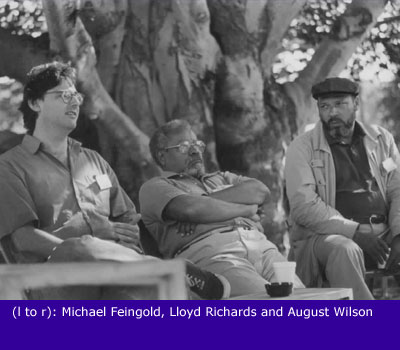
After You've Gone: The O'Neill Center Blues
Since the late Lloyd Richards left the Eugene O'Neill Center, its centerpiece--the National Playwrights Conference--just hasn't been the same. Partly, one assumes, the turmoil is due to funding setbacks that were already taking a toll in 1991, when I spent a couple of weeks there. And partly it now seems to me because the people running it have lost Lloyd Richards' vision.
This is about the time of year that the conference happens. It's four weeks in July, when a dozen or more playwrights would work with professional directors, dramaturgs, designers and actors, many of them coming up from New York City. (My article about the O'Neill for Smithsonian magazine is reproduced here in somewhat expanded form.)
They've had a couple of artistic directors since Richards' retired, at least one of them leaving under a cloud. Last month--well before Lloyd Richards died--the new artistic director, 31 year old Wendy Goldberg, gave an interview in American Theatre. Her quotes, and some statements in the story which seem to be based on impressions and information the writer got from her, suggests how far the O'Neill has strayed, and for my money, fallen.
For four decades, the O'Neill had a policy of open submissions: anybody could send a script and it would be considered. Without such a policy, it's doubtful that many if not most of the new voices the O'Neill discovered and nurtured would have had a chance, and that seems especially true for its most important discovery: August Wilson.
A few years ago, the new regime tried to change that, and limit submissions to pre-selected playwrights. There was a hue and cry and unsolicited scripts were again considered, though in a narrower time frame, and with conditions that made entering a pretty pricey proposition. Goldberg reinstated open submissions, and though I don't know the exact rules and regs this year, statements that she makes in the interview suggest the situation hasn't really returned to what it was.
"We've had 800 submissions this year, a record amount of plays," Goldberg is quoted as saying. First of all, unless she is judging them by weight, she probably meant "a record number of plays." But even that is simply false, and by quite a lot. There were some 1500 scripts submitted for the 1991 conference, according to Lloyd Richards, and confirmed by others that summer.
There were also 12 playwrights chosen for 1991, although I believe they had previously hosted 14, but budget shortfalls forced both fewer playwrights and an altered schedule--the pre-conference in the spring, during which the playwrights spend a couple of days simply each reading their plays aloud, had to be folded into the summer conference.
But the conference in 2006 will host but eight playwrights, and one of them did not emerge from the regular submissions process. Moreover, this play will be "workshopped" before a scheduled production in Atlanta, something that Richards' resisted. He didn't want the O'Neill to become a venue tied to specific productions elsewhere. The O'Neill was about the playwright and the play, and nothing else.
That clearly is no longer true. Goldberg had done away with the system Richards instituted (and which other places copied) of simple, modular sets and basic production values, and script-in-hand performance, so that playwrights could change things right up to the minute of production, based on what they learned in their creative collaboration with all the others involved. Goldberg says that "each play is different" which is a truism but also signifies the distinct possibility that some plays are going to be favored in light of imminent productions elsewhere.
The critique system Richards set up is also slandered in the article, as some sort of vicious punishment visited upon the victimized playwright. I don't know what they were like in later years, but when I was there, Richards himself made sure these sessions were positive. He spoke before every one of them, about their purpose and how they fit into the larger purpose of the conference.
Through design and through his presence, authority and leadership, Lloyd Richards created a sense of the process as almost sacred, as touching the foundations of theatre and theatrical creativity and collaboration. It's no coincidence that one 1991 actor who did a lot of TV playing cops and criminals (an awful lot of O'Neill actors show up in episodes of Law & Order, a series co-created by an O'Neill playwright) described his participation as "renewing my vows."
The O'Neill was so important to so many people in the theatre, and so treasured, because it was a kind of temporary monastery (with a lot of un-monklike--or nunlike--behavior, to be sure) for the kind of pure creative process that the theatre needs. If it has succumbed to whatever pressures and necessities, or to poor judgment, then theatre will suffer for it, and so will playwrights.
And while a new generation of administrators has every right to their own vision, and certainly a responsibility to respond to today's realities, they might try respecting what made the O'Neill a living legend in world theatre. And the people who created it.
Since the late Lloyd Richards left the Eugene O'Neill Center, its centerpiece--the National Playwrights Conference--just hasn't been the same. Partly, one assumes, the turmoil is due to funding setbacks that were already taking a toll in 1991, when I spent a couple of weeks there. And partly it now seems to me because the people running it have lost Lloyd Richards' vision.
This is about the time of year that the conference happens. It's four weeks in July, when a dozen or more playwrights would work with professional directors, dramaturgs, designers and actors, many of them coming up from New York City. (My article about the O'Neill for Smithsonian magazine is reproduced here in somewhat expanded form.)
They've had a couple of artistic directors since Richards' retired, at least one of them leaving under a cloud. Last month--well before Lloyd Richards died--the new artistic director, 31 year old Wendy Goldberg, gave an interview in American Theatre. Her quotes, and some statements in the story which seem to be based on impressions and information the writer got from her, suggests how far the O'Neill has strayed, and for my money, fallen.
For four decades, the O'Neill had a policy of open submissions: anybody could send a script and it would be considered. Without such a policy, it's doubtful that many if not most of the new voices the O'Neill discovered and nurtured would have had a chance, and that seems especially true for its most important discovery: August Wilson.
A few years ago, the new regime tried to change that, and limit submissions to pre-selected playwrights. There was a hue and cry and unsolicited scripts were again considered, though in a narrower time frame, and with conditions that made entering a pretty pricey proposition. Goldberg reinstated open submissions, and though I don't know the exact rules and regs this year, statements that she makes in the interview suggest the situation hasn't really returned to what it was.
"We've had 800 submissions this year, a record amount of plays," Goldberg is quoted as saying. First of all, unless she is judging them by weight, she probably meant "a record number of plays." But even that is simply false, and by quite a lot. There were some 1500 scripts submitted for the 1991 conference, according to Lloyd Richards, and confirmed by others that summer.
There were also 12 playwrights chosen for 1991, although I believe they had previously hosted 14, but budget shortfalls forced both fewer playwrights and an altered schedule--the pre-conference in the spring, during which the playwrights spend a couple of days simply each reading their plays aloud, had to be folded into the summer conference.
But the conference in 2006 will host but eight playwrights, and one of them did not emerge from the regular submissions process. Moreover, this play will be "workshopped" before a scheduled production in Atlanta, something that Richards' resisted. He didn't want the O'Neill to become a venue tied to specific productions elsewhere. The O'Neill was about the playwright and the play, and nothing else.
That clearly is no longer true. Goldberg had done away with the system Richards instituted (and which other places copied) of simple, modular sets and basic production values, and script-in-hand performance, so that playwrights could change things right up to the minute of production, based on what they learned in their creative collaboration with all the others involved. Goldberg says that "each play is different" which is a truism but also signifies the distinct possibility that some plays are going to be favored in light of imminent productions elsewhere.
The critique system Richards set up is also slandered in the article, as some sort of vicious punishment visited upon the victimized playwright. I don't know what they were like in later years, but when I was there, Richards himself made sure these sessions were positive. He spoke before every one of them, about their purpose and how they fit into the larger purpose of the conference.
Through design and through his presence, authority and leadership, Lloyd Richards created a sense of the process as almost sacred, as touching the foundations of theatre and theatrical creativity and collaboration. It's no coincidence that one 1991 actor who did a lot of TV playing cops and criminals (an awful lot of O'Neill actors show up in episodes of Law & Order, a series co-created by an O'Neill playwright) described his participation as "renewing my vows."
The O'Neill was so important to so many people in the theatre, and so treasured, because it was a kind of temporary monastery (with a lot of un-monklike--or nunlike--behavior, to be sure) for the kind of pure creative process that the theatre needs. If it has succumbed to whatever pressures and necessities, or to poor judgment, then theatre will suffer for it, and so will playwrights.
And while a new generation of administrators has every right to their own vision, and certainly a responsibility to respond to today's realities, they might try respecting what made the O'Neill a living legend in world theatre. And the people who created it.
Sunday, July 02, 2006

R.I. P. Lloyd Richards
I met Lloyd Richards, and though I spent only a few hours talking with him, I observed him over the course of a couple of weeks, and learned a lot about him from others. I didn't know however that our birthdays were one day apart. I found out just now, reading his obituary in the New York Times. He died on June 29, his 87th birthday.
Richards directed the first New York production of Lorraine Hansberry's A Raisin in the Sun in 1957, arguably the first authentic portrayal of African American life on the American stage. It was a classic when I read it in high school in the early 60s. But in his years of directing and discovering and nurturing playwrights of all races, his most important find was August Wilson, a great American playwright, who created the richest and most sustained expression of African American life in the twentieth century.
Only hours ago I opened a box of books one of my sisters sent for my birthday--an August Wilson play, an August Wilson essay, and a book on August Wilson (all from my Amazon Wish List.) Richards was instrumental in Wilson's career, and I met them both on the same day (July 1, a day after my birthday in 1991) at the Eugene O'Neill Center summer playwrights conference, where they had begun working together. It was Richards who picked out the manuscript for "Ma Rainey's Black Bottom" from the thousand or so that came to the O'Neill, brought the unknown Pittsburgh playwright to Waterford to work on the play, and then mounted its first productions at Yale and in New York.
Lloyd Richards was the heart and soul of the O'Neill, so important to many American playwrights. He transformed it into a community concentrating on honing and freeing new voices in theatre. He was utterly respected by everyone, for his discipline and gentleness, his rigor and humor, his attentiveness to detail and insistence on communicating the big picture, so everyone knew and shared the same vision of the O'Neill process. It hasn't been the same since he retired from being its artistic director.August Wilson died last year, and so the two giants of African American theatre are gone.
And to think just minutes ago I was ordering the last play I haven't read (apart from the one I just got) in Wilson's titanic ten play cycle, one for each decade of the twentieth century. That cycle is a truly stunning achievement, and Richards was part of getting many of those plays to their staged versions. I was looking forward to reading them all in the order of decades. Then minutes later I happened to read this. Of course, it's not as shocking as August Wilson's death at age 61. But it is another indication of an era passing. These two men have left such an incredible legacy to America and theatre everywhere.
I met Lloyd Richards, and though I spent only a few hours talking with him, I observed him over the course of a couple of weeks, and learned a lot about him from others. I didn't know however that our birthdays were one day apart. I found out just now, reading his obituary in the New York Times. He died on June 29, his 87th birthday.
Richards directed the first New York production of Lorraine Hansberry's A Raisin in the Sun in 1957, arguably the first authentic portrayal of African American life on the American stage. It was a classic when I read it in high school in the early 60s. But in his years of directing and discovering and nurturing playwrights of all races, his most important find was August Wilson, a great American playwright, who created the richest and most sustained expression of African American life in the twentieth century.
Only hours ago I opened a box of books one of my sisters sent for my birthday--an August Wilson play, an August Wilson essay, and a book on August Wilson (all from my Amazon Wish List.) Richards was instrumental in Wilson's career, and I met them both on the same day (July 1, a day after my birthday in 1991) at the Eugene O'Neill Center summer playwrights conference, where they had begun working together. It was Richards who picked out the manuscript for "Ma Rainey's Black Bottom" from the thousand or so that came to the O'Neill, brought the unknown Pittsburgh playwright to Waterford to work on the play, and then mounted its first productions at Yale and in New York.
Lloyd Richards was the heart and soul of the O'Neill, so important to many American playwrights. He transformed it into a community concentrating on honing and freeing new voices in theatre. He was utterly respected by everyone, for his discipline and gentleness, his rigor and humor, his attentiveness to detail and insistence on communicating the big picture, so everyone knew and shared the same vision of the O'Neill process. It hasn't been the same since he retired from being its artistic director.August Wilson died last year, and so the two giants of African American theatre are gone.
And to think just minutes ago I was ordering the last play I haven't read (apart from the one I just got) in Wilson's titanic ten play cycle, one for each decade of the twentieth century. That cycle is a truly stunning achievement, and Richards was part of getting many of those plays to their staged versions. I was looking forward to reading them all in the order of decades. Then minutes later I happened to read this. Of course, it's not as shocking as August Wilson's death at age 61. But it is another indication of an era passing. These two men have left such an incredible legacy to America and theatre everywhere.
Thursday, April 27, 2006

The Man Who Loved Movies
This post is personal reminicence, inspired by an issue of the alumni magazine of Knox College, where I was an undergraduate. And if you've arrived here from the Knox site, welcome. This particular site has become a more personal one over the past few years, though it's more about personal obsessions than a day-in-the-life.
For those who were at Knox when I was, you might be interested in a couple of other sites I've just started: 60s Now and the Boomer Hall of Fame.
I post on current events affecting the future on Captain Future's Dreaming Up Daily. If you took astronomy with me, and happen to recall my Captain Space hat, you won't be surprised at that title, nor my Soul of Star Trek blog.
And if you'd like to catch up on my past published writing, some of my favorite magazine and newspaper pieces are at Kowincidence. Now, forward to the past.
I was pleased to see Jay Matson on the cover of Knox Magazine, and to read of the Alumni Achievement Awards to David Axelrod and Bill Barnhart.
Though he identifies himself as a philosophy major, Jay Matson was known on campus foremost as a poet, at least by his senior year, when I was a freshman. We were all in awe of him---his quiet, brooding figure defined “the poet” for me. When Mary Jacobson (who I essentially---or was it existentially?-- adored) told me that my writing had been singled out as promising (for a freshman) by Jay Matson, I felt I had something to live up to.
Then I recall visiting his farmhouse several years later, where a water pipe had burst from the cold, and several rooms were virtual skating rinks. I didn’t see him on my visit to Galesburg in the early 1980s, but I did write about his success transforming historic downtown buildings in my book, The Malling of America.
As the editor of the Knox Student, Bill Barnhart honed his journalistic skills in a tumultuous time on and off campus, and he also had to deal with several unruly columnists, like Skip Peterson, Mark Brooks, Kevin Cameron (unless he was gone already), and me: wild men all.
But the person I want to acknowledge most is David Axelrod. David ran the Cinema Club, which I believe was his invention as well. He chose, booked and exhibited foreign films, pretty much monthly as I recall. This may not sound like a big deal now, but consider this: at the time there were few film courses anywhere in American colleges, and none at Knox (I believe the first at Knox was a filmmaking course given by Richard Alexander of the English department in 1967 or so.) Only a few small theatres in major cities showed foreign films at all (and of course this was before video stores and cable TV.) Movies in general were still considered disposable entertainment.
So beginning with my freshman year, I bought the little card that entitled me to see these movies with strange titles, identified as well by the magic names of the directors: Bergman, Fellini, Godard, Antonioni, Truffaut, Kurosawa… I used to read the titles and names and try to imagine what the movie would be like. When I went to them, sitting in the darkness and staring at these strange apparitions of light, I understood very little of what I saw that first year. But gradually I absorbed their vocabulary, and by the time David graduated, I was a film buff for life.
Although my screenwriting efforts got me no further than an entertaining Hollywood lunch with a William Morris agent (our waitress had been a stand-in for Lillian Gish, who she still resembled), and writing and even directing a few videos for clients, I did wind up writing a lot about film, for various periodicals. This not only involved seeing hundreds of movies but doing interviews on Hollywood sets and on one occasion, spending an hour talking with Francois Truffaut, and exchanging letters afterwards. (I even told him about the scene in which he and Godard—his friend and later New Wave rival—have a shootout, in the last play I wrote and directed at Knox. He laughed.)
The resulting article was in Rolling Stone, called "The Man Who Loved Movies." He liked it, and a piece I did on the (now lost) art of double features, which mentioned a pairing of two of his films. Both of them are reproduced over at kowincidence. (Which was a name given to me, by the way, by the ineffably beautiful Mary Jacobson. (I can see her cringing at my word choice.) I used it for the name of my temporary band for my one and only rock and roll record. But that's another story. )
I’m pretty certain I saw Truffaut’s “Shoot the Piano Player” at Cinema Club, probably my first Truffaut film. I just watched the DVD of it last week, with commentary by Annette Indsdorf, Columbia film professor. I met Annette when she was Truffaut’s translator for his U.S. retrospectives in 1979. Just another link in my life that began with the Cinema Club.
With his dark hair falling in his eyes, David was a personality and a presence at Knox. His off campus apartment featured a homemade reproduction of a Modrian painting (“Broadway Boogie-Woogie”)? rendered with colored tape, as assembled by the rapturously lovely Judee Settipani. I remember him as not saying a lot, and saying it softly (not like some of us loudmouths) but after due consideration, making it count.
I remember some of his pronouncements to this day, and not all of them about film, though this one was: he pointed out to me that the world is not black and white, so black and white movies are inherently abstract. It’s a basic concept now, but at the time it was profoundly new, at least to me, and especially impressive because it seemed to be an insight he’d reached on his own.
The only times I’ve seen him since Knox were in movie theatres: once in Chicago, and once in the mid 1970s at the Orson Welles Cinema in Cambridge, MA. (Actually I ran into him in the adjoining restaurant.) At the time I was practically living at the Orson Welles. I was seeing at least 10 to 20 films a week; once I saw 10 movies in one day. I may be an extreme example, but I’m sure there are others whose lives were enriched by what David Axelrod began, as a student at Knox.
UPDATE: If you're interested in David's more recent activities, his web site is, strangely enough, davidaxelrod.com. Which isn't the no-brainer it might seem to be, because there are lots of David Axelrods out there in cyberspace. So I figure he had to be pretty quick to get that url.
This post is personal reminicence, inspired by an issue of the alumni magazine of Knox College, where I was an undergraduate. And if you've arrived here from the Knox site, welcome. This particular site has become a more personal one over the past few years, though it's more about personal obsessions than a day-in-the-life.
For those who were at Knox when I was, you might be interested in a couple of other sites I've just started: 60s Now and the Boomer Hall of Fame.
I post on current events affecting the future on Captain Future's Dreaming Up Daily. If you took astronomy with me, and happen to recall my Captain Space hat, you won't be surprised at that title, nor my Soul of Star Trek blog.
And if you'd like to catch up on my past published writing, some of my favorite magazine and newspaper pieces are at Kowincidence. Now, forward to the past.
I was pleased to see Jay Matson on the cover of Knox Magazine, and to read of the Alumni Achievement Awards to David Axelrod and Bill Barnhart.
Though he identifies himself as a philosophy major, Jay Matson was known on campus foremost as a poet, at least by his senior year, when I was a freshman. We were all in awe of him---his quiet, brooding figure defined “the poet” for me. When Mary Jacobson (who I essentially---or was it existentially?-- adored) told me that my writing had been singled out as promising (for a freshman) by Jay Matson, I felt I had something to live up to.
Then I recall visiting his farmhouse several years later, where a water pipe had burst from the cold, and several rooms were virtual skating rinks. I didn’t see him on my visit to Galesburg in the early 1980s, but I did write about his success transforming historic downtown buildings in my book, The Malling of America.
As the editor of the Knox Student, Bill Barnhart honed his journalistic skills in a tumultuous time on and off campus, and he also had to deal with several unruly columnists, like Skip Peterson, Mark Brooks, Kevin Cameron (unless he was gone already), and me: wild men all.
But the person I want to acknowledge most is David Axelrod. David ran the Cinema Club, which I believe was his invention as well. He chose, booked and exhibited foreign films, pretty much monthly as I recall. This may not sound like a big deal now, but consider this: at the time there were few film courses anywhere in American colleges, and none at Knox (I believe the first at Knox was a filmmaking course given by Richard Alexander of the English department in 1967 or so.) Only a few small theatres in major cities showed foreign films at all (and of course this was before video stores and cable TV.) Movies in general were still considered disposable entertainment.
So beginning with my freshman year, I bought the little card that entitled me to see these movies with strange titles, identified as well by the magic names of the directors: Bergman, Fellini, Godard, Antonioni, Truffaut, Kurosawa… I used to read the titles and names and try to imagine what the movie would be like. When I went to them, sitting in the darkness and staring at these strange apparitions of light, I understood very little of what I saw that first year. But gradually I absorbed their vocabulary, and by the time David graduated, I was a film buff for life.
Although my screenwriting efforts got me no further than an entertaining Hollywood lunch with a William Morris agent (our waitress had been a stand-in for Lillian Gish, who she still resembled), and writing and even directing a few videos for clients, I did wind up writing a lot about film, for various periodicals. This not only involved seeing hundreds of movies but doing interviews on Hollywood sets and on one occasion, spending an hour talking with Francois Truffaut, and exchanging letters afterwards. (I even told him about the scene in which he and Godard—his friend and later New Wave rival—have a shootout, in the last play I wrote and directed at Knox. He laughed.)
The resulting article was in Rolling Stone, called "The Man Who Loved Movies." He liked it, and a piece I did on the (now lost) art of double features, which mentioned a pairing of two of his films. Both of them are reproduced over at kowincidence. (Which was a name given to me, by the way, by the ineffably beautiful Mary Jacobson. (I can see her cringing at my word choice.) I used it for the name of my temporary band for my one and only rock and roll record. But that's another story. )
I’m pretty certain I saw Truffaut’s “Shoot the Piano Player” at Cinema Club, probably my first Truffaut film. I just watched the DVD of it last week, with commentary by Annette Indsdorf, Columbia film professor. I met Annette when she was Truffaut’s translator for his U.S. retrospectives in 1979. Just another link in my life that began with the Cinema Club.
With his dark hair falling in his eyes, David was a personality and a presence at Knox. His off campus apartment featured a homemade reproduction of a Modrian painting (“Broadway Boogie-Woogie”)? rendered with colored tape, as assembled by the rapturously lovely Judee Settipani. I remember him as not saying a lot, and saying it softly (not like some of us loudmouths) but after due consideration, making it count.
I remember some of his pronouncements to this day, and not all of them about film, though this one was: he pointed out to me that the world is not black and white, so black and white movies are inherently abstract. It’s a basic concept now, but at the time it was profoundly new, at least to me, and especially impressive because it seemed to be an insight he’d reached on his own.
The only times I’ve seen him since Knox were in movie theatres: once in Chicago, and once in the mid 1970s at the Orson Welles Cinema in Cambridge, MA. (Actually I ran into him in the adjoining restaurant.) At the time I was practically living at the Orson Welles. I was seeing at least 10 to 20 films a week; once I saw 10 movies in one day. I may be an extreme example, but I’m sure there are others whose lives were enriched by what David Axelrod began, as a student at Knox.
UPDATE: If you're interested in David's more recent activities, his web site is, strangely enough, davidaxelrod.com. Which isn't the no-brainer it might seem to be, because there are lots of David Axelrods out there in cyberspace. So I figure he had to be pretty quick to get that url.
Subscribe to:
Posts (Atom)