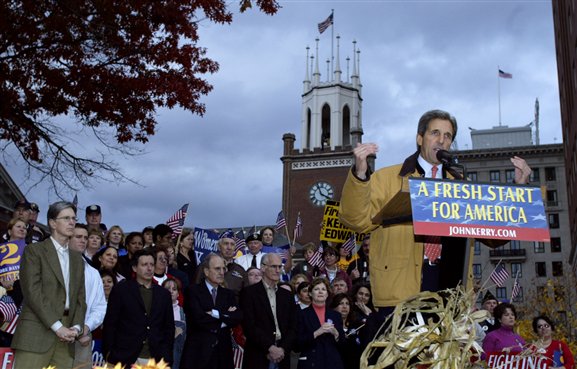
I've recently confirmed that my memo on why the Kerry campaign should adopt the slogan, "A Fresh Start," was forwarded to the upper echelons of the Kerry campaign by a person of importance known to them, in June. More than that I don't know yet, but I'm intrigued. My high level contact has promised to find out more.
The reason I bring this up is---well, check out the Kerry photo below.
Showing posts with label John Kerry. Show all posts
Showing posts with label John Kerry. Show all posts
Friday, November 26, 2004

Monday, November 15, 2004

Friday, November 05, 2004
These are post-election notes relevant to the election day post which follows.
After a hopeful weekend, a frenzy of election day activity, and even a first flurry of very promising exit poll numbers, everything slowly fell apart. David Gergen, counsel to Republican and one Democratic president, commented as the hoped-for Kerry victory was slipping away, that his university students were going to be devastated, they would not be able to understand this.
How could they understand it when it doesn't make any sense? Beyond that recognition is the intensity of effort and commitment many of them gave. Young people worked for Kerry and voted for Kerry in record numbers. In Ohio, some stood in line for up to ten hours just to cast their votes.
I got an email from a young Kerry activist in California that is well worth quoting. I won't name her because I haven't yet solicited her permission, but this was an email sent to a number of Kerry supporters. Read it in conjunction with the story that follows.
I feel like I’ve been punched in the chest. Like I did after September 11th. Like I did when my mother died.But it’s not because of any self absorbed pity for us having put so much blood sweat and tears into this campaign. It’s because John Kerry should be President of the United States. And America will realize that only when it’s too late. John Kerry is a man of integrity, grace, strength and maturity. He embodies the America of my dreams and distant memories.
I was honored and deeply transformed by participating in the massive mobilization to get this man elected. I was also honored and deeply transformed by working with, and getting to know and love all of you, my compatriots. Your dedication, humor, professionalism and goodness reassures me that this nation cannot and will not suffer for long. She will once again be a beacon to all who want to be shown the light. But it is up to us.
I truly believe that in order to see our vision for this country realized, we must stay unified, energized, organized and positive. There is much work to do both locally and nationally, politically and culturally, physically and spiritually.
Take the month to mourn, rest and regroup. Spend Thanksgiving truly giving thanks for a fight well fought, and a man worth fighting for.Then, I invite all of you to join me as we look to the future and begin that work. We here in Southern California will keep our structure, though we will shift our focus. To those elsewhere, please keep in touch, let me know how you are staying engaged. What groups you recommend, people you believe in that may need support as they run for office, issues and news that needs to be investigated and exposed. Help communicate our values and reframe the debate with those who have been misled by a political and media machinery that is broken and needs to be replaced. Continue to give of your talent, time, money and networks so the foundation upon which we stand will be the only dry, solid, high ground left when the flood comes. Thank you again, and God bless us all.
After a hopeful weekend, a frenzy of election day activity, and even a first flurry of very promising exit poll numbers, everything slowly fell apart. David Gergen, counsel to Republican and one Democratic president, commented as the hoped-for Kerry victory was slipping away, that his university students were going to be devastated, they would not be able to understand this.
How could they understand it when it doesn't make any sense? Beyond that recognition is the intensity of effort and commitment many of them gave. Young people worked for Kerry and voted for Kerry in record numbers. In Ohio, some stood in line for up to ten hours just to cast their votes.
I got an email from a young Kerry activist in California that is well worth quoting. I won't name her because I haven't yet solicited her permission, but this was an email sent to a number of Kerry supporters. Read it in conjunction with the story that follows.
I feel like I’ve been punched in the chest. Like I did after September 11th. Like I did when my mother died.But it’s not because of any self absorbed pity for us having put so much blood sweat and tears into this campaign. It’s because John Kerry should be President of the United States. And America will realize that only when it’s too late. John Kerry is a man of integrity, grace, strength and maturity. He embodies the America of my dreams and distant memories.
I was honored and deeply transformed by participating in the massive mobilization to get this man elected. I was also honored and deeply transformed by working with, and getting to know and love all of you, my compatriots. Your dedication, humor, professionalism and goodness reassures me that this nation cannot and will not suffer for long. She will once again be a beacon to all who want to be shown the light. But it is up to us.
I truly believe that in order to see our vision for this country realized, we must stay unified, energized, organized and positive. There is much work to do both locally and nationally, politically and culturally, physically and spiritually.
Take the month to mourn, rest and regroup. Spend Thanksgiving truly giving thanks for a fight well fought, and a man worth fighting for.Then, I invite all of you to join me as we look to the future and begin that work. We here in Southern California will keep our structure, though we will shift our focus. To those elsewhere, please keep in touch, let me know how you are staying engaged. What groups you recommend, people you believe in that may need support as they run for office, issues and news that needs to be investigated and exposed. Help communicate our values and reframe the debate with those who have been misled by a political and media machinery that is broken and needs to be replaced. Continue to give of your talent, time, money and networks so the foundation upon which we stand will be the only dry, solid, high ground left when the flood comes. Thank you again, and God bless us all.
Tuesday, November 02, 2004
The Future of Hope
We get hope in various ways from various places, inside and outside, in good times and bad. But there's often learning involved, and models. Something that we've seen work in the real world, and someone we could observe in some way, if even from a distance, and perhaps if even through a glass too brightly.
I'm reminded of this because in my meager campaigning efforts, I made some calls to swing states through the Kerry "phone corps" organized on the campaign website. I talked to a woman in Florida (I think it was), whose fifteen year old son was on the volunteer list, and my call to him hadn't been the first. She was a Kerry activist herself, and her son was involved in a political campaign for the first time, though she seemed to feel he wasn't ready for canvassing and phone banking activities. But John Kerry had sparked his interest.
I was fourteen when I got involved in my first political campaign, for John F. Kennedy. It was in a way the last of the old fashioned campaigns, and the first of the new media-dominated ones. I participated in what would be the last election eve campaign parade for many years in Greensburg, Pa. I imagine they've revived them now. John Edwards was speaking there yesterday.
It wasn't called a swing state in 1960. Greensburg was a pretty reliably Republican town inside a heavily Democratic county and region. We lived outside the city limits, in Democrat country. Unions were powerful, and though the tiny city hall was Republican, the big county courthouse was Democrat.
Now I'm out here in California, in a town where there are five Green candidates for city council, one of them named Harmony Groves, another Phoenix Fyre; three unaffiliated, one Democrat, and no Republicans. California was the key to Kennedy’s election, but this year nobody has even visited, certainly not in this little town. We're not a swing state. My sleepy little hometown of Greensburg was one of the first stops for John Kerry and John Edwards after Edwards was selected as the v.p. candidate.
But I know that in Greensburg now, as in Florida now and in Greensburg then, some young people are focusing their hopes on John Kerry, even as they are learning to define what they hope for. If he wins, as JFK did, they will be invested in learning even more. For instance, how to make their hopes happen. And what happens to hopes as they meet the present.
My hope is that they get that chance this time. The 1960 campaign was really formative for me, as was the thousand days of JFK's presidency. It happened to coincide with my experiences in high school forensics, in the system of extemp speaking and debating in competitions. I learned quite a bit from those experiences in those few years.
So in honor of all that, and in hopes that things will turn out well for John Kerry, I want to reproduce a column I wrote for the In Pittsburgh weekly in 1988, about those hopes on an election night when they were cut short.
Young Hearts
For awhile, there was hope. As the sky darkened to dusk beyond the glass wall of the Dukakis headquarters in Chatham Center [Pittsburgh], staffers started hearing about heavy turnouts and early strength in the key states.
The news sent another pulse of energy through the last hours of effort, as staffers collecting numbers from key precincts dispatched their troops---many of them college, high school and junior high students---to where they were most needed. Some volunteers had been up all night hanging leaflets on doors that said "Good morning! Vote Today/Dukakis-Bentsen." They'd been on the phones at the United Steelworkers phone bank, or canvassing and passing out flyers, knocking on doors and stopping people on the street, or simply standing at major intersections waving signs at passing cars. They returned for new instructions to this temporary office, where the message boxes for staffers were white Styrofoam cups tacked to a room divider. They picked at the wilting cold cuts and the pasta salad in the makeshift kitchen, then grabbed their maps and headed out again. For most of them, this was their first campaign.
I was fourteen when John F. Kennedy ran for President. That was my first campaign. I learned about primaries when he ran in Wisconsin; I learned poverty's name when he ran in West Virginia. I thrilled to my first roll-call of the states as I watched the 1960 Democratic Convention, and I taped his acceptance speech on a clunky cut-rate reel-to-reel: "But the New Frontier of which I speak is not a set of promises----it is a set of challenges. It sums up, not what I intend to offer to the American people, but what I intend to ask of them. It appeals to their pride, not their pocketbook---it holds out the promise of more sacrifice instead of more security..." This was the speech that Vice-President Nixon thought was over the heads of the American people.
I went to the local "Citizens for Kennedy" headquarters. The director there may have been the first adult in the public world to take me seriously. He gave me a copy of Kennedy's book, "The Strategy of Peace," which I still have. I handed campaign literature to strangers outside supermarkets and on the street. Once my two best friends and I were sent by bus to a nearby town, Kennedy posters affixed to our persons, front and back, and we stuck leaflets in doors in the pouring rain. I'd read those pamphlets---I was prepared to discuss the issues with anyone. I'm sure we won a few votes---we were so young and enthusiastic, and so completely devoted. And so soaking wet.
Around 8:30 pm, the young Dukakis volunteers began returning from the polls and streamed into the Hyatt ballroom, under the big banner that said, "The Best America is Yet To Come." By then the staffers already knew the score, and their eyes had that peculiar shining---part tears, part defiant excitement. I asked Peg McCormick, the western Pennsylvania campaign director and CMU professor, what effect a Bush victory might have on the young. "If I were sixteen years old and George Bush was President, I wouldn't have excitement about the future---and that's what this is all about, it's the future, it's for them."
I asked the same question of Margaret-Anne McKibben, who teaches some of these high school students. "It could be emotionally devastating," she said. "It's like first love. You believe it with all your heart. And that's why these kinds are here---they really care. They believed that if you work hard, it'll happen. And all these young hearts---they really did work hard."
I stayed up all night to watch the election returns, because it all came down to California. After a few hours sleep, I awoke in mid-morning to watch JFK read, in a voice thick with a morning cold, Nixon's concession telegram. My candidate had won. I had relatives in Washington and I took my first long bus trip alone to visit them on Inaugural weekend. We watched the parade on Friday, toured the monuments on Saturday, and on Sunday we went to the Georgetown church where JFK was known (by me) to go. We lucked out. We sat several pews behind him, and on his way out, the brand new President of the United States---my President---shook my hand.
When I was 15 I knew the names of everyone in the Kennedy cabinet (with a little time, I can recite them still.) I knew his speeches, filled with allusions to philosophers and statesmen; speeches about courage, commitment and moral responsibility, challenging the country to look beyond their immediate present to the future they created with every decision they made. I watched his press conferences, filled with fact and wit. I knew details of his programs---the minimum wage increase, the Peace Corps, the Alliance for Progress in Latin America---and I followed his battles with a reluctant Congress. I learned about the many facets of leadership, as I learned about the world. The next time I was in Washington was for the great Civil Rights march, but I never thought of this as opposing him. He understood dissent. He was my President. I imitated him in my extemp speeches. I played touch football, and learned to like Boston clam chowder, and to aspire to be educated and seek after greatness.
I was 16 when I watched the world almost end in the Cuban Missile Crisis. (When we came back to homeroom one day, someone had drawn a big mushroom cloud on the blackboard, ha ha.) I read and listened to everything about those events, and learned about decision-making, about strategy and the interplay of personalities, and about different kinds of strength. Then came the nuclear test ban treaty, and I learned what the presidency could be as a force for good, from a President who was so obviously learning and expanding his horizons every day, as I was.
I was 17 when my President was shot to death in Dallas. Kennedy had appealed to our youth with his sense of urgency, and held out to us the opportunity to make a difference, to move forward and not just fight to keep from slipping back; to get at what he always called the unfinished business of America. That sense of urgency filled those three years, the only three years in my conscious lifetime when I looked to a President for leadership. Then the man he defeated for his party's nomination became President and escalated the Vietnam war; then the man he had defeated in the general election became President and prolonged it, and lied and cheated and subverted the Constitution. The nightmare had begun.
That was 25 years ago, as a spate of television documentaries will remind us this month, interspersed with the dopey grin of George Bush, a President-elect whose campaign makes him impossible for me to respect; and the vice-president-elect of the United States of America, Dan Quayle. To me, the history of the presidency since JFK has been a prolonged insult, a black comedy, a tragedy of the absurd, starring twisted or ineffective men.
Even several of the Dukakis staffers from out of state were very young, just out of college. Reagan had been President for more than a third of their lives. Vibrant, intelligent and eager, they've never had a President to emulate, to respect. But there was no overwhelming pall of gloom in the ballroom as the networks made their fatal projections. It wasn't like Boston in 1972, when McGovern workers sat stunned in front of TV monitors, and the ballroom was empty and as quiet as a tomb. The Dukakis kids ran to the TV sets in the four corners of the room to cheer the good news they got, including the fruits of their own efforts: a 120,000 vote plurality in Allegheny County. They talked about catching up on sleep and laundry, and took snapshots of each other, and cherished the bonds they'd made and the feelings that only those who have fought together know. They found what strength and hope they could in each other.
But still...two college students watched Lloyd Bentsen speak to his supporters in Texas. "Mike Dukakis and I waged a campaign that's worthy of the American people," Bentsen said. "Too bad the American people weren't worthy of the campaign," one of them said. "The American people suck," said the other. This was their first campaign. The first one (she's a freshman) said it will be her last. The second (a junior) said she'll be back.
At one point, when Teddy Kennedy was being interviewed, I turned and looked at those who were watching the TV---there was something special in the eyes of the older ones. They remembered.
The young campaigners listened to comments from the podium by Peg McCormick, and County Comissioner Pete Flaherty, and United Steelworkers President Lynn Williams, all of whom took pains to tell them of the progress and the contribution they'd made, and gently urged them not to be discouraged. And when the ballroom became quiet and everyone clustered in the four corners to hear Mike Dukakis make his concession speech from Boston, he also singled out his young supporters, and urged them to realize the satisfaction of working to help others and---a specific Kennedy echo---of making a contribution. He called politics " a noble profession." In Boston, the crowd started chanting, "92!" In the ballroom here, a young voice shouted, "Don't give up!"
When Mike and Kitty Dukakis disappeared from the screen, Kenny Blake's band played again, and the young staffers and volunteers clustered together and hugged and said goodbye. Then they danced. And then the music stopped.
* * * *
Now the young Lieutenant Governor in the Dukakis administration is the repository of the hopes of young hearts like those in 1988 and 1960. Our hope is that as a result of their efforts, the music won't stop so soon. It'll still be playing on Inauguration Day.
We get hope in various ways from various places, inside and outside, in good times and bad. But there's often learning involved, and models. Something that we've seen work in the real world, and someone we could observe in some way, if even from a distance, and perhaps if even through a glass too brightly.
I'm reminded of this because in my meager campaigning efforts, I made some calls to swing states through the Kerry "phone corps" organized on the campaign website. I talked to a woman in Florida (I think it was), whose fifteen year old son was on the volunteer list, and my call to him hadn't been the first. She was a Kerry activist herself, and her son was involved in a political campaign for the first time, though she seemed to feel he wasn't ready for canvassing and phone banking activities. But John Kerry had sparked his interest.
I was fourteen when I got involved in my first political campaign, for John F. Kennedy. It was in a way the last of the old fashioned campaigns, and the first of the new media-dominated ones. I participated in what would be the last election eve campaign parade for many years in Greensburg, Pa. I imagine they've revived them now. John Edwards was speaking there yesterday.
It wasn't called a swing state in 1960. Greensburg was a pretty reliably Republican town inside a heavily Democratic county and region. We lived outside the city limits, in Democrat country. Unions were powerful, and though the tiny city hall was Republican, the big county courthouse was Democrat.
Now I'm out here in California, in a town where there are five Green candidates for city council, one of them named Harmony Groves, another Phoenix Fyre; three unaffiliated, one Democrat, and no Republicans. California was the key to Kennedy’s election, but this year nobody has even visited, certainly not in this little town. We're not a swing state. My sleepy little hometown of Greensburg was one of the first stops for John Kerry and John Edwards after Edwards was selected as the v.p. candidate.
But I know that in Greensburg now, as in Florida now and in Greensburg then, some young people are focusing their hopes on John Kerry, even as they are learning to define what they hope for. If he wins, as JFK did, they will be invested in learning even more. For instance, how to make their hopes happen. And what happens to hopes as they meet the present.
My hope is that they get that chance this time. The 1960 campaign was really formative for me, as was the thousand days of JFK's presidency. It happened to coincide with my experiences in high school forensics, in the system of extemp speaking and debating in competitions. I learned quite a bit from those experiences in those few years.
So in honor of all that, and in hopes that things will turn out well for John Kerry, I want to reproduce a column I wrote for the In Pittsburgh weekly in 1988, about those hopes on an election night when they were cut short.
Young Hearts
For awhile, there was hope. As the sky darkened to dusk beyond the glass wall of the Dukakis headquarters in Chatham Center [Pittsburgh], staffers started hearing about heavy turnouts and early strength in the key states.
The news sent another pulse of energy through the last hours of effort, as staffers collecting numbers from key precincts dispatched their troops---many of them college, high school and junior high students---to where they were most needed. Some volunteers had been up all night hanging leaflets on doors that said "Good morning! Vote Today/Dukakis-Bentsen." They'd been on the phones at the United Steelworkers phone bank, or canvassing and passing out flyers, knocking on doors and stopping people on the street, or simply standing at major intersections waving signs at passing cars. They returned for new instructions to this temporary office, where the message boxes for staffers were white Styrofoam cups tacked to a room divider. They picked at the wilting cold cuts and the pasta salad in the makeshift kitchen, then grabbed their maps and headed out again. For most of them, this was their first campaign.
I was fourteen when John F. Kennedy ran for President. That was my first campaign. I learned about primaries when he ran in Wisconsin; I learned poverty's name when he ran in West Virginia. I thrilled to my first roll-call of the states as I watched the 1960 Democratic Convention, and I taped his acceptance speech on a clunky cut-rate reel-to-reel: "But the New Frontier of which I speak is not a set of promises----it is a set of challenges. It sums up, not what I intend to offer to the American people, but what I intend to ask of them. It appeals to their pride, not their pocketbook---it holds out the promise of more sacrifice instead of more security..." This was the speech that Vice-President Nixon thought was over the heads of the American people.
I went to the local "Citizens for Kennedy" headquarters. The director there may have been the first adult in the public world to take me seriously. He gave me a copy of Kennedy's book, "The Strategy of Peace," which I still have. I handed campaign literature to strangers outside supermarkets and on the street. Once my two best friends and I were sent by bus to a nearby town, Kennedy posters affixed to our persons, front and back, and we stuck leaflets in doors in the pouring rain. I'd read those pamphlets---I was prepared to discuss the issues with anyone. I'm sure we won a few votes---we were so young and enthusiastic, and so completely devoted. And so soaking wet.
Around 8:30 pm, the young Dukakis volunteers began returning from the polls and streamed into the Hyatt ballroom, under the big banner that said, "The Best America is Yet To Come." By then the staffers already knew the score, and their eyes had that peculiar shining---part tears, part defiant excitement. I asked Peg McCormick, the western Pennsylvania campaign director and CMU professor, what effect a Bush victory might have on the young. "If I were sixteen years old and George Bush was President, I wouldn't have excitement about the future---and that's what this is all about, it's the future, it's for them."
I asked the same question of Margaret-Anne McKibben, who teaches some of these high school students. "It could be emotionally devastating," she said. "It's like first love. You believe it with all your heart. And that's why these kinds are here---they really care. They believed that if you work hard, it'll happen. And all these young hearts---they really did work hard."
I stayed up all night to watch the election returns, because it all came down to California. After a few hours sleep, I awoke in mid-morning to watch JFK read, in a voice thick with a morning cold, Nixon's concession telegram. My candidate had won. I had relatives in Washington and I took my first long bus trip alone to visit them on Inaugural weekend. We watched the parade on Friday, toured the monuments on Saturday, and on Sunday we went to the Georgetown church where JFK was known (by me) to go. We lucked out. We sat several pews behind him, and on his way out, the brand new President of the United States---my President---shook my hand.
When I was 15 I knew the names of everyone in the Kennedy cabinet (with a little time, I can recite them still.) I knew his speeches, filled with allusions to philosophers and statesmen; speeches about courage, commitment and moral responsibility, challenging the country to look beyond their immediate present to the future they created with every decision they made. I watched his press conferences, filled with fact and wit. I knew details of his programs---the minimum wage increase, the Peace Corps, the Alliance for Progress in Latin America---and I followed his battles with a reluctant Congress. I learned about the many facets of leadership, as I learned about the world. The next time I was in Washington was for the great Civil Rights march, but I never thought of this as opposing him. He understood dissent. He was my President. I imitated him in my extemp speeches. I played touch football, and learned to like Boston clam chowder, and to aspire to be educated and seek after greatness.
I was 16 when I watched the world almost end in the Cuban Missile Crisis. (When we came back to homeroom one day, someone had drawn a big mushroom cloud on the blackboard, ha ha.) I read and listened to everything about those events, and learned about decision-making, about strategy and the interplay of personalities, and about different kinds of strength. Then came the nuclear test ban treaty, and I learned what the presidency could be as a force for good, from a President who was so obviously learning and expanding his horizons every day, as I was.
I was 17 when my President was shot to death in Dallas. Kennedy had appealed to our youth with his sense of urgency, and held out to us the opportunity to make a difference, to move forward and not just fight to keep from slipping back; to get at what he always called the unfinished business of America. That sense of urgency filled those three years, the only three years in my conscious lifetime when I looked to a President for leadership. Then the man he defeated for his party's nomination became President and escalated the Vietnam war; then the man he had defeated in the general election became President and prolonged it, and lied and cheated and subverted the Constitution. The nightmare had begun.
That was 25 years ago, as a spate of television documentaries will remind us this month, interspersed with the dopey grin of George Bush, a President-elect whose campaign makes him impossible for me to respect; and the vice-president-elect of the United States of America, Dan Quayle. To me, the history of the presidency since JFK has been a prolonged insult, a black comedy, a tragedy of the absurd, starring twisted or ineffective men.
Even several of the Dukakis staffers from out of state were very young, just out of college. Reagan had been President for more than a third of their lives. Vibrant, intelligent and eager, they've never had a President to emulate, to respect. But there was no overwhelming pall of gloom in the ballroom as the networks made their fatal projections. It wasn't like Boston in 1972, when McGovern workers sat stunned in front of TV monitors, and the ballroom was empty and as quiet as a tomb. The Dukakis kids ran to the TV sets in the four corners of the room to cheer the good news they got, including the fruits of their own efforts: a 120,000 vote plurality in Allegheny County. They talked about catching up on sleep and laundry, and took snapshots of each other, and cherished the bonds they'd made and the feelings that only those who have fought together know. They found what strength and hope they could in each other.
But still...two college students watched Lloyd Bentsen speak to his supporters in Texas. "Mike Dukakis and I waged a campaign that's worthy of the American people," Bentsen said. "Too bad the American people weren't worthy of the campaign," one of them said. "The American people suck," said the other. This was their first campaign. The first one (she's a freshman) said it will be her last. The second (a junior) said she'll be back.
At one point, when Teddy Kennedy was being interviewed, I turned and looked at those who were watching the TV---there was something special in the eyes of the older ones. They remembered.
The young campaigners listened to comments from the podium by Peg McCormick, and County Comissioner Pete Flaherty, and United Steelworkers President Lynn Williams, all of whom took pains to tell them of the progress and the contribution they'd made, and gently urged them not to be discouraged. And when the ballroom became quiet and everyone clustered in the four corners to hear Mike Dukakis make his concession speech from Boston, he also singled out his young supporters, and urged them to realize the satisfaction of working to help others and---a specific Kennedy echo---of making a contribution. He called politics " a noble profession." In Boston, the crowd started chanting, "92!" In the ballroom here, a young voice shouted, "Don't give up!"
When Mike and Kitty Dukakis disappeared from the screen, Kenny Blake's band played again, and the young staffers and volunteers clustered together and hugged and said goodbye. Then they danced. And then the music stopped.
* * * *
Now the young Lieutenant Governor in the Dukakis administration is the repository of the hopes of young hearts like those in 1988 and 1960. Our hope is that as a result of their efforts, the music won't stop so soon. It'll still be playing on Inauguration Day.
Monday, July 26, 2004
Why I'm Not There
I watched my first Democratic convention on television in the summer of 1960. I was 14, an age for heroes, and I had one: John F. Kennedy. It was an exciting convention, in the conventional sense: the outcome was in doubt. Kennedy had won the most primaries, but not enough to assure him the nomination. There was powerful opposition from the party elders: none other than Eleanor Roosevelt and Harry Truman included. They favored their two-time loser, Adlai Stevenson. Kennedy was too young, and his Catholicism was the unspoken fatal flaw. By the night of the voting, the Huntley-Brinkley and Walter Cronkite conventional wisdom was that if Kennedy didn't win on the first ballot, he might not win at all. So the first roll call of the states I ever saw was one of high drama as well as high theatricality. While reporters tried to keep up with Robert Kennedy's visits to key delegations, Kennedy did win on the first ballot.
Conventions since then haven't had that kind of contest, although they had plenty of drama in 64, 68 and 72. Except for 1968, when my candidate was dead and I was outside the Chicago hall in spirit and for a couple of nights, in fact, I always enjoyed watching the conventions on TV. I liked the speeches, the hoopla, the roll call of the states, the celebrations. I projected myself inside them, fantasized being part of them. But though I labored to one degree or another in various presidential primary and general election campaigns, I'd never been to a convention. So you'd think if I ever had the chance, I'd take it.
My chance came, as chances often do, as a surprise, or a series of surprises and accidents. About a year before the 04 campaigning actually started I had coffee with a new friend I'd met during the 2000 election campaign, who was soon to become the chair of the Humboldt County Democratic party executive committee. We talked about possible 2004 candidates and I mentioned John Kerry. It was the first he'd heard of him as a possible candidate.
By the by, a couple of summers ago when I was in Washington, eating the very good pasta cooked for us by the former Chief of Staff to Bill Clinton-and former classmate of mine at Knox College---John Podesta, I ventured to suggest that John Kerry might be the 04 candidate. Podesta thought not.
Anyway, as the California primary came closer, I responded to a meet-up invitation for Kerry here in Arcata. It was a very small gathering. There was my friend from the Dems, who'd become a Kerry enthusiast, and a few others. This is Green country, and Democratic activists tended to favor Dean and Dennis the K. The party wasn't terribly interested in the presidential primary, since Kerry seemed to have the nomination nearly locked up, and the chances of Bush winning California depended on the Democrats nominating, say, Osama bin Laden. So I found myself one of the few people willing to actively support the candidate most likely to win the nomination.
Brian Mau, my Dem friend (also known as Chairman Mau) had to find someone to speak for Kerry at a university forum, and at the county Democratic convention. As Chairman Mau, he couldn't do it. So I did, as I've described in an earlier entry. He also needed people to run as Kerry delegates to the convention. Only one other person was willing to do this, so I said I would, too, just so there would be Kerry delegates.
This delegate election turned out to be almost as private an affair as our meet-ups. But there were actually two elections to poll registered Democrats who showed up: one up here in northern Humboldt, and one in the southern part of the county. I believe there were slots available for two men, three women, and one male alternate. Everyone up here voted for the two of us who were there, and everybody down there voted for their folks. They however had more people at their polling place. If I had invited a friend or two, I would have won, but even in this odd arrangement, I was elected as the alternate.
I almost didn't run at all---for as I was filling out the form, very close to the end it mentioned that the delegate would be responsible for his or her own convention expenses, including transport and housing, and that this would be about $1500. However, delegates could raise funds from others to pay their way. $1500 is a major chunk of change for me these days. But I figured I'd cross that bridge when I came to it.
Having been unreliably informed that as an alternate, I wouldn't be going to the convention anyway, I relaxed. It was only much later that I learned I was not only eligible, I was expected to attend. And that $1500 figure turned out to be an estimate from some prior century. It was likely to be double that.
By that time I'd made several commitments for work that was actually going to earn me something, and that looked like it would take me through July to accomplish. It seemed to be what they call a no-brainer, which usually means an obvious practical decision based on balance sheet figures.
Still, I put off a final decision until I was getting so many emails and phone calls from the state and national Dems and the Kerry campaign that I had to commit one way or another. By that time I was deep into this work. I had a moment of enthusiasm about going to the convention, of realizing it was a once in a lifetime opportunity, and even that because I knew Boston and knew some people who might put me up, the expenses could be cut down considerably. But then all the noise about security and traffic, and security checks on delegates. And all the emails I was getting that cast being a delegate as being a fund-raiser. I don't actually know who the delegates are, but it seemed they were either fund-raising types, or members of unions and other organizations who were footing the bill for their attendance. (Politicians and officeholders have their own delegate slots.) And I can't say I felt a whole lot of encouragement to throw caution to the winds and go.
So I had to actually resign as a delegate, and thanks to the layers of organization involved, I had to do it at least twice. It was a bummer. I had a day of very gloomy second thoughts about it. What was I thinking? I thought. So what if I wasn't a typical delegate---I am a writer, I could write about it, right? When I was younger there wouldn't have been any hesitation. I would be off on the adventure. Now I thought about the physical demands: the travel east, jet-lag, the T to the convention, the standing around, the foot-miles in the city, etc. Even from a career point of view---I'd meet more and different people than I will sitting at home. What's wrong with me?
Then the mail started coming. I have a shopping bag full of it: from Americans for Democratic Action, Yankee the Magazine of New England Living, the Democratic Party Visa Platinum Card, the Mayor of Boston, American Association of Registered Nurses, Planned Parenthood, Greater Boston Convention and Visitors Bureau, Senators Dianne Feinstein, Barbara Boxer and Edward Kennedy, Southern California Edison, National Democratic Ethnic Leadership Council, etc. etc., with invitations to cocktail parties, receptions, galas, breakfasts and a No Carb Lunch. As flattered as I might be, I somehow couldn’t believe I’d make much of a lasting impression.
Now that the convention is about to begin, I am only slightly uncomfortable. I realize that I could have combined a sentimental journey back to Boston and Cambridge and the Italian North End with witnessing some unique moments---Hillary and Bill Clinton, Edwards, the most important speech of John Kerry's life so far, plus all those balloons. And maybe if things had happened a bit differently---if I'd realized sooner that I was eligible to go and maybe found some support or at least thought about it more, if I hadn't happened to get more work this summer than I've had in many months, etc. When I was most upset about not going was when I was most upset with myself for letting the environment dull my sense of possibility and adventure, the lack of an echo chamber for my enthusiasms keep me from even considering them as legitimate.
But this didn't last long. Maybe it's just ego to recoil from the given role as delegate cog, assumed fund-raiser, with no voice except to say hooray. Or maybe I'm giving into my introversion, combining it with the age-related reluctance to push physical limits for vague purposes, and coming up with timidity. I do know one thing: I felt it would be lonely. In a city where I once belonged but do no longer, peopled by ghosts, and by people who no longer would take my calls. I would be a member of the California delegation---none of whom I know or who know me-- and of nothing else. I have nothing to offer lobbyists except explanations for why they ought not waste their time lobbying me. It would be noisy, frenetic and filled with people. Not everybody's definition of lonely, I admit, but for me it's not necessarily a contradiction.
There will be thousands of people writing about this convention, and if they are anything like the commentators on TV, they will be largely saying the same things. I don't think they need me there to add either to the noise or to the silence (since it's unlikely I'd get published anywhere but here.) I'll watch the speeches on TV, mostly on C-Span, where they won't be background noise for perky analysts chatter. I'll watch the roll call of the states, I guess. But if I don't want to watch it all, I can do something else. I suppose I can't really explain why I'm not there. Maybe it's as simple as being of the age to view resources---of money, energy, time and emotional resilience---as having limits. Or let's just say I didn't feel finally that it was my fate to be there. I have responsibilities here, and they are real. Though not all of them are very important in any greater sense, they are personal to me, while my presence was not required in Boston except as a body to fill a folding chair. I hope they got somebody to fill it who can clap loud and yell continuously for hours. That's the job, after all.
I watched my first Democratic convention on television in the summer of 1960. I was 14, an age for heroes, and I had one: John F. Kennedy. It was an exciting convention, in the conventional sense: the outcome was in doubt. Kennedy had won the most primaries, but not enough to assure him the nomination. There was powerful opposition from the party elders: none other than Eleanor Roosevelt and Harry Truman included. They favored their two-time loser, Adlai Stevenson. Kennedy was too young, and his Catholicism was the unspoken fatal flaw. By the night of the voting, the Huntley-Brinkley and Walter Cronkite conventional wisdom was that if Kennedy didn't win on the first ballot, he might not win at all. So the first roll call of the states I ever saw was one of high drama as well as high theatricality. While reporters tried to keep up with Robert Kennedy's visits to key delegations, Kennedy did win on the first ballot.
Conventions since then haven't had that kind of contest, although they had plenty of drama in 64, 68 and 72. Except for 1968, when my candidate was dead and I was outside the Chicago hall in spirit and for a couple of nights, in fact, I always enjoyed watching the conventions on TV. I liked the speeches, the hoopla, the roll call of the states, the celebrations. I projected myself inside them, fantasized being part of them. But though I labored to one degree or another in various presidential primary and general election campaigns, I'd never been to a convention. So you'd think if I ever had the chance, I'd take it.
My chance came, as chances often do, as a surprise, or a series of surprises and accidents. About a year before the 04 campaigning actually started I had coffee with a new friend I'd met during the 2000 election campaign, who was soon to become the chair of the Humboldt County Democratic party executive committee. We talked about possible 2004 candidates and I mentioned John Kerry. It was the first he'd heard of him as a possible candidate.
By the by, a couple of summers ago when I was in Washington, eating the very good pasta cooked for us by the former Chief of Staff to Bill Clinton-and former classmate of mine at Knox College---John Podesta, I ventured to suggest that John Kerry might be the 04 candidate. Podesta thought not.
Anyway, as the California primary came closer, I responded to a meet-up invitation for Kerry here in Arcata. It was a very small gathering. There was my friend from the Dems, who'd become a Kerry enthusiast, and a few others. This is Green country, and Democratic activists tended to favor Dean and Dennis the K. The party wasn't terribly interested in the presidential primary, since Kerry seemed to have the nomination nearly locked up, and the chances of Bush winning California depended on the Democrats nominating, say, Osama bin Laden. So I found myself one of the few people willing to actively support the candidate most likely to win the nomination.
Brian Mau, my Dem friend (also known as Chairman Mau) had to find someone to speak for Kerry at a university forum, and at the county Democratic convention. As Chairman Mau, he couldn't do it. So I did, as I've described in an earlier entry. He also needed people to run as Kerry delegates to the convention. Only one other person was willing to do this, so I said I would, too, just so there would be Kerry delegates.
This delegate election turned out to be almost as private an affair as our meet-ups. But there were actually two elections to poll registered Democrats who showed up: one up here in northern Humboldt, and one in the southern part of the county. I believe there were slots available for two men, three women, and one male alternate. Everyone up here voted for the two of us who were there, and everybody down there voted for their folks. They however had more people at their polling place. If I had invited a friend or two, I would have won, but even in this odd arrangement, I was elected as the alternate.
I almost didn't run at all---for as I was filling out the form, very close to the end it mentioned that the delegate would be responsible for his or her own convention expenses, including transport and housing, and that this would be about $1500. However, delegates could raise funds from others to pay their way. $1500 is a major chunk of change for me these days. But I figured I'd cross that bridge when I came to it.
Having been unreliably informed that as an alternate, I wouldn't be going to the convention anyway, I relaxed. It was only much later that I learned I was not only eligible, I was expected to attend. And that $1500 figure turned out to be an estimate from some prior century. It was likely to be double that.
By that time I'd made several commitments for work that was actually going to earn me something, and that looked like it would take me through July to accomplish. It seemed to be what they call a no-brainer, which usually means an obvious practical decision based on balance sheet figures.
Still, I put off a final decision until I was getting so many emails and phone calls from the state and national Dems and the Kerry campaign that I had to commit one way or another. By that time I was deep into this work. I had a moment of enthusiasm about going to the convention, of realizing it was a once in a lifetime opportunity, and even that because I knew Boston and knew some people who might put me up, the expenses could be cut down considerably. But then all the noise about security and traffic, and security checks on delegates. And all the emails I was getting that cast being a delegate as being a fund-raiser. I don't actually know who the delegates are, but it seemed they were either fund-raising types, or members of unions and other organizations who were footing the bill for their attendance. (Politicians and officeholders have their own delegate slots.) And I can't say I felt a whole lot of encouragement to throw caution to the winds and go.
So I had to actually resign as a delegate, and thanks to the layers of organization involved, I had to do it at least twice. It was a bummer. I had a day of very gloomy second thoughts about it. What was I thinking? I thought. So what if I wasn't a typical delegate---I am a writer, I could write about it, right? When I was younger there wouldn't have been any hesitation. I would be off on the adventure. Now I thought about the physical demands: the travel east, jet-lag, the T to the convention, the standing around, the foot-miles in the city, etc. Even from a career point of view---I'd meet more and different people than I will sitting at home. What's wrong with me?
Then the mail started coming. I have a shopping bag full of it: from Americans for Democratic Action, Yankee the Magazine of New England Living, the Democratic Party Visa Platinum Card, the Mayor of Boston, American Association of Registered Nurses, Planned Parenthood, Greater Boston Convention and Visitors Bureau, Senators Dianne Feinstein, Barbara Boxer and Edward Kennedy, Southern California Edison, National Democratic Ethnic Leadership Council, etc. etc., with invitations to cocktail parties, receptions, galas, breakfasts and a No Carb Lunch. As flattered as I might be, I somehow couldn’t believe I’d make much of a lasting impression.
Now that the convention is about to begin, I am only slightly uncomfortable. I realize that I could have combined a sentimental journey back to Boston and Cambridge and the Italian North End with witnessing some unique moments---Hillary and Bill Clinton, Edwards, the most important speech of John Kerry's life so far, plus all those balloons. And maybe if things had happened a bit differently---if I'd realized sooner that I was eligible to go and maybe found some support or at least thought about it more, if I hadn't happened to get more work this summer than I've had in many months, etc. When I was most upset about not going was when I was most upset with myself for letting the environment dull my sense of possibility and adventure, the lack of an echo chamber for my enthusiasms keep me from even considering them as legitimate.
But this didn't last long. Maybe it's just ego to recoil from the given role as delegate cog, assumed fund-raiser, with no voice except to say hooray. Or maybe I'm giving into my introversion, combining it with the age-related reluctance to push physical limits for vague purposes, and coming up with timidity. I do know one thing: I felt it would be lonely. In a city where I once belonged but do no longer, peopled by ghosts, and by people who no longer would take my calls. I would be a member of the California delegation---none of whom I know or who know me-- and of nothing else. I have nothing to offer lobbyists except explanations for why they ought not waste their time lobbying me. It would be noisy, frenetic and filled with people. Not everybody's definition of lonely, I admit, but for me it's not necessarily a contradiction.
There will be thousands of people writing about this convention, and if they are anything like the commentators on TV, they will be largely saying the same things. I don't think they need me there to add either to the noise or to the silence (since it's unlikely I'd get published anywhere but here.) I'll watch the speeches on TV, mostly on C-Span, where they won't be background noise for perky analysts chatter. I'll watch the roll call of the states, I guess. But if I don't want to watch it all, I can do something else. I suppose I can't really explain why I'm not there. Maybe it's as simple as being of the age to view resources---of money, energy, time and emotional resilience---as having limits. Or let's just say I didn't feel finally that it was my fate to be there. I have responsibilities here, and they are real. Though not all of them are very important in any greater sense, they are personal to me, while my presence was not required in Boston except as a body to fill a folding chair. I hope they got somebody to fill it who can clap loud and yell continuously for hours. That's the job, after all.
Monday, February 16, 2004
Why I Support John Kerry
It's been awhile since I've written a political speech. It took some time to get back into the rhythm but eventually I had a good time doing it---and delivering it. The last line is adapted from a Kerry line that I first heard him use to end his Iowa acceptance speech. (I was interested to see that it wasn't in the prepared text.) He used it again in Virginia last Tuesday. The fact that "giving America back its future, and its soul" happens to echo the title of my long awaited project, Soul of the Future (well, I'm certainly awaiting it) has absolutely no bearing on my support for John Kerry. Almost absolutely.
Why I Support John Kerry
Delivered to Humboldt County Democrats
February 15, 2004
I am pleased to speak to you today about why I support John Kerry.
From Arizona to Maine, from New Mexico to North Dakota to Tennessee, from Michigan to Missouri, Democrats in record numbers have spoken in one clear voice.
They listened to the candidates, and they liked what they heard, but from the Iowa caucuses to the Virginia primary last Tuesday and the Nevada caucuses yesterday, they made their choice, and their choice is John Kerry. Over and over they said, we like these new ideas and all this passion, but we're choosing a candidate who has the ideas, who has the passion, but he also has the experience and the knowledge and the character to do what needs to be done. We choose John Kerry.
They said we want a candidate with a proven record of making hard choices, of fiscal responsibility, with practical ideas for growing a sustainable forward-looking economy that benefits all Americans. We want a candidate who has a record in the U.S. Senate of supporting small business, of fighting for American jobs, for social justice, international cooperation, the environment, equal rights and a woman's right to choose. We choose John Kerry.
They said we want a candidate who understands fairness and understands strength. So we choose John Kerry, who as a mill town county prosecutor put the #2 Mob Boss in New England behind bars, and as a defense attorney worked hard to prove the innocence of a man convicted for a crime he didn't commit.
They said the war in Iraq was a tragic mistake but we know we live in a dangerous world, so we choose John Kerry the war hero with the Silver Star and the Bronze Star who risked his life under fire to save others, and we choose John Kerry the anti-war hero who as spokesperson for the Vietnam Veterans against the war was so feared by the Republican administration that he made it onto Nixon's enemies list, and whose leadership in the Senate against the shameful war in Nicaragua exposed Oliver North.
Voters looked at John Kerry and saw this combination of sanity and savvy and strength, and they chose him because they know it's all needed for a President to protect us and lead our foreign policy, to fight effectively against powerful corporations for jobs and health care and the environment. But they also saw that strength would be needed in the coming battle to defeat George W. Bush. For we all know what kind of campaigners these Republicans are. We know they're going to spends hundreds of millions on scurrilous attack ads, they're going to distort every Senate vote and policy conversation, they will be try to convince the American people there's a Willie Horton under every bed, and a Saddam Hussein in every closet. We all know the shameless lies and easy slander that pours out of the sewers of talk radio. This year the Democrats need a fighter, somebody who knows who he is and knows what he's doing, and won't back down.
But the voters in the primaries suggest the possibility that this year, all Americans will no longer be willing victims of the same old weapons of mass distraction. That they too will focus on the issues that really matter. We want a President we can trust, who will right this ship of state before it takes us all down.
In 1841 Emerson said humanity is divided between the party of hope and the party of memory. In the 2004 election, America must decide between the party of hope and the party of fear. And make no mistake-we will be hearing a lot from the other side in the coming months about what we must fear. But it is as true now as it was when Franklin Roosevelt said it---the only thing we have to fear is fear itself. We cannot allow fear to triumph, or hope will be a memory.
What has this administration of fear given us? Loss of constitutional freedoms that we've always fought to defend. A war born of arrogance, over the urgent threat of weapons that the UN and other international agencies warned did not exist, and a war begun with lies, when the president broke his promises to the U.S. Senate to let inspectors finish their work, and not to use force without the international community. Without a realistic plan, the Bush administration committed the United States to a horribly costly occupation of Iraq, which so far has only led to more violence, terrorism and death. America believed its president, and America was betrayed.
What else has the administration of fear given us? We saw a five trillion dollar federal surplus left to the nation by those free-spending Democrats turn into a five trillion dollar federal deficit in the blink of an eye, and what did we get for it? A health care system that covers all Americans? New infrastructure in our states and cities? New schools, better teacher pay, decent wages for the people we depend on most-nurses, childcare and eldercare workers, emergency medical personnel? New investments in creating jobs and helping families? Did we even get adequate funding for firefighters and police to carry out their new responsibilities for homeland security?
We got none of that. Instead we got a tax cut for the already obscenely wealthy, pork barrel for pharmaceutical industries, schools in Iraq but not in Ukiah, new jobs in Jakarta but not in Eureka, comfort for senior partners but not senior citizens, everything that Wall Street wants and nothing that Main Street needs.
In 2000, too many of us sat on the sidelines, or demanded purity and perfection, or succumbed to a folksy smile because it didn't really matter who won. Well, it did matter. Instead of joining the world to confront the climate crisis, we're back fighting to keep oil rigs out of the Alaskan wilderness. Instead of building the digital economy, America is bleeding jobs. Instead of securing Social Security and Medicare, and dealing with the health care crisis, this administration has pillaged the future, not just of those who will soon reach retirement age, but of those who have not yet reached pre-school age. Instead of getting at the roots of terrorism, we're off securing oil fields for Halliburton at the cost of American and Iraqi blood, and our future and our sacred honor.
Yes, the election of 2000 mattered. And that's why the election of 2004 matters even more.
And that's why the voters in the Democratic primaries -and 40% of them in New Hampshire were Independents---have spoken with that one strong voice. They've listened to good men and women with good ideas, candidates of great heart and great vision, including some who will be the future of the Democratic party. Perhaps they've also listened to the ideas and candidates of other progressive parties, who may also contribute to the future. But this year their voices were united in a great cry, that to save the future we must change the present, we can't afford to wait.
Back when Franklin Roosevelt was elected president, he gathered his advisors to figure out how to fight the Great Depression. Some of them called only for long-term measures to bolster the economy. But then FDR's chief advisor, Harry Hopkins spoke up. He said, "Mr. President, people don't eat in the long term. They eat every day."
And in 2004, 44 million Americans are without health insurance, 18,000 die every year because they have no health insurance-we don't need health care in the long term, we need health care as a right not a privilege for the wealthy few---we need it every day, we need it now. Eight million Americans who want to work can't find a job-we need jobs now. The richest nation in the history of the world has 35 million people in poverty---we need to deal with that now. Our cities and counties and our states are in crisis, we don't need to keep our schools open and our police on the street in the long term-we need to do it now.
And above all we can't wait to get rid of George W. Bush and Dick Cheney and John Ashcroft and Donald Rumsfeld in four more years, we need to get rid of them this November. It's time to send this trigger-happy, photo-op-governing, double-talking, supreme court-appointed bush league president back to the ranch.
To defeat George W. Bush now, to begin a new era for America now, voters in the west, the east, the north and the south have chosen John Kerry, voters in Wisconsin will choose John Kerry on Tuesday, voters on March 2 will choose John Kerry in New York, Ohio, Minnesota, Maryland, Rhode Island and in California… This is our time, to join our voices to the one strong voice of these primaries that is already echoing around the world---it's our turn to join John Kerry's campaign to give America back its future, to give America back its soul.
It's been awhile since I've written a political speech. It took some time to get back into the rhythm but eventually I had a good time doing it---and delivering it. The last line is adapted from a Kerry line that I first heard him use to end his Iowa acceptance speech. (I was interested to see that it wasn't in the prepared text.) He used it again in Virginia last Tuesday. The fact that "giving America back its future, and its soul" happens to echo the title of my long awaited project, Soul of the Future (well, I'm certainly awaiting it) has absolutely no bearing on my support for John Kerry. Almost absolutely.
Why I Support John Kerry
Delivered to Humboldt County Democrats
February 15, 2004
I am pleased to speak to you today about why I support John Kerry.
From Arizona to Maine, from New Mexico to North Dakota to Tennessee, from Michigan to Missouri, Democrats in record numbers have spoken in one clear voice.
They listened to the candidates, and they liked what they heard, but from the Iowa caucuses to the Virginia primary last Tuesday and the Nevada caucuses yesterday, they made their choice, and their choice is John Kerry. Over and over they said, we like these new ideas and all this passion, but we're choosing a candidate who has the ideas, who has the passion, but he also has the experience and the knowledge and the character to do what needs to be done. We choose John Kerry.
They said we want a candidate with a proven record of making hard choices, of fiscal responsibility, with practical ideas for growing a sustainable forward-looking economy that benefits all Americans. We want a candidate who has a record in the U.S. Senate of supporting small business, of fighting for American jobs, for social justice, international cooperation, the environment, equal rights and a woman's right to choose. We choose John Kerry.
They said we want a candidate who understands fairness and understands strength. So we choose John Kerry, who as a mill town county prosecutor put the #2 Mob Boss in New England behind bars, and as a defense attorney worked hard to prove the innocence of a man convicted for a crime he didn't commit.
They said the war in Iraq was a tragic mistake but we know we live in a dangerous world, so we choose John Kerry the war hero with the Silver Star and the Bronze Star who risked his life under fire to save others, and we choose John Kerry the anti-war hero who as spokesperson for the Vietnam Veterans against the war was so feared by the Republican administration that he made it onto Nixon's enemies list, and whose leadership in the Senate against the shameful war in Nicaragua exposed Oliver North.
Voters looked at John Kerry and saw this combination of sanity and savvy and strength, and they chose him because they know it's all needed for a President to protect us and lead our foreign policy, to fight effectively against powerful corporations for jobs and health care and the environment. But they also saw that strength would be needed in the coming battle to defeat George W. Bush. For we all know what kind of campaigners these Republicans are. We know they're going to spends hundreds of millions on scurrilous attack ads, they're going to distort every Senate vote and policy conversation, they will be try to convince the American people there's a Willie Horton under every bed, and a Saddam Hussein in every closet. We all know the shameless lies and easy slander that pours out of the sewers of talk radio. This year the Democrats need a fighter, somebody who knows who he is and knows what he's doing, and won't back down.
But the voters in the primaries suggest the possibility that this year, all Americans will no longer be willing victims of the same old weapons of mass distraction. That they too will focus on the issues that really matter. We want a President we can trust, who will right this ship of state before it takes us all down.
In 1841 Emerson said humanity is divided between the party of hope and the party of memory. In the 2004 election, America must decide between the party of hope and the party of fear. And make no mistake-we will be hearing a lot from the other side in the coming months about what we must fear. But it is as true now as it was when Franklin Roosevelt said it---the only thing we have to fear is fear itself. We cannot allow fear to triumph, or hope will be a memory.
What has this administration of fear given us? Loss of constitutional freedoms that we've always fought to defend. A war born of arrogance, over the urgent threat of weapons that the UN and other international agencies warned did not exist, and a war begun with lies, when the president broke his promises to the U.S. Senate to let inspectors finish their work, and not to use force without the international community. Without a realistic plan, the Bush administration committed the United States to a horribly costly occupation of Iraq, which so far has only led to more violence, terrorism and death. America believed its president, and America was betrayed.
What else has the administration of fear given us? We saw a five trillion dollar federal surplus left to the nation by those free-spending Democrats turn into a five trillion dollar federal deficit in the blink of an eye, and what did we get for it? A health care system that covers all Americans? New infrastructure in our states and cities? New schools, better teacher pay, decent wages for the people we depend on most-nurses, childcare and eldercare workers, emergency medical personnel? New investments in creating jobs and helping families? Did we even get adequate funding for firefighters and police to carry out their new responsibilities for homeland security?
We got none of that. Instead we got a tax cut for the already obscenely wealthy, pork barrel for pharmaceutical industries, schools in Iraq but not in Ukiah, new jobs in Jakarta but not in Eureka, comfort for senior partners but not senior citizens, everything that Wall Street wants and nothing that Main Street needs.
In 2000, too many of us sat on the sidelines, or demanded purity and perfection, or succumbed to a folksy smile because it didn't really matter who won. Well, it did matter. Instead of joining the world to confront the climate crisis, we're back fighting to keep oil rigs out of the Alaskan wilderness. Instead of building the digital economy, America is bleeding jobs. Instead of securing Social Security and Medicare, and dealing with the health care crisis, this administration has pillaged the future, not just of those who will soon reach retirement age, but of those who have not yet reached pre-school age. Instead of getting at the roots of terrorism, we're off securing oil fields for Halliburton at the cost of American and Iraqi blood, and our future and our sacred honor.
Yes, the election of 2000 mattered. And that's why the election of 2004 matters even more.
And that's why the voters in the Democratic primaries -and 40% of them in New Hampshire were Independents---have spoken with that one strong voice. They've listened to good men and women with good ideas, candidates of great heart and great vision, including some who will be the future of the Democratic party. Perhaps they've also listened to the ideas and candidates of other progressive parties, who may also contribute to the future. But this year their voices were united in a great cry, that to save the future we must change the present, we can't afford to wait.
Back when Franklin Roosevelt was elected president, he gathered his advisors to figure out how to fight the Great Depression. Some of them called only for long-term measures to bolster the economy. But then FDR's chief advisor, Harry Hopkins spoke up. He said, "Mr. President, people don't eat in the long term. They eat every day."
And in 2004, 44 million Americans are without health insurance, 18,000 die every year because they have no health insurance-we don't need health care in the long term, we need health care as a right not a privilege for the wealthy few---we need it every day, we need it now. Eight million Americans who want to work can't find a job-we need jobs now. The richest nation in the history of the world has 35 million people in poverty---we need to deal with that now. Our cities and counties and our states are in crisis, we don't need to keep our schools open and our police on the street in the long term-we need to do it now.
And above all we can't wait to get rid of George W. Bush and Dick Cheney and John Ashcroft and Donald Rumsfeld in four more years, we need to get rid of them this November. It's time to send this trigger-happy, photo-op-governing, double-talking, supreme court-appointed bush league president back to the ranch.
To defeat George W. Bush now, to begin a new era for America now, voters in the west, the east, the north and the south have chosen John Kerry, voters in Wisconsin will choose John Kerry on Tuesday, voters on March 2 will choose John Kerry in New York, Ohio, Minnesota, Maryland, Rhode Island and in California… This is our time, to join our voices to the one strong voice of these primaries that is already echoing around the world---it's our turn to join John Kerry's campaign to give America back its future, to give America back its soul.
Monday, February 09, 2004
The President of Projection
This column---mmm, blog I mean--- usually defers politics to the gonzo literati at American Samizat these days, but in the process of making myself available for a backstage role as I usually do at presidential campaign time, I find myself thrust a bit forward, though on a very small stage. Partly because John Kerry's surge in the Democratic pre-nominating contests has been so swift and so complete, he's has no organization in this isolated corner of California. So when I showed for a John Kerry meet-up, I became part of a small core group, and on two occasions (one past, one coming up) the only one available and foolhardy enough to speak for the candidate in public.
Today I found myself on a platform with an actual presidential candidate, though he was a local but prominent candidate for the Green Party nomination. A Democrat like Kerry is more likely to get attacked from the left than the right in this neck of the woods (unless such a candidate actually went into the woods where logging was occurring.) So my remarks and rejoinders took a different trajectory than they normally would elsewhere, especially in this election year. My central argument hasn't changed much since 2000, actually: that I believe in progressive causes, long-term thinking, new ideas, demonstrations and other non-violent actions to advocate and to keep officeholders accountable, and I love the openness and the give and take of the Primary process, but when it comes election time, I become a member of the hiring committee looking at two resumes. One of these two is going to get the job of President. More often than not, I've found the Democratic candidate to represent my beliefs sufficiently, and I've trusted that candidate to be a decent President, while I've found the Republican candidate to be a mortal threat to civilization and (as the Klingons would say) without honor. As they have so often turned out to be, I might add.
This year is different only in the number of candidates in the primaries I could have cheerfully supported (even apart from their supreme virtue in not being G.W. Bush) and the fact that the one of them who is going to be the nominee, John Kerry, is so utterly right for the moment. So my support is definitely not "lesser-of-two-evilism" (as the Green candidate dubbed it.) Kerry's presidency could transform this country at the moment it needs it the most, and I frankly am astonished at our good luck so far.
But the point of this column (and by that of course I mean blog) is not to praise John Kerry or recapitulate my remarks of today (nor rehearse my remarks for next Sunday's county Democratic convention) but to offer a few meandering thoughts about how people seem to view the presidency, and how that might influence their voting behavior.
It's said that George Washington fled the presidency because he was afraid people were going to try to make him king. The pomp and circumstance of royalty is powerful even in a democracy (powerful enough that our chief teenage rite of passage is the prom, and we insist on royal treatment for our major transitions of marriage and funeral.) But there is also the deep history of kings as mystical figures. The king as personification of the nation is only part of it. Their blood gives them the divine right to rule because kings had direct connection to God, the first proof of which was that the crops grew. If they didn't, the king was killed. Later that practice was amended so the king could substitute a fool, a kind of scapegoat, in his place for the ritual sacrifice.
Later the one King became identified with the one God. And so as Alan Watts said, "In the United States we are in a serious social and political conflict because we think we ought to be living in a republic when the great majority of citizens believe the universe is a monarchy."
Today pomp and circumstance has been augmented by celebrity, and the mystical identification enhanced by the enormous power the president of the U.S. represents. So mix all this together and you've got a powerful if bewildering and contradictory set of expectations, on all kinds of levels.
I began to see all this is a particular way during the first days of the Clinton administration. Partly that had to do with it being Clinton, a Democrat who came along not a moment too soon after 12 years of Republican destruction; and especially that he was almost exactly my age (In fact, I am six weeks older) and roughly the age of my contemporaries. And partly it had to do with some new conceptual tools I acquired or let's say adapted from C.G. Jung, at about the same time.
That Clinton was our age made identifying with him to some degree pretty natural. It was interesting to note how differently it played out. I think it made all of us reevaluate our lives, and not too cheerfully, since he was President and we weren't. But it really bothered some men my age, including some far more successful than I. Some of them realized it, but I think a lot did not. They were hostile to Clinton without quite knowing why. But if you listened to them, you knew why, basically.
This comparison kind of identification is more broadly a kind of projection, which is one of those conceptual tools. Many people projected their expectations onto Clinton, not because he was our age but because he was our President. He was supposed to represent and fulfill our hopes and dreams, in every way, all the time. I began noticing it so much that I began calling him the President of Projection.
It seems true of any president. But why? Another tool came in handy to answer that. This part may be a bit offensive, though (if you aren't offended already.) I've been something of an amateur political junkie for many years. But I know that most people don't follow politics or statecraft, or what got to be called the "policy wonk" stuff (also in the Clinton years.) (In previous years we just called it "government" or "issues.") Yet everyone has opinions, and if they don't, they'll make one up when asked by an acquaintance or a pollster.
Jung's theory of functions says we each have predominant ways of perceiving things. Besides being more extraverted or more introverted, we primarily favor our thinking, feeling (or evaluating), sensation or intuition. During our lives we develop that function to be quite sophisticated and discriminating. Often we develop a second and sometimes a third function. But almost never the fourth. And that "inferior" function becomes our Achilles heel when it finally becomes activated, because we react very strongly, and even with great certainty, yet our perceptions aren't very sophisticated and we are prone to make huge errors. The classic example is the plot of "The Blue Angel." The professor (the thinking man) who falls in love with a beautiful woman (through his sensations) and makes a complete fool of himself, and destroys his life. Thanks to his powerful sensations, he can't think straight. He couldn't have been fooled by a weak argument, but he couldn't tell he was being used by a woman he felt was the love of his life. Another example is Daisy Buchanan's husband in The Great Gatsby, a former athlete, apparently a sensation type but definitely not a thinker, who talks enthusiastically about a book that "scientifically proves" the white race is superior. He is taken in through his inferior function of thinking.
How I applied this to politics is perhaps a little roundabout (since it doesn't apply to the functions directly) but it makes sense to me. The basic insight that does apply is that we're apt to get hooked and suddenly most strongly about subjects we aren't used to dealing with, that we aren't sophisticated about.
People feel very strongly, but their feelings lead them to indiscriminate conclusions, because they haven't developed their powers of perceiving the reality of political situations. Now that doesn't mean people who don't read political journals are therefore going to be wrong about a candidate or an issue. Nor does it mean that people who follow every Senate vote or blip in the polls are capable of seeing the forest for the trees. It just explains to me how people can have such strong feelings about things they admittedly don't know much about. It's a combination of this inferior function idea, and the idea of projection. The President is supposed to be perfect, and when he's not, we're devastated.
This possibly accounts for some of the predisposition of people to have the same knee-jerk reactions when their "hot buttons" are pushed. Republicans have made a living on this for over 20 years, by labeling every Democrat they don't like as liberal soft on crime perpetrators of class warfare, who hate America, don't share "our" values, and will leave America defenseless. Not to mention bleeding heart baby killers who won't let kids pray. Who want to raise your taxes (even though they say they just want to put back the taxes on the wealthy Bush took away.)
On the other side, at primary time some left of center voters in Democratic primaries have been ready to turn up their noses at anyone who doesn't emphasize the exact issue they care about the most, or who don't talk like Noam Chomsky and Ralph Nader on the stump. I think it's possible to support a candidate you don't agree with 100%, and even if you believe Chomsky and Nader, maybe a candidate who has been a Senator or Governor or both for a few decades and has talked to professional pols, scholars and scientists, and voters from every walk of life and leaders from other nations and cultures, might know a thing or two they don't.
Then of course sometimes people react to knowing they don't know much about what's going on by throwing up their hands and saying I guess those people know what they're doing. Which can be even worse. But the problem that Democrats usually face at primary time is the nitpicking demand for perfection, and the projection. Picking a candidate is not a bloodless process, of course. It requires some sort of emotional commitment, bond, even identification. But when it becomes unconscious projection, it can become dangerous.
But the early Clinton years also evoked another response from some of my contemporaries. Because they had similar jobs by then---in some sort of executive capacity, say, perhaps even in government, though on a different level and different scale---they understood that just like them, the President had 24 hours in a day, at least some of which had to be devoted to sleep, rest and family. He could not do things by magic. Like them, he had to deal with impossible demands, deadlines, subordinates who screwed up, intrigues, betrayals, bureaucratic bungling, incompetence, vicious rivalries, and ordinary human problems. Not to mention competing priorities, mixed messages, competing and conflicting interests, head colds, and muscle strains from exercising because of sudden weight gain. In other words, they were more forgiving, and less liable to project king-like expectations, because they identified with what they imagined was a similar situation, though worse (and of course in some ways, a lot better.)
We don't have to study the Congressional Record to develop some sophistication in judging our leaders. We're going to hear a lot in the coming campaign about this Kerry vote or that Kerry vote in the Senate, and out of context some of them are going to sound bad. Most will be distortions and lies, but let's say some aren't: Could they be seen as mistakes? Or will people judge them out of proportion, as huge failings? And will they judge proportionately to the enormity of taking a nation to war on false pretenses, or decimating the lives of millions to make some rich people richer? I guess we'll find out. My own sense is that this country may be turning a corner on a lot of nonsense it used to swallow, at the same time that projection is not so severe to be blinding.
I don't know if George Bush is evil or a bad man, and I don't care. I care if he uses evil means to deceive the public. I care if he's wrong. I care if the reigning Republicans are so cynical that they have utter contempt for the voters, which I believe they do. But I'm not looking to marry any of them anyway. I'm looking to hire a President to lead this country in the right direction, and do some things that badly need to be done, or there won't be much of a future for Democrats or (most) Republicans, and especially if we're including the climate crisis, for Christians, French, bears, dogs and cats, and possibly wildflowers.
This column---mmm, blog I mean--- usually defers politics to the gonzo literati at American Samizat these days, but in the process of making myself available for a backstage role as I usually do at presidential campaign time, I find myself thrust a bit forward, though on a very small stage. Partly because John Kerry's surge in the Democratic pre-nominating contests has been so swift and so complete, he's has no organization in this isolated corner of California. So when I showed for a John Kerry meet-up, I became part of a small core group, and on two occasions (one past, one coming up) the only one available and foolhardy enough to speak for the candidate in public.
Today I found myself on a platform with an actual presidential candidate, though he was a local but prominent candidate for the Green Party nomination. A Democrat like Kerry is more likely to get attacked from the left than the right in this neck of the woods (unless such a candidate actually went into the woods where logging was occurring.) So my remarks and rejoinders took a different trajectory than they normally would elsewhere, especially in this election year. My central argument hasn't changed much since 2000, actually: that I believe in progressive causes, long-term thinking, new ideas, demonstrations and other non-violent actions to advocate and to keep officeholders accountable, and I love the openness and the give and take of the Primary process, but when it comes election time, I become a member of the hiring committee looking at two resumes. One of these two is going to get the job of President. More often than not, I've found the Democratic candidate to represent my beliefs sufficiently, and I've trusted that candidate to be a decent President, while I've found the Republican candidate to be a mortal threat to civilization and (as the Klingons would say) without honor. As they have so often turned out to be, I might add.
This year is different only in the number of candidates in the primaries I could have cheerfully supported (even apart from their supreme virtue in not being G.W. Bush) and the fact that the one of them who is going to be the nominee, John Kerry, is so utterly right for the moment. So my support is definitely not "lesser-of-two-evilism" (as the Green candidate dubbed it.) Kerry's presidency could transform this country at the moment it needs it the most, and I frankly am astonished at our good luck so far.
But the point of this column (and by that of course I mean blog) is not to praise John Kerry or recapitulate my remarks of today (nor rehearse my remarks for next Sunday's county Democratic convention) but to offer a few meandering thoughts about how people seem to view the presidency, and how that might influence their voting behavior.
It's said that George Washington fled the presidency because he was afraid people were going to try to make him king. The pomp and circumstance of royalty is powerful even in a democracy (powerful enough that our chief teenage rite of passage is the prom, and we insist on royal treatment for our major transitions of marriage and funeral.) But there is also the deep history of kings as mystical figures. The king as personification of the nation is only part of it. Their blood gives them the divine right to rule because kings had direct connection to God, the first proof of which was that the crops grew. If they didn't, the king was killed. Later that practice was amended so the king could substitute a fool, a kind of scapegoat, in his place for the ritual sacrifice.
Later the one King became identified with the one God. And so as Alan Watts said, "In the United States we are in a serious social and political conflict because we think we ought to be living in a republic when the great majority of citizens believe the universe is a monarchy."
Today pomp and circumstance has been augmented by celebrity, and the mystical identification enhanced by the enormous power the president of the U.S. represents. So mix all this together and you've got a powerful if bewildering and contradictory set of expectations, on all kinds of levels.
I began to see all this is a particular way during the first days of the Clinton administration. Partly that had to do with it being Clinton, a Democrat who came along not a moment too soon after 12 years of Republican destruction; and especially that he was almost exactly my age (In fact, I am six weeks older) and roughly the age of my contemporaries. And partly it had to do with some new conceptual tools I acquired or let's say adapted from C.G. Jung, at about the same time.
That Clinton was our age made identifying with him to some degree pretty natural. It was interesting to note how differently it played out. I think it made all of us reevaluate our lives, and not too cheerfully, since he was President and we weren't. But it really bothered some men my age, including some far more successful than I. Some of them realized it, but I think a lot did not. They were hostile to Clinton without quite knowing why. But if you listened to them, you knew why, basically.
This comparison kind of identification is more broadly a kind of projection, which is one of those conceptual tools. Many people projected their expectations onto Clinton, not because he was our age but because he was our President. He was supposed to represent and fulfill our hopes and dreams, in every way, all the time. I began noticing it so much that I began calling him the President of Projection.
It seems true of any president. But why? Another tool came in handy to answer that. This part may be a bit offensive, though (if you aren't offended already.) I've been something of an amateur political junkie for many years. But I know that most people don't follow politics or statecraft, or what got to be called the "policy wonk" stuff (also in the Clinton years.) (In previous years we just called it "government" or "issues.") Yet everyone has opinions, and if they don't, they'll make one up when asked by an acquaintance or a pollster.
Jung's theory of functions says we each have predominant ways of perceiving things. Besides being more extraverted or more introverted, we primarily favor our thinking, feeling (or evaluating), sensation or intuition. During our lives we develop that function to be quite sophisticated and discriminating. Often we develop a second and sometimes a third function. But almost never the fourth. And that "inferior" function becomes our Achilles heel when it finally becomes activated, because we react very strongly, and even with great certainty, yet our perceptions aren't very sophisticated and we are prone to make huge errors. The classic example is the plot of "The Blue Angel." The professor (the thinking man) who falls in love with a beautiful woman (through his sensations) and makes a complete fool of himself, and destroys his life. Thanks to his powerful sensations, he can't think straight. He couldn't have been fooled by a weak argument, but he couldn't tell he was being used by a woman he felt was the love of his life. Another example is Daisy Buchanan's husband in The Great Gatsby, a former athlete, apparently a sensation type but definitely not a thinker, who talks enthusiastically about a book that "scientifically proves" the white race is superior. He is taken in through his inferior function of thinking.
How I applied this to politics is perhaps a little roundabout (since it doesn't apply to the functions directly) but it makes sense to me. The basic insight that does apply is that we're apt to get hooked and suddenly most strongly about subjects we aren't used to dealing with, that we aren't sophisticated about.
People feel very strongly, but their feelings lead them to indiscriminate conclusions, because they haven't developed their powers of perceiving the reality of political situations. Now that doesn't mean people who don't read political journals are therefore going to be wrong about a candidate or an issue. Nor does it mean that people who follow every Senate vote or blip in the polls are capable of seeing the forest for the trees. It just explains to me how people can have such strong feelings about things they admittedly don't know much about. It's a combination of this inferior function idea, and the idea of projection. The President is supposed to be perfect, and when he's not, we're devastated.
This possibly accounts for some of the predisposition of people to have the same knee-jerk reactions when their "hot buttons" are pushed. Republicans have made a living on this for over 20 years, by labeling every Democrat they don't like as liberal soft on crime perpetrators of class warfare, who hate America, don't share "our" values, and will leave America defenseless. Not to mention bleeding heart baby killers who won't let kids pray. Who want to raise your taxes (even though they say they just want to put back the taxes on the wealthy Bush took away.)
On the other side, at primary time some left of center voters in Democratic primaries have been ready to turn up their noses at anyone who doesn't emphasize the exact issue they care about the most, or who don't talk like Noam Chomsky and Ralph Nader on the stump. I think it's possible to support a candidate you don't agree with 100%, and even if you believe Chomsky and Nader, maybe a candidate who has been a Senator or Governor or both for a few decades and has talked to professional pols, scholars and scientists, and voters from every walk of life and leaders from other nations and cultures, might know a thing or two they don't.
Then of course sometimes people react to knowing they don't know much about what's going on by throwing up their hands and saying I guess those people know what they're doing. Which can be even worse. But the problem that Democrats usually face at primary time is the nitpicking demand for perfection, and the projection. Picking a candidate is not a bloodless process, of course. It requires some sort of emotional commitment, bond, even identification. But when it becomes unconscious projection, it can become dangerous.
But the early Clinton years also evoked another response from some of my contemporaries. Because they had similar jobs by then---in some sort of executive capacity, say, perhaps even in government, though on a different level and different scale---they understood that just like them, the President had 24 hours in a day, at least some of which had to be devoted to sleep, rest and family. He could not do things by magic. Like them, he had to deal with impossible demands, deadlines, subordinates who screwed up, intrigues, betrayals, bureaucratic bungling, incompetence, vicious rivalries, and ordinary human problems. Not to mention competing priorities, mixed messages, competing and conflicting interests, head colds, and muscle strains from exercising because of sudden weight gain. In other words, they were more forgiving, and less liable to project king-like expectations, because they identified with what they imagined was a similar situation, though worse (and of course in some ways, a lot better.)
We don't have to study the Congressional Record to develop some sophistication in judging our leaders. We're going to hear a lot in the coming campaign about this Kerry vote or that Kerry vote in the Senate, and out of context some of them are going to sound bad. Most will be distortions and lies, but let's say some aren't: Could they be seen as mistakes? Or will people judge them out of proportion, as huge failings? And will they judge proportionately to the enormity of taking a nation to war on false pretenses, or decimating the lives of millions to make some rich people richer? I guess we'll find out. My own sense is that this country may be turning a corner on a lot of nonsense it used to swallow, at the same time that projection is not so severe to be blinding.
I don't know if George Bush is evil or a bad man, and I don't care. I care if he uses evil means to deceive the public. I care if he's wrong. I care if the reigning Republicans are so cynical that they have utter contempt for the voters, which I believe they do. But I'm not looking to marry any of them anyway. I'm looking to hire a President to lead this country in the right direction, and do some things that badly need to be done, or there won't be much of a future for Democrats or (most) Republicans, and especially if we're including the climate crisis, for Christians, French, bears, dogs and cats, and possibly wildflowers.
Subscribe to:
Posts (Atom)