Showing posts with label Jane Austen. Show all posts

Tuesday, December 16, 2008

Jane Austen in Hollywood: celebrating her birthday with a DVD (see post below.)
On Jane Day

It's Jane Austen's birthday. We recently saw two of the Austen-themed movies on DVD. Becoming Jane was ostensibly about Austen, puffing up what biographers consider a brief acquaintance into a major love affair. Apart from that, it was somewhat true to Austen's life. We see her madly writing Pride and Prejudice in response to this affair. Though she didn't publish Pride and Prejudice first, she probably wrote the first version of that novel before the first version of her first publication, Sense and Sensibility. She did not write under her own name, and so her identity was unknown to her reading public until after her death. Her family was larger than in the film--in fact, her older brothers helped support her. Though she made some money from her books, it was not enough to make her financially independent.

The movie itself is well done, lush to look at, and despite the fairly predictable romance, it was well written, acted and shot. The Jane of the film was interesting, and her process as a writer was better than the usually embarrassing idea of how a writer writes in films, especially biographies. But it wasn't Jane Austen, and in the end it seemed fairly forgettable. The special features of the DVD are ok, though the Austen bio is mediocre.

So having seen this, I suppose I didn't have particularly high hopes for The Jane Austen Book Club, which had the air of gimmickry in its contemporary story of what I assumed would be those madcap mismatched people and their romantic lives, linked by the slender thread of being fans of Austen. So this film surprised me, and even beyond the pleasant surprise, I really admire in particular the work of Robin Swicord, a veteran screenwriter whose adaptation of the book by Karen Joy Fowler was deft, creative and inspired--and she also directed the film (her first) with great sense and sensibility.

In matching the stories of the characters to Austen novels in often subtle ways, she managed to be truer to Jane than Becoming Jane was. The acting in this ensemble movie was terrific, so together with the writing the characters were absorbing and dimensional. The tone was Austenly austere--dramatic but not over the top, romantic ditto--with bits of Jane's wit and social satire.

The DVD extras were also generous and excellent, including a far better Austen bio. So if you're in the mood to celebrate Jane, I'd choose to see The Jane Austen Book Club over Becoming Jane. Particularly since the Book Club movie is more likely to send you back to Jane's books.

Friday, January 20, 2006


The 2005 Darcy and Lizzie.
A Tale of Two Prides

I caught up with the 2005 film version of Jane Austen's Pride and Prejudice at a subrun double feature, presumably before it disappears until DVDed. I loved Austen's novels, which combine great wit and writing, social and character study, with strong stories. Pride and Prejudice has emerged as the story that touches people most deeply and has the most powerful cultural hold of nearly mythic intensity. Inevitably this kind of story is retold with different emphases at different times, by different storytellers.

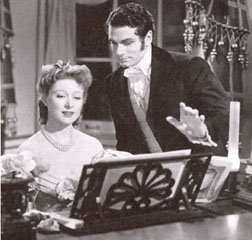
The 1940 version starring Lawrence Olivier and Greer Garson is one of my favorite movies, for a combination of reasons I can't fully describe. I used to watch it every New Year's Eve. But by now it's clear that like many Shakespeare plays, this Austen novel is too large to be contained in a single movie, and the best a movie can do is emphasize aspects of it with a fresh vision. If done with enough heart and skill, Austen is only enhanced.

This version is a very different kind of movie based on the same novel, and it works for me. Moreover, some of the differences are fascinating in themselves. The 1940 version was located in the Hollywood set version of elegant England. There was much talk, as in the novel, of the modesty of the Bennet household, and the financial necessity for the sisters to marry well. While the Bennet family was portrayed as a kind of small town American brood, and Olivier's Darcy and his friends were obviously snobbish, the material difference was hard to see.

Not so in the new version. Here the vast gulf between the country folk and the landed gentry with their estates and houses in London is very obvious. The Bennet household includes pigs and geese and other farm animals, and fields to cultivate and harvest---so there's a sense of how it actually supports itself, missing from the 1940 version. Mr. Bennet (Donald Sutherland) is a working farmer, as well as the father who retreats to his ramshackle study for the shelter of books. We see a direct contrast in the uniformed servant with his precise walk to the exact center of the room to announce visitors to the Darcy crowd, and the shamble by the Bennet's hayseed hired man to announce theirs.

The country folk are mostly unattractive but excited at their noisy, sweaty ball, but they all freeze into a gaping frieze at the appearance of the two gentlemen, Mr. Bingley (Simon Wood) and Mr. Darcy ( Matthew Macfadyen), and the snobbishly cynical Caroline Bingley (Kelly Reilly). In this scene, director Joe Wright also makes Darcy appear about a foot taller than everyone else in the room. After gaping and bowing at them like the freaks they are in this place, the locals then ignore them as they go back to their enthusiastic dancing.

Late in the film, Wright ups the ante even more by presenting Darcy's estate as huge and utterly magnificent. In an almost modern touch, he follows the heroine Elizabeth Bennet's refusal of Darcy's offer of marriage with a scene of her touring the palace that could have been hers, on a kind of great homes tour.

text continues after photo


Greer Garson and Lawrence Olivier in the 1940 version. Posted by Picasa
This visualization of the class differences is the most obvious difference and contribution of this film. This makes the material stakes clearer---the Bennet girls don't need to marry into the gentry (they aren't golddiggers or social climbers), but just to stay at their present level, since their home and lands will go to a male relative according to the law.

But there are also noteworthy and interesting differences in narrative and character shadings. Though keeping some of Austen's references to the ages of the sisters (the oldest in her late 20s), this film portrays them as younger, especially Keira Knightley as the heroine, Lizzie Bennet. She is bright and witty, but no Greer Garson. She seems more like a mischevious 20 at the oldest, trembling with girlish energy. This actually works to make plausible the idea that she's considered the less attractive sister. When she wrinkles up her nose, giggles and ducks her head, having fun with her sisters, it's plausible that her beauty, so evident in repose, would go unnoticed.

Her "more beautiful" older sister, Jane (Rosamund Pike) is evidently beautiful, and is seen much more in repose. What makes this film work immediately is how perfectly matched she is with Simon Wood's Mr. Bingley. Both are shy, modest and sincere, and seem out of place except with each other. They are also both blond. It takes the dark-haired Elizabeth and dark-haired Darcy awhile to discover the secret of their darkness: though both are flawed with pride and prejudice, they share a fierce moral rectitude not at all incompatible with physically passionate natures.

As for this film's take on Darcy, I endorse Stephen Holden's description in his New York Times review (this time in contrast not with Olivier but Colin Firth's portrayal on the 1990s miniseries):Mr. Firth might have been far more dashing, but Mr. Macfadyen's portrayal of the character as a shy, awkward suitor whose seeming arrogance camouflages insecurity and deep sensitivity is more realistic. Isolated by his wealth, ethical high-mindedness and fierce critical intelligence, Mr. Darcy is as stubborn in his idealism as Elizabeth is in hers. The disparity between his diffidence and her forthrightness makes the lovers' failure to connect more than a delaying tactic to keep the story churning forward; it's a touching tale of misread signals.

This is the first major film by director Joe Wright, and it has the studied innocence and ambition of a first movie. Somebody will no doubt study the significance of the many appearances of flame, and how they dissolve into something else. There are plenty of references to other films, especially Olivier's more famous romantic role in Wuthering Heights. But he has so much visual energy (with a score that suggests Philip Glass playing appropriate bits from classical composers, and I say that with admiration) that the symbolism of Lizzie whirling on a swing when she's confused is not at all heavy-handed because it's so deftly done and neat to look at.

He and the screenplay author (Deborah Moggach) also deliver some subtle scenes and dialogue that illuminate minor characters, in place of the delightful movie caricatures,of 1940, particularly Sutherland's Mr. Bennet. Brenda Blethyn's shrill and frenetic Mrs. Bennet also gets some sympathetic moments, when she makes clear what she's up against, that the necessity of five daughters marrying decently if not exceptionally well is no joke, in an age and place that could condemn them to the most degrading circumstances Dickens presented. (This couldn't have been an easy script to write either, as the story seems to defy Hollywood's preferred simple three-act structure.)

In the last part of the movie, realism is perhaps stretched to accomodate the romance, but the film has earned some indulgence. Perhaps someday I'll put together my own double feature of these two Prides and Prejudices. Maybe next New Year's Eve.