Showing posts with label journal. Show all posts

Sunday, August 17, 2014

Summer Set

    photos by Kowinski 2014

Another summer gone, sort of.  Humboldt State starts very early by my standards, so my work--intermittent though it may be--begins again.  But the theatre season is mercifully at an end, so my series of columns--mostly reviews, one preview--is done for now.

I did more than I wanted to for Stage Matters, to add at least some income to balance higher expenses, principally a whopping dental bill for one lonely tooth.  At least whopping for me.  It will take me writing 12 columns to pay for it.  Which means that all of my summer income goes there, and it will require more.

Otherwise, I went nowhere, stayed home in June and July to deal with necessary household matters.  I got some writing of my own done, not a lot but some.  I revised plans for several projects, which I hope make them more doable.  In the fiction based on my life and times, I decided to center it in the most dramatic period (which in fact was the original plan!) and what is now the most historic period, the mid-60s to the early 70s.  It would start with leaving for college.

So I dug out what I'd saved, and it was quite a lot.  I had the first piece of writing I did at college, a cliche-ridden piece that nevertheless preserved a few details about the car trip from burg to burg (Greens to Gales.)  I had occasion to marvel again at what has survived over time--in this case, a postcard from the motel outside Moline where we stayed overnight before driving on into Galesburg in September 1964.

As for freshman year, I have letters (letters!), bound copies of the student newspaper, some academic work, and evidently I'd decided before to focus on orientation week because there are drafts with lots of information.  More than I remember in fact, so there are items in those pages that I can't identify as fact or my own fictioning.  Not that it matters.  But over the years, even when it wasn't going right or I had to abandon drafts,  I've always felt that I was preparing raw material for some ultimate draft.

After completing the introductory story of those couple of days, it struck me that I could frame the college years by starting with a moment at my draft physical, the second one, at Fort Des Moines.  So I found what files remain on that.  I found something like a narration (in something like verse), and there might be more writing I did about it near that time that I haven't found.  But I have the official letters back and forth.  I was amazed to see how compacted in time it was, between my pre-induction physical in Chicago and the appeal physical in Iowa.  The reality of all this leaves me a little dazed, still.

So in short, as usual I didn't do nearly the amount of writing I had hoped, and summer was not nearly as different in terms of demands on my time as the rest of the year.  Time of course is running out on realizing projects, but as there is no demand for them from outside myself,  it's harder to concentrate, to work through the emotions, the effort, the psychological exhaustions, etc.  And the prospect of that enormous silence at the end.  I feel that when I complete smaller projects, even columns (if I hear from any 'readers' at all it's too long after, and I've already disconnected) and it takes awhile to get back the required energy and focus on my world of illusions.  Finishing a big project, what would that be like?

As for the outside world around me, despite the drought we've had roses all summer, and a self-transplanted gaggle of yellow flowers in the back yard (previously known as Toby's flowers).  The grass is browner than it has ever been in front, and the ferns there are wilting.  On the side however, the shaded ferns are doing better.

Our hummers are returning to the feeders more regularly.  I saw two and so I got the second feeder out of storage since early spring. I see them around occasionally in the spring and summer but they seem to range pretty far for the flowering flowers, and the one year-round feeder is very slow to empty.  August is about the time they rediscover the ready supply of the feeder. Sitting on the back porch, listening to a Doctor Who audiobook read by David Tennant, I saw three together, with one hovering in front of me as I said hello.  I've read they know the face of the person who stocks the feeders.  They sure seem to.

It's an odd time--the changing climate resulting in noticeably dryer, sunnier and warmer summers is disquieting for what it portends, though it is pleasant enough in itself.  A hot day here is still under 80F.  Now that I'm acclimated to the North Coast, I find I relax more when it's foggy, the way it is supposed to be.  The persistent sunshine is almost shocking.  And we do have some foggy days and nights, though they seem like afterthoughts.  They say the redwoods could be gone in a century.  But then, I'll be gone long before.  How many more summers, still pretty strong and capable?

It's comforting to know from the blogger stats that almost no one reads this particular blog.  I have some readers for a couple of blogs, and virtually none for others.  So I do them for my pleasure and to keep a record.  I don't know why it is easier to do it this way than simply by keeping a digital journal.  But it somehow is.  

Monday, February 19, 2007


Regret


In Richard Ford's novel, The Sportswriter, the protagonist observes that "for your life to be worth anything you must sooner or later face the possibility of terrible, searing regret." That idea knocked me back when I first read it, in the mid 1980s, when the Vintage Contemporary version of it cost $6.95. Ford's protagonist was 39 years old, and I was very close to that age at the time.

I didn't want to think about regret, and I wasn't fooled by the sportwriter's belief he had licked it. In the years since then, I've mistakenly recalled this quotation as stating that after a certain age a man can't avoid regret. Well, if Ford doesn't say it, I will.

I used to think regret was an offshoot of Catholic guilt, and maybe associated with the shame of the working class hero who doesn't quite "make it." Maybe so. But there's a non-freakish and maybe even appropriate quality to it. And a certain inevitability, at least for some of us.

Several years ago I was pleased to hear novelist Martin Amis admit that small regrets hit him suddenly every day, to the point that they stop him in his tracks, literally, as he walks down the street, and he involuntarily winces and mutters to himself because of some small memory that emerged with the peculiar force of shame and the pitiless, bottomless thump of regret. I was pleased because I thought I was the only one this happened to.

For it seems there isn’t a day—and on some days (or most often, nights) that I don’t wince, mutter and wish to hide when some memory surfaces that demonstrates my mistakes, idiocy, foolishness, stupidity, arrogance, fear, timidity, etc. Were I more actively suicidal (and this particular means available to me), the fitting method would be to put my head in an oven, for its appropriate combination of ending the farce and hiding my head in shame.

Regrets range from the absurd (maybe if I'd discovered hair conditioners sooner...) to the nearly absurd but poignant (so that's what she meant--she wanted to sleep with me! Why did it take me 25 years for my brain to tell me this?), and the cringe-worthy moments of being a clueless jerk, either arrogant or timid, passive or too aggressive...and so on, ad infinitum. As the years pass, it seems entire eras of my life belong in the "being a jerk" or "being a fool" categories.

Fortunately, I haven't killed or maimed anyone, and since I've never been a husband or father (the source of many regrets, that grab like a hand on the windpipe at odd moments, seeing a child with a father for instance) I also don't have to deal with the death of a child, the failure to support one, the effect on children of a divorce, or just the "what did we do wrong" of a child who turned out badly. But there are times when the regret over not having done things overwhelms such calculation.

My regrets do tend to be of what I haven't done, haven't accomplished; the story of my life I kept faith with that was supposed to have a different middle and ending. And though regrets run the gamut, they often do return to what I haven't written, how I haven't connected.

More recently, as both he and I have gotten even older, I heard Amis on TV tell Charlie Rose that he believes men experience regret, possibly for the first time in their lives, as they get older, and probably have a bad death because of it. Whereas, he believes, women are more likely to come to terms with their lives, and die in peace.

I'm not sure about that, but a fog of regret does permeate my life at times. It particularly comes at times I return to the frenzy (which by other peoples standards probably looks leisurely) of schedules, duties and writing for hire. Much if not all of my writing, both paid and unpaid, seems these days to be shouting down a well. And I face the terrible choice of risking and extending myself each time anyway to do the best writing I can, or the equally terrible alternative of not caring how badly I write, since it doesn’t really matter.

At times like that—when I regard the ruin of the past, the lost energies and time when I could have concentrated on creating something worthwhile and lasting but did not quite do it, rather conned myself into thinking I was doing it; and I regard how my time is being absorbed now, the person I am becoming—the future looks bleak indeed: continuing to diminish myself until I get sick and die.

But there is a little balm to be had in my little corner of the blogosphere. I've been writing and posting on A Blue Voice since August 2002. This was one of my first blogs, and though I have posted more often on newer ones the past couple of years, there's more here than I probably remember.

Thanks now to the new Blogger/Google formats, there's this "label" process that allows these posts to be organized according to content. I've really just started that on this one, with the most recent posts, and then (for the hell of it, hah!) the earliest. The process is very time consuming, especially on this blog, because I have to read or at least skim every post. But it is oddly comforting. I may not have accomplished much in worldly terms, or in earning a vast readership, but I did produce writing that is not half bad, more or less, from time to time.

I don't know if the labels will be useful to anyone else, but I think they will be useful to me. There's a growing list of them to the side--click on one and you get all the posts with that particular label, that topic or reference. Access from organization is what works for me. Who know, I might even be able to grow a book from this, for whatever that might be worth.

I don't know if regret is ever very useful. But at this point it's doubtful. You probably never know when you've made your last move, but once that happens, regret is truly useless. The option that the well-timed regret may serve to move you towards just isn't there. Whatever road you're on, is the road you're on.

Sunday, January 02, 2005

The Year Ends

The year ends in winter, in the time of sleep and stories. What will be the stories of 2004?

I pause to look back at a pretty full year of my stories, beginning in the San Francisco Chronicle with "Buddha by the Bay" in January and the Wiyot vigil story in February. Then two highly contrasting multi-book review essays (one on a series based on dialogues between the Dalai Lama and scientists, the other on several books on war and terrorism) and 3 or 4 other reviews in the Chronicle Sunday Book Review in '04 (after 10 or so in 2003 and 7 or 8 in '02) and a couple of Sunday Insight pieces (not as many as in 03 but more than '02). The year also included an op-ed in the Los Angeles Times and was capped this late summer with a feature in the New York Times, page 1 of the Arts section. A long piece in News from Native California, and a pretty interesting interview article in the Humbolt State University alumni magazine in the fall, with a short piece in Native Peoples and for a British magazine on Buddhism awaiting publication shortly.

So together with lots of blogwords and unpublished pieces, a short play, revision of a long one, some fiction and even a poem or two, and of course the perennial book proposals, it was a year of some volume. I'm basically proud of the work, happy to have gotten compliments on some of it, particularly by those directly involved in the stories (you know, like Michael McClure on the Buddhism story, and Leonard Nimoy on the Star Trek piece in the Times.)

Yet so far all my published jabber hasn't materially changed how '05 begins. I had hoped that my run of work in five separate sections of the SF Chronicle might get me an invitation to draw a salary, but none was forthcoming---even when I asked. Word from inside was that the Chron is chronically overextended financially and saddled with some contracts they wish they could drop (sort of like the 49ers) and the morale among even those who are salaried is low. (The joke was, I'm told, that when a meeting was called to discuss the low morale, most people were too depressed to show up.) Last week I was told there is no freelance budget at all, except I guess for book reviews and maybe Insight. So no more Chronicling. I still have some hopes involving the NY Times and (separately) Star Trek.

I'm finding that blogging is a lot of fun but way too time consuming, so I may have to lower the volume there if I'm going to get projects accomplished that may wind up being legacies of a kind. The only kind I'll leave, I suppose. I will be working this month and for several months forward on launching and maintaining the This North Coast Place blog, my Cultural Trust project. But like most January firsts, the new year is entirely free of recognizable income-generators.

As for the stories we share, not many good ones, eh? The Tragedy of November, the tsunami of December. And hereabouts the loss this summer of our beloved Tess the cat, who I still think about and miss every day, usually at bedtime. Sometimes when I got into bed, she would sit on my chest to be petted into such a state of bliss that she didn't want to move when I was ready to turn over on my stomach to sleep, so if I turned very slowly and carefully, she just sort of rode the move, and wound up on the other side, on my back, where she would sleep.

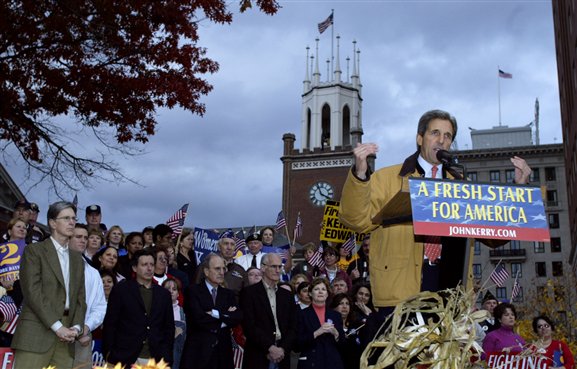
Prior to the Tragedy of November, I got involved in politics again this year in a haphazard way. A couple of speeches on behalf of Kerry, one to the county Democrats, one where I found myself debating an actual presidential candidate, the Green Party's David Cobb (who lives nearby in Eureka.) Elected as a Kerry delegate to the national convention, but couldn't afford to go. Then there's the "Fresh Start" saga, which still lacks definitive information. Still, it was a weird rush to see the Democratic candidate speaking behind the words I pleaded that his campaign adopt as their slogan. I read that one of Kerry's official consultants made $5 million in the campaign. That's about $5 million and fifty dollars more than I made.

Then at the very end of August, my first Star Trek convention since 1975. I met Gene Roddenberry at the first one, and at this one, Nichelle Nichols introduced me to Neil Armstrong, and I shook hands with the first human to set foot on another world. So now I've shaken hands with JFK, Roberto Clemente and Neil Armstrong. Not bad.

I worked on several projects for Humboldt State University this year, which felt like a good match of my skills and interests with their needs and purpose. I can imagine myself on the right university campus.

Margaret had a busy but pretty good year, becoming Ombudsperson at HSU, seeing a couple of her plays performed, adding to her skills and knowledge in various ways. Her children are healthy, as are my sisters and their children and grandchild, and so are we. Whatever else '05 brings, we hope that much stays the same.

Friday, November 26, 2004

I've recently confirmed that my memo on why the Kerry campaign should adopt the slogan, "A Fresh Start," was forwarded to the upper echelons of the Kerry campaign by a person of importance known to them, in June. More than that I don't know yet, but I'm intrigued. My high level contact has promised to find out more.

The reason I bring this up is---well, check out the Kerry photo below.

Monday, November 15, 2004


Blue President Posted by Hello

Sunday, October 03, 2004

When Elsewhere is Nowhere

Somewhere on the East Coast a woman I've never met is getting phone calls today prompted by something I wrote. At least this is what I imagine and expect, based on past experience. A substantial positive review in the Sunday review section of the San Francisco Chronicle, the big cheese in a book-buying town, can be a fairly big deal for an author, especially of serious nonfiction, even one as already celebrated as Kay Redfield Jamison.

Friends probably called her, and if her agent or editor hasn't, they will likely mention it in their next conversation. (I did hear of another best-selling author who happened to be in San Francisco when my review came out, and he called his editor and read the complete short review to him over the phone.) I got an email from Leonard Nimoy on my New York Times Star Trek piece which he said was "a fun read for me" and "I've had a lot excited calls from folks who enjoyed it." Needless to say, I got no excited calls myself.

A quote might be taken from today's review for an ad or a blurb on the paperback edition, but more likely than not, it will be attributed only to "San Francisco Chronicle." That's happened before, and it's how this game is played---I've done it myself: if the reviewer isn't a national name, the name of the paper is more impressive on a blurb. An article or review might get reproduced on web sites and be a cause for a blog comment here and there, but unless I write something else on exactly that subject covered by the site, it won't happen again.

These are ways in which some of what I write becomes consequential in the world. It happens elsewhere. Hereabouts, just silence. I got no calls today, and never do; even though I got some nice emails from people I interviewed or were otherwise involved in the Star Trek story, I got no calls from anyone else about it.

Nor are there usually any other consequences to my life, apart from getting paid, and that's seldom very much. The jury is still out on the further adventures the Star Trek piece might lead me on, but most everything else has had no direct or discernable effect here. Today's review didn't, and won't.

Even though I should be used to this, and probably would be undone if I did get calls, I still find this a bit alienating. You know, feeling alien to this place. A familiar feeling.

Musing on this is prompted by something else. In reading my own review I noticed something I didn't like. Though on balance it's solid and has some music to it, I detect some slackness here and there in the writing. Especially things I should have caught, and probably would have if I had gone through it once more, a day or so after I finished it. And I realize that my state of mind at the time I wrote it had some effect. For one thing, I've concluded I have no immediate future and probably no future at all with the Chronicle, beyond writing for minimal payment. I've contacted other papers who pay better for reviews, but haven't gotten a response. What I have now taken note of is that my feelings regarding this have affected my work, although so far only in small matters of style that few others are likely to detect.

So the motivation of building something isn't there to compensate for the lack of motivation from my immediate environment, or let's say my life. There's not much motivation anywhere for the quality of the writing. Even where this review or that article might be consequential, it's not because of the sentences. It's whether it is a positive or negative review, and whether it has a selling line in it or not. For an article it's whether it is good press or bad press for the subject. (In fact it seems that the reviewers who themselves get attention get it for writing biting negative reviews.)

I am exaggerating a bit---I know that when people say they enjoy a piece that they are in part feeling the effect of the writing. Just as I'm exaggerating about lack of response: I've had subjects of reviews and articles contact me and express gratitude for the attention, the quality of it, and for being "understood." I sometimes even get phone calls and emails from readers,usually no more than one per piece, often from a stranger with a strange story to tell; I am usually discomfited by these calls though I hold them in awe as well. A complete stranger going to all that trouble means some chord was struck, something important to that person. I value all those responses very much.

But most of the motivation for writing as well as I can, comes from an inner compulsion, an inner dialogue (I write things I hope to enjoy reading), and principle. Maybe even some writerly fear and/or superstition, that if you abuse the gift you lose it.

I also wonder if my new-found equanimity about editing that detracts from my work (subject of an earlier entry on 9/09) is the other side of this. I had a piece recently that was essentially strip-mined for a newsier and stylistically blunt and forgettable collection of information. It didn't bother me, at least not as it would have in the past.

Standing on principle seldom gets approval from others when it means offending somebody with power, or cutting off a source of income. I see pretty clearly that caring so much about the integrity of the final product has done me and my "career" far more harm than good. And I take note that the work I feel closest to, that I consider my best, is not generally so approved. So the worth of what I defend is questionable, especially to others. So what do I do?

As the editor of a Japanese art magazine once said to me when I asked him when I would be paid, "good question!" Certainly attending more rigorously to the writing that I am commissioned to do, at whatever price, is an obvious lesson and not that hard to heed. Being able to publish my work myself on the Internet helps enormously. I get more feedback from doing that, especially from the people on my email lists, than from anything else. But for the larger questions, it's hard to say.

There is a sense in which I've always felt it is out of my hands. We are servants of the gifts we're given, and whatever value they have (or are supposed to have) is probably more to the whole than to us. Whatever the "whole" might be. I suspect it includes other times and other places.

Just as the ants probably don't suffer from angst about searching out sugar and not finding much, we just do what we are compelled to do, regardless.

Wednesday, September 15, 2004

Now and soon

It's hot. I haven't seen statistics on the season yet, but this summer right into September has certainly felt warmer than any since we arrived in Arcata almost exactly eight years ago. It feels hot because the humidity on this coastal strip is consistently high. It's not that noticeable most of the time, because the temperatures are cool. But when the temperature is warmer for days and weeks at a time, even a little, you feel the humidity, and so it feels hot. Not New Orleans hot. But maybe Pittsburgh summer hot.

Allergies seem worse this summer, too, for both of us. Whatever combination of humidity, dampness and the year round flourishing of flora and fauna is responsible, the "Humboldt Crud" kind of illness is as much a part of the local scene as redwoods, banana slugs and dairy cows.

It seems to me the warmer weather has had something to do with our bumper crop of tomatoes, too. When we were first here, growing tomatoes in Arcata was almost unheard of. But Margaret works at it, and we do have an apparent advantage in a cement driveway (used exclusively now for container plants with basketball quarter-court), which seems to reflect sunlight. So Margaret planted a number of varieties this year, hoping some would flourish, and some have in the past few years. But they all did this year, so we've got big tomatoes, small tomatoes, round ones, sort of oblong ones, as well as red, orange and yellow ones. And so I've been trying to keep up consumption with lots of salads, tomato sandwiches, fried peppers and tomatoes, and sliced tomatoes over pasta. And I'm not complaining.

Still, I don't like the heat or the allergies. And the forecasts for the future aren't too good. A recently released analysis of California cities shows increasing heatwaves even in San Francisco, with more heat-related deaths expected-as much as a 70% rise by the end of the century.

Sacramento will be worse than that, and Fresno worse still. San Bernadino--forget it. It's global heating, brought home.

Click here for the SF Chronicle story on this survey:

SAN FRANCISCO / 'Cool gray city' projected to turn murderously hot / Temperatures likely to rise by mid-century as a result of global warming, study warns

Like our summer here, there will be some relatively good things as well as the relatively bad things associated with hotter times, and that will help mask the eventual consequences. But of course it's not just heatwave-related deaths we're talking about, but the need for more electricity for air conditioning (one of the problems here when it gets hot is that nobody has air conditioning, not even the restaurants and movie theatres, because nobody needed it before), the need for more water when it may be dryer, and the likely increase in pest-borne diseases where cooler weather used to temper these outbreaks by keeping the insect population down. Then the whole ecology gets thrown out of whack. Wildlife hereabouts is already being affected by the years of drought and now the heat.

At the least it will all mean more demand on civic services, which will cost more money. It's a problem for cities losing population and businesses, and tax base. It's a problem for a state that already has fiscal problems, and an addiction to lower taxes and more services. And thanks to the G. W. Bush crowd, it's going to be a big problem for the debt and deficit-laden federal government for a long time.

We're already seeing that in the states (and countries) suffering the onslaught of hurricanes. Loss of life, of homes, of property are the most proximate and most obvious, but there's also the impact on the economy when so many people are dislocated; the economic impact of a loss of tourism for a year or more in some areas; plus the costs to government and NGOs like the Red Cross, which lessens their resources for the hurricanes yet to come. Somewhat similiarly, the costs to insurance companies will eventually mean more expensive and less available insurance for people and businesses, which will make the next round of hurricanes even more expensive, and so on. For if even if this is the return of an otherwise normal cycle, only augmented by global heating, damaging hurricanes will be such a regular feature of existence there that even the cable news stations will tire of sending reporters out in slickers to try to talk while being manfully blown around.

The hurricanes are dramatic and obvious in their effects, though even there we shortchange them. Florida has certainly been hard-hit but there have been other places too, that got it worse (Haiti) and bad enough, but fewer reporters were there (much of Pennsylvania had damaging floods from rivers and streams---including Pittsburgh and its three rivers; flooding in West Virginia was said to be the worst in its history.) Tornadoes, cyclones, all part of the disturbances, are also part of the larger cycles. Cycles within cycles, and global heating may not even be the largest in scale. However it is still shaping up to be the most telling. Recent research suggesting that carbon from natural sources is increasing because of the carbon from human-made pollution, further multiplying greenhouse effects beyond the usual projections.

The worst of these predicted scenarios for California's future would be mitigated somewhat by real attention to doing what has to be done to lessen global heating. But we've barely gotten to first base on recognizing the climate crisis, let along doing much about it.

John Kerry, with one of the best environmental records in Congress, has usually talked about this issue in connection with the Bush administration's failures in international cooperation (on Letterman, Kerry said the U.S. should rejoin the world on the global warming treaty) and especially in supporting science. He's exactly right in this regard, and only a level of understanding and confidence in science behind public support for the necessary policies has any chance of helping to head off the worst.

So for those of you who will be alive in 2050, and who will have children who are alive in 2090, I ask you to remember that some of us tried our best to raise the alarm.

That will probably be cold comfort, but anything cold may be a comfort by then.

Thursday, September 09, 2004

On being and editedness

I'm not as upset as I used to be about being less than well edited. I'm still annoyed when bad editing or mistakes make a piece harder to read, but I don't obsess about it. People do get over the rough spots.

But it's not just the years and the mellowing of age, though they do play a part. And it's not because I no longer care as much about writing as well as I can, and seeing my work presented as well as I wrote it. If not better (which is what good editing can do.)

The other important factor is digital. Thanks to blogs and web pages, I can publish my own work in a way that is a bit more permanent than in newspapers or magazines, with a greater availability---literally a global availability. And what I write, for better or worse, is what you get.

And if I feel strongly enough that I want to fix forever in print some longer work, I can always spring for the relatively modest cost of a print-on-demand book.

Just knowing this is liberating. No editor or publisher has the absolute say, the complete power over what I write.

So when I write for a newspaper or magazine or, maybe someday again, under contract to a book publisher, I now concentrate on two other elements rather than just the finished product: 1. the process. 2. the money.

The process is the research, interviewing, travel, gathering and organizing information. The process is the writing itself, the effort, against whatever deadline pertains, to make it as good as I can.

The process can also include working on the editing: conferring with editors, reading changes, re-working them when that seems right. Sometimes an editor will reorganize a piece but it doesn't quite work. I add, subtract, multiply and divide, shift around and so on, to make it work within the new structure.

But there isn't always time or opportunity for all that, and sometimes I just have to let it ride. It can still be disappointing when something I really liked---large or small---is unnecessarily lost, but then it can also be disappointing when that something is preserved, and nobody really notices.

I've always been especially sensitive to losing the sense of my voice, of a piece no longer "sounding like me." It's part of my larger obsession with sound and voice, hearing through the eyes, etc. which I've come to realize is pretty integral to who I am, one-eared and all. But sometimes I even have to let that go, at least if it's not complete ventriloquism.

So it's best to stay invested in the process, make that as much fun and as rewarding in itself as possible, and make sure in the end you get paid.

For the truth is that seeing it in print (either in some publication or as I want it on the Internet or in a print-on-demand book), seeing that you still think it is as good as when you wrote it, and even seeing others appreciate it, is not a thing in itself but a continuation of the process. At best it's closure but also generative, for you and for others.

Some of the mellowing is probably also the result of just getting worn out, or benumbed. Some of it is just perspective. The echo of time passing, of time running out. Once you're done with the writing, it's really over. It's time for the next task, the next curiosity, the next attempt, the next stretch, the next discovery, the next performance, the next making and re-making, the next surprise.

Monday, July 26, 2004

Why I'm Not There

I watched my first Democratic convention on television in the summer of 1960. I was 14, an age for heroes, and I had one: John F. Kennedy. It was an exciting convention, in the conventional sense: the outcome was in doubt. Kennedy had won the most primaries, but not enough to assure him the nomination. There was powerful opposition from the party elders: none other than Eleanor Roosevelt and Harry Truman included. They favored their two-time loser, Adlai Stevenson. Kennedy was too young, and his Catholicism was the unspoken fatal flaw. By the night of the voting, the Huntley-Brinkley and Walter Cronkite conventional wisdom was that if Kennedy didn't win on the first ballot, he might not win at all. So the first roll call of the states I ever saw was one of high drama as well as high theatricality. While reporters tried to keep up with Robert Kennedy's visits to key delegations, Kennedy did win on the first ballot.

Conventions since then haven't had that kind of contest, although they had plenty of drama in 64, 68 and 72. Except for 1968, when my candidate was dead and I was outside the Chicago hall in spirit and for a couple of nights, in fact, I always enjoyed watching the conventions on TV. I liked the speeches, the hoopla, the roll call of the states, the celebrations. I projected myself inside them, fantasized being part of them. But though I labored to one degree or another in various presidential primary and general election campaigns, I'd never been to a convention. So you'd think if I ever had the chance, I'd take it.

My chance came, as chances often do, as a surprise, or a series of surprises and accidents. About a year before the 04 campaigning actually started I had coffee with a new friend I'd met during the 2000 election campaign, who was soon to become the chair of the Humboldt County Democratic party executive committee. We talked about possible 2004 candidates and I mentioned John Kerry. It was the first he'd heard of him as a possible candidate.

By the by, a couple of summers ago when I was in Washington, eating the very good pasta cooked for us by the former Chief of Staff to Bill Clinton-and former classmate of mine at Knox College---John Podesta, I ventured to suggest that John Kerry might be the 04 candidate. Podesta thought not.

Anyway, as the California primary came closer, I responded to a meet-up invitation for Kerry here in Arcata. It was a very small gathering. There was my friend from the Dems, who'd become a Kerry enthusiast, and a few others. This is Green country, and Democratic activists tended to favor Dean and Dennis the K. The party wasn't terribly interested in the presidential primary, since Kerry seemed to have the nomination nearly locked up, and the chances of Bush winning California depended on the Democrats nominating, say, Osama bin Laden. So I found myself one of the few people willing to actively support the candidate most likely to win the nomination.

Brian Mau, my Dem friend (also known as Chairman Mau) had to find someone to speak for Kerry at a university forum, and at the county Democratic convention. As Chairman Mau, he couldn't do it. So I did, as I've described in an earlier entry. He also needed people to run as Kerry delegates to the convention. Only one other person was willing to do this, so I said I would, too, just so there would be Kerry delegates.

This delegate election turned out to be almost as private an affair as our meet-ups. But there were actually two elections to poll registered Democrats who showed up: one up here in northern Humboldt, and one in the southern part of the county. I believe there were slots available for two men, three women, and one male alternate. Everyone up here voted for the two of us who were there, and everybody down there voted for their folks. They however had more people at their polling place. If I had invited a friend or two, I would have won, but even in this odd arrangement, I was elected as the alternate.

I almost didn't run at all---for as I was filling out the form, very close to the end it mentioned that the delegate would be responsible for his or her own convention expenses, including transport and housing, and that this would be about $1500. However, delegates could raise funds from others to pay their way. $1500 is a major chunk of change for me these days. But I figured I'd cross that bridge when I came to it.

Having been unreliably informed that as an alternate, I wouldn't be going to the convention anyway, I relaxed. It was only much later that I learned I was not only eligible, I was expected to attend. And that $1500 figure turned out to be an estimate from some prior century. It was likely to be double that.

By that time I'd made several commitments for work that was actually going to earn me something, and that looked like it would take me through July to accomplish. It seemed to be what they call a no-brainer, which usually means an obvious practical decision based on balance sheet figures.

Still, I put off a final decision until I was getting so many emails and phone calls from the state and national Dems and the Kerry campaign that I had to commit one way or another. By that time I was deep into this work. I had a moment of enthusiasm about going to the convention, of realizing it was a once in a lifetime opportunity, and even that because I knew Boston and knew some people who might put me up, the expenses could be cut down considerably. But then all the noise about security and traffic, and security checks on delegates. And all the emails I was getting that cast being a delegate as being a fund-raiser. I don't actually know who the delegates are, but it seemed they were either fund-raising types, or members of unions and other organizations who were footing the bill for their attendance. (Politicians and officeholders have their own delegate slots.) And I can't say I felt a whole lot of encouragement to throw caution to the winds and go.

So I had to actually resign as a delegate, and thanks to the layers of organization involved, I had to do it at least twice. It was a bummer. I had a day of very gloomy second thoughts about it. What was I thinking? I thought. So what if I wasn't a typical delegate---I am a writer, I could write about it, right? When I was younger there wouldn't have been any hesitation. I would be off on the adventure. Now I thought about the physical demands: the travel east, jet-lag, the T to the convention, the standing around, the foot-miles in the city, etc. Even from a career point of view---I'd meet more and different people than I will sitting at home. What's wrong with me?

Then the mail started coming. I have a shopping bag full of it: from Americans for Democratic Action, Yankee the Magazine of New England Living, the Democratic Party Visa Platinum Card, the Mayor of Boston, American Association of Registered Nurses, Planned Parenthood, Greater Boston Convention and Visitors Bureau, Senators Dianne Feinstein, Barbara Boxer and Edward Kennedy, Southern California Edison, National Democratic Ethnic Leadership Council, etc. etc., with invitations to cocktail parties, receptions, galas, breakfasts and a No Carb Lunch. As flattered as I might be, I somehow couldn’t believe I’d make much of a lasting impression.

Now that the convention is about to begin, I am only slightly uncomfortable. I realize that I could have combined a sentimental journey back to Boston and Cambridge and the Italian North End with witnessing some unique moments---Hillary and Bill Clinton, Edwards, the most important speech of John Kerry's life so far, plus all those balloons. And maybe if things had happened a bit differently---if I'd realized sooner that I was eligible to go and maybe found some support or at least thought about it more, if I hadn't happened to get more work this summer than I've had in many months, etc. When I was most upset about not going was when I was most upset with myself for letting the environment dull my sense of possibility and adventure, the lack of an echo chamber for my enthusiasms keep me from even considering them as legitimate.

But this didn't last long. Maybe it's just ego to recoil from the given role as delegate cog, assumed fund-raiser, with no voice except to say hooray. Or maybe I'm giving into my introversion, combining it with the age-related reluctance to push physical limits for vague purposes, and coming up with timidity. I do know one thing: I felt it would be lonely. In a city where I once belonged but do no longer, peopled by ghosts, and by people who no longer would take my calls. I would be a member of the California delegation---none of whom I know or who know me-- and of nothing else. I have nothing to offer lobbyists except explanations for why they ought not waste their time lobbying me. It would be noisy, frenetic and filled with people. Not everybody's definition of lonely, I admit, but for me it's not necessarily a contradiction.

There will be thousands of people writing about this convention, and if they are anything like the commentators on TV, they will be largely saying the same things. I don't think they need me there to add either to the noise or to the silence (since it's unlikely I'd get published anywhere but here.) I'll watch the speeches on TV, mostly on C-Span, where they won't be background noise for perky analysts chatter. I'll watch the roll call of the states, I guess. But if I don't want to watch it all, I can do something else. I suppose I can't really explain why I'm not there. Maybe it's as simple as being of the age to view resources---of money, energy, time and emotional resilience---as having limits. Or let's just say I didn't feel finally that it was my fate to be there. I have responsibilities here, and they are real. Though not all of them are very important in any greater sense, they are personal to me, while my presence was not required in Boston except as a body to fill a folding chair. I hope they got somebody to fill it who can clap loud and yell continuously for hours. That's the job, after all.

Friday, July 23, 2004

Cause Unknown

One isolated story after another, about the wildfires scorching thousands of acres in southern California, Nevada, Arizona and Alaska, derive their import as news items directly from the number and type of homes threatened or destroyed. Big fire but don't worry, no homes were destroyed.

Some recent stories from southern CA and the southwest mention that there has been six years of drought in the area, and that this spate of huge fires is appearing about two months earlier than past "fire seasons." Which certainly doesn't mean the season will be over two months earlier as well. They fear another season like way back in '03. That was a real bad year. Hey, wasn't that actually like...last year?

What causing the fires? It's either something very specific (one of them was reported to have been caused by a bird, electocuted on a power wire, whose burning body touched off the ensuing inferno) or it's "cause unknown."

So it's not just the deliberate ostrich heads of the Bush administration, refusing to believe in global heating and the climate crisis. It's the ostrich habits of the news media, brains full of sawdust that will eventually catch on fire, along with their permed hair, though of course by then it will be cause unknown.

You'd think that obvious and quite violent evidence that climate models have predicted would at least attract that level of analysis. But then you would be thinking, and that drops you right out of this happy nightmare.

Tuesday, July 13, 2004

The Real News Update

Most of the U.S. sweltering with temperatures in the 90s. Violent storms continue in many parts of the country. Torrential rains in New Jersey and Pennsylvania cause floods---13 inches of rain fell in Philadelphia in one day. Tornadoes touched down in Maryland and in Illinois. Dangerous storms moving across the Midwest into the lower Great Lakes and Ohio Valley, where they are expected to merge Tuesday evening.

Giant forest fires in Alaska and California. A huge dust storm in Phoenix. Scientists in the U.S. and Canada report that due to drought in both countries, the duck population has fallen by 11% in one year.

Friday, July 09, 2004

The Real News Update


Severe storms including tornadoes tore through large swatches of the U.S. midsections last week, as mega-forest fires rage in Arizona. Forecast for severe storms in Montana and Wyoming this weekend. Retail sales in U.S. down in June, attributed to "bad weather."

Saturday, July 03, 2004

as the year turns


We mark the turn of the year we have in common, and the turn of the year that is ours especially, because it marks our birth, our inauguration day. Remembering my birthday this year was almost unavoidable, since it was portentously mentioned many times a day on television for weeks, even months. Countdown to June 30 even had its own banner, though not yet its own theme music on cable news.

Then on June 28 the surprise backroom transfer of Iraqi sovereignty was accomplished---no big deal, just harried-looking men huddling around a piece of paper that could have been a cartoon somebody copied off the Internet, and suddenly the countdown was dropped, and June 30 not mentioned again. So my birthday went by as quietly as usual after all.

There will be important birthdays marked soon-George W. Bush and Bill Clinton were both born the same summer I was. We're all of the age that birthday fuss becomes reserved for the turn of decades. But probably more for me than for them, this coming year assumes a more defining importance. G.W. will either be president or an ex-president next year, but there's not that much difference in identity once you've been one. Bill Clinton is being pretty smart about his authorial authority---he understands the effects, large and small, with the power of celebrity creating real contact of his words with millions of readers and non-readers of his book, so he's written things that others have written better, but without the audience and the power to reach them. I do wince when I hear of him bragging that he had no writer's block. He also apparently had no editor block, internal or external. He may have written a fine book, there are no rules about that, but writing is not his trade. Still, could you even imagine G.W. writing a thousand pages---or even reading them?

But where was I? Oh yes, my birthday. In late June I picked up a book--a gift Margaret gave me on some earlier occasion, Christmas or birthday:Original Self by soul man Thomas Moore. It's comprised of short thematic chapters, similar to his book of meditations some years ago (which Margaret also gave me.) At least that's how I had been reading it, a chapter now and then, perhaps before bed.

But in late June one passage I read struck me, with a certain birthday appropriateness. I read a few more chapters then, and realized that although each chapter was self-contained, the chapters could also be read sequentially, as a kind of organic exploration. So I made that my birthday project, reading this book front to back.

As usual I found passages and thoughts that pertained to various simmering writing projects (even a Star Trek reference) but I also placed little checkmarks here and there where a thought jumped out at me. So just for fun, and to mark the occasion, I've typed up those line, and offer them to you.

I'll begin with the passage that first got my attention, and then proceed sequentially in terms of the pages where the quotes appear, repeating that passage in its proper place. Of course, the quotations take on more power with the surrounding contexts.

Thomas Moore has a genial face, a soft manner in his writing and speaking, which helped attract a following for his first best-seller, Care of the Soul. He achieved the popular success that his mentor James Hillman hasn't. Partly because he's younger, more media-friendly, with the spiritual aura of a former Christian monk, but the casual manner of a suburban American family man who has good things to say about sex; partly because his writing is more personal, and Care of the Soul in particular deals more specifically with finding meaning through appreciating and honoring the textures of daily life.

But Moore's message is no less complex and even heretical than Hillman's. It can even be considered harsh. They agree on the limitations of the current dogma of human potential as constant growth, and spiritual growth as something to pursue because it's healthy. Moore and Hillman don't minimize the difficulties and the darknesses, and their conception of soul bears this out. Spirit is airy and pure, the body is earthy and prone to troubles. Soul includes them both; it is the mediator, the harmonizer, the active synthesis that defines identity and is the center of vitality, the blue fire.

I don't go for any dogma, and striving for spiritual growth and complete health seems pretty okay and healthy to me, as long as you realize that it's the process and not the attainment you'd better concentrate on, or else you're just setting yourself up for failure and guilt. But I agree completely that these limitations and complexities exist and we must resist the temptation to be scandalized by them. Soul is pretty important.

But I should let Moore---Thomas, not Michael this time---have the stage.


"It may be more important to be awake than to be successful, balanced, or healthy. What does it mean to be awake? Perhaps to be living with a lively imagination, responding honestly and courageously to opportunity and avoiding the temptation to follow mere habit or collective values. It means to be an individual, in every instance manifesting the originality of who we are. This is the ultimate form of creativity---following the lead of the deep soul as we make a life." (126)


"The secret of a soul-based life is to allow someone or something other than the usual self to be in charge.
(7)

Anxiety is nothing but fear inspired by an imagined future collapse. It is the failure of trust.
(13)

But an established habit of defensiveness is not the same as defending oneself in the presence of a threat. The former is a neurotic habit, while the latter is a way of keeping sane.
(16)

Puer [Latin for child, a term used by Jung to describe the spirit of youth] is not simply literal young age, but an attitude of youthfulness that may be full of spirit, high destiny, and a forgetfulness of mortality. It is a spirit that brings new life....As Jung says, dreams of children may signal some new beginning, a fresh turning of the cycle. [29]

The best response [to depression] might be to respond courageously to the world's suffering. The attachment to sadness one sometimes senses in people diagnosed as depressed may simply be the odd presence of ego in what is the world's malady. If we could let go of the need to make it personal by clutching it close as a symptom, we might find some relief by finding its proper mileu. (35)

Each artist seems to have access to a special chink in the opacity of the cosmos, a crack through which they can perceive the whole and make a philosophy and a life out of it.(40)

The impetus for dealing only with what is may be rooted in a spirit imagination of pristine clarity. If only life were simple, separated from the haunting past, the underworld of emotions and desires, and connections with the rest of the world! It may be equally important to deal with what was and what appears to be beneath the surface of things. (42)

Our criticisms have obscured the archetype [of patriarchy], and in all areas of life we are left without the leadership and procreativity we need. Procreativity differs from plain creativity in that specifically it seeds a future, offering confidence and hope. (51)

We may each have an idea of who we should be, knowing the seeds of a self for many years. But our idea of who we are and the direction we ought to go may be entirely thwarted by circumstances and fate. We may discover that we are most ourselves when we are furthest from the self we think we ought to be. (57) Our life is then a response, our creativity a surrender. (58)

The ideal is not to become sane and hygienic, but to live creatively by responding positively to the powerful moods, feelings, and ideas that captivate us. If we don't meet these life-shaping expressions of the soul creatively, they will quickly become adversaries, and we will develop the split psyche so characteristic of our times, in which our sane lives are flat and aimless while our passions seem incomprehensible and out of control. (60)

Modern psychology tries to tell us that we are constantly developing creatures, but I prefer to think of us as seasonal beings. We have our summers of sunny pleasure and our winters of discontent, our springtimes of renewal and our autumns of necessary decay. We are essentially rhythmic, musical. As the ancients used to say, our emotions are in orbit, like the planets. Patterns that define us return again and again, and in these returns we find our substance and our continuity, our original nature and our identity. (64)

This loyalty to one's own myth is understandable because our story is the most precious thing we have. Our lives depend on it. (65)

The story within and beneath the familiar story is almost always full of insight and new possibility. It may take courage to go another level down, to abandon clarity, however illusory, for confusion and puzzlement. Our habitual stories usually protect us from the mystery of our lives. But there is always the opportunity to take our storytelling deeper, always the chance to find the intelligence and comfort we have been seeking at a level far beneath the basement of our expectations. (67)

Many want to be somebodies, and that appetite is probably natural and fine, but it can also be a distraction from the rich life available midway between being somebody and nobody.
(70)
Maybe it isn't literal celebrity we long for, but the sense that life has meaning, that we belong on this earth, that we are contributing, and that we are appreciated...But the thing for which being a celebrity is only a symptom is the strong sense of self offered by one's passion, one's real substance, and true and heartfelt recognition from the people around us. (70-1)

We may come to know our friends and lovers over years of conversation and experience, but we may eventually realize that it is enough to love them without knowing what they are all about. We may not approve of everything they do, and we may not appreciate their eccentric ways, but still we know and appreciate them. We have faith that in the dimness of our ignorance we have the opportunity to give ourselves more fully to their reality. Unconditional love means that we don't love on the condition that we understand. (74)

We go on living when meaning fails and when we don't get it right. We go on in the presence of mortification, a word that means simply "death-making", and we become who we are destined to be as much through the death-making as the life-making. Success and happiness are impossible without the continuing nudge of death. Living through our mortifications is the coupon for vitality and the ticket home. (80)

Both Shakespeare and archetypal psychology take their power from their capacity to reveal what we all know, if we were only to think openly enough, about the fundamentals of human life. If we could live from that deep place of recognition, we might allow ourselves the beauty of our eccentricity and tolerate in others their efforts to find their souls in the odd collection of emotions, fantasies, and behaviors that form the raw material of a human life. (92)

But it is also the path toward that extreme of desire, that ultimate love that usually feels unrequited, which is the eternal and the infinite. The opening made by desire, that hole in our satisfaction, is the opening to divinity, and only there is our desire brought into the realm of the possible.
(94)

....we feel the absence of meaning and are speechless when we learn of atrocities in our society. We don't know how to think about them because we don't know how to think, and we don't know how to think because we don't believe that thinking for its own sake is worthy of our attention. (97)

In the currently accepted view, as long as you do the right thing, it makes little difference what your reason is. But this, says T.S. Eliot, is the greatest treason, a betrayal of our humanity, because the interior life counts. Without it we are indeed machines that can be manipulated genetically and given new mechanical parts. (98)

The key to seeing the world's soul, and in the process wakening our own, is to get over the confusion by which we think that fact is real and imagination is illusion. It is the other way around. Fact is an illusion, because every fact is part of a story and is riddled with imagination. Imagination is real because every perception of the world around us is absolutely colored by the narrative or image-filled lens through which we perceive. We are all poets and artists as we live our daily lives, whether or not we recognize this role and whether or not we believe it. (100)

During the European Renaissance it was thought that the first role of the imagination was to keep old thought fresh through reflection, interpretation, and re-presentation. (102)
I love Monday mornings, the time we wash our clothes and write our books. Yet I sail in imagination and I like to leave nothing I touch uncontaminated by my own fleeting way of thinking. (103)
In the intersection of movement and stasis, life becomes interesting and is worth living. Change ennobles tradition, and honoring the old gives grounding to vitality and movement. The waters of a mountain stream flow constantly and yet it is one stream, a static picture of endless flow. (104)

The wish to be normal conceals a deeper desire: negatively, an attempt to avoid the weight of our individuality, and positively, the idea of being fully ourselves in a community where we can belong and participate. (118)

It may be more important to be awake than to be successful, balanced, or healthy. What does it mean to be awake? Perhaps to be living with a lively imagination, responding honestly and courageously to opportunity and avoiding the temptation to follow mere habit or collective values. It means to be an individual, in every instance manifesting the originality of who we are. This is the ultimate form of creativity---following the lead of the deep soul as we make a life. (126)

A second step might be to shape a life that is more in tune with our perceived nature, or dharma, and stand firm in our originality and eccentricity. This intense level of self-possession comes at a price, of course, for friends and associates will feel the rub of individuality when their concern is to sustain the adaptation to unconsciousness, otherwise known as normalcy. (129)

A third step would be to manifest our originality, not at all for ego rewards, but as a necessary way of giving it life and substance...The simple act of showing one's deeper nature is a form of personal liberation and a generous contribution to community." (130)

Monday, June 28, 2004

The Real News Update

Over the weekend, heavy rains and floods in Colorado.
Today, heavy rains and severe thunderstorms forecast for the southern plains.

expected high temperatures:
Honolulu 88F
Fairbanks, Alaska 95F

Saturday, June 19, 2004

The Real News

Where do you go for the real news, the significant news, the news you need to heed? Well, you can get the latest on Britney's tour cancellation, the Lacy Peterson trial or Madonna’s name change, plus the furor over whether the voting is really fair for American Idol, in most any newspaper, TV network news, MSNBC, CNN and Fox. But for the real news, you might try the Weather Channel.

There you will see, day after day, a summer full of violent storms from the east coast through the Middle Atlantic States---particularly the Ohio Valley---and into the Midwest. Torrential rains, frequent and damaging thunderstorms. In much of the Midwest, this stormy weather has been accompanied by tornadoes---up to 100 in a day this spring, which NOAA has announced was the 3rd warmest spring on record. Storms in the mountain states, too. And in the West, the worst drought in 500 years. Get that? Since the continent was invaded, since it saw its first metal plow.

Nobody really knows how bad the global climate crisis will get, but it’s clearly underway. Not clearly enough for most people yet, it seems. Americans are incredibly literal---the only time they “got” global warming was the very hot summers at the end of the 1980s in the eastern U.S.---including the media capitals of New York and Washington. Hot summer equal global warming, get it? So the first flood of books and films made their way into the marketplace in 1990. But now there's just storms and floods in some places, drought in others, too scattered and slow for the pattern to look as real as a still photo, a special effects sequence.

Probably it will take a combination of extreme events and a new president to point out what the problem is. Or it might be the next international climate change report, due this year, though with a Bush-approved change in its leadership, probably not till after the election.

What really will matter is what the U.S. does or doesn’t do about climate change. Later it will also matter what China and other growing industrial economies do or don’t do. Much of Europe is getting itself into better position to both cope and begin slowing down the runaway train. But the consequences are likely to go on, and probably continue getting worse, for a hundred years or so. In twenty to fifty years, our children and their children will probably have a pretty good idea just how bad it will be---whether it’s going to be manageable, survivable or apocalyptic.

If it’s apocalypse in store, the half-full folks can cheer themselves by remembering that our species achieved its humanity, that we became pretty much what we still are, except with a closer relationship with nature and the realities of the universe now hidden to us, during the last period of major climate disruption---the most recent big Ice Age.

The kind of consequences outlined in the deadpan predictions of the last international report suggest there will be some big losers (in the Third World mostly) and a few offsetting winners (some in the U.S.), so this will be something we’ll just muddle through. I don’t really think so. For one thing, our current government is not only unprepared for any serious set of problems, but is bleeding away the financial resources the U.S. will need, even if incrementally over a very long time, to cope. The goodwill of the world to offer help that might offset what the U.S. can’t afford, is an even more precious resource being bled away. We could wind up with no recourse but to threaten people with our hydrogen bombs and other WMDs.

Or the whole nation-state vs. global corporation situation could come to a head, what with gigantic companies buying up fresh water and doing their best to destabilize governments that might stop them (I’ve even seen this charge applied to attempting to destabilize Canada, the biggest reserve of fresh water in the world.)

It’s all way beyond my meager knowledge, but my intuition does tell me that (and I suppose this is another half-fool move) a lot of the things people are terribly worried about in our technological future---wholesale genetic engineering, human cloning to order, etc.--—aren’t going to turn out to be problems, because society won’t be able to afford them (financially, in terms of energy or social stability), and technology is going to have to take quite a different turn.

There’s just no doubt that climate is going to shape how humans live in the future that is now beginning, for climate always has. And apparently we’ve usually been blind to that fact.

For the last half century or more, and certainly since the 1980s when coincidentally the “greenhouse effect” began to attract notice (although Arthur Miller notes in his autobiography that some scientist he met mentioned the possibility in the 40s) there’s been the drumbeat of the end of western civilization, one that has been growing so insistent that it seems a foregone conclusion. But we might have figured that, absent blowing ourselves up, this might turn out to be overly dramatic. Still, the end of a “civilization” is a bit abstract---a lot of people who wouldn’t agree with each other on what constitutes western civilization, believe it has already ended.

It’s “civilization” or “society” in the broader sense that’s now at issue---humanity that doesn’t shrink way down, that doesn’t go back to the caves and the deserts. Absent being overcome by barbarians---not an idle thought anymore, thanks to…well, let’s not get into that—we’re looking at biological threats. We might be poisoning ourselves fatally---I’ve always expected that my generation would be the litmus test of that, since most of this crap started when we were babies. Overcrowding breeding disease and spreading around the world in a flash, or even the coincidence of a few badly placed disasters that might have gone unnoticed in a less intensely interconnected and interdependent, smugly vulnerable time as ours---earthquake in LA, big volcano eruption somewhere else---or just another brazen meteor—there are lots of scenarios for the possibility of Armaggedon. I’ve even had the nasty thought that a fairly large human die-back is the only way this planet will survive without tossing out the last few million years of evolution: the Gaian enterprise. Still, it wasn’t until this climate thing that it truly seemed that major painful change became all but inevitable.

If it’s the end of the world as we know it, I can’t say I feel fine about it. I’d like to believe we’ve learned enough to make a conscious transition, to do what plenty of us know has to be done (and plenty of people smarter than me know how to do). We could even eventually go back for what we mistakenly jettisoned and see if we can’t recover what we lost in the process of developing certain other aspects of ourselves. At the edge of science and other thought, we seem primed for that.

Oh well.

I’ll keep plugging at this for as long as I’ve got the resources and the wits to do so, because I believe that the future is what we do and what we dream right now, so living in the future and living in the present are really the same thing, as far as our mortal lives go. There are a lot of people working that future more diligently, more knowledgeably and more effectively than me. But facing the climate challenge will take the whole society, and sooner or later it will change the whole society, maybe all societies and cultures on the planet. The longer we do nothing, the worse and the longer-lasting the crisis will be. The sooner people start taking in the real news, the better chance we’ll have to make the major changes that might keep this enterprise going with the least possible amount of pain and destruction.

Friday, May 21, 2004

Summer Preview

What's this?---Half of Arcata's population has suddenly disappeared!

Taken by aliens? The rapture? Health care and cheap gasoline in Canada?

Not exactly. School is out.

The university students who comprise half of Arcata's population are mostly gone for summer vacation. As are the ones who won't be back, the graduates. Last weekend their families gladdened the hearts of the local restaurants with their traditional biggest weekend. Now some of the local eating establishments will shut down completely for weeks or months, while others shrink their hours.

This was as close to an alien invasion as we get, though. I remember several years ago sitting in a local establishment called Los Bagels (yes, it is a Mexican bagel bakery and café) near a table of invaders from the Planet New York. Having spent some time there, I recognized the accent. But then, so would everyone else here. I've learned that here in far northern California, "the East" (which begins just past Las Vegas) is essentially defined as "New York," and everyone who lives there is Jewish. But the provincialism of the cultural capital of New York is also justifiably famous. From that table I heard one older woman exclaim, "I can't believe we're eating bagels here, on the edge of the oith!"

So now summer begins. Despite the increased quiet, the decreased traffic on the streets, it's shaping up to be a busy one. I'm doing three, maybe four writing jobs for the university, plus an article for a magazine. All of them will be due in July. As an elected Kerry delegate alternate, I could attend the Democratic National Convention in Boston in late July, if I scrape up the money to do so.

Counting the reviews and articles I just finished, I haven't had so much paying work at the same time in several years. Last summer's highlight though was the time I spent writing a play. As regular readers may recall, my goal was to finish it in time to enter it in a contest, which I did. It turned out to be a strange sort of contest. I didn't win, and I didn't lose. As far as I know, no one did. The theatre involved seems to have run into financial problems, and never chose a winner, perhaps because they were obligated to mount two productions of the winning play in two different cities, and pay out some prize money.

This spring I entered this play, a full length called "Dance of Souls," in another competition. Though it is for a festival to be held locally, the judging is "blind" (no names on the scripts), and the final choices are made by judges far away. The theme is ecological theatre. This spring I also wrote another play for this contest, a one-act comedy called "That Human Comedy." I suppose I could find out, but at the moment I have no idea whether either or both of these plays made the final cut and got sent to the distinguished outside judges.

Writing and entering the comedy may have been a mistake, since it's easier to like comedies and I'm more interested in the success of the full length. Still, even if they didn't make the cut and/or don't win, I have high hopes for future productions or at least readings.

Writing these plays was a blissful experience both times. Follow my bliss? I'm tempted. I do have the itch to do another this summer. I've had a basic idea for one for at least a decade but every time I wrote a little dialogue for it, it didn't work. If I get enough good dialogue to get started, I may have to. There are other projects of my own that it would be smarter to work on, after this blitz of paying work. The chapters I wrote (also this spring) for the nonfiction "Soul of the Future" finally worked, after several attempts over way too many years. I have a really good plan for the rest of the book, and I'm confident that I can write it, and that I will write it, eventually, and publish it, even if I have to self-publish. And there's my young adult novel, which an agent in the field encouraged me to rewrite. After many false starts, I think I've come up with a way to do it. It would make more sense to work on either or both of those.

I enjoy writing on both of these projects. But plays somehow are the best. Realistically, what I should be concentrating on is getting productions or readings of the ones I've already written-the abovementioned two, plus my antismoking musical for middle school age. But realistic is a relative word when you are my age, without credits or credentials in the field, up here at the edge of the oith.

Monday, February 09, 2004

The President of Projection

This column---mmm, blog I mean--- usually defers politics to the gonzo literati at American Samizat these days, but in the process of making myself available for a backstage role as I usually do at presidential campaign time, I find myself thrust a bit forward, though on a very small stage. Partly because John Kerry's surge in the Democratic pre-nominating contests has been so swift and so complete, he's has no organization in this isolated corner of California. So when I showed for a John Kerry meet-up, I became part of a small core group, and on two occasions (one past, one coming up) the only one available and foolhardy enough to speak for the candidate in public.

Today I found myself on a platform with an actual presidential candidate, though he was a local but prominent candidate for the Green Party nomination. A Democrat like Kerry is more likely to get attacked from the left than the right in this neck of the woods (unless such a candidate actually went into the woods where logging was occurring.) So my remarks and rejoinders took a different trajectory than they normally would elsewhere, especially in this election year. My central argument hasn't changed much since 2000, actually: that I believe in progressive causes, long-term thinking, new ideas, demonstrations and other non-violent actions to advocate and to keep officeholders accountable, and I love the openness and the give and take of the Primary process, but when it comes election time, I become a member of the hiring committee looking at two resumes. One of these two is going to get the job of President. More often than not, I've found the Democratic candidate to represent my beliefs sufficiently, and I've trusted that candidate to be a decent President, while I've found the Republican candidate to be a mortal threat to civilization and (as the Klingons would say) without honor. As they have so often turned out to be, I might add.

This year is different only in the number of candidates in the primaries I could have cheerfully supported (even apart from their supreme virtue in not being G.W. Bush) and the fact that the one of them who is going to be the nominee, John Kerry, is so utterly right for the moment. So my support is definitely not "lesser-of-two-evilism" (as the Green candidate dubbed it.) Kerry's presidency could transform this country at the moment it needs it the most, and I frankly am astonished at our good luck so far.

But the point of this column (and by that of course I mean blog) is not to praise John Kerry or recapitulate my remarks of today (nor rehearse my remarks for next Sunday's county Democratic convention) but to offer a few meandering thoughts about how people seem to view the presidency, and how that might influence their voting behavior.


It's said that George Washington fled the presidency because he was afraid people were going to try to make him king. The pomp and circumstance of royalty is powerful even in a democracy (powerful enough that our chief teenage rite of passage is the prom, and we insist on royal treatment for our major transitions of marriage and funeral.) But there is also the deep history of kings as mystical figures. The king as personification of the nation is only part of it. Their blood gives them the divine right to rule because kings had direct connection to God, the first proof of which was that the crops grew. If they didn't, the king was killed. Later that practice was amended so the king could substitute a fool, a kind of scapegoat, in his place for the ritual sacrifice.

Later the one King became identified with the one God. And so as Alan Watts said, "In the United States we are in a serious social and political conflict because we think we ought to be living in a republic when the great majority of citizens believe the universe is a monarchy."

Today pomp and circumstance has been augmented by celebrity, and the mystical identification enhanced by the enormous power the president of the U.S. represents. So mix all this together and you've got a powerful if bewildering and contradictory set of expectations, on all kinds of levels.

I began to see all this is a particular way during the first days of the Clinton administration. Partly that had to do with it being Clinton, a Democrat who came along not a moment too soon after 12 years of Republican destruction; and especially that he was almost exactly my age (In fact, I am six weeks older) and roughly the age of my contemporaries. And partly it had to do with some new conceptual tools I acquired or let's say adapted from C.G. Jung, at about the same time.

That Clinton was our age made identifying with him to some degree pretty natural. It was interesting to note how differently it played out. I think it made all of us reevaluate our lives, and not too cheerfully, since he was President and we weren't. But it really bothered some men my age, including some far more successful than I. Some of them realized it, but I think a lot did not. They were hostile to Clinton without quite knowing why. But if you listened to them, you knew why, basically.

This comparison kind of identification is more broadly a kind of projection, which is one of those conceptual tools. Many people projected their expectations onto Clinton, not because he was our age but because he was our President. He was supposed to represent and fulfill our hopes and dreams, in every way, all the time. I began noticing it so much that I began calling him the President of Projection.

It seems true of any president. But why? Another tool came in handy to answer that. This part may be a bit offensive, though (if you aren't offended already.) I've been something of an amateur political junkie for many years. But I know that most people don't follow politics or statecraft, or what got to be called the "policy wonk" stuff (also in the Clinton years.) (In previous years we just called it "government" or "issues.") Yet everyone has opinions, and if they don't, they'll make one up when asked by an acquaintance or a pollster.

Jung's theory of functions says we each have predominant ways of perceiving things. Besides being more extraverted or more introverted, we primarily favor our thinking, feeling (or evaluating), sensation or intuition. During our lives we develop that function to be quite sophisticated and discriminating. Often we develop a second and sometimes a third function. But almost never the fourth. And that "inferior" function becomes our Achilles heel when it finally becomes activated, because we react very strongly, and even with great certainty, yet our perceptions aren't very sophisticated and we are prone to make huge errors. The classic example is the plot of "The Blue Angel." The professor (the thinking man) who falls in love with a beautiful woman (through his sensations) and makes a complete fool of himself, and destroys his life. Thanks to his powerful sensations, he can't think straight. He couldn't have been fooled by a weak argument, but he couldn't tell he was being used by a woman he felt was the love of his life. Another example is Daisy Buchanan's husband in The Great Gatsby, a former athlete, apparently a sensation type but definitely not a thinker, who talks enthusiastically about a book that "scientifically proves" the white race is superior. He is taken in through his inferior function of thinking.

How I applied this to politics is perhaps a little roundabout (since it doesn't apply to the functions directly) but it makes sense to me. The basic insight that does apply is that we're apt to get hooked and suddenly most strongly about subjects we aren't used to dealing with, that we aren't sophisticated about.

People feel very strongly, but their feelings lead them to indiscriminate conclusions, because they haven't developed their powers of perceiving the reality of political situations. Now that doesn't mean people who don't read political journals are therefore going to be wrong about a candidate or an issue. Nor does it mean that people who follow every Senate vote or blip in the polls are capable of seeing the forest for the trees. It just explains to me how people can have such strong feelings about things they admittedly don't know much about. It's a combination of this inferior function idea, and the idea of projection. The President is supposed to be perfect, and when he's not, we're devastated.

This possibly accounts for some of the predisposition of people to have the same knee-jerk reactions when their "hot buttons" are pushed. Republicans have made a living on this for over 20 years, by labeling every Democrat they don't like as liberal soft on crime perpetrators of class warfare, who hate America, don't share "our" values, and will leave America defenseless. Not to mention bleeding heart baby killers who won't let kids pray. Who want to raise your taxes (even though they say they just want to put back the taxes on the wealthy Bush took away.)

On the other side, at primary time some left of center voters in Democratic primaries have been ready to turn up their noses at anyone who doesn't emphasize the exact issue they care about the most, or who don't talk like Noam Chomsky and Ralph Nader on the stump. I think it's possible to support a candidate you don't agree with 100%, and even if you believe Chomsky and Nader, maybe a candidate who has been a Senator or Governor or both for a few decades and has talked to professional pols, scholars and scientists, and voters from every walk of life and leaders from other nations and cultures, might know a thing or two they don't.

Then of course sometimes people react to knowing they don't know much about what's going on by throwing up their hands and saying I guess those people know what they're doing. Which can be even worse. But the problem that Democrats usually face at primary time is the nitpicking demand for perfection, and the projection. Picking a candidate is not a bloodless process, of course. It requires some sort of emotional commitment, bond, even identification. But when it becomes unconscious projection, it can become dangerous.

But the early Clinton years also evoked another response from some of my contemporaries. Because they had similar jobs by then---in some sort of executive capacity, say, perhaps even in government, though on a different level and different scale---they understood that just like them, the President had 24 hours in a day, at least some of which had to be devoted to sleep, rest and family. He could not do things by magic. Like them, he had to deal with impossible demands, deadlines, subordinates who screwed up, intrigues, betrayals, bureaucratic bungling, incompetence, vicious rivalries, and ordinary human problems. Not to mention competing priorities, mixed messages, competing and conflicting interests, head colds, and muscle strains from exercising because of sudden weight gain. In other words, they were more forgiving, and less liable to project king-like expectations, because they identified with what they imagined was a similar situation, though worse (and of course in some ways, a lot better.)

We don't have to study the Congressional Record to develop some sophistication in judging our leaders. We're going to hear a lot in the coming campaign about this Kerry vote or that Kerry vote in the Senate, and out of context some of them are going to sound bad. Most will be distortions and lies, but let's say some aren't: Could they be seen as mistakes? Or will people judge them out of proportion, as huge failings? And will they judge proportionately to the enormity of taking a nation to war on false pretenses, or decimating the lives of millions to make some rich people richer? I guess we'll find out. My own sense is that this country may be turning a corner on a lot of nonsense it used to swallow, at the same time that projection is not so severe to be blinding.

I don't know if George Bush is evil or a bad man, and I don't care. I care if he uses evil means to deceive the public. I care if he's wrong. I care if the reigning Republicans are so cynical that they have utter contempt for the voters, which I believe they do. But I'm not looking to marry any of them anyway. I'm looking to hire a President to lead this country in the right direction, and do some things that badly need to be done, or there won't be much of a future for Democrats or (most) Republicans, and especially if we're including the climate crisis, for Christians, French, bears, dogs and cats, and possibly wildflowers.

Friday, January 23, 2004

What is Success?

I seem to be in the rather odd position of not being famous enough to get a book contract, but too famous to get a job.

I don’t have a sufficient “platform” nor am I a prominent enough “brand”, but any job I am qualified for, I am apparently overqualified for. Or something.

When I mentioned this to someone on the phone, she suggested that I was “between trapezes.” Sounds about how I feel.


There's a chapter in The Malling of America called "Kids in the Mall: Growing Up Controlled." It's just five pages long in the hard cover edition, out of 400. (the chapter is longer in the paperback, with new material.) But it's been far and away the chapter reprinted most often. It's in literally dozens of anthologies and readers, mostly for college and high school students. It started getting reprinted right after the book was published in 1985, and has been in a couple of new volumes every year since. It will be in new anthologies through 2005.

It didn't occur to me when I wrote it that a chapter on kids in the mall would be a natural for classroom use. But I get a few hundred dollars a year because it is (one publisher called it one of the most teachable essays of the past 50 years), making it easily the most lucrative five pages I've ever written.

And it's why my name appears in anthologies that include Shakespeare, Chekhov, Thoreau and Gabriel Garcia Marquez. In the collection I'm looking at, called "Legacies," it follows a poem by Margaret Atwood, and is a few pages in front of a story by William Faulkner.

Is it the best thing I ever wrote? I doubt it. Is it truly in a class with the work of those literary greats? Not really. Do I like it? Sure. It's flawed, but it's fun. And I remember being in a good mood when I wrote it---this draft of it anyway. I was on a roll then. I wrote several of the chapters in that section in just a few days, once I had the first one.

That chapter also happens to be one that my editor really hated. She thought it wasn't an accurate reflection of kids' experience, at least according to her resident expert, a young intern in her office. (To be fair, this was an earlier draft, but there's little substantive change.) If I had heeded her, I would have dropped it completely. Only my stubbornness kept me working on that book, after that particular set of meetings.

The Malling of America is the only book I've written---that is, that's been commissioned and/or published. It's a good book. I still like it. Now that Amazon has a new goggle-like system which, when you type in a name, gives you not only the author's book(s) but any references in other books, it occurred to me to look myself up. There are about 58 books in the amazon search that mention mine, and this doesn't include several more I know about. When I interviewed Michael McClure for my feature on Buddhism and the arts in San Francisco, I mentioned my book for some reason. "That's a famous book!" he said. "Well, it's a famous title," I heard myself replying. And that's true. More people know the title than the book. But I still get fan mail occasionally, from people who enjoyed reading it.

So why am I not more excited about this? For two reasons, that by the end of this bit of comment will be related. The first is a point that many people find difficult to understand. I like the writing in that book very much. But I feel exactly the same way about other pieces of my writing that have gotten far less praise, and some that have never gotten so much as a single word of praise. In a few cases, I feel the work that has been ignored (sometimes politely, by people who clearly don't like it) is better.

In a way this relates to the larger phenomenon of outsized praise, which is usually soon followed by outsized blame. This has been a feature of my work for clients in particular. The first work I do is not just satisfactory, it's genius. That very word has been used, more than once. These days when I hear it, I feel like running for the door. Because it is inevitably followed at some time by a piece of work that they don't like as much. And that is often enough the last job I get from them. The example I recall most vividly was one of the times the word "genius" was used, in conjunction with the words "perfect" and "just what I hoped for." This was a rewrite on a grant application for hundreds of thousands of dollars. It was followed by similar praise for work on a grant for a couple of million dollars. Then I was called in to help on another project already in progress. There was a multi-national conference call involved. Unfortunately, the person who hired me left the room for part of the call, and when what I wrote responded in part to what he had not heard, he wasn't happy with it. And I was no longer a genius, and no longer called for other projects.

I do the best I can on every job I do, for clients or for naught. I don't let anything leave that I don't feel is good. I usually put far more work into what I write than is warranted by the money I make from it, on those occasions I make any.

Then there is work I feel pushes the envelope in more interesting ways, or expresses more, more than I had expressed before, more than I knew.
I have a special fondness for this work. I am often alone in this fondness. It's more often true of my non non-fiction (including music) but there's nonfiction, published and not, that qualifies.

So if I'm not going to jump off a cliff in despair because nobody is excited or inspired by something I really like---and I always want what I like to excite and inspire others (is there any greater bliss than having a melody you wrote hummed by children, and even to have it outlive you? A play performed by strangers? Not to my fantasy knowledge.) It's disappointing, I'm not happy about it, but finally it's my standards that count, in terms of my own feelings, and my own sense of my work, and my play. And so it's difficult to get too carried away by the responses I do get to other work.

I don't want to become like Conan Doyle, who hated Sherlock Holmes and valued most his metaphysical writing, which even in his own time was considered largely gibberish. Or like TV actors whose small screen success drives them to believe they should be movie stars. On the other hand, we aren't talking about living with the lavish rewards of success, but maybe living a little too deluded.

That's the other point. My mall book is known around the world. It's how I am identified, and probably will be in the first line of my obit wherever it happens to appear, if anywhere. But in commercial terms, in career terms, it was a failure. It was not enough of a success to propel me into a career writing books. I made plenty of naïve mistakes, mind you, leading up to publication and in the years immediately afterwards. But it is also true that one rather large factor in my ideas and proposals for books being all turned down after that, is that the mall book was perceived as a failure. It never even got a paperback edition, until I paid for one.

Had it been a big commercial success, I could have proposed a book on the influence of moonshine on white wall tires, and it would have been immediately hailed as a stroke of genius, and money thrown at it. Had it been perceived as at least a moderate commercial success, and especially a critical success, I would have had another couple of books to make a career. A success would have meant my screenplay would be looked at favorably, and I could add other forms to my legitimate repertoire.

But it wasn't. So it's a famous title. It's a semi-famous book. In paperback now, it sells a few copies each month. Around Christmas shopping season, I get emails from reporters (Hamilton, Ontario this year) and a phone call from NBC News with Tom Brokaw, asking me questions. Sometimes they are even questions I can reasonably answer.

Now when I propose a book idea, I'm told (by an agent) I don't have a "big enough platform." I'm not a star, a brand name. I'm not an expert, with a constituency. Of course, the only thing that made me a shopping mall expert was publishing the book. I keep getting called a sociologist. I've had exactly two sociology courses in my life. I may not be an expert on the skills of peace, or the soul of the future, but I am also no expert on sociology or retail, architecture or business. So what? What about what I actually wrote, and people read? That may matter to you and me (it certainly matters to me) but not to anybody I've met in publishing. (At least they aren't in publishing any more.)

But I have to factor this in, when I evaluate my work. Not what it's worth to me, not even what it might be worth to readers (or listeners), but what it's worth in money. Which ultimately becomes what I'm worth in money, and that's what I have to deal with now. For in this society, the ultimate measure of all things is money. There's no getting around it. Probably even monks are expected to do some telemarketing for the monastery these days.

Over the course of a lifetime, you realize all too well that your virtues and your flaws are the same. The stubbornness that kept me working on the mall book, that keeps me following my enthusiasms, has led me through decades in which I wrote a lot, published a good deal less, and missed a lot. Like having a family, a house, a nest-egg, or a real career. I got ridiculed the other night for not having money in a mutual fund. Instead I have had a series of assignments, a series of articles, a series of unpublished drafts of fictions, plays, screenplays, and songs that not very many voices shared. Maybe that's why I insist on re-publishing my old work, even if only on the Internet. So it adds up to something, something whole, and in the world now.

Now I am trying to be realistic about where I fit, not by my standards, but by the standards of those who control livelihoods. But as flawed as my judgment must be, I still find it difficult to believe that my rightful place is rote work for minimum wage with a few hours a week of dubious focus on writing unproduced plays. That may in fact be the scenario, although if that's the direction it goes, it could be a lot uglier than that peaceful sounding little scene suggests. And who knows, maybe it's for the best---to give up any pretense of a public role, of even a middle class life, and write in the literary forms I always wanted to the most, if I am so able.

But even in that case, I will still be stuck with my own evaluations of my work, as delusional as they might be. There are still going to be things that mean a lot to me and to no one else. And other things that mean something to a few others, some of which will mean less to me. And I'm still going to pine for the response of excitement and inspiration, and in the end when I don't get it, it won't change my opinion. I still like what I like. I see what I see around me, I have my evaluations about the work of others, and my opinion where I fit in (somewhere in the second tier, just below the quite thin top tier, if you must know.) And as long as I can, I will remain stubbornly involved in what I care about. For example, even after I sent out a few CDs of my accumulated music this Christmas, I listened to the selection, liked a lot of it, but decided there were a couple of vocals I could do better, so I re-recorded them. I will probably work on this CD off and on for years. In the final analysis, though I care if others like it, it doesn't really change how I feel about it, how I evaluate it. Or put it this way. The ideal situation would be if my work happened to be making me a living, and people---maybe even lots of people-liked it, were stimulated by it, got joy from it, and I liked it. The joy of others would definitely add to my joy in my work. If my work were making me a living and I liked it, but what I created didn't make much difference to anyone, I could accept that and go on, hoping to do better work that might catch on, or just hope that someone might discover it later on. The much harder cases would be if my work were making me a living and I didn't like it, or my current case, in which my work is not making me a living but I like it and some others do as well. In those cases it's difficult to know what to feel.

The trick is going to be to accept the consequences of how I am evaluated by others in the context of whatever present is current. Especially the others with power. I've been avoiding that while I've been fighting it. A lot of my self-image is internal, but a lot of it is also based on a fantasy of my relationship to the external world. I don't know how I will handle the violent separation of the internal and external. I've never felt equal to being able to compartmentalize enough to give eight or ten hours a day of energy and attention falsely, and then come home and be energetic and true. And these days, simply your body and your brain aren't enough. Employers want your heart and soul. And the worse job it is, the more they demand it.

That's if there is such a job. I am the right age to be at the apex of my writing career, and the wrong age to be looking for a job. I am also in the wrong region of the wrong state. With the wrong job history. And introverts don't cold call well, as a rule.

I've had something in the Sunday SF Chronicle four out of the last five weeks. Two book reviews, one a cover; the cover story in Sunday Datebook, and tomorrow, a long Insight piece. This writing has cost more than it pays, and so it can't go on this way. It only works if it leads to something else. So far, it hasn't. No interested book editor or agent on the phone. It still could happen, of course. This is a weird game, and getting stranger all the time, but the odds are also getting longer. It's getting to be more of a lottery.

I alternate panic and not panic. At the moment I’m feeling okay. There was a certain “closure” in finding out that, as I suspected, a particular door was definitely closed to me. There was an aha moment in the shower when the intro line I’ve been looking for to begin “Soul of the Future” came to me, and ideas starting falling into place. So I may be at the starting point of a familiar cycle, of generating a proposal that I hope will liberate me from this angst without requiring me to move my life again… all such hopes have been dashed in the recent past, and even in the not so recent past, but for the moment the creative excitement carries me forward into another day.

So what is success? There's mine, there's yours, and there's the big old world's. If we all aren't on the same page, it's very hard to say. Maybe there is honest work I'm suited for, that I can't even imagine. Maybe I will find it, or it will find me. And maybe my fate will be the same as so many before me, after me, and all around me: a fate that would be regarded as tragic were it not played by unknown actors on so small a stage, in the midst of so much noise, in the dark. We do the best we can, with as much grace as honors us.