I last talked with Spalding Gray at Wildberries Marketplace in Arcata on the afternoon of his last Center Arts performance here. I’d had dinner with him in Pittsburgh (along with six or eight others) several years before, where the general conversation was high-spirited—at least until he quietly observed that he couldn’t laugh anymore. He didn’t know why. He just couldn’t.
But when I ran into him at Wildberries he smiled broadly and spoke with enthusiasm about the Humboldt landscape. It was January 2001, just months before he suffered major injuries in a car accident, including brain damage. In this film about his life, Spalding Gray says that the years leading up to the 2001 accident were the happiest of his life. Three years later he was dead, presumably by suicide.
Spalding Gray virtually invented the autobiographical monologue, although he preferred to call what he did “poetic journalism.” Several of his monologues became feature films, including Swimming to Cambodia (directed by Jonathan Demme in 1987) and Gray’s Anatomy (directed by Steven Soderbergh in 1996.)
Soderbergh and his team assembled pieces of video—monologues, interviews, reflections—into a kind of posthumous autobiography, with the help of Kathie Russo, Gray’s widow. It's called And Everything is Going Fine (Criterion Collection.)
There are gaps (notably in the years of his greatest celebrity) and the portrait that emerges may or may not be accurate (there’s emphasis on death and suicide throughout.) But the contours of his life and career are here, from childhood obsessions to the fatherhood that started those happy years. (His son wrote music for this film.) Between them were the yearnings and penchant for seeking extremes, and then the need to construct monologues about the resulting experiences.
In the film he says that at a certain point he got tired of talking about himself, and sought ways to talk about other people. I witnessed him one sunny afternoon in PPG Plaza in Pittsburgh, soliciting stories from an assembled audience. He was a careful, caring listener, and people responded. Later he told some of these stories with as much pith and power as he told his own.
This DVD includes an informative “making of” extra, in which Soderbergh owns up to his cowardice in avoiding Gray after his accident. It also includes Gray’s first monologue, “Sex and Death to Age 14.” Although chaotic, it had his signature emphasis on details as well as the humor and honesty (and the poetic inventions) that he would learn to structure in his later, more mesmerizing works.
The film’s title comes from a monologue in which Gray talks about his father’s attempt to create the perfect suburban home, but even though “everything is going fine,” there was always one more thing to buy or do to create the completely protected life.
Showing posts with label theatre. Show all posts
Thursday, August 01, 2013
Saturday, July 08, 2006
After You've Gone: The O'Neill Center Blues
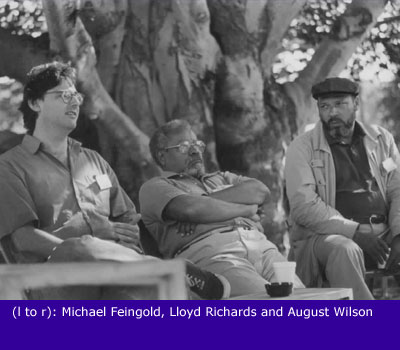
Since the late Lloyd Richards left the Eugene O'Neill Center, its centerpiece--the National Playwrights Conference--just hasn't been the same. Partly, one assumes, the turmoil is due to funding setbacks that were already taking a toll in 1991, when I spent a couple of weeks there. And partly it now seems to me because the people running it have lost Lloyd Richards' vision.
This is about the time of year that the conference happens. It's four weeks in July, when a dozen or more playwrights would work with professional directors, dramaturgs, designers and actors, many of them coming up from New York City. (My article about the O'Neill for Smithsonian magazine is reproduced here in somewhat expanded form.)
They've had a couple of artistic directors since Richards' retired, at least one of them leaving under a cloud. Last month--well before Lloyd Richards died--the new artistic director, 31 year old Wendy Goldberg, gave an interview in American Theatre. Her quotes, and some statements in the story which seem to be based on impressions and information the writer got from her, suggests how far the O'Neill has strayed, and for my money, fallen.
For four decades, the O'Neill had a policy of open submissions: anybody could send a script and it would be considered. Without such a policy, it's doubtful that many if not most of the new voices the O'Neill discovered and nurtured would have had a chance, and that seems especially true for its most important discovery: August Wilson.
A few years ago, the new regime tried to change that, and limit submissions to pre-selected playwrights. There was a hue and cry and unsolicited scripts were again considered, though in a narrower time frame, and with conditions that made entering a pretty pricey proposition. Goldberg reinstated open submissions, and though I don't know the exact rules and regs this year, statements that she makes in the interview suggest the situation hasn't really returned to what it was.
"We've had 800 submissions this year, a record amount of plays," Goldberg is quoted as saying. First of all, unless she is judging them by weight, she probably meant "a record number of plays." But even that is simply false, and by quite a lot. There were some 1500 scripts submitted for the 1991 conference, according to Lloyd Richards, and confirmed by others that summer.
There were also 12 playwrights chosen for 1991, although I believe they had previously hosted 14, but budget shortfalls forced both fewer playwrights and an altered schedule--the pre-conference in the spring, during which the playwrights spend a couple of days simply each reading their plays aloud, had to be folded into the summer conference.
But the conference in 2006 will host but eight playwrights, and one of them did not emerge from the regular submissions process. Moreover, this play will be "workshopped" before a scheduled production in Atlanta, something that Richards' resisted. He didn't want the O'Neill to become a venue tied to specific productions elsewhere. The O'Neill was about the playwright and the play, and nothing else.
That clearly is no longer true. Goldberg had done away with the system Richards instituted (and which other places copied) of simple, modular sets and basic production values, and script-in-hand performance, so that playwrights could change things right up to the minute of production, based on what they learned in their creative collaboration with all the others involved. Goldberg says that "each play is different" which is a truism but also signifies the distinct possibility that some plays are going to be favored in light of imminent productions elsewhere.
The critique system Richards set up is also slandered in the article, as some sort of vicious punishment visited upon the victimized playwright. I don't know what they were like in later years, but when I was there, Richards himself made sure these sessions were positive. He spoke before every one of them, about their purpose and how they fit into the larger purpose of the conference.
Through design and through his presence, authority and leadership, Lloyd Richards created a sense of the process as almost sacred, as touching the foundations of theatre and theatrical creativity and collaboration. It's no coincidence that one 1991 actor who did a lot of TV playing cops and criminals (an awful lot of O'Neill actors show up in episodes of Law & Order, a series co-created by an O'Neill playwright) described his participation as "renewing my vows."
The O'Neill was so important to so many people in the theatre, and so treasured, because it was a kind of temporary monastery (with a lot of un-monklike--or nunlike--behavior, to be sure) for the kind of pure creative process that the theatre needs. If it has succumbed to whatever pressures and necessities, or to poor judgment, then theatre will suffer for it, and so will playwrights.
And while a new generation of administrators has every right to their own vision, and certainly a responsibility to respond to today's realities, they might try respecting what made the O'Neill a living legend in world theatre. And the people who created it.
Since the late Lloyd Richards left the Eugene O'Neill Center, its centerpiece--the National Playwrights Conference--just hasn't been the same. Partly, one assumes, the turmoil is due to funding setbacks that were already taking a toll in 1991, when I spent a couple of weeks there. And partly it now seems to me because the people running it have lost Lloyd Richards' vision.
This is about the time of year that the conference happens. It's four weeks in July, when a dozen or more playwrights would work with professional directors, dramaturgs, designers and actors, many of them coming up from New York City. (My article about the O'Neill for Smithsonian magazine is reproduced here in somewhat expanded form.)
They've had a couple of artistic directors since Richards' retired, at least one of them leaving under a cloud. Last month--well before Lloyd Richards died--the new artistic director, 31 year old Wendy Goldberg, gave an interview in American Theatre. Her quotes, and some statements in the story which seem to be based on impressions and information the writer got from her, suggests how far the O'Neill has strayed, and for my money, fallen.
For four decades, the O'Neill had a policy of open submissions: anybody could send a script and it would be considered. Without such a policy, it's doubtful that many if not most of the new voices the O'Neill discovered and nurtured would have had a chance, and that seems especially true for its most important discovery: August Wilson.
A few years ago, the new regime tried to change that, and limit submissions to pre-selected playwrights. There was a hue and cry and unsolicited scripts were again considered, though in a narrower time frame, and with conditions that made entering a pretty pricey proposition. Goldberg reinstated open submissions, and though I don't know the exact rules and regs this year, statements that she makes in the interview suggest the situation hasn't really returned to what it was.
"We've had 800 submissions this year, a record amount of plays," Goldberg is quoted as saying. First of all, unless she is judging them by weight, she probably meant "a record number of plays." But even that is simply false, and by quite a lot. There were some 1500 scripts submitted for the 1991 conference, according to Lloyd Richards, and confirmed by others that summer.
There were also 12 playwrights chosen for 1991, although I believe they had previously hosted 14, but budget shortfalls forced both fewer playwrights and an altered schedule--the pre-conference in the spring, during which the playwrights spend a couple of days simply each reading their plays aloud, had to be folded into the summer conference.
But the conference in 2006 will host but eight playwrights, and one of them did not emerge from the regular submissions process. Moreover, this play will be "workshopped" before a scheduled production in Atlanta, something that Richards' resisted. He didn't want the O'Neill to become a venue tied to specific productions elsewhere. The O'Neill was about the playwright and the play, and nothing else.
That clearly is no longer true. Goldberg had done away with the system Richards instituted (and which other places copied) of simple, modular sets and basic production values, and script-in-hand performance, so that playwrights could change things right up to the minute of production, based on what they learned in their creative collaboration with all the others involved. Goldberg says that "each play is different" which is a truism but also signifies the distinct possibility that some plays are going to be favored in light of imminent productions elsewhere.
The critique system Richards set up is also slandered in the article, as some sort of vicious punishment visited upon the victimized playwright. I don't know what they were like in later years, but when I was there, Richards himself made sure these sessions were positive. He spoke before every one of them, about their purpose and how they fit into the larger purpose of the conference.
Through design and through his presence, authority and leadership, Lloyd Richards created a sense of the process as almost sacred, as touching the foundations of theatre and theatrical creativity and collaboration. It's no coincidence that one 1991 actor who did a lot of TV playing cops and criminals (an awful lot of O'Neill actors show up in episodes of Law & Order, a series co-created by an O'Neill playwright) described his participation as "renewing my vows."
The O'Neill was so important to so many people in the theatre, and so treasured, because it was a kind of temporary monastery (with a lot of un-monklike--or nunlike--behavior, to be sure) for the kind of pure creative process that the theatre needs. If it has succumbed to whatever pressures and necessities, or to poor judgment, then theatre will suffer for it, and so will playwrights.
And while a new generation of administrators has every right to their own vision, and certainly a responsibility to respond to today's realities, they might try respecting what made the O'Neill a living legend in world theatre. And the people who created it.
Labels:
August Wilson,
Lloyd Richards,
O'Neill Center,
theatre
Sunday, July 02, 2006
R.I. P. Lloyd Richards
I met Lloyd Richards, and though I spent only a few hours talking with him, I observed him over the course of a couple of weeks, and learned a lot about him from others. I didn't know however that our birthdays were one day apart. I found out just now, reading his obituary in the New York Times. He died on June 29, his 87th birthday.
Richards directed the first New York production of Lorraine Hansberry's A Raisin in the Sun in 1957, arguably the first authentic portrayal of African American life on the American stage. It was a classic when I read it in high school in the early 60s. But in his years of directing and discovering and nurturing playwrights of all races, his most important find was August Wilson, a great American playwright, who created the richest and most sustained expression of African American life in the twentieth century.
Only hours ago I opened a box of books one of my sisters sent for my birthday--an August Wilson play, an August Wilson essay, and a book on August Wilson (all from my Amazon Wish List.) Richards was instrumental in Wilson's career, and I met them both on the same day (July 1, a day after my birthday in 1991) at the Eugene O'Neill Center summer playwrights conference, where they had begun working together. It was Richards who picked out the manuscript for "Ma Rainey's Black Bottom" from the thousand or so that came to the O'Neill, brought the unknown Pittsburgh playwright to Waterford to work on the play, and then mounted its first productions at Yale and in New York.
Lloyd Richards was the heart and soul of the O'Neill, so important to many American playwrights. He transformed it into a community concentrating on honing and freeing new voices in theatre. He was utterly respected by everyone, for his discipline and gentleness, his rigor and humor, his attentiveness to detail and insistence on communicating the big picture, so everyone knew and shared the same vision of the O'Neill process. It hasn't been the same since he retired from being its artistic director.August Wilson died last year, and so the two giants of African American theatre are gone.
And to think just minutes ago I was ordering the last play I haven't read (apart from the one I just got) in Wilson's titanic ten play cycle, one for each decade of the twentieth century. That cycle is a truly stunning achievement, and Richards was part of getting many of those plays to their staged versions. I was looking forward to reading them all in the order of decades. Then minutes later I happened to read this. Of course, it's not as shocking as August Wilson's death at age 61. But it is another indication of an era passing. These two men have left such an incredible legacy to America and theatre everywhere.
I met Lloyd Richards, and though I spent only a few hours talking with him, I observed him over the course of a couple of weeks, and learned a lot about him from others. I didn't know however that our birthdays were one day apart. I found out just now, reading his obituary in the New York Times. He died on June 29, his 87th birthday.
Richards directed the first New York production of Lorraine Hansberry's A Raisin in the Sun in 1957, arguably the first authentic portrayal of African American life on the American stage. It was a classic when I read it in high school in the early 60s. But in his years of directing and discovering and nurturing playwrights of all races, his most important find was August Wilson, a great American playwright, who created the richest and most sustained expression of African American life in the twentieth century.
Only hours ago I opened a box of books one of my sisters sent for my birthday--an August Wilson play, an August Wilson essay, and a book on August Wilson (all from my Amazon Wish List.) Richards was instrumental in Wilson's career, and I met them both on the same day (July 1, a day after my birthday in 1991) at the Eugene O'Neill Center summer playwrights conference, where they had begun working together. It was Richards who picked out the manuscript for "Ma Rainey's Black Bottom" from the thousand or so that came to the O'Neill, brought the unknown Pittsburgh playwright to Waterford to work on the play, and then mounted its first productions at Yale and in New York.
Lloyd Richards was the heart and soul of the O'Neill, so important to many American playwrights. He transformed it into a community concentrating on honing and freeing new voices in theatre. He was utterly respected by everyone, for his discipline and gentleness, his rigor and humor, his attentiveness to detail and insistence on communicating the big picture, so everyone knew and shared the same vision of the O'Neill process. It hasn't been the same since he retired from being its artistic director.August Wilson died last year, and so the two giants of African American theatre are gone.
And to think just minutes ago I was ordering the last play I haven't read (apart from the one I just got) in Wilson's titanic ten play cycle, one for each decade of the twentieth century. That cycle is a truly stunning achievement, and Richards was part of getting many of those plays to their staged versions. I was looking forward to reading them all in the order of decades. Then minutes later I happened to read this. Of course, it's not as shocking as August Wilson's death at age 61. But it is another indication of an era passing. These two men have left such an incredible legacy to America and theatre everywhere.
Labels:
August Wilson,
Lloyd Richards,
O'Neill Center,
R.I.P.,
theatre
Tuesday, March 07, 2006
The Accidental Brecht-a-thon
Brecht's Mother Courage and Her Children and The Caucasian Chalk Circle
by William S. Kowinski
By sheer coincidence, the Humboldt State University campus hosted two productions of plays by Bertolt Brecht during the same fortnight, with two nights that both plays were staged simultaneously. In late February and early March, HSU may have briefly been the Brecht capital of the world.
But even though it was accidental, this local Brecht-a-thon was not eccentric. The unique ways Brecht’s plays address searing issues that are suddenly central to this moment is a chief reason several of them are being revisited on stages from Los Angeles to New York, where a new adaptation of Mother Courage and Her Children by playwright Tony Kushner will appear this summer, starring Meryl Streep.
This was one of the plays done locally, by the HSU Department of Theatre, Film and Dance. The other was The Caucasian Chalk Circle performed by the Young Actors Guild of the North Coast Preparatory and Performing Arts Academy.
Brecht's Mother Courage and Her Children and The Caucasian Chalk Circle
by William S. Kowinski
By sheer coincidence, the Humboldt State University campus hosted two productions of plays by Bertolt Brecht during the same fortnight, with two nights that both plays were staged simultaneously. In late February and early March, HSU may have briefly been the Brecht capital of the world.
But even though it was accidental, this local Brecht-a-thon was not eccentric. The unique ways Brecht’s plays address searing issues that are suddenly central to this moment is a chief reason several of them are being revisited on stages from Los Angeles to New York, where a new adaptation of Mother Courage and Her Children by playwright Tony Kushner will appear this summer, starring Meryl Streep.
This was one of the plays done locally, by the HSU Department of Theatre, Film and Dance. The other was The Caucasian Chalk Circle performed by the Young Actors Guild of the North Coast Preparatory and Performing Arts Academy.
Born 108 years ago this February in Bavaria, Bertolt Brecht studied medicine before working in an army hospital during World War I, where he saw the butchery of war in person. His first poems were published and his first plays produced in the early 1920s.
By 1924 he was becoming a central figure in Berlin theatre, in a particularly frenzied and creative period in Europe and specifically in Germany under the Weimar Republic. Among the intellectual and political currents swirling around him were Dada, Futurism and Marxism, as well as the slowly growing influences of Nazism. It was then he began writing his theoretical essays, and developed his “epic theatre” style, with its use of music, titles and screens. Brecht collaborated with musical composer Kurt Weill in 1928 for his most famous play, The Threepenny Opera.
As a poet he was said to be influenced by Rimbaud, Villion and Kipling, and as a playwright by Shakespeare and the Greek tragedies. Asian mask theatre as well as Bavarian folk plays and fairground entertainments are also mentioned in analyses of his work. By the early 1930s, Brecht’s anti-bourgeois and anti-Fascist politics led him to the Communist Party, and exile from Hitler’s Germany. He escaped first to Scandinavia, where in a feverish few weeks, he wrote what many consider his greatest play, Mother Courage and Her Children.
As the Nazis advanced across Europe. Brecht fled to America in 1941, thanks to the support of a large expatriate German colony in Hollywood (including actor Peter Lorre, who’d worked with Brecht in Berlin) and the sponsorship of Luise Rainer, star of The Good Earth, even though they’d never met.
But when they did take a walk on the beach together, Brecht asked her what kind of a story she would like him to write for her. Rainer suggested he try a story using the “chalk circle”—a kind of King Solomon method for deciding a child’s true mother, apparently from China. Brecht agreed, and eventually wrote The Caucasian Chalk Circle while living in Santa Monica.
Brecht wasn’t very successful in his attempts to write for Hollywood, and though like many other European exiles he felt creatively, culturally and intellectually stifled and alienated there, he did absorb aspects of American culture. He also wasn’t successful in staging plays in America--The Caucasian Chalk Circle was meant for Broadway. But he did meet a young professor teaching in Los Angeles named Eric Bentley, who would become his chief champion in America for the next half century, and with whom he would collaborate.
Brecht had been a Communist since the 1930s, and he returned to Europe the day following his questioning before the House Un-American Activities Committee. Eric Bentley believes it was only due to bureaucratic bungling that Brecht ended up in East Germany rather than West Germany in 1947.
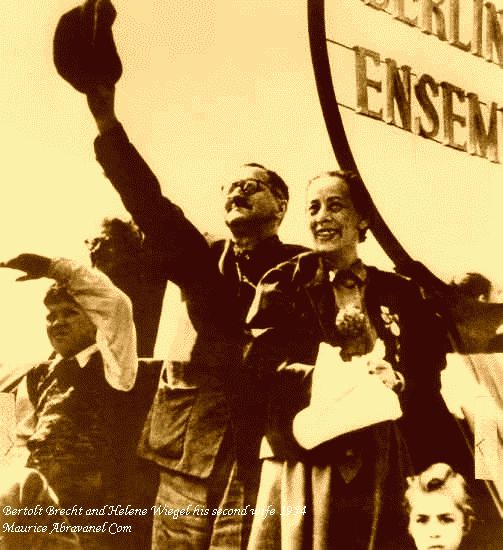
It was in Berlin in 1949 that Mother Courage and Her Children finally had its official premiere, with Brecht directing, and his wife, the actor and director Helene Weigel playing the lead. It was the production and the performance that influenced and outshone all subsequent stagings in Europe and in America.
Though Brecht has long been considered one of the 20th century’s most influential playwrights, in America his plays were not done often, nor very successfully, at least until recent years. There is very little on film that is readily available. Apart from Cold War politics, much of the problem seems to be due to confusion about how to stage his plays, according to his own theories and pronouncements. According to Bentley, Brecht (who died in 1956) could be doctrinaire about staging, and his acolytes even more insistent on purity.
But at other times, even Brecht relented, when it became clear that the theories were getting in the way of the plays. While directors continue to worry if their productions are sufficiently “epic,” and actors wonder how best to create “alienation” in the audience, Brecht is said to have kept this motto above his writing desk: “Simpler, with more laughter.” This may be the moment his plays can be seen for themselves, without the baggage.
By 1924 he was becoming a central figure in Berlin theatre, in a particularly frenzied and creative period in Europe and specifically in Germany under the Weimar Republic. Among the intellectual and political currents swirling around him were Dada, Futurism and Marxism, as well as the slowly growing influences of Nazism. It was then he began writing his theoretical essays, and developed his “epic theatre” style, with its use of music, titles and screens. Brecht collaborated with musical composer Kurt Weill in 1928 for his most famous play, The Threepenny Opera.
As a poet he was said to be influenced by Rimbaud, Villion and Kipling, and as a playwright by Shakespeare and the Greek tragedies. Asian mask theatre as well as Bavarian folk plays and fairground entertainments are also mentioned in analyses of his work. By the early 1930s, Brecht’s anti-bourgeois and anti-Fascist politics led him to the Communist Party, and exile from Hitler’s Germany. He escaped first to Scandinavia, where in a feverish few weeks, he wrote what many consider his greatest play, Mother Courage and Her Children.
As the Nazis advanced across Europe. Brecht fled to America in 1941, thanks to the support of a large expatriate German colony in Hollywood (including actor Peter Lorre, who’d worked with Brecht in Berlin) and the sponsorship of Luise Rainer, star of The Good Earth, even though they’d never met.
But when they did take a walk on the beach together, Brecht asked her what kind of a story she would like him to write for her. Rainer suggested he try a story using the “chalk circle”—a kind of King Solomon method for deciding a child’s true mother, apparently from China. Brecht agreed, and eventually wrote The Caucasian Chalk Circle while living in Santa Monica.
Brecht wasn’t very successful in his attempts to write for Hollywood, and though like many other European exiles he felt creatively, culturally and intellectually stifled and alienated there, he did absorb aspects of American culture. He also wasn’t successful in staging plays in America--The Caucasian Chalk Circle was meant for Broadway. But he did meet a young professor teaching in Los Angeles named Eric Bentley, who would become his chief champion in America for the next half century, and with whom he would collaborate.
Brecht had been a Communist since the 1930s, and he returned to Europe the day following his questioning before the House Un-American Activities Committee. Eric Bentley believes it was only due to bureaucratic bungling that Brecht ended up in East Germany rather than West Germany in 1947.
It was in Berlin in 1949 that Mother Courage and Her Children finally had its official premiere, with Brecht directing, and his wife, the actor and director Helene Weigel playing the lead. It was the production and the performance that influenced and outshone all subsequent stagings in Europe and in America.
Though Brecht has long been considered one of the 20th century’s most influential playwrights, in America his plays were not done often, nor very successfully, at least until recent years. There is very little on film that is readily available. Apart from Cold War politics, much of the problem seems to be due to confusion about how to stage his plays, according to his own theories and pronouncements. According to Bentley, Brecht (who died in 1956) could be doctrinaire about staging, and his acolytes even more insistent on purity.
But at other times, even Brecht relented, when it became clear that the theories were getting in the way of the plays. While directors continue to worry if their productions are sufficiently “epic,” and actors wonder how best to create “alienation” in the audience, Brecht is said to have kept this motto above his writing desk: “Simpler, with more laughter.” This may be the moment his plays can be seen for themselves, without the baggage.
Brecht set Mother Courage and Her Children in central Europe during the Thirty Years War of the seventeenth century. After World War I, some Europeans (including H.G. Wells in England) feared the next world war would itself last 20 years or more, and destroy western civilization.
While the unfolding second world war was on Brecht’s mind when he wrote the play, the continuing war in Iraq is much on the minds of those doing the play now, and inevitably on the audiences.
Brecht uses plain language and dark humor to tell the story of a woman trying to eke out an existence selling goods from her cart to armies on the road, while protecting her three grown children from the very war that feeds them. The basic story is fairly simple, and is foretold early in the play by a kind of oracle, like a Greek tragedy. The three children of Mother Courage all die: first, her second son whose execution is partly his mother’s doing; second, her eldest son who is executed for the same acts that had him proclaimed a hero (though by the end of the play she still doesn’t know he’s dead) and lastly, her daughter, who wakens a sleeping town by banging a drum, to warn them of the approaching army.
Commenting on this play’s theme, Brecht said: “War is a continuation of business by other means, making the human virtues fatal even to those who exercise them.” For John Heckel, director of the HSU production, the core question Mother Courage faces is: “How do you remain soulful, how do you retain a sense of nurturance?” in this situation of endless war, feeding and fed by endless greed.
While the unfolding second world war was on Brecht’s mind when he wrote the play, the continuing war in Iraq is much on the minds of those doing the play now, and inevitably on the audiences.
Brecht uses plain language and dark humor to tell the story of a woman trying to eke out an existence selling goods from her cart to armies on the road, while protecting her three grown children from the very war that feeds them. The basic story is fairly simple, and is foretold early in the play by a kind of oracle, like a Greek tragedy. The three children of Mother Courage all die: first, her second son whose execution is partly his mother’s doing; second, her eldest son who is executed for the same acts that had him proclaimed a hero (though by the end of the play she still doesn’t know he’s dead) and lastly, her daughter, who wakens a sleeping town by banging a drum, to warn them of the approaching army.
Commenting on this play’s theme, Brecht said: “War is a continuation of business by other means, making the human virtues fatal even to those who exercise them.” For John Heckel, director of the HSU production, the core question Mother Courage faces is: “How do you remain soulful, how do you retain a sense of nurturance?” in this situation of endless war, feeding and fed by endless greed.
HSU’s “Mother Courage” was presented in the 110-seat Gist Hall Theatre. It is in one of the older buildings on campus, often too warm and stuffy, with the audience looking down on the stage from severely raked rows of seats. However, about half the seats are quite close to the stage.
Though this production sold out every performance (and Heckel mourned the days when plays received 12 performances over three weekends, instead of six over two), he chose this theatre over the larger Van Duzer. Heckel likes to stage large dramas in intimate circumstances. After all, he did both parts of Angels in America here, an amazing and memorable experience.
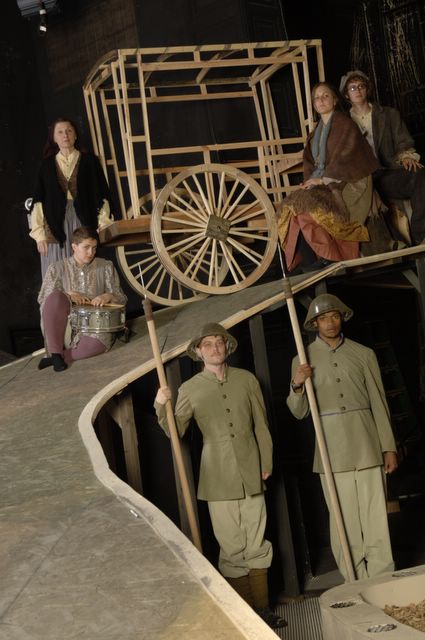
The set (by Jody Sekas) was magnificent, dominated by a raised, serpentine and circular ramp, representing the road (also depicted on a large faded map of central Europe, one of the evocative hangings on either side.) The actors pulled a cart up and down this very steep ramp, anchoring it in various places for the next scene. There was also a small central area (not unlike the mosh pit in the center of the Rolling Stone’s mouth-like ramp stage at the Super Bowl), where some action took place. A working scroll above the stage area reproduced the Brechtian titles, which tell you not only when and where the next scene is, but basically what will happen.
The cart was elaborate, and styled like a circus wagon, a motif echoed in some of other decorative elements, such as the stripes on the army’s tents depicted in a hanging.
Lila Nelson, a North Coast singer-songwriter, performer and recording artist with experience in theatre as a student here, wrote new music for Brecht’s songs. She also played piano in the accompanying band (guitar, bass, sax and cello.) Her music, folk and country-inflected, brought a distinctly American sound to the production.
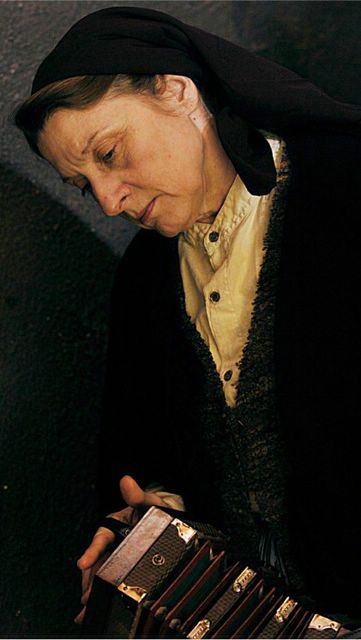
Though the singing was uneven (due in part to technical problems and the placing of the band behind the performers which made it difficult for musicians and singers to hear each other well enough), there were outstanding moments. Bernadette Cheyne (HSU theatre professor and actor) as Mother Courage brought a Judy Collins quality to her songs (reminding me that Judy Collins had recorded a Kurt Weill composition), and her powerful rendering of a song about anger was the perfect end to the first act in this production.
With a combination of recitation and singing, Joshua Switzer’s song as the Cook in the second act was a standout, and the soldier’s sternly plaintive song, “A soldier has no time to wait,” was a sober counterpoint to the absurdity going on around him---an important and haunting moment, well conceived and executed. The singing of the young women (Jessica Brown, Renee Carney, Jolie Colby and Missy Hopper) playing peasants caught in the crossfire of death, was soaring and heart-rending, especially in combination with poetic staging, gesture and movement.
I saw the first performance of the second week (Thursday), and the second act on its final night (Saturday.) The text was presented well, and the movement and stage pictures were often striking. By Saturday, the acting was purified, stripped to its essence. On the whole, it was a success. But for me, some of the production’s problems and missed opportunity’s remained.
Though this production sold out every performance (and Heckel mourned the days when plays received 12 performances over three weekends, instead of six over two), he chose this theatre over the larger Van Duzer. Heckel likes to stage large dramas in intimate circumstances. After all, he did both parts of Angels in America here, an amazing and memorable experience.
The set (by Jody Sekas) was magnificent, dominated by a raised, serpentine and circular ramp, representing the road (also depicted on a large faded map of central Europe, one of the evocative hangings on either side.) The actors pulled a cart up and down this very steep ramp, anchoring it in various places for the next scene. There was also a small central area (not unlike the mosh pit in the center of the Rolling Stone’s mouth-like ramp stage at the Super Bowl), where some action took place. A working scroll above the stage area reproduced the Brechtian titles, which tell you not only when and where the next scene is, but basically what will happen.
The cart was elaborate, and styled like a circus wagon, a motif echoed in some of other decorative elements, such as the stripes on the army’s tents depicted in a hanging.
Lila Nelson, a North Coast singer-songwriter, performer and recording artist with experience in theatre as a student here, wrote new music for Brecht’s songs. She also played piano in the accompanying band (guitar, bass, sax and cello.) Her music, folk and country-inflected, brought a distinctly American sound to the production.
Though the singing was uneven (due in part to technical problems and the placing of the band behind the performers which made it difficult for musicians and singers to hear each other well enough), there were outstanding moments. Bernadette Cheyne (HSU theatre professor and actor) as Mother Courage brought a Judy Collins quality to her songs (reminding me that Judy Collins had recorded a Kurt Weill composition), and her powerful rendering of a song about anger was the perfect end to the first act in this production.
With a combination of recitation and singing, Joshua Switzer’s song as the Cook in the second act was a standout, and the soldier’s sternly plaintive song, “A soldier has no time to wait,” was a sober counterpoint to the absurdity going on around him---an important and haunting moment, well conceived and executed. The singing of the young women (Jessica Brown, Renee Carney, Jolie Colby and Missy Hopper) playing peasants caught in the crossfire of death, was soaring and heart-rending, especially in combination with poetic staging, gesture and movement.
I saw the first performance of the second week (Thursday), and the second act on its final night (Saturday.) The text was presented well, and the movement and stage pictures were often striking. By Saturday, the acting was purified, stripped to its essence. On the whole, it was a success. But for me, some of the production’s problems and missed opportunity’s remained.
Here my description and evaluation becomes intermixed with argument. It’s a problematic line, especially between critique and “here’s how I would do it.” I would be much more careful if this was a published review. But hey, this is just my blog, and I can do what I like.
Part of my argument goes to the point alluded to before, about how much Brechtian theory is necessary, or even how is it appropriately applied, especially now in 2006. Part of it is based on my conception of the play, and how to put that conception across. So again it can be construed partly as critique, or simply as alternative.
The set was memorable, and John Heckel used it well to position actors to make arresting stage pictures. But it was also a trap, even apart from the metaphorical trap of the endlessly circular road of war. Not only did the steep ramps and heavy cart prove treacherous for the actors, but they dictated a style that at time could not take full advantage of the text.
The cart was quite a problem, especially on the steep ramp, even as the actors became quite adept and moving and anchoring it with a minimum of distraction. It almost toppled, taking Bernadette with it, on opening night, causing a change in the play’s famous ending---in which Mother Courage, her children dead, pulls the cart alone down the endless road. But oddly, the change actually added to the effect: now her two ghostly sons helped her part way, and then stood as she continued (though she did not go to the top of the ramp as planned, but left the cart at the foot and mimed the ascent. Even so, there was another almost-fall Saturday.)
But the steep ramps also made it difficult for two people to stand next to each other very easily. This may have been part of the intent, but to me it didn’t allow for variations and nuances in space and pace. There were scenes in which words exchanged quickly between two people in close proximity, with appropriate pauses and so on, could have added a great deal. But they were played, as often they had to be, with the actors separated—even on opposite sides of the ramp—essentially shouting at each other, and the audience. This tended to flatten the affect, and the effect.
But again, this may have been intentional, based at least partly on a “Brechtian” approach. But I don’t think it served the play. First of all, I don’t think imposing a “Brechtian” approach is really necessary any longer. The theatre is not what it was in Berlin in 1928. We’ve had decades of movies and television, as well as theatrical experimentation that has become mainstream. We understand different cues to different approaches now.
Part of my argument goes to the point alluded to before, about how much Brechtian theory is necessary, or even how is it appropriately applied, especially now in 2006. Part of it is based on my conception of the play, and how to put that conception across. So again it can be construed partly as critique, or simply as alternative.
The set was memorable, and John Heckel used it well to position actors to make arresting stage pictures. But it was also a trap, even apart from the metaphorical trap of the endlessly circular road of war. Not only did the steep ramps and heavy cart prove treacherous for the actors, but they dictated a style that at time could not take full advantage of the text.
The cart was quite a problem, especially on the steep ramp, even as the actors became quite adept and moving and anchoring it with a minimum of distraction. It almost toppled, taking Bernadette with it, on opening night, causing a change in the play’s famous ending---in which Mother Courage, her children dead, pulls the cart alone down the endless road. But oddly, the change actually added to the effect: now her two ghostly sons helped her part way, and then stood as she continued (though she did not go to the top of the ramp as planned, but left the cart at the foot and mimed the ascent. Even so, there was another almost-fall Saturday.)
But the steep ramps also made it difficult for two people to stand next to each other very easily. This may have been part of the intent, but to me it didn’t allow for variations and nuances in space and pace. There were scenes in which words exchanged quickly between two people in close proximity, with appropriate pauses and so on, could have added a great deal. But they were played, as often they had to be, with the actors separated—even on opposite sides of the ramp—essentially shouting at each other, and the audience. This tended to flatten the affect, and the effect.
But again, this may have been intentional, based at least partly on a “Brechtian” approach. But I don’t think it served the play. First of all, I don’t think imposing a “Brechtian” approach is really necessary any longer. The theatre is not what it was in Berlin in 1928. We’ve had decades of movies and television, as well as theatrical experimentation that has become mainstream. We understand different cues to different approaches now.
Eric Bentley insisted that just as staging Brecht doesn’t require any of Brecht’s political theory, it requires little if any of his theatrical theory. This is true in structural terms. “I think, you know, the Mother Courage structure is certainly unorthodox according to Ibsen or Arthur Miller,” he said in a conversational interview, “ but it's not that far from Elizabethan.”
Brecht’s theory on the theatrical effects he wants productions to avoid is also often contradicted by the text itself. “You know, Brecht would say you don't need climaxes, that they're a bourgeois illusion,” Bentley said. “But the terrific climax in Mother Courage-- in the scene of the drumbeat-- it's the orthodox place for dramatic climax, namely about 2/3 of the way through the plot. It reaches a high point, or low point according to your point of view, of tragedy. And such is the case with the other things that he's supposed not to have, like emotion. There's a lot of it. So I think a perfectly orthodox approach, critically speaking, is valid. And the same goes for the actors.”
Naturalistic and “in the moment” acting is our age’s way of creating verisimilitude. Apart from interpretations of Brecht’s theories and pronouncements on acting in his plays, the plays themselves clearly call for at least elements of what we might call performance. But I contend this should not really be a problem.
For one thing, I don’t think it requires or benefits from elaborate or self-conscious strategies. Actors sometimes seem to take “alienation” so literally that they attempt to alienate the audience with bad acting, especially with the kind of gestures and signifying that has defined bad acting for generations (though perhaps not…everywhere.)
Look at the text of this play. It begins with a Recruiting Officer and a Sergeant self-righteously complaining they are unable to trick enough men into becoming cannon fodder in the army to meet their quota. The Recruiting Officer is moaning that he’s seriously thinking of killing himself because when he finally gets a potential recruit drunk enough to join up, the guy runs off.
Here’s what the Sergeant says: “Well, that’s the problem, isn’t it? They havent’ had a war here for such a long time. Without a good war, where do you get your moral standards from? Everything goes to pot in peacetime…Of course, as with all good things, it’s hard to get a proper war started. Once it starts, of course, there’s no stopping it, thank God.”
This kind of dark humor, black irony plainly stated, should not be stylistically unfamiliar in 2006. Not after Catch-22, Kurt Vonnegut, Dr. Strangelove (especially George C. Scott’s General Turgeson), and the absurdist/surrealist/Brechtian films of Richard Lester, notably How I Won the War and the nuclear apocalypse farce, The Bed-Sitting Room—but come to that, his better known two Beatles films have those "Brechtian" qualities, too. Which they share with the Marx Brothers movies, including Duck Soup, another satire of war. And after that, Monty Python, and before, Chaplin---there are plenty of examples. Fantasy, realism, political and class satire, emotion, irony, gags, drama, character arcs and a flexible fourth wall---they've all been combined many times.
Brecht himself knew all about the wise fool and jester tradition that goes as far back in European history and performance as its possible to go. The court jester was really the first allowed free speech, challenging the rulers and what they do. It was also part of the folk and festival traditions, the carnival, burlesque and Vaudeville. In Brecht it may be class analysis, but it uses the tools of irony, satire, lampoon. It attacks with startling, pithy truth, but in a way that evokes laughter.
We are heirs of that tradition, and all we need is to be tipped off to the fact that we’re allowed to laugh. This to me was the greatest weakness of this production. The laughter should have begun with this first exchange between the Recruiting Officer and the Sergeant. The audience knows this is about a weighty subject, and it comes draped in art and the mystification of a playwright who has an “ian” after his name in the textbooks. They need to know these guys are clowns, and what they are saying is meant to be both absurd and absurdly truthful. Playing it on the overly dramatic side of naturalism---with the actors on opposite sides of the stage, talking loudly and slowly--- is going in the wrong direction.
Not all the parts worked this way but several of the key ones did, and a few of the actors performed this aspect effectively, especially Kato Buss as the Chaplain---and not surprisingly, he got the most laughs.
This is the tone I felt was mostly missing and at times undermined. In one scene, Mother Courage, the Chaplain and the Cook are in conversation, while Kattrin (the daughter) is trying on a pair of red shoes and a red hat left behind by a whore. It is an important scene for building the character of Kattrin, and director Heckel chose to focus on it, to the extent of completely obscuring the conversation (it was pre-recorded and kept at a soft monotone, while the predominant sound was the cello accompanying Kattrin’s movements.) Unfortunately, that conversation also contains some of the sharpest and most outrageous observations about war in the play, completely lost.
In the play as a whole, there were so many references that chillingly parallel what’s been going on with the Iraq war, that together with the play’s own drama, this production couldn’t fail to have a powerful effect. But I think I would have liked it better if it had been simpler, with more laughter.
Brecht’s theory on the theatrical effects he wants productions to avoid is also often contradicted by the text itself. “You know, Brecht would say you don't need climaxes, that they're a bourgeois illusion,” Bentley said. “But the terrific climax in Mother Courage-- in the scene of the drumbeat-- it's the orthodox place for dramatic climax, namely about 2/3 of the way through the plot. It reaches a high point, or low point according to your point of view, of tragedy. And such is the case with the other things that he's supposed not to have, like emotion. There's a lot of it. So I think a perfectly orthodox approach, critically speaking, is valid. And the same goes for the actors.”
Naturalistic and “in the moment” acting is our age’s way of creating verisimilitude. Apart from interpretations of Brecht’s theories and pronouncements on acting in his plays, the plays themselves clearly call for at least elements of what we might call performance. But I contend this should not really be a problem.
For one thing, I don’t think it requires or benefits from elaborate or self-conscious strategies. Actors sometimes seem to take “alienation” so literally that they attempt to alienate the audience with bad acting, especially with the kind of gestures and signifying that has defined bad acting for generations (though perhaps not…everywhere.)
Look at the text of this play. It begins with a Recruiting Officer and a Sergeant self-righteously complaining they are unable to trick enough men into becoming cannon fodder in the army to meet their quota. The Recruiting Officer is moaning that he’s seriously thinking of killing himself because when he finally gets a potential recruit drunk enough to join up, the guy runs off.
Here’s what the Sergeant says: “Well, that’s the problem, isn’t it? They havent’ had a war here for such a long time. Without a good war, where do you get your moral standards from? Everything goes to pot in peacetime…Of course, as with all good things, it’s hard to get a proper war started. Once it starts, of course, there’s no stopping it, thank God.”
This kind of dark humor, black irony plainly stated, should not be stylistically unfamiliar in 2006. Not after Catch-22, Kurt Vonnegut, Dr. Strangelove (especially George C. Scott’s General Turgeson), and the absurdist/surrealist/Brechtian films of Richard Lester, notably How I Won the War and the nuclear apocalypse farce, The Bed-Sitting Room—but come to that, his better known two Beatles films have those "Brechtian" qualities, too. Which they share with the Marx Brothers movies, including Duck Soup, another satire of war. And after that, Monty Python, and before, Chaplin---there are plenty of examples. Fantasy, realism, political and class satire, emotion, irony, gags, drama, character arcs and a flexible fourth wall---they've all been combined many times.
Brecht himself knew all about the wise fool and jester tradition that goes as far back in European history and performance as its possible to go. The court jester was really the first allowed free speech, challenging the rulers and what they do. It was also part of the folk and festival traditions, the carnival, burlesque and Vaudeville. In Brecht it may be class analysis, but it uses the tools of irony, satire, lampoon. It attacks with startling, pithy truth, but in a way that evokes laughter.
We are heirs of that tradition, and all we need is to be tipped off to the fact that we’re allowed to laugh. This to me was the greatest weakness of this production. The laughter should have begun with this first exchange between the Recruiting Officer and the Sergeant. The audience knows this is about a weighty subject, and it comes draped in art and the mystification of a playwright who has an “ian” after his name in the textbooks. They need to know these guys are clowns, and what they are saying is meant to be both absurd and absurdly truthful. Playing it on the overly dramatic side of naturalism---with the actors on opposite sides of the stage, talking loudly and slowly--- is going in the wrong direction.
Not all the parts worked this way but several of the key ones did, and a few of the actors performed this aspect effectively, especially Kato Buss as the Chaplain---and not surprisingly, he got the most laughs.
This is the tone I felt was mostly missing and at times undermined. In one scene, Mother Courage, the Chaplain and the Cook are in conversation, while Kattrin (the daughter) is trying on a pair of red shoes and a red hat left behind by a whore. It is an important scene for building the character of Kattrin, and director Heckel chose to focus on it, to the extent of completely obscuring the conversation (it was pre-recorded and kept at a soft monotone, while the predominant sound was the cello accompanying Kattrin’s movements.) Unfortunately, that conversation also contains some of the sharpest and most outrageous observations about war in the play, completely lost.
In the play as a whole, there were so many references that chillingly parallel what’s been going on with the Iraq war, that together with the play’s own drama, this production couldn’t fail to have a powerful effect. But I think I would have liked it better if it had been simpler, with more laughter.
Mother Courage and Her Children is a kind of tragedy, but The Caucasian Chalk Circle is classically a comedy, with a happy ending. Of course it still have biting irony concerning class and politics, and some unfortunate events.
The basic story: In the midst of a palace coup, the infant prince is left behind, then rescued---reluctantly at first—by the young peasant woman, Grusha. She is pursued by soldiers, in the dangerous landscape of shifting allegiances. Eventually the old rulers return, the governor’s wife wants the baby back, so Grusha is again pursued, and this time is caught.
Then the matter is put before a court, with the genially corrupt, former revolutionary Azdak presiding as judge. He eventually invokes the “chalk circle” test, in which the two women contending for the baby— the now devoted Grusha and the child’s ‘birth mother,’ the governor’s wife—struggle to pull the child outside the circle on their side. Though Grusha loses the struggle, because she won’t endanger the child, she wins the baby, for precisely that reason. She is finally reunited with her soldier lover, so a Shakespearian marriage is not far off to cap the comedy.
The two pivotal characters are Grusha and Azdak. Brecht’s stay in America is reflected in at least one way. In the notes to this play, Brecht writes, “In the English language there is an American term, ‘sucker,’ and this is exactly what Grusha is being when she takes over the child.” He tries to explain what the word means but there is no German equivalent, which probably suggests the concept was new to him in America.
Eric Bentley takes up this theme in a 1966 essay on this play. “To give way to the promptings of nature, to natural sympathy, to the natural love of the Good, is to be a Sucker. America invented that expressive word, and America’s most articulate comedian, W.C. Fields, called one of his films, Never Give a Sucker An Even Break. In The Caucasian Chalk Circle, a sucker gets an even break."
Azdak is as a character in the “fool” or trickster tradition, especially as preserved in folk tales of clever animals who sometimes triumph, but also sometimes subvert themselves with arrogance, gluttony, greed and too much cleverness. He is a kind of rogue, but he rises to the occasion in Grusha’s case.
Though the play is lighter than “Mother Courage,” it is also suffused with irony and social consciousness, this time more directly concentrated on class. But like Charles Dickens, who also wrote to champion the downtrodden, Brecht spares no class, high or low, in his exposure of hypocrisy, meanness and selfishness. He does so with comedy (as folk stories do) and irony, but never simply as a joke. A peasant in "Mother Courage" is willing to die rather than give information that would allow the sleeping children in town to be slaughtered, when the soldiers threaten her bull and cows, she relents. This is ironic and funny, an apparent comment on character, yet deeply tragic, because it’s tragically true: without livestock, the entire family might starve.
The local "Chalk Circle" production was a project for freshmen and sophomores at North Coast Prep, ranging in age from 13 to l6 (including several foreign exchange students.) More than thirty actors and musicians participated, with music composed and played by students Greg Moore and Izzy Samuels.
Director and teacher Jean Bazemore said her students responded to this play's humor and core message-- --“that there are good people who take risks and make difficult choices in difficult times. They love it. The opportunity to meet characters who make courageous choices is really appealing to them.”
Though the players were young, this was not an ordinary high school production. Theatre is a core subject at North Coast Prep, and everyone involved lives up to their membership in the Young Actors Guild ensemble: they take theatre and learning about it seriously, and work together and support each other every day.
Plus they have Jean Bazemore, a talented and visionary director who directed at HSU and elsewhere for many years. Also the set and lighting design of Gerald Beck, always breathtaking in their simplicity, elegance and appropriateness, providing these young actors with an environment that both expresses and guides them. Neither of them approaches their productions as anything less than a professional effort, and their seriousness is palpable in the discipline of the actors.
But the production still has an educational function, and part of it is to provide for as much participation as possible. Even with so many roles, some are double-cast. The Chalk Circle is quite a challenge, but added to that, it was performed in the large Van Duzer theatre over 4 consecutive nights, with two additional morning performances for other schools. (Residents of a local homeless shelter were also guests at one performance.) Double-casting in the main roles probably helped, and so does youth, but it was still a daunting schedule.
I saw it on opening night, when the cast was still getting their legs under them, though by the second half they were proceeding with more confidence and less self-consciousness. Chisa Hughes as Grusha (she alternated with Fiona Ryder) and Bo Banducci as Azdak (alternating with Isaiah Cooper) did very well in their key roles, and made sure everything they said and did was clear, with defined actions and strong stage voices.
Hughes has an impressive singing voice, though she only got to sing one song the night I saw her perform (many of the play's songs weree spoken.) Banducci has the physical ease and fluidity of a natural performer, plus a vocal quality that is not only clear but inherently interesting, like Peter Coyote’s voice, which invites and commands attention. I look forward to seeing both of them (as well as others in the cast) develop their skills to play nuance and control pace.
While not as powerful or focused as the fall production of Antigone and St. Joan by North Coast Prep’s juniors and seniors, at least when I saw it, this “Chalk Circle” was still a good night of theatre for local audiences, especially as an introduction to Brecht. I wish I could have seen it again later in the run, for I felt that this group would learn a great deal in a few days. What especially interested me was that none of these very young actors had any visible problem playing Brecht. Chisa Hughes was an appropriately sympathetic Grusha, and Bo Banducci was an appropriately ironic Azdak.
For all of Brecht’s influential theories, his plays are filled with drama and emotion, as well as irony and dark laughter (be it gallows humor or black humor, or “Brechtian” humor.) Eric Bentley said that when he taught Brecht, he didn’t start with Brecht’s theories but with his poems. (The North Coast Prep program included a great one.) Perhaps it’s even enough to start with his plays.
“The plays of so socially conscious a playwright as Brecht, who was dedicated to the task of showing his fellow human beings that the world must be changed through social action, also contain powerful poetic metaphors of human emotion,” wrote Martin Esslin, in the final pages of his book, An Anatomy of Drama. “Mother Courage pulling her cart, Gruscha in The Caucasian Chalk Circle crossing the swaying bridge over the ravine to save the child…these are poetic images of human resilence, tenderness and sensuality...”
The basic story: In the midst of a palace coup, the infant prince is left behind, then rescued---reluctantly at first—by the young peasant woman, Grusha. She is pursued by soldiers, in the dangerous landscape of shifting allegiances. Eventually the old rulers return, the governor’s wife wants the baby back, so Grusha is again pursued, and this time is caught.
Then the matter is put before a court, with the genially corrupt, former revolutionary Azdak presiding as judge. He eventually invokes the “chalk circle” test, in which the two women contending for the baby— the now devoted Grusha and the child’s ‘birth mother,’ the governor’s wife—struggle to pull the child outside the circle on their side. Though Grusha loses the struggle, because she won’t endanger the child, she wins the baby, for precisely that reason. She is finally reunited with her soldier lover, so a Shakespearian marriage is not far off to cap the comedy.
The two pivotal characters are Grusha and Azdak. Brecht’s stay in America is reflected in at least one way. In the notes to this play, Brecht writes, “In the English language there is an American term, ‘sucker,’ and this is exactly what Grusha is being when she takes over the child.” He tries to explain what the word means but there is no German equivalent, which probably suggests the concept was new to him in America.
Eric Bentley takes up this theme in a 1966 essay on this play. “To give way to the promptings of nature, to natural sympathy, to the natural love of the Good, is to be a Sucker. America invented that expressive word, and America’s most articulate comedian, W.C. Fields, called one of his films, Never Give a Sucker An Even Break. In The Caucasian Chalk Circle, a sucker gets an even break."
Azdak is as a character in the “fool” or trickster tradition, especially as preserved in folk tales of clever animals who sometimes triumph, but also sometimes subvert themselves with arrogance, gluttony, greed and too much cleverness. He is a kind of rogue, but he rises to the occasion in Grusha’s case.
Though the play is lighter than “Mother Courage,” it is also suffused with irony and social consciousness, this time more directly concentrated on class. But like Charles Dickens, who also wrote to champion the downtrodden, Brecht spares no class, high or low, in his exposure of hypocrisy, meanness and selfishness. He does so with comedy (as folk stories do) and irony, but never simply as a joke. A peasant in "Mother Courage" is willing to die rather than give information that would allow the sleeping children in town to be slaughtered, when the soldiers threaten her bull and cows, she relents. This is ironic and funny, an apparent comment on character, yet deeply tragic, because it’s tragically true: without livestock, the entire family might starve.
The local "Chalk Circle" production was a project for freshmen and sophomores at North Coast Prep, ranging in age from 13 to l6 (including several foreign exchange students.) More than thirty actors and musicians participated, with music composed and played by students Greg Moore and Izzy Samuels.
Director and teacher Jean Bazemore said her students responded to this play's humor and core message-- --“that there are good people who take risks and make difficult choices in difficult times. They love it. The opportunity to meet characters who make courageous choices is really appealing to them.”
Though the players were young, this was not an ordinary high school production. Theatre is a core subject at North Coast Prep, and everyone involved lives up to their membership in the Young Actors Guild ensemble: they take theatre and learning about it seriously, and work together and support each other every day.
Plus they have Jean Bazemore, a talented and visionary director who directed at HSU and elsewhere for many years. Also the set and lighting design of Gerald Beck, always breathtaking in their simplicity, elegance and appropriateness, providing these young actors with an environment that both expresses and guides them. Neither of them approaches their productions as anything less than a professional effort, and their seriousness is palpable in the discipline of the actors.
But the production still has an educational function, and part of it is to provide for as much participation as possible. Even with so many roles, some are double-cast. The Chalk Circle is quite a challenge, but added to that, it was performed in the large Van Duzer theatre over 4 consecutive nights, with two additional morning performances for other schools. (Residents of a local homeless shelter were also guests at one performance.) Double-casting in the main roles probably helped, and so does youth, but it was still a daunting schedule.
I saw it on opening night, when the cast was still getting their legs under them, though by the second half they were proceeding with more confidence and less self-consciousness. Chisa Hughes as Grusha (she alternated with Fiona Ryder) and Bo Banducci as Azdak (alternating with Isaiah Cooper) did very well in their key roles, and made sure everything they said and did was clear, with defined actions and strong stage voices.
Hughes has an impressive singing voice, though she only got to sing one song the night I saw her perform (many of the play's songs weree spoken.) Banducci has the physical ease and fluidity of a natural performer, plus a vocal quality that is not only clear but inherently interesting, like Peter Coyote’s voice, which invites and commands attention. I look forward to seeing both of them (as well as others in the cast) develop their skills to play nuance and control pace.
While not as powerful or focused as the fall production of Antigone and St. Joan by North Coast Prep’s juniors and seniors, at least when I saw it, this “Chalk Circle” was still a good night of theatre for local audiences, especially as an introduction to Brecht. I wish I could have seen it again later in the run, for I felt that this group would learn a great deal in a few days. What especially interested me was that none of these very young actors had any visible problem playing Brecht. Chisa Hughes was an appropriately sympathetic Grusha, and Bo Banducci was an appropriately ironic Azdak.
For all of Brecht’s influential theories, his plays are filled with drama and emotion, as well as irony and dark laughter (be it gallows humor or black humor, or “Brechtian” humor.) Eric Bentley said that when he taught Brecht, he didn’t start with Brecht’s theories but with his poems. (The North Coast Prep program included a great one.) Perhaps it’s even enough to start with his plays.
“The plays of so socially conscious a playwright as Brecht, who was dedicated to the task of showing his fellow human beings that the world must be changed through social action, also contain powerful poetic metaphors of human emotion,” wrote Martin Esslin, in the final pages of his book, An Anatomy of Drama. “Mother Courage pulling her cart, Gruscha in The Caucasian Chalk Circle crossing the swaying bridge over the ravine to save the child…these are poetic images of human resilence, tenderness and sensuality...”
Friday, July 15, 2005
Films About Theatre: A DVD Friday Collection
Supplementing what has become a nightly diet of "Six Feet Under" episodes on DVD (an HBO series we've never seen because we didn't have HBO even when we had cable---we're into the second season now), I rented two movies that just got off the "new" list, and by complete accident they both were films about the theatre (the first two in the list below).
Films about theatre happen to form one of my favorite subgenres, and so these two new additions inspire the first of the DVD Friday lists of personal favorites. All are available on DVD unless otherwise noted, though I haven't yet seen them all on DVD.
1. '>BEING JULIA (2004) From a novel by Somerset Magham, scripted by playwright and theatre explainer Ronald Harwood, this story about a famous but aging actress in London of 1938 is smart, stylish, funny and moving. Annette Benning deserved the Oscar she was robbed of, for this film, and the other performances---from Jeremy Irons to the wonderful Juliet Stevenson to relative newcomers, at least to film in America---are uniformly excellent. And in dealing with youthful ambition (somewhat reminiscent of "All About Eve"-see below) the resolution is wonderfully theatrical.
2. '>FINDING NEVERLAND (2004) Johnny Depp plays J.M Barrie in London as the nineteenth century becomes the 20th, when after his latest play fails he meets the woman and her children who will inspire "Peter Pan," which as a play has a double role in the film's climax. Depp and Kate Winslet are outstanding, supported by perfectly pitched performances from Julie Christie and Dustin Hoffman. The whole cast is very good, especially the boys who play the boys (proving that not all the talented English children are in the Harry Potter movies.)
The story is based on real events, though of course reality was much messier. Barrie did in fact write his play for the sons of a woman he met, and did later become guardian to the boys. But the woman's husband was still alive (he's conveniently dead in the movie), and for all the faith in the power of magic Barrie may have instilled in them, the boys came to bad ends: one killed in World War I, one drowned in the embrace of another man, and Peter killed himself, although he was an adult by then, and in publishing, but may have felt himself a prisoner of Barrie's imaginings.
Still, it's a very good movie, if a little saccarine about imagination and unimaginative about faith. But it has lovely touches about theatre, especially the relationships between actors, trying to support each other in the midst of not having a clue why they are dressed up as a pirate and a dog. The DVD extras are great---the deleted scenes are as good as any in the movie, and the outtakes are funny. There's one of Johnny Depp doing a scene in the park with a dog that decides to take a dump, and Depp talks to him in the same Scottish accent he employs for Barrie.
Supplementing what has become a nightly diet of "Six Feet Under" episodes on DVD (an HBO series we've never seen because we didn't have HBO even when we had cable---we're into the second season now), I rented two movies that just got off the "new" list, and by complete accident they both were films about the theatre (the first two in the list below).
Films about theatre happen to form one of my favorite subgenres, and so these two new additions inspire the first of the DVD Friday lists of personal favorites. All are available on DVD unless otherwise noted, though I haven't yet seen them all on DVD.
1. '>BEING JULIA (2004) From a novel by Somerset Magham, scripted by playwright and theatre explainer Ronald Harwood, this story about a famous but aging actress in London of 1938 is smart, stylish, funny and moving. Annette Benning deserved the Oscar she was robbed of, for this film, and the other performances---from Jeremy Irons to the wonderful Juliet Stevenson to relative newcomers, at least to film in America---are uniformly excellent. And in dealing with youthful ambition (somewhat reminiscent of "All About Eve"-see below) the resolution is wonderfully theatrical.
2. '>FINDING NEVERLAND (2004) Johnny Depp plays J.M Barrie in London as the nineteenth century becomes the 20th, when after his latest play fails he meets the woman and her children who will inspire "Peter Pan," which as a play has a double role in the film's climax. Depp and Kate Winslet are outstanding, supported by perfectly pitched performances from Julie Christie and Dustin Hoffman. The whole cast is very good, especially the boys who play the boys (proving that not all the talented English children are in the Harry Potter movies.)
The story is based on real events, though of course reality was much messier. Barrie did in fact write his play for the sons of a woman he met, and did later become guardian to the boys. But the woman's husband was still alive (he's conveniently dead in the movie), and for all the faith in the power of magic Barrie may have instilled in them, the boys came to bad ends: one killed in World War I, one drowned in the embrace of another man, and Peter killed himself, although he was an adult by then, and in publishing, but may have felt himself a prisoner of Barrie's imaginings.
Still, it's a very good movie, if a little saccarine about imagination and unimaginative about faith. But it has lovely touches about theatre, especially the relationships between actors, trying to support each other in the midst of not having a clue why they are dressed up as a pirate and a dog. The DVD extras are great---the deleted scenes are as good as any in the movie, and the outtakes are funny. There's one of Johnny Depp doing a scene in the park with a dog that decides to take a dump, and Depp talks to him in the same Scottish accent he employs for Barrie.
Subscribe to:
Posts (Atom)