Friday, July 22, 2005


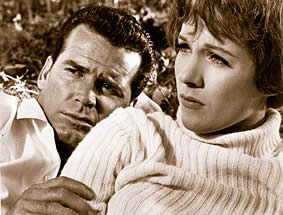
James Garner, Julie Andrews in "The Americanization of Emily"  Posted by Picasa
DVD FRIDAY: The Americanization of Emily

Of all the movies he made, James Garner said this was his favorite. So did Julie Andrews, his co-star. So did James Coburn, who had a more prominent role in many other films than he did in this one.

It was producer Martin Ransohoff's favorite of his movies, and Arthur Hiller's favorite of the many movies he directed. Script writer Paddy Chayevsky, who wrote several classics and an Academy Award winner, said this was one of his two favorite films.

Yet until the newly released DVD, '>The Americanization of Emily had all but disappeared. Perhaps because in many ways it was unclassifiable: a romantic comedy, a war movie, an anti-war movie, or as director Hiller insists, "an anti-the-glorification-of-war movie."

Made in 1964 in black and white, it may have become overshadowed by other more famous films of that era and that style on something like that theme: "Dr. Strangelove," perhaps even "Fail-Safe." Set in World War II, it was more distanced and with a dryer wit than the anti-war war novel of that time, "Catch-22."

But the new DVD reveals its considerable virtues: the eloquent and characteristically Chayevsky script, the fine, committed performances by Garner, Andrews, Coburn and Melvyn Douglas, among others. The rhythms and fluid camera of Arthur Hiller's first major directing job, that managed to make a single movie out of a unique combination of elements.

Hiller's DVD commentary is a great bonus. Producer Ransohoff bought the William Bradford Huie novel of the same title, which was a pretty straightforward romance about an English girl falling in love with an American soldier stationed in England during World War II. At some point he got the idea of asking Chayevsky to write it. Chayevsky flew from New York to Hollywood, and told Ransohoff it really wasn't for him. But on his flight back he thought of a way to do it, and called Ransohoff, explained this very different approach of making the hero a selfish sensualist who despises wartime heroics, but winds up being an accidental hero himself. For some reason, Ransohoff liked it.

Various directors and actors were attached to the project---at one point William Holden was the lead, and James Garner was to play his friend. When Holden dropped out, Garner moved up, and Coburn was added (possibly at the behest of Garner.)
Julie Andrews hadn't done a major movie yet---but she went from this one directly to making "Mary Poppins."

Arthur Hiller was a young and untested director, who got the job when better known directors turned it down. He was pretty nervy for a kid. He insisted on making it in black and white, which the studio opposed, since color films made more money. He set up shots so they were done without cuts, so the studio could slice and dice his film.

Later, Hiller recounts, Ted Turner bought the TV rights and colorized it. Hiller protested loud and long, as did other directors and film buffs. Eventually Turner listened and not only stopped colorizing, he joined Hiller in leading new efforts to preserve America's movie heritage by restoring and preserving endangered films.

This is a quirky, sometimes unsettling but often surprising and always entertaining movie, a real DVD treasure for your weekend viewing.

Friday, July 15, 2005


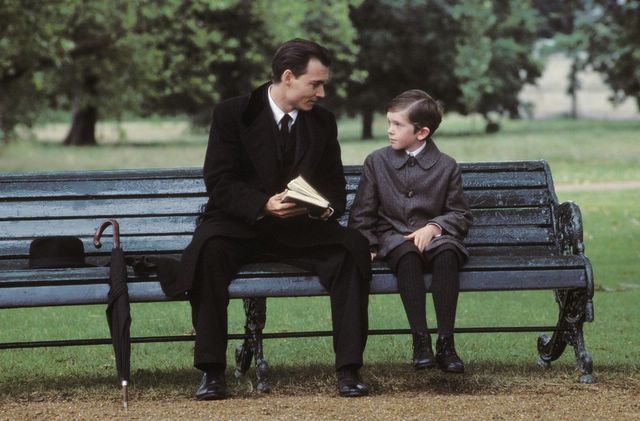
Before Charlie, Finding Neverland Posted by Picasa
Films About Theatre: A DVD Friday Collection

Supplementing what has become a nightly diet of "Six Feet Under" episodes on DVD (an HBO series we've never seen because we didn't have HBO even when we had cable---we're into the second season now), I rented two movies that just got off the "new" list, and by complete accident they both were films about the theatre (the first two in the list below).

Films about theatre happen to form one of my favorite subgenres, and so these two new additions inspire the first of the DVD Friday lists of personal favorites. All are available on DVD unless otherwise noted, though I haven't yet seen them all on DVD.

1. '>BEING JULIA (2004) From a novel by Somerset Magham, scripted by playwright and theatre explainer Ronald Harwood, this story about a famous but aging actress in London of 1938 is smart, stylish, funny and moving. Annette Benning deserved the Oscar she was robbed of, for this film, and the other performances---from Jeremy Irons to the wonderful Juliet Stevenson to relative newcomers, at least to film in America---are uniformly excellent. And in dealing with youthful ambition (somewhat reminiscent of "All About Eve"-see below) the resolution is wonderfully theatrical.

2. '>FINDING NEVERLAND (2004) Johnny Depp plays J.M Barrie in London as the nineteenth century becomes the 20th, when after his latest play fails he meets the woman and her children who will inspire "Peter Pan," which as a play has a double role in the film's climax. Depp and Kate Winslet are outstanding, supported by perfectly pitched performances from Julie Christie and Dustin Hoffman. The whole cast is very good, especially the boys who play the boys (proving that not all the talented English children are in the Harry Potter movies.)

The story is based on real events, though of course reality was much messier. Barrie did in fact write his play for the sons of a woman he met, and did later become guardian to the boys. But the woman's husband was still alive (he's conveniently dead in the movie), and for all the faith in the power of magic Barrie may have instilled in them, the boys came to bad ends: one killed in World War I, one drowned in the embrace of another man, and Peter killed himself, although he was an adult by then, and in publishing, but may have felt himself a prisoner of Barrie's imaginings.

Still, it's a very good movie, if a little saccarine about imagination and unimaginative about faith. But it has lovely touches about theatre, especially the relationships between actors, trying to support each other in the midst of not having a clue why they are dressed up as a pirate and a dog. The DVD extras are great---the deleted scenes are as good as any in the movie, and the outtakes are funny. There's one of Johnny Depp doing a scene in the park with a dog that decides to take a dump, and Depp talks to him in the same Scottish accent he employs for Barrie.

All About Eve Posted by Picasa
3. '>STAGE DOOR (1937). The struggling actor or most often actress who makes good is a staple of dozens of filmed stories: musicals, comedies, dramas and melodramas. This is one of the best, which seems to incorporate all possibilities, veering from screwball comedy to melodrama and ending up a fairly authentic kind of human comedy. It's singular for the appearance of star actresses who seldom worked together, so it's a treat to see Katharine Hepburn trade barbs with Ginger Rogers, while Eve Arden, Lucille Ball and Ann Miller wisecrack around them. It's also one of the better roles for Gail Patrick, who is seldom remembered now but excelled at playing cold manipulative women with just a touch of vulnerability.

Though the film tends to sag where the story does, Gregory La Cava keeps it moving briskly most of the time. (La Cava, a very busy silent movie actor who became a prodigious producer and director, had just directed his best film, the classic comedy '>My Man Godfrey---with Gail Patrick's most memorable performance. "Stage Door" was not only about the theatre, it started out as a play, by the formidable team of Edna Ferber and George S. Kaufman.

4.'>ALL ABOUT EVE (1950) The dark side of "Stage Door" and one of the best written movies of all time (written and directed by Joseph L. Mankiewicz). Famous as a Bette Davis vehicle, it also features outstanding performances by George Sanders, Gary Merill, Celeste Holm and Anne Baxter. Also an early appearance by Marilyn Monroe.

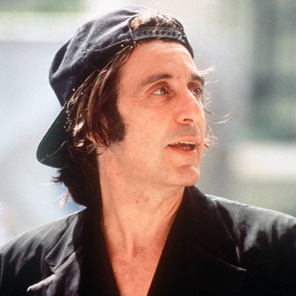
Looking for Richard in Manhattan Posted by Picasa
5. '>SHAKESPEARE IN LOVE (1998). Then there are films about the actual process of creating theatre, the heart of this subgenre. This has to be the ultimate, not just because it's a romantic comedy about the young William Shakespeare writing Romeo and Juliet, with lively and passionate performances by Joseph Fiennes and Gwyneth Paltrow (both their best, in my opinion) and some scenes stolen with relish by Dame Judi Dench.

The script by Marc Norman and Tom Stoppard incorporates so many delicious theatrical in-jokes (for instance, actors always describe the play as being about their character. "What's Romeo and Juliet about?" "Well, it's about this nurse...") as well as delightful bits of throwaway anachronisms. But the real heart of it is the performance of the play that leads to one gorgeous climax after another. Not only is the movie within the play within the movie handled brilliantly, but we get an idea of why Elizabethan theatre was so vital: the audience crowded against the stage, totally involved in every moment. Yes, and it's a mystery.

There isn't anything I don't like about this movie, from the color to the music. I'm looking forward to seeing the Collector's Series DVD with the commentaries, but it looks like I'll have to buy it---the ones for rent here are the extraless version.

6. A MIDWINTER'S TALE (1995) (also known as IN THE BLEAK MIDWINTER). In contrast to "Shakespeare in Love" which won the Best Picture Oscar, this little movie about a ragtag group of actors in England putting on a Christmas production of "Hamlet" is unknown. But it is also funny, with lots of heart and lots of theatre texture. It was written and directed by Kenneth Branagh around the time he directed his huge "Hamlet" for the screen. It's filled with affection, yet Michael Maloney's frenetic performance as the neurotic director and star of the play keeps it moving at a fast pace. And unlike Albert Finney's A MAN OF NO IMPORTANCE (1994), another excellent film about a provincial man who tries to find himself through theatre, this one has a theatrically happy ending.

7. '>LOOKING FOR RICHARD(1996). This is a completely unique film---part documentary in which Al Pacino lead us through his attempts to understand Shakespeare's Richard III and mount a production, culminating in Pacino and his cast performing key scenes of the play. It is entertaining from start to finish, thanks to Pacino's personality, the skillful editing of the cinema verite glimpses of the process (Pacino also directed) and the other oddballs he gathers in, and the power, complexity and ultimately the simplicity of Shakespeare's play. Much of it was shot in Manhattan, so it's Shakespeare with true contemporary grit. It ends up being a great film about the process of actors "finding" the play and performing what they find.

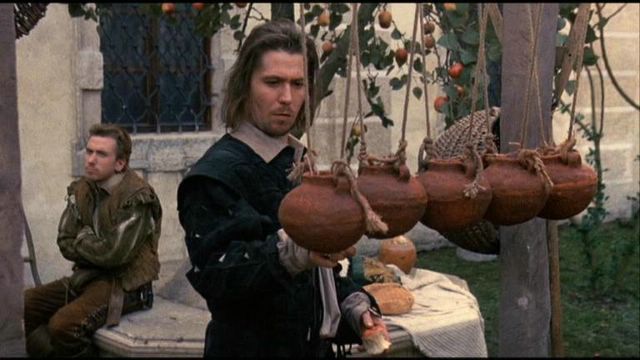
Tim Roth, Gary Oldman, R& G in perpetual immobility Posted by Picasa
8. '>ROSENCRANTZ AND GILDENSTERN ARE DEAD (1990). Then there are films about theatre within theatre. Tom Stoppard directed this film version of his famous play about two minor characters in Hamlet, and what they do when everybody else is watching the Prince of Denmark. The play is a classic, though its echoes of Beckett are now a bit jarring in view of Stoppard's later work. The movie is visually interesting and moves along at a goodly pace, but its chief virtue is the performances of Gary Oldman and Tim Roth, and Richard Dreyfuss as the Player. Oldman and Roth play R & G like a literate Laurel and Hardy, and there are numerous anachronistic sight gags that suggest Stoppard was responsible for that brand of humor in "Shakespeare in Love."

The DVD bonus disk is amazing, featuring an interview with Tom Stoppard of over an hour, and exceptionally revealing (but shorter) interviews with Gary Oldman and Richard Dreyfuss. Trust me, you've never heard actors talk like this in public.

Of course, there are lots of film versions of famous plays, with waves of contemporary Shakespeare still washing over us, but that’s another list. Still it’s worth mentioning here that Gary Oldman said that he and Roth had so much fun being R & G that they rehearsed continually, and in public—they would even do scenes in the pub that they had already shot. Plus, when Mel Gibson did his “Hamlet” they volunteered to play R & G in it, wearing the same costumes as in this movie. Apparently the Gibson folks didn’t get it.

9. '>VANYA ON 42ND STREET (1994). This is another collaboration between Wallace Shawn, Andre Gregory and Louis Malle, the team that created the unique "'>MY DINNER WITH ANDRE" (1981), an apparently spontaneous but in fact scripted conversation that was largely about theatre and its connections to contemporary life.

This time, we watch a group of New York actors gather one morning in an abandoned Ziegfield Follies theatre. They chat, get coffee, and suddenly, seamlessly, their chat becomes Chekov's "Uncle Vanya," and you are utterly hooked. Shawn plays Vanya, and Gregory directs from a script he adapted from David Mamet's very contemporary translation. This group of actors in fact had gathered periodically for years and years to simply work on this play with no thought of performance. Thanks to Malle's intimate camera work, we are privileged witnesses.

And with this, we have come full circle, to a film that is not only about theatre, but is theatre.

Tuesday, July 12, 2005


speed, quickness and lightness Posted by Picasa
From the Basketball Diary

This was the first in many years I didn't watch a single NBA game on TV until the finals, and then only parts of the last three. There's nothing much to watch---not when I've got old tapes of Michael Jordan and those Bulls teams, the Lakers of Shaq and Kobe championships, and even some of the Magic Johnson Lakers. So from time to time I watch them.

But I can't turn off the writer completely, so I do wonder what those announcers are talking about. If you know anything about the game, you know that some of what seems like dumb redundancy really isn't, like "He's got speed and quickness." They really are two different things. Speed means running fast: foot speed. Quickness means reflexes and all kinds of movement--lateral, up and down. It takes quick feet to play tight defense, quick hands to strip the ball or change the shot. You get the idea.

But then there are other habitual expressions that always bother me... The one that comes to mind is "shot attempt." Certain announcers are always talking about shot attempts. How many shot attempts. What I wonder is the difference between a shot attempt and a shot?
A made shot is a score. He shoots, he scores. Not---he executes a shot attempt, the attempt is successful, the shot is off, and it fulfills the requirements of the rules such that two points ensue.

They really should ask me about these things.

Monday, May 23, 2005


Unhand me, aliens! Your hairdryer will give Dale split ends!
Okay, so this has nothing to do with the post below
but it's dull around here without pictures. Posted by Hello
Interim Report

I've recently made the first in what will be a number of changes eventually affecting how I interact with the ever-changing Internet.

It may not seem related, but it is: I cancelled most of my cable television channels. We now have what is called "basic" cable service, the 2 through 13 channels, which consist of local outlets of the old networks, and public service/access channels.

This was partly a protest against the dereliction of the cable news channels, now united in an agenda of fluff and right wing propaganda. Paying more than $30 a month for what else cable TV had to offer was absurd as well as an elective payment for one's own oppression and degradation. We'll miss the Daily Show and the new Monk series, but that's about it.

Frankly if it were practical, I'd have it shut off altogether. The network news---and increasingly, disturbingly, this includes PBS though to a lesser extent so far---are becoming as irrelevant and noxious as cable. It may come to that, but for the moment I am investigating which way to go in the inevitable move away from dial-up Internet service: DSL or cable. As I'm leaning towards cable, I need to keep the minimum service. In either case, the money saved from cable bills will help offset additional one-time expenses for either choice.

Any advice on the DSL versus cable question would be welcome.

A change from my current dial-up account, which has migrated up the food chain as Tidepool was bought out by a slightly bigger fish and then consumed whole by a California-wide whale, will necessitate a new email address and change things for my web page and probably my blogs.

Though I don't know what the changes will be yet, the blogs are unlikely to remain in their current form for much longer. As an interim report on blog traffic, nothing much has changed in terms of ranking. This blog is still one of the least visited. My most visited blog by far is still Soul of Star Trek, and I'll say more about that below.

American Dash is the second most visited, but by about 10% of the number visiting Soul of Star Trek. With only a few exceptions in the past month, there have been fewer than 10 visitors per day, with an eyeball average of about six.

Because AD is updated frequently, these numbers probably indicate readers, whereas for some other blogs, it's clear from the searches that resulted in a hit, that visitors were looking for something else and probably didn't stick around long enough to read anything. That seems to be the case for Shopopolis and Kowincidence (which I regard as a kind of archive anyway.)

I had hopes for Books in Heat in particular, and Shopopolis, as well as my local experiments, the North Coast blogs. But traffic hasn't established any of them. Reviews in Books in Heat are quoted in publisher publicity, and there's sometimes been a nice bump when its address is appended to my reviews in the SF Chronicle (usually from the online link) but that's been about all the notice it's gotten.

I never intended to keep them all going, and so eventually they will be abandoned or fused together somehow.

By contrast, though not by comparison with truly successful blogs, Soul of Star Trek is at least healthy. It rarely receives fewer than 40 visitors a day, and in the past month has exceeded 100 on 10 days, with the one-day high approaching 400. Three times during the month it got more than 100 visitors on 3 successive days, and once it was over 100 for four of five days.

It benefits from links for specific posts from the big Trek boards (Trek Today mostly, but also Trekweb and a couple of similar sites in Europe), plus specific links from smaller blogs and BBS posts. That's when the higher numbers usually occur, although once this month it got over 100 visitors without being mentioned anywhere.

Soul of Star Trek has a healthy number of returning visitors, and an interesting geographical spread. United States visitors normally comprise around 65% of visitors, with reliable contingents from Canada and the UK. But there was a day this month when the second largest number of visitors were from Germany. I continue to be amazed by the geographical variety--really from everywhere in the world, including China.

The Soul of Star Trek blog has its fans as well. Someone with a Harvard address visits a lot and someone in Arizona visits very frequently. There was a day when somebody in San Francisco visited all my blogs. If the logs are to be believed, this person spent the entire day reading them. But how computers register on this system may not be always accurately reflected in the categories of the report.

Soul of Star Trek also gets comments, which none of the other blogs do, except rarely. I suppose it's helped to focus me on the work I've been doing anyway in this area, as I finally may be getting a draft of a publishable book together.

The summer movies have helped expand the subject matter of Soul of Star Trek some, so I'll be writing there about H.G. Wells soon, and I enjoyed doing a long piece on Douglas Adams, which gave me the opportunity to post photos from some of my 60s faves.

A couple of other factors are conspiring to keep me in that neighborhood these days. One of them is the possibility of publishing a book on Star Trek. I am in the weird position of being told by the editors at Pocket Books/Simon and Schuster who are in charge of Star Trek books there, that I am their choice to write the official 40th anniversary of Star Trek book. Unfortunately, the publisher isn't willing to commit to it, because Trek nonfiction hasn't been selling, and Paramount isn't yet focused on the matter.

So it is possible that late this summer I will learn that I have a couple of months to write this book. I've known this for awhile now, so I've gone ahead with writing what could be adapted to this book, or could be a book I would self-publish, through Xlibris probably, around the time of the 40th anniversary next year. Whether it will be positioned as a Star Trek book, or more of a Soul of the Future book, is yet to be determined.

The feedback I've gotten from the Soul of Star Trek blog, as small as it is, has been encouraging. It constitutes the only current encouragement from the outside world. Last year I freelanced for the arts sections of the San Francisco Chronicle and the New York Times, and I did several fairly long client projects for Humboldt State University. So far this year, I haven't gotten any more work from HSU (my contact and champion there left to literally go sailing), and after soliciting a proposal on the new Star Wars, a Times editor apologetically told me that word had come down from on high: no freelance. I heard the same from an editor at the Chronicle. (Although I eventually published a piece on the Star Wars movie in the Chronicle's Insight section.)

So things have been very, very quiet. Yet some work and some royalties and permissions fees has come through, enough so I could concentrate on the Trek/future book and related writing. At a certain point it felt like it was working, and I knew I had to go with the momentum. After all, I've been working on this off and on for at least six years. It feels like something (who knows what) may yet come of it.

Sunday, May 15, 2005


East meets West in "Lost Horizon" Posted by Hello
Lost Horizon Found

When I recently heard a reference to Jane Wyatt in Frank Capra's 1937 film, '>Lost Horizon, it dawned on me that this was a famous film I hadn't seen since I was very young, and then only on television. I had only a hazy memory of it, as somewhat mystical but mostly confusing.

After that, I don't recall it being mentioned much in the company of classic films, or even in references to Capra, his Mr. Smith Goes to Washington, Meet John Doe and the Oscar winning It Happened One Night being the ones usually cited.

So I rented the DVD, which turned out to be a restored version from 1999. The history of this movie would be bizarre even if it wasn't shared with a lot of less remembered films. Capra was the producer as well as director of this epic attempt to film the best selling novel by James Hilton. His rough cut was something like 5 hours long. The first version tested with an audience in Santa Barbara was 3 hours, and was considered a disaster.

With lots of cuts, some reshaping of the narrative and even new scenes shot, the movie was released in Los Angeles and other big cities in 1937 with a running time of 132 minutes. But the version that went out to theatres across the country was considerably shorter, by about 25 minutes. Even at that it was longer than the usual 90 minute movie, and individual theatres cut even more of it.

Then thanks to an offhand reference to Shangri-la by President Roosevelt, it was re-released during World War II, with more cuts for content reasons-taking out questionable references to allies, and too much of that pacifist stuff. (It is rather remarkable that it was made by the director who would soon be fashioning the Why We Fight "documentaries" ---they were actually mostly composed of pieces of Hollywood films---but then these Capra productions probably saved a lot of Italian Americans from internment camps.) By the time the movie got to television in the 50s, which is probably when I saw it, it was pretty much an incomprehensible mess. A plane wreck, snow, Shangri-la, escape, more snow, an avalanche, and a young woman suddenly becoming old. That was about it.

By the early 1970s, there wasn't a good intact negative of any version of the film anywhere. The American Film Institute, and later the UCLA film preservation project, began a series of restorations. The major finds that made the 1999 restoration possible in particular was an intact 132 minute soundtrack, discovered in British film archives. Several prints and dupe negatives of varying length and quality were located and though they were all shorter than 132 minutes (some considerably shorter), they were missing different scenes, and some had scenes the others didn't.

Two versions were particularly notable: a British dupe, shorter than even the 108 minute version but containing scenes no other version had, and a knarly print cut for Canadian TV, dubbed in French. This version had key moments missing from the others, usually within scenes.

The restorers even used some outtakes preserved on a reel shown to film exhibitors at a convention in Ohio before the film's release---in fact, before Capra had finished shooting the movie. With all that put together, they still lacked about seven minutes, but the 1999 restoration uses the complete soundtrack, so still photos are substituted for these minutes (using photos of the scenes where possible.)

Another remarkable fact about this restoration is that in 1999, digital enhancement and repair was still prohibitively expensive, so only a few scenes were given the full digital treatment. Most repair was done by "wet-printing," a technique then new that fills in film scratches with liquid so they fade from the print.

Given all the versions Capra assembled, and the cuts he made at the studio's insistence, it's fruitless to try to establish a definitive version, but this is as close as 25 years of restoration work could come to reproducing "Lost Horizon" as it was seen at its Los Angeles premiere in 1937. Though not quite the clarification that the restored "Metropolis" was a few years ago, it is still quite a revelation.

The film's flaws are perhaps even more clearly exposed. American action actor John Howard was obviously miscast as Ronald Colman's mercurial, weak and prejudiced brother (David Niven was said to be the favorite, but Howard was cast just days before shooting began.) The minor characters, while well acted for the most part, have a certain charm but don't quite jell. This isn't Capra at his characteristic best. Yet at this remove, even these flaws say something memorable.

Today the sight of Shangri-la is not quite as awe-inspiring as it was supposed to be, since it resembles a jumble of Frank Lloyd Wright and a half dozen other styles in a complex that looks like a World's Fair exhibit, or maybe a 1960s housing development crossed with a corporate campus. Some of the doorways and interiors seem borrowed from a Flash Gordon serial.

The idea that the heathens of Tibet need to be taught civilization by a European priest, whose natural superiority they recognize by making him their High Lama, is laughable. Yet none of these flaws, not even Capra's uneasy sentimentality about the idea of Shangri-la, completely distort the timeless power of this film, revealed especially and in some ways, for almost the first time, in this restoration.

The heart of the film is in Colman's wonderful performance, but its soul is in Sam Jaffe's haunting speeches as the High Lama. This was the most controversial part of this movie even while it was being made. Columbia Studios demanded Jaffe be replaced, and his scenes were shot with another actor, before test audiences affirmed Capra's choice of Jaffe's portrayal. Then much of the key scene was shortened and reshot again, after the Santa Barbara preview. (Another character was given some of its exposition, which required more shooting.)

Frank Capra monitored the restoration until his death, and requested that in particular the Lama's scenes be restored. This is in fact this version's great gift. It's remarkable how much of it was cut out in the various versions. Some of the most important lines have no existing footage at all, others only the grainy remains of the Canadian TV dupe.

The view of the world expressed here can be understood as coming from the Great Depression era and after the Great War, during the obvious prelude to another World War, just as the censoring of these scenes would be a product of World War II and the Cold War. But in another sense they are, if not timeless, then of our time as well as theirs.

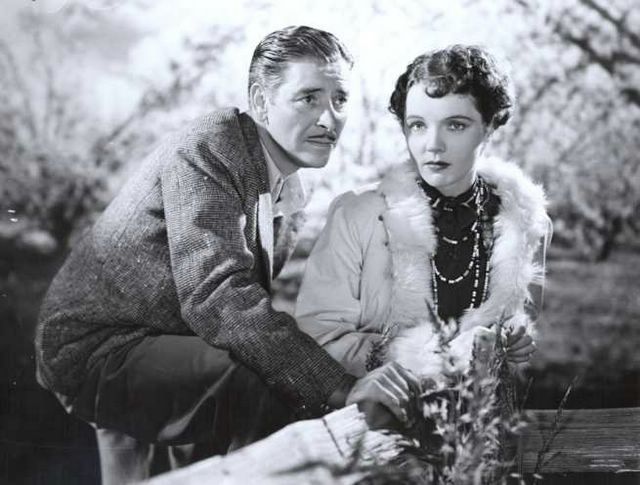
This is a film worth seeing. If you've seen it in earlier versions, you probably haven't seen the lovely scenes with Ronald Colman and Jane Wyatt inexplicably cut from most versions---and without them the movie really doesn't make that much sense. It's worth seeing for Ronald Colman--"beautiful of face and soul, sensitive to the fragile and gentle, responsive to poetic visions and hard intellect," as Frank Capra describes both the character and the actor in his autobiography.

But if you don't get around to it, here is the best transcription I can offer of the High Lama talking about the meaning and purpose of Shangri-la. It could have been delivered yesterday, or tomorrow.

It came to me in a vision long long ago. I saw all the nations strengthening, not in wisdom but in vulgar passions and the will to destroy. I saw their machine power multiplying, until a single weaponed man might match a whole army. I foresaw a time in which man exalting in the technique of murder would rage so hotly over the world that every book, every treasure will be doomed to destruction.

This vision was so vivid and so real that I determined to gather together all things of beauty and of culture that I could, and preserve them here against the doom toward which the world is rushing.

Look at the world today. Is there anything more pitiful? What madness there is! What blindness! What unintelligent leadership! A scurrying mass of bewildered humanity crashing against each other, propelled by an orgy of greed and brutality. A time must come, my friend, when this orgy will spend itself. When brutality and the lust for power must perish by its own sword.

Against that time is why I avoided death...When that day comes the world may begin to look for a new life. It is my hope they will find it here. Their books and their music, and a way of life based on one simple rule: be kind. When that day comes, it is our home that the brotherly love of Shangri la will spread throughout the world. When the strong have devoured each other, the Christian ethic will at last be fulfilled, and the meek shall inherit the earth."

Ronald Colman and Jane Wyatt in "Lost Horizon" Posted by Hello

Thursday, April 21, 2005


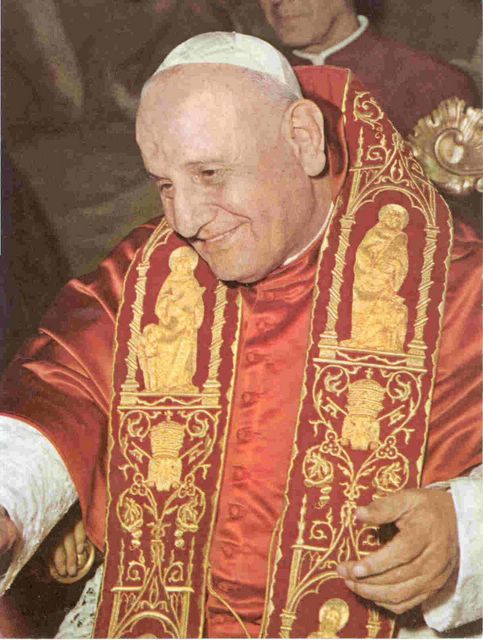
Pope John XXIII  Posted by Hello
Pope John

All the Pope talk and controversy sent me back to see if I still had a handle on Vatican II and the papacy of Pope John XXIII. I remembered his encyclical "Pacem in Terris" and re-read it for the first time in many years. It was an emotional experience. The language is so pure, and the document is amazing. For as long and strange as this trip has been, I will always be grateful that I came of age in those brief years when Pope John and JFK were there to help form my principles and ideals.

I posted a version of this on Daily Kos, the big southpaw political blog, and discovered in the responses that I wasn't alone in this. One person referred to Pope John simply as "the Sunshine."

Pope John XXIII is associated in many American minds with JFK. John's papacy and Kennedy's presidency occurred at almost exactly the same time. They died within a few months of each other in 1963.

This period also coincides with my years at a Catholic high school, with a faculty comprised almost entirely of nuns and priests. Both Johns were of considerable and sometimes daily interest.

Pope John was a surprise choice when Pope Pius XII died in 1958. He was considered a compromise and caretaker pope, and like the new pope, his age seemed to guarantee a short and therefore inconsequential papacy.

He was Angelo Roncalli, the son of a sharecropper in a small Italian village. In World War I he was drafted into the Italian army and served as a medic and chaplan. At the start of World War II he was the Apostolic (Vatican) Delegate to Turkey and Greece, and saved thousands of Jewish refugees throughout Europe by working with the Jewish underground. He is considered by some Holocaust groups to be a Righteous Gentile.

In 1944 he was appointed Apostolic Nuncio to Paris, and Charles DeGaulle became so fond of him that when Roncalli was named a cardinal in 1953, President DeGaulle claimed an ancient right of French rulers to ceremonially bestow the red hat of the Cardinal himself.

When he became Pope in 1959, he was immediately popular as the people's pope. With his open smile and peasant face, he was an obvious contrast to the formal and aristocratic Pius XII. Pope John Paul II was famous as a world traveler, so it's strange to note that until Pope John XXIII, no pope since 1870 had left Vatican City on official business. John's first foray outside the Vatican was to visit prisoners. He also was the first Pope to reach out to other religions, first by meeting with the Archbishop of Canterbury in 1960, the first such meeting in 400 years.

In the 1960 presidential election, John F. Kennedy was the first Catholic to be nominated by a major party since 1928, when the Democrats nominated Al Smith. (Though Smith lost, some credit his running with moving Italians and other immigrant Catholics to the Democratic party, a process solidified by FDR and the New Deal.) Some of the same charges as helped defeat Smith were raised against Kennedy: that a Catholic would be bound to take orders from the Pope.

Protestant fundamentalists were particularly virulent in their opposition, fearing the collapse of the separation of church and state., and perhaps something else... The Reverend Harvey Springer, "cowboy evangelist of the Rockies," proclaimed: "Let the Romanists move out of America! Did you see the coronation of Big John? [meaning Pope John.] Let's hope we never see the coronation of Little John...How many Catholics came over on the Mayflower? Not one...The Constitution is a Protestant Constitution."

Kennedy confronted the issue by affirming that he would honor his oath as President first, and maintain the separation of church and state. In Rome, Pope John was trying to learn English. When an American bishop told him that Kennedy had a good chance of being elected, John joked with him: "Do not expect me to run a country with a language as difficult as yours."

JFK and John XXIII never met, although as First Lady, Jacqueline Kennedy had a papal audience in Rome. The Wikipedia bio of John preserves the story that the Pope had nervously rehearsed the proper greeting, "Madame, Mrs. Kennedy." But when he saw her he rushed over and cried, "Jackie!"

Vatican II

John XXIII shocked even the inner circle in the Vatican by calling for the Second Vatican Council just a few months after he became Pope. (The first council had been some 90 years before, was cut short by war and had little effect.) There were several years of preparation, and four sessions from 1962 to 1965. Pope John was alive for only one of the sessions. Most of the Council was actually run by his successor, Pope Paul VI.

Most of the Council's work, such as changes in the liturgy that allowed modern languages to be substituted for Latin, affected only Catholics. But the larger ramification was in opening dialogues with those outside the church. It was called an Ecumenical Council, and this was the word we heard the most---ecumenical, which means the whole church, and was interpreted to mean the possible unification of all Christians to some degree, and perhaps beyond that.
Observers from other religions were made part of Vatican II. Pope John's intention was preserved in this quote: "I want to throw open the windows of the Church so that we can see out and the people can see in."

As evidenced in the excerpts below from his encyclical, Pacem in Terris, Pope John based many of his thoughts on natural law, in the manner of Thomas Jefferson, for instance. This was to both include other traditions, and to place Catholicism within a larger context.

Why was the Council so controversial? Conservatives within the church didn't like change. I remember that some of my teachers were enthusiastic, but others kept quiet about the Council. One of my English teachers had high hopes that the Council would end the "Index of Forbidden Books," or at least take off some recognized classics that Catholics were reading away. This was the modernization trend, and together with the rest of the 1960s, it did cause a lot of wrenching change, and sometimes chaos.

For instance, a lot of rules governing religious orders were "liberalized." Just a few years after my graduation, two younger siblings of a classmate told me how much the school had changed. Some of the nuns who had taught me had left their orders altogether (my French teacher, who used to pretend to be scolding me when she read aloud my rather free translations---I just made up funny stories using words reminicent of the French words---showed up at a homecoming game a few years later with flaming red hair.) Others were out of their habits, and living in apartments (my old English teacher got in a tiff with her order over her car allowance). And just as some had feared, discipline had broken down at our old high school. Students were essentially laughing at their teachers, and going outside to get high. So if you're wondering why conservatives get apoplectic over the 60s, this may be a clue.

Personally I'm not sure the folk Mass was an improvement over the Latin I had to learn as an altar boy. But being able to legitimately use local language and music was important to places that had them as vital parts of their cultures, like Africa.

But to me the greatest legacy of Pope John was his final encyclical, "Pacem in Terris" (Peace on Earth). It is to me the greatest liberal document since the UN Declaration of Human Rights. Even today it reads like a Bill of Rights for the world.
I recommend reading the whole thing:
http://www.vatican.va/holy_father/john_xxiii/encyclicals/documents/hf_j-xxiii_enc_11041963_pacem_en.html
But here are some excerpts to give you the flavor, and whet your appetite. (I should point out that although this encyclical doesn't mention abortion, it does reserve the right of the Church to instruct its members on moral issues, thus offering some justification for the current Pope's letter as Prefect of the Congregation to American bishops that essentially read John Kerry out of the Church for his position on choice. But it seems unlikely to me that Pope John would have sanctioned such an extreme and both morally and politically troubling action.)

From Pacem in Terris:

"Any well-regulated and productive association of men in society demands the acceptance of one fundamental principle: that each individual man is truly a person. His is a nature, that is, endowed with intelligence and free will. As such he has rights and duties, which together flow as a direct consequence from his nature. These rights and duties are universal and inviolable, and therefore altogether inalienable.

We must speak of man's rights. Man has the right to live. He has the right to bodily integrity and to the means necessary for the proper development of life, particularly food, clothing, shelter, medical care, rest, and, finally, the necessary social services. In consequence, he has the right to be looked after in the event of ill health; disability stemming from his work; widowhood; old age; enforced unemployment; or whenever through no fault of his own he is deprived of the means of livelihood.

Moreover, man has a natural right to be respected. He has a right to his good name. He has a right to freedom in investigating the truth, and-within the limits of the moral order and the common good-to freedom of speech and publication, and to freedom to pursue whatever profession he may choose. He has the right, also, to be accurately informed about public events.

In the economic sphere, it is evident that a man has the inherent right not only to be given the opportunity to work, but also to be allowed the exercise of personal initiative in the work he does.

The worker is likewise entitled to a wage that is determined in accordance with the precepts of justice. This needs stressing. The amount a worker receives must be sufficient, in proportion to available funds, to allow him and his family a standard of living consistent with human dignity.

Each man should act on his own initiative, conviction, and sense of responsibility, not under the constant pressure of external coercion or enticement. There is nothing human about a society that is welded together by force. Far from encouraging, as it should, the attainment of man's progress and perfection, it is merely an obstacle to his freedom.

Women are gaining an increasing awareness of their natural dignity. Far from being content with a purely passive role or allowing themselves to be regarded as a kind of instrument, they are demanding both in domestic and in public life the rights and duties which belong to them as human persons.

... a regime which governs solely or mainly by means of threats and intimidation or promises of reward, provides men with no effective incentive to work for the common good. And even if it did, it would certainly be offensive to the dignity of free and rational human beings. Authority is before all else a moral force. For this reason the appeal of rulers should be to the individual conscience, to the duty which every man has of voluntarily contributing to the common good. But since all men are equal in natural dignity, no man has the capacity to force internal compliance on another. Only God can do that, for He alone scrutinizes and judges the secret counsels of the heart.

The attainment of the common good is the sole reason for the existence of civil authorities. In working for the common good, therefore, the authorities must obviously respect its nature, and at the same time adjust their legislation to meet the requirements of the given situation.

The common welfare further demands that in their efforts to co-ordinate and protect, and their efforts to promote, the rights of citizens, the civil authorities preserve a delicate balance. An excessive concern for the rights of any particular individuals or groups might well result in the principal advantages of the State being in effect monopolized by these citizens.

Here, then, we have an objective dictated first of all by reason. There is general agreement-or at least there should be-that relations between States, as between individuals, must be regulated not by armed force, but in accordance with the principles of right reason: the principles, that is, of truth, justice and vigorous and sincere co-operation.

Furthermore, relations between States must be regulated by the principle of freedom. This means that no country has the right to take any action that would constitute an unjust oppression of other countries, or an unwarranted interference in their affairs.

The United Nations Organization has the special aim of maintaining and strengthening peace between nations, and of encouraging and assisting friendly relations between them, based on the principles of equality, mutual respect, and extensive cooperation in every field of human endeavor.

A clear proof of the farsightedness of this organization is provided by the Universal Declaration of Human Rights passed by the United Nations General Assembly on December 10, 1948. The preamble of this declaration affirms that the genuine recognition and complete observance of all the rights and freedoms outlined in the declaration is a goal to be sought by all peoples and all nations.

We are, of course, aware that some of the points in the declaration did not meet with unqualified approval in some quarters; and there was justification for this. Nevertheless, We think the document should be considered a step in the right direction, an approach toward the establishment of a juridical and political ordering of the world community. It is a solemn recognition of the personal dignity of every human being; an assertion of everyone's right to be free to seek out the truth, to follow moral principles, discharge the duties imposed by justice, and lead a fully human life. It also recognized other rights connected with these.

What has so far been achieved is insufficient compared with what needs to be done; all men must realize that. Every day provides a more important, a more fitting enterprise to which they must turn their hands-industry, trade unions, professional organizations, insurance, cultrual institutions, the law, politics, medical and recreational facilities, and other such activities. The age in which we live needs all these things. It is an age in which men, having discovered the atom and achieved the breakthrough into outer space, are now exploring other avenues, leading to almost limitless horizons."
Monday, April 11, 2005

Bonus Track!

This little piece was a rejoinder to a column in the local Eureka Reporter, and was published there as a Guest Column. I'd just give you the url except it has an annoying typo that this version doesn't. Discerning readers in this space won't be surprised by the opinions, but I couldn't let a chance go by to say Something Nice about one of the few new things in the world I actually like.

Unlike Wendy Butler, I love the bonus features on DVD. If I didn't, I just wouldn't watch them. Sometimes they are even the main reason I rent or buy a DVD movie, apart from the image quality, especially if I've already got it on tape.

Bonus features typically include short documentaries related to the film, a commentary track for the movie itself, and scenes that weren't in the theatrical release version, either reintegrated into the film, or by themselves. They are all hit or miss, of course, but they often add new layers to the experience of the movie.

The documentaries I often like best are retrospective interviews with directors and actors years after release, when they can put their efforts in perspective, and they can say things that maybe they couldn't before. But I also like to know how movies are made. I enjoy learning about the process.

Commentary tracks can be maddening, especially when the voices don't bother talking about what you're watching, and what you'd like to know. The worst I'm come across recently is "Spiderman II." The director (Sam Raimi) is cueing the star (Tobey Maguire) to talk solemnly about how he learns his lines while I'd like to know why they kept that scene with the neighbor bringing Peter Parker a piece of pie is the movie. It's also nearly impossible to follow both commentary and movie, even when you select for subtitles (which I usually do). But fortunately there's scene selection, pause, review---and fast-forward.

But much of the time, the commentary is enlightening (between descriptions of how effects shots were done, George Lucas describes a surprisingly serious intent for the Star Wars cycle: "how a democracy becomes a dictatorship, and a good person becomes a bad person") or it's just entertaining (counting the number of times that director Roland Emmerich says "this is one of my favorite scenes" during "The Day After Tomorrow.")

Sometimes the commentaries are even better than that. The dialogue between writer/director Nancy Meyers and actor Jack Nicholson on the DVD of "Something's Gotta Give" is hilarious, and a master class in film acting as well. So not only is this movie worth repeating, so is the commentary.

If DVDs have done nothing else, they proven how stupid movie studios can be in editing scenes out of movies just to make them shorter. They leave gaping holes in the story and make the actors look dumb, just so they can have more showings to confuse more people. But without the need to sell more tickets on opening weekend at the multiplex, DVDs can restore the scenes that at least give the movie a chance to make sense. That's more of a restoration than a bonus.

The bonus scenes work best when they actually put them back where they belong in the movie (and the commentary track can tip you off to this). Sometimes when they're offered as "deleted scenes," you wonder what the filmmakers were thinking when they deleted them. I remember several of the deleted scenes from the second Harry Potter movie better than I do a lot of the scenes that are in it. They tended to be mood pieces, like Harry and his owl sitting on a hill high above the landscape, but the movie needed some quiet moments, some beauty that evokes magic.

Selecting imaginative and high quality bonus features, delivering smart and honest commentaries, are becoming part of the DVD. package. I look forward to more.


Oddly or not, while nursing the cold I thought I'd avoided for this year, I watched a lot of DVD over the weekend, including bonuses. I even played some of the Harry Potter games (scored two goals in Quidditch, too, even in my weakened condition.) After hearing Star Trek's Dan Curry call the 1938 Erroll Flynn Adventures of Robin Hood the best adventure movie of all time, I thought I'd see it again with that in mind. It came with a film scholar's commentary, pretty informative, and a bonus disk, not too impressive except for a terrific long feature on the history of Technicolor (seems the name came from MIT, where the inventor went to school).

What I missed in the commentary but what I saw in the film was historical context: the Depression and already ravaged Europe of 1937-8. The scenes of Robin showing Maid Marion the plight of the poor was reminicent of similiar scenes in Sullivan's Travels and My Man Godfrey. Also, the scholar mentioned that in the earliest Robin Hood legends he was a trickster, and a figure in the May festival. What he failed to note was that in this film, Robin forcing the nobles to exchange clothing with the poor reproduced the Lord of Misrule reversals of those festivals. It was neat to see that the final sword battle between Flynn and Sherlock Holmes was as exciting as I remembered it as a kid, watching it on TV, probably in black and white.