Thursday, February 09, 2006


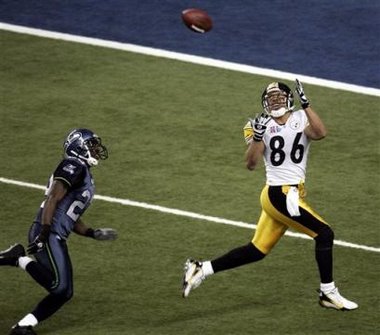
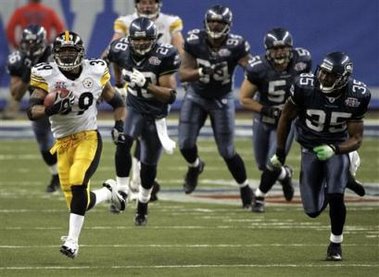
The run that won it-- Posted by Picasa

The catch that sealed it Posted by Picasa

Pittsburgh South Side--game over Posted by Picasa

How sweet it is! Posted by Picasa

MVP Hines Ward and the Bus Posted by Picasa

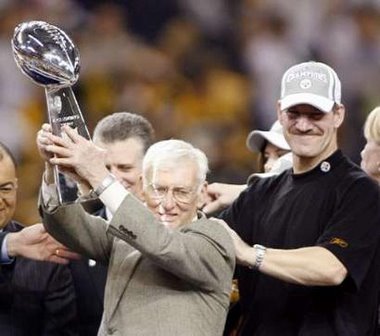
Dan Rooney, Bill Cowher in Detroit Posted by Picasa

Big Ben dawntawn--250,000 fans
greeted the Steelers' ceremonial return Posted by Picasa

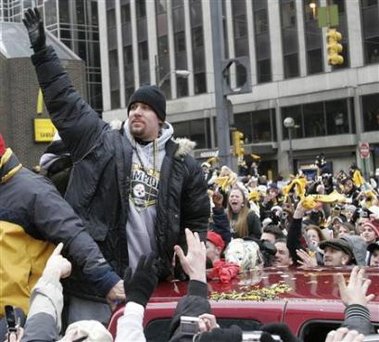
Steelers tackle Max Starks at victory parade downtown Pittsburgh. Posted by Picasa
Pittsburgh on Super Sunday

On a normal Sunday in football season, business in the Pittsburgh area is slow, especially during the game. It's a favorite time for non-fans to go to the mostly empty supermarket, though the game will be blaring from the p.a.

On this Super Bowl Sunday, come six pm eastern time, the city will just stop. The malls will actually close. It's not just that fewer customers are likely. Too many employees want to be watching the game.

The Pittsburgh Public Theatre has cancelled its Sunday night performance of "The Importance of Being Earnest." The Importance of Being Steelers takes precedence. The city's science and art museums, and even the zoo, are running programs and contests related to the Steelers. The game is the cultural event. The Super Bowl is the city's theatre.

By the time the game ends, portions of downtown Pittsburgh will be closed to motorized traffic. A big safe space is being created for the hoped-for celebration. There hasn't been one for a Super Bowl victory since 1980.

City of Champions

The Steelers grabbed the heart of Pittsburgh with its great teams of the 70s, at precisely the same time that the steel mills, the source of the city's identity, were shutting down.

The mills were failing, the Steelers were succeeding, preaching the blue collar ethic. Steel City became Steelers City.

From then until about 1990, the city of Pittsburgh lost half of its population. But people who left in this industrial diaspora retained close connections, if not also to family and the area itself, then certainly to the Steelers. That's why the Steelers can go to any NFL city in North America and play to Steelers fans in the stands.

The Steelers were and are part of everything else that is and was Pittsburgh.

Family: you see it in the photos in the Pittsburgh Post-Gazette online Steelers Nation collection: seven young cousins in Big Ben No. 7 jerseys, a father and his infant daughter in Steelers shirts, etc.

Community: you see it in the joyful faces in other P-G photos of the rally downtown last week. The Steelers organization and individuals within it, including the players, are out in the community and doing for the community.

Tradition: Pittsburgh doesn't much like people who put on airs, but they do appreciate special individuals. Sports heroes and TV news personalities, once Pittsburgh takes them into their hearts, they are royalty forever. Wherever they came from, many of them stay. Pittsburgh respects loyalty and commitment to the city, and they give loyalty back.

Football is itself a tradition there. Western Pennsylvania was once ruled by King Coal, but in recent decades by King Football. Friday nights are high school football, and everyone in town goes to the games. Why not? They've seen Danny Marino, Jim Kelly, Joe Montana, Bill Cowher, and many more later NFL stars. Saturday is college football, Pitt and Penn State and smaller colleges. Since the 70s, Sunday is Steelers time. It doesn't matter what church you go to or don't go to. Sunday at 1, everyone worships at the same shrine.

All of these, and more, come together in the Steelers. They are important to this city and its people as a symbol of winning with their values, but also of persevering in adversity.

The Steelers represent the heart of Pittsburgh, the will to keep on going in tough times, a celebration of its unique character, and the moments of victory that come into almost every life, at least once in awhile. It's very important to know how to celebrate them. This year, Pittsburgh and the Steelers did pretty well on all counts.

Friday, January 20, 2006


The 2005 Darcy and Lizzie.
A Tale of Two Prides

I caught up with the 2005 film version of Jane Austen's Pride and Prejudice at a subrun double feature, presumably before it disappears until DVDed. I loved Austen's novels, which combine great wit and writing, social and character study, with strong stories. Pride and Prejudice has emerged as the story that touches people most deeply and has the most powerful cultural hold of nearly mythic intensity. Inevitably this kind of story is retold with different emphases at different times, by different storytellers.

The 1940 version starring Lawrence Olivier and Greer Garson is one of my favorite movies, for a combination of reasons I can't fully describe. I used to watch it every New Year's Eve. But by now it's clear that like many Shakespeare plays, this Austen novel is too large to be contained in a single movie, and the best a movie can do is emphasize aspects of it with a fresh vision. If done with enough heart and skill, Austen is only enhanced.

This version is a very different kind of movie based on the same novel, and it works for me. Moreover, some of the differences are fascinating in themselves. The 1940 version was located in the Hollywood set version of elegant England. There was much talk, as in the novel, of the modesty of the Bennet household, and the financial necessity for the sisters to marry well. While the Bennet family was portrayed as a kind of small town American brood, and Olivier's Darcy and his friends were obviously snobbish, the material difference was hard to see.

Not so in the new version. Here the vast gulf between the country folk and the landed gentry with their estates and houses in London is very obvious. The Bennet household includes pigs and geese and other farm animals, and fields to cultivate and harvest---so there's a sense of how it actually supports itself, missing from the 1940 version. Mr. Bennet (Donald Sutherland) is a working farmer, as well as the father who retreats to his ramshackle study for the shelter of books. We see a direct contrast in the uniformed servant with his precise walk to the exact center of the room to announce visitors to the Darcy crowd, and the shamble by the Bennet's hayseed hired man to announce theirs.

The country folk are mostly unattractive but excited at their noisy, sweaty ball, but they all freeze into a gaping frieze at the appearance of the two gentlemen, Mr. Bingley (Simon Wood) and Mr. Darcy ( Matthew Macfadyen), and the snobbishly cynical Caroline Bingley (Kelly Reilly). In this scene, director Joe Wright also makes Darcy appear about a foot taller than everyone else in the room. After gaping and bowing at them like the freaks they are in this place, the locals then ignore them as they go back to their enthusiastic dancing.

Late in the film, Wright ups the ante even more by presenting Darcy's estate as huge and utterly magnificent. In an almost modern touch, he follows the heroine Elizabeth Bennet's refusal of Darcy's offer of marriage with a scene of her touring the palace that could have been hers, on a kind of great homes tour.

text continues after photo


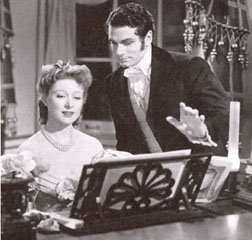
Greer Garson and Lawrence Olivier in the 1940 version. Posted by Picasa
This visualization of the class differences is the most obvious difference and contribution of this film. This makes the material stakes clearer---the Bennet girls don't need to marry into the gentry (they aren't golddiggers or social climbers), but just to stay at their present level, since their home and lands will go to a male relative according to the law.

But there are also noteworthy and interesting differences in narrative and character shadings. Though keeping some of Austen's references to the ages of the sisters (the oldest in her late 20s), this film portrays them as younger, especially Keira Knightley as the heroine, Lizzie Bennet. She is bright and witty, but no Greer Garson. She seems more like a mischevious 20 at the oldest, trembling with girlish energy. This actually works to make plausible the idea that she's considered the less attractive sister. When she wrinkles up her nose, giggles and ducks her head, having fun with her sisters, it's plausible that her beauty, so evident in repose, would go unnoticed.

Her "more beautiful" older sister, Jane (Rosamund Pike) is evidently beautiful, and is seen much more in repose. What makes this film work immediately is how perfectly matched she is with Simon Wood's Mr. Bingley. Both are shy, modest and sincere, and seem out of place except with each other. They are also both blond. It takes the dark-haired Elizabeth and dark-haired Darcy awhile to discover the secret of their darkness: though both are flawed with pride and prejudice, they share a fierce moral rectitude not at all incompatible with physically passionate natures.

As for this film's take on Darcy, I endorse Stephen Holden's description in his New York Times review (this time in contrast not with Olivier but Colin Firth's portrayal on the 1990s miniseries):Mr. Firth might have been far more dashing, but Mr. Macfadyen's portrayal of the character as a shy, awkward suitor whose seeming arrogance camouflages insecurity and deep sensitivity is more realistic. Isolated by his wealth, ethical high-mindedness and fierce critical intelligence, Mr. Darcy is as stubborn in his idealism as Elizabeth is in hers. The disparity between his diffidence and her forthrightness makes the lovers' failure to connect more than a delaying tactic to keep the story churning forward; it's a touching tale of misread signals.

This is the first major film by director Joe Wright, and it has the studied innocence and ambition of a first movie. Somebody will no doubt study the significance of the many appearances of flame, and how they dissolve into something else. There are plenty of references to other films, especially Olivier's more famous romantic role in Wuthering Heights. But he has so much visual energy (with a score that suggests Philip Glass playing appropriate bits from classical composers, and I say that with admiration) that the symbolism of Lizzie whirling on a swing when she's confused is not at all heavy-handed because it's so deftly done and neat to look at.

He and the screenplay author (Deborah Moggach) also deliver some subtle scenes and dialogue that illuminate minor characters, in place of the delightful movie caricatures,of 1940, particularly Sutherland's Mr. Bennet. Brenda Blethyn's shrill and frenetic Mrs. Bennet also gets some sympathetic moments, when she makes clear what she's up against, that the necessity of five daughters marrying decently if not exceptionally well is no joke, in an age and place that could condemn them to the most degrading circumstances Dickens presented. (This couldn't have been an easy script to write either, as the story seems to defy Hollywood's preferred simple three-act structure.)

In the last part of the movie, realism is perhaps stretched to accomodate the romance, but the film has earned some indulgence. Perhaps someday I'll put together my own double feature of these two Prides and Prejudices. Maybe next New Year's Eve.

Sunday, January 15, 2006

How to Avoid A Heart Attack (and still be a Steelers fan)

You have to be a veteran Steeler---a veteran Steeler fan, that is--to appreciate the emotions of today's game. For three quarters plus, the Pittsburgh Steelers (#6 seed in the playoffs) dominated the Indianapolis Colts (#1 seed), the odds-on favorite to win the Super Bowl. No #6 seed had ever done this.

For veterans, it was like thirty years had melted away, and the Steel Curtain, Terry Bradshaw and Franco Harris were invincible. Those were the days when every schoolkid wore a Steelers jacket, and waitresses would ask you if you wanted your coffee black or gold.

Then after another defensive crush, the Steelers were on the goal line for the touchdown that would put the game away, when their Mr. Automatic, the Bus, did the unthinkable and fumbled the ball. The Colts nearly scored a touchdown after recovering it.

This then was a different echo---the talented teams since the 70s, brilliant one week, and yet in playoff games or even once in the Super Bowl, able to snatch defeat from the jaws of victory in terrible ways, and I'm not talking about towels.Then the Pittsburgh working class self-contempt would kick in, and it would all seem like fate. The little guy never gets a break.

Needless to say, the bonehead plays of the 70s teams were all forgotten, because that now mythic team won so many crucial games, more by the skin of their teeth than most memories would allow.

Anyway, the Steelers survived that scare today when the Colts improbably missed a field goal to tie, and the team that deserved to win did. (In addition to the fumble, the Steelers had a late interception taken away on an inexplicably bad call on replay; they'd lost a couple of other crucial calls as well.) It was the biggest upset of the weekend, although Denver over New England was close.

I taped the game so I could watch it without commercials, and only if it turned out to be worth watching. I didn't even see the score until it was over. I've paid my emotional roller coaster dues. But I'm sure this would have been impossible if I still lived in Pittsburgh (I'm in CA now, where the traditional afternoon games are in the morning, which makes it easier to resist watching them) and my first thought when I read about the fourth quarter, was that I hoped my old friend Clayton didn't have a heart attack.

Tuesday, November 01, 2005


Monday Night Football in Pittsburgh--ceremony of the Terrible Towel Posted by Picasa
The Terrible Towel, an Origin Story

I missed the first half of the Steelers game on Monday Night Football, but even so I doubt I would have seen much of the pre-game ceremonies at Heinz Field honoring the broadcaster Myron Cope on his official retirement.

Although Cope was a local TV and radio broadcaster and civic character, he had an impact on anybody who has seen a Pittsburgh Steelers game in the past thirty years. Because Myron Cope invented The Terrible Towel.

Pittsburgh is a no-nonsense town, where a certain degree of dumb behavior is tolerated but not a lot of non-conformity. That's left up to people like Myron Cope. Pittsburgh projects all its latent rebelliousness on sportscasters and other media figures. Pittsburgh also sticks with what it likes. The news anchors who stay in town for five years usually stay in town for forty years.

Myron Cope is a gravelly voiced character with a strange accent even for Pittsburgh. Pittsburgh has a solid Jewish community that gravitates towards the professions and the arts, and Myron Cope was an anomaly there as well.

Unless you've been in outer space for awhile, you probably know that Pittsburgh loves sports, and above all, the Steelers. The game Monday was on Halloween, but every game is dress-up time in Pittsburgh. There are no rules, except black and gold.

About thirty years ago, on his "Speaking of Sports" segment on TV, Myron Cope waved the first Terrible Towel. Inspired by the babuskas (scarves) that were a staple for working class women in western Pennsylvania, which he said he saw at games (though even then Steelers tickets were pricey and hard to come by, some steelworkers still managed to hang onto their reserved seats, even passing them down through the family), he told his audience, keyed up before a playoff game, that they should bring gold towels to the game and wave them to encourage the Steelers defense and place a hex on the opposing offense.

I saw that broadcast, and I have to tell you I thought he was nuts (not for the first time), and that it was a gimmick that would never work.

Thirty years later the stands are a sea of Terrible Towels, and the Post Gazette is interviewing a guy who is wearing a coat sewn by his grandmother made out of Terrible Towels, which have long since become "official" items that hardcore fans buy, along with their other Steelers gear. That's three generations of Terrible Towel wavers, and counting.

That's tradition. That's show biz. That's Pittsburgh.

Wednesday, September 14, 2005


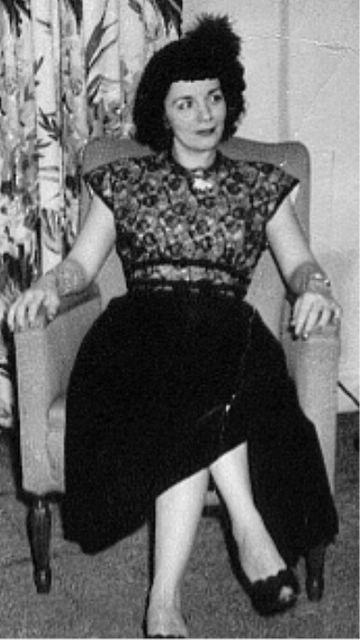
Flora Severini Kowinski, probably in the late 1940s after her marriage, but perhaps earlier. Posted by Picasa

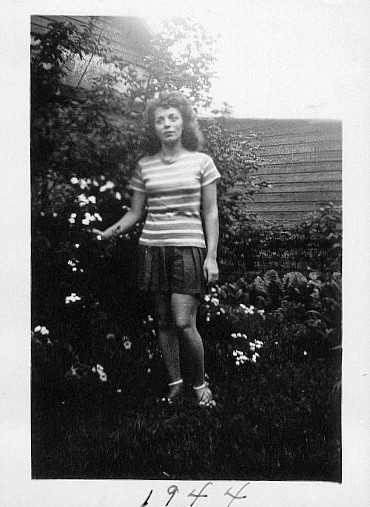
Flora in the back yard of her parent's home in Youngwood, PA in 1944, about a year before she married my father. Posted by Picasa

Billy (me) and Flora (my mother) in 1948.  Posted by Picasa

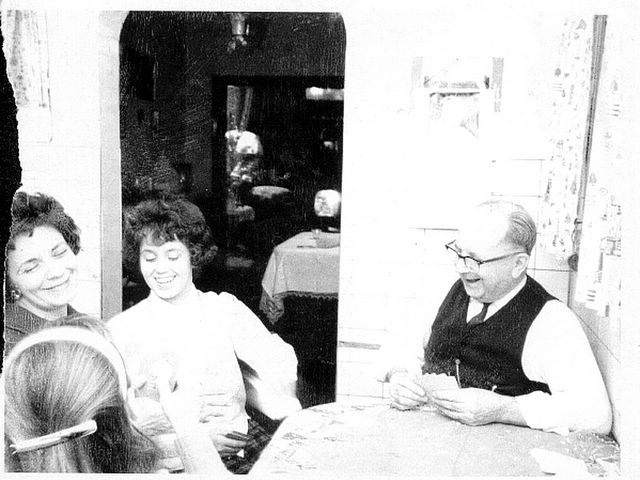
The kitchen of the house in Youngwood where my mother grew up. That's her father, my sister Kathy to his right, and my mother, smiling at my sister Debbie. I'm taking the picture. Posted by Picasa
Flora

She would have been eighty-five yesterday, on September 13. My mother was born in Italy in 1920, named after the character in a novel my grandmother was reading. My grandmother was one of the few women in her village in the Abruzzi mountains who could read---she read letters for people, and wrote their replies. It's how she found out that another woman had her eye on Ignazio Severini, her intended, who was away at war in the north, the Great War. But that's another story.

Flora came to America with her mother when she was four, and met her father, who'd left Manopello to work in Pittsburgh as a tailor when she was an infant. She grew up in Youngwood, PA, a small western PA railroad town about six miles from the bigger town of Greensburg, where she lived most of her life. She married my father in August 1945. I was born at the end of June in 1946.

So I'm less than a year shy of 60 myself, an age my mother didn't reach. (Her mother, however, passed 85; I took her a birthday cake and lit 85 candles on it---it was in the kitchen in the photo above. It makes quite a fire.) Flora died in 1974, after surviving her cancer past the supposed 5 year safety mark.

So you can look at the picture here of the dreamy-eyed young woman in 1944, who doesn't know that at 24 she's got but 30 years left to live. She's lived almost half her life.

After me, two daughters, Kathy in 1950, Debbie in 1954. She knew one granddaughter, Kathy's daughter Christina ; if she'd lived just another decade, she would have known two more: Debbie's daughters, Sarah and Megan.

I can't say when exactly I developed the perspective that would have allowed me to talk with my mother without so much of the freight of parent-child relationship expectations and habits of feeling and thought. But it wasn't fully developed when she was alive. I was smart about some things at 28, and clueless about a lot more. The father-son thing is more complicated, and I may never have gotten out of that dynamic. But I often feel I could have learned a lot and had a better relationship with my mother over these many years.

Not that we had a bad relationship. There just wasn't much perspective in it, at least on my part. So I wonder what it would have been like, to be able to talk to my mother when I was 40 or 50, or now. Apart from what it would bring to the present, there would be a lot of past to talk about, now that I'm more deeply interested in the past, having acquired quite a bit of it.

I would have liked to light 85 candles on her cake. As I say, it makes quite a fire.

Friday, August 05, 2005


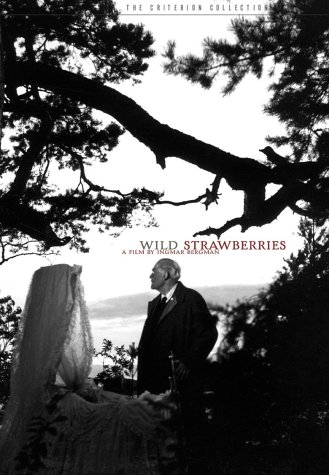
"Wild Strawberries" Posted by Picasa
Wild Strawberries and Bergman at 80

Though he was a young man when he started making films, Ingmar Bergman has always been the trademark filmmaker of mortality. The epic battle on the beach with the devil in "The '>Seventh Seal" is famous enough to be routinely parodied, and the intense beauty of "'>Cries and Whispers" is framed in pain and fatality. Even the child in "'>Through A Glass Darkly" seems to be glimpsing mortal lessons as the adults around him pose and flail on their train trip to the end of the line.

But oddly perhaps, his early film concerning an old man is among his most gentle. The Criterion Collection '>DVD of "Wild Strawberries" happens also to include an extended interview with Bergman when he had just passed the age of that film's protagonist. He was a sharp and physically graceful 80 (and this was in 1998. He's gone back to making films since---his latest release was 2003.) Both the movie and the interview turn out to be rather encouraging.

Ingmar Bergman's films were the closest thing to holy writ I can remember from my college days through the early 70s, when I was editing Janet Maslin's review of "Cries and Whispers" for the Boston Phoenix. Because I hadn't seen a "foreign film" until college, I was learning the cinematic vocabulary and syntax by osmosis mostly, and mostly by watching the French New Wave filmmakers, the Italian giants, and Bergman. Partly because the experience of watching Bergman had been conditioned by his reputation as being deep and depressing, I've seldom gone back to those films. But curiosity for what Bergman can tell me now, inspired me to take a look at this DVD of "Wild Strawberries."

"Wild Strawberries" is the story of an eminent 79 year old doctor, who lives alone with his housekeeper, on the day he is to receive a prestigious honorary degree in another city. It opens with a dream and contains several reveries---the kind of thing that became pretty standard on television dramas like "Thirty-something," but was disconcerting in 1957. Even with all these copycats, these scenes in this movie retain their power: they are economical, with not an extra image or a sound, and elegant.

The doctor wakes up from his unusual dream and suddenly decides instead of taking a plane as was planned, he will drive to the ceremony. Then his daughter-in-law appears; she's been staying with him, and asks to come along, since he'll be driving to the city where she lives. Why is she going back to her husband now? Why has she left?

They pick up three young hitchhikers---including the radiant young Bibi Anderssen, who reminds him of a lost love (who she also plays in his reverie). They get involved in a traffic accident, a bickering couple piles into the car, and suddenly we're in another prototype: the road movie.

The group covers a lot of ground in the past and present, and so does the movie, in a compact ninety minutes. But then, it was his 19th film. And he wasn't half done.) In one of his essays on Bergman, Truffaut comments that Bergman's women are "infinitely subtle," while his men "are mere conventions." This film is a rarity in focusing on a male character, played by Victor Sjostrom, a giant of Swedish theater and film who was all but forgotten by the time this movie was made, and he came out of retirement to act in it. Bergman said he did more than that---he took it over. The character was originally based (at least physically) on his father, but the film ceased being Bergman's, he said, and became Sjostrom's. If he meant through the subtle performance and the life he brought to the character, then it was all to the good.

This is an enjoyable film to watch, and there's extra enjoyment in watching it again with the commentary of film scholar Peter Cowie. His commentary has just the right mixture of preparation and spontaneity (as when he comments on how good a particular scene looks on DVD---the film is in glorious black and white.) When Cowie explains how precious the summers are in Sweden, just a few weeks of warmth and sunshine, it helps you feel the power of the imagery, in the professor's recollections of family summers by the sea.

Bergman directing Liv Ullman in "Saraband" 2003 Posted by Picasa
In a greenish patterned shirt with a black sweater vest, Bergman at 80 sat and talked easily with a friend and fellow filmmaker and writer, Jorn Donner, for a 90 minute interview made for Swedish television, and available here for the first time here on this DVD. He spoke about the relationship of his life to his work, elements of his autobiography (especially his exile from Sweden when he felt he was being persecuted by authorities on tax evasion charges that later proved groundless), and about his work habits, and his beliefs.

Harsh parental discipline and formality felt as coldness dominated Bergman's experience of his childhood, as he portrayed in several films. While his older brother survived it through aggressive assertion, he said, he survived it by adopting a persona pleasing to his parents, and by being a liar. "I lied freely and without restraint."

It's remarkably close to what Truffaut said about his own childhood survival technique. "I see life as very hard; I believe one should have a very simple, very crude and very strong moral system," Truffaut said in an interview. " One should say, 'yes, yes,' and do exactly as one pleases. This is why there can't be any direct violence in my films. Already in The 400 Blows, Antoine is a child who never rebels openly. His moral system is more subtle than that. Like me, Antoine is against violence because it signifies confrontation. Violence is replaced by escape, not escape from what is essential, but escape in order to achieve the essential. "

Bergman affirms his continuing relationship to his childhood, which is central to "Wild Strawberries." "The whole of my creativity is finally childish," he says, at age 80. "I can, in a second, go back to my childhood...Anything I've done that's of value [is] a dialogue with my childhood."

It was his fear of death, strongest in his teen years, that led him to write and film "The Seventh Seal," released just before "Wild Strawberries," and which he says exorcised that particular demon.

Bergman writes by hand, on the same kind of thick square yellow pads that were standard issue for screenwriters in Sweden when he started in 1942, but which in later years he had to have specially made. His only concession to change is that he's switched from a fountain pen to a ball-point.

He always begins with notes in workbooks. He fills many for each project. "Workbooks are fun!" By the time he starts writing the script itself, he knows exactly what he wants to do. "It goes quickly, but it's so boring. It goes quickly because it's so boring...The workbooks are the creative process. Scripts are the process of putting it in order." He adheres to a strict schedule: three hours a day, in 45 minute sessions with 15 minute breaks. This is as much ritual as routine, he agrees.

Bergman's tumultuous private life, which got translated into his domestic relationship films, is well known. But his last long marriage of 24 years ended with his wife's death, and he says he survived only by strictly scheduling his day, and finally by forcing himself to write. He has lived alone since, and though he enjoys talking on the telephone, he is comfortable in solitude.

He says he's not religious but is aware of "the possibilities of bigger patterns...I have a lot of ideas about other realities that surround me. I also have the feeling that we're part of an infinitely large pattern, that we never analyze [or] understand. You can feel that sometimes."

But he is sternly practical about his work, which at the time of his interview was mostly as a theatre director (though he'd had a decade of writing many scripts and stories.) Fame doesn't help the next day's work, he says, when he goes to rehearsals with the same prayer: "Let this day go well. Let it be meaningful and let it be alive."

"Let the work be meaningful for those who do it and then also be alive, so that it will live its own life. That's the only thing I'm afraid of---that suddenly the ability to make something living and moving will be taken away from me. I'll no longer know how to do it."

He has that anxiety every time, "the anxiety that what I do won't live." There are many stone dead days, he says, it's the most terrible thing there is. "This is my recurring nightmare."

"I'm a craftsman, and I make a good product. I make a product to be used. I'll be terribly upset if nobody wants to use my product."

The documentary ends with Bergman walking down the beach of his island of Faro, where he lives and the only place he writes. With his walking stick carried more like a sword, his stride is quick and sure, fluid, elegant and full of authority, like Peter O'Toole playing Lawrence or the King of England.

The television movie he made at age 86 is called "Saraband." Some say it's one of his best.

Friday, July 22, 2005


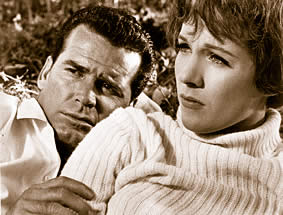
James Garner, Julie Andrews in "The Americanization of Emily"  Posted by Picasa
DVD FRIDAY: The Americanization of Emily

Of all the movies he made, James Garner said this was his favorite. So did Julie Andrews, his co-star. So did James Coburn, who had a more prominent role in many other films than he did in this one.

It was producer Martin Ransohoff's favorite of his movies, and Arthur Hiller's favorite of the many movies he directed. Script writer Paddy Chayevsky, who wrote several classics and an Academy Award winner, said this was one of his two favorite films.

Yet until the newly released DVD, '>The Americanization of Emily had all but disappeared. Perhaps because in many ways it was unclassifiable: a romantic comedy, a war movie, an anti-war movie, or as director Hiller insists, "an anti-the-glorification-of-war movie."

Made in 1964 in black and white, it may have become overshadowed by other more famous films of that era and that style on something like that theme: "Dr. Strangelove," perhaps even "Fail-Safe." Set in World War II, it was more distanced and with a dryer wit than the anti-war war novel of that time, "Catch-22."

But the new DVD reveals its considerable virtues: the eloquent and characteristically Chayevsky script, the fine, committed performances by Garner, Andrews, Coburn and Melvyn Douglas, among others. The rhythms and fluid camera of Arthur Hiller's first major directing job, that managed to make a single movie out of a unique combination of elements.

Hiller's DVD commentary is a great bonus. Producer Ransohoff bought the William Bradford Huie novel of the same title, which was a pretty straightforward romance about an English girl falling in love with an American soldier stationed in England during World War II. At some point he got the idea of asking Chayevsky to write it. Chayevsky flew from New York to Hollywood, and told Ransohoff it really wasn't for him. But on his flight back he thought of a way to do it, and called Ransohoff, explained this very different approach of making the hero a selfish sensualist who despises wartime heroics, but winds up being an accidental hero himself. For some reason, Ransohoff liked it.

Various directors and actors were attached to the project---at one point William Holden was the lead, and James Garner was to play his friend. When Holden dropped out, Garner moved up, and Coburn was added (possibly at the behest of Garner.)
Julie Andrews hadn't done a major movie yet---but she went from this one directly to making "Mary Poppins."

Arthur Hiller was a young and untested director, who got the job when better known directors turned it down. He was pretty nervy for a kid. He insisted on making it in black and white, which the studio opposed, since color films made more money. He set up shots so they were done without cuts, so the studio could slice and dice his film.

Later, Hiller recounts, Ted Turner bought the TV rights and colorized it. Hiller protested loud and long, as did other directors and film buffs. Eventually Turner listened and not only stopped colorizing, he joined Hiller in leading new efforts to preserve America's movie heritage by restoring and preserving endangered films.

This is a quirky, sometimes unsettling but often surprising and always entertaining movie, a real DVD treasure for your weekend viewing.

Friday, July 15, 2005


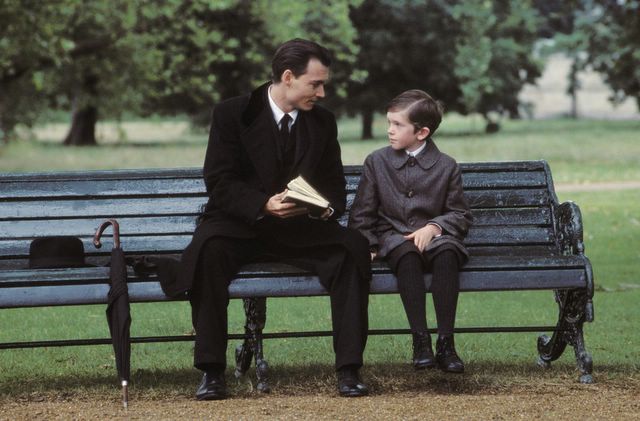
Before Charlie, Finding Neverland Posted by Picasa
Films About Theatre: A DVD Friday Collection

Supplementing what has become a nightly diet of "Six Feet Under" episodes on DVD (an HBO series we've never seen because we didn't have HBO even when we had cable---we're into the second season now), I rented two movies that just got off the "new" list, and by complete accident they both were films about the theatre (the first two in the list below).

Films about theatre happen to form one of my favorite subgenres, and so these two new additions inspire the first of the DVD Friday lists of personal favorites. All are available on DVD unless otherwise noted, though I haven't yet seen them all on DVD.

1. '>BEING JULIA (2004) From a novel by Somerset Magham, scripted by playwright and theatre explainer Ronald Harwood, this story about a famous but aging actress in London of 1938 is smart, stylish, funny and moving. Annette Benning deserved the Oscar she was robbed of, for this film, and the other performances---from Jeremy Irons to the wonderful Juliet Stevenson to relative newcomers, at least to film in America---are uniformly excellent. And in dealing with youthful ambition (somewhat reminiscent of "All About Eve"-see below) the resolution is wonderfully theatrical.

2. '>FINDING NEVERLAND (2004) Johnny Depp plays J.M Barrie in London as the nineteenth century becomes the 20th, when after his latest play fails he meets the woman and her children who will inspire "Peter Pan," which as a play has a double role in the film's climax. Depp and Kate Winslet are outstanding, supported by perfectly pitched performances from Julie Christie and Dustin Hoffman. The whole cast is very good, especially the boys who play the boys (proving that not all the talented English children are in the Harry Potter movies.)

The story is based on real events, though of course reality was much messier. Barrie did in fact write his play for the sons of a woman he met, and did later become guardian to the boys. But the woman's husband was still alive (he's conveniently dead in the movie), and for all the faith in the power of magic Barrie may have instilled in them, the boys came to bad ends: one killed in World War I, one drowned in the embrace of another man, and Peter killed himself, although he was an adult by then, and in publishing, but may have felt himself a prisoner of Barrie's imaginings.

Still, it's a very good movie, if a little saccarine about imagination and unimaginative about faith. But it has lovely touches about theatre, especially the relationships between actors, trying to support each other in the midst of not having a clue why they are dressed up as a pirate and a dog. The DVD extras are great---the deleted scenes are as good as any in the movie, and the outtakes are funny. There's one of Johnny Depp doing a scene in the park with a dog that decides to take a dump, and Depp talks to him in the same Scottish accent he employs for Barrie.

All About Eve Posted by Picasa
3. '>STAGE DOOR (1937). The struggling actor or most often actress who makes good is a staple of dozens of filmed stories: musicals, comedies, dramas and melodramas. This is one of the best, which seems to incorporate all possibilities, veering from screwball comedy to melodrama and ending up a fairly authentic kind of human comedy. It's singular for the appearance of star actresses who seldom worked together, so it's a treat to see Katharine Hepburn trade barbs with Ginger Rogers, while Eve Arden, Lucille Ball and Ann Miller wisecrack around them. It's also one of the better roles for Gail Patrick, who is seldom remembered now but excelled at playing cold manipulative women with just a touch of vulnerability.

Though the film tends to sag where the story does, Gregory La Cava keeps it moving briskly most of the time. (La Cava, a very busy silent movie actor who became a prodigious producer and director, had just directed his best film, the classic comedy '>My Man Godfrey---with Gail Patrick's most memorable performance. "Stage Door" was not only about the theatre, it started out as a play, by the formidable team of Edna Ferber and George S. Kaufman.

4.'>ALL ABOUT EVE (1950) The dark side of "Stage Door" and one of the best written movies of all time (written and directed by Joseph L. Mankiewicz). Famous as a Bette Davis vehicle, it also features outstanding performances by George Sanders, Gary Merill, Celeste Holm and Anne Baxter. Also an early appearance by Marilyn Monroe.

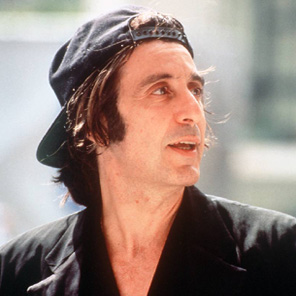
Looking for Richard in Manhattan Posted by Picasa
5. '>SHAKESPEARE IN LOVE (1998). Then there are films about the actual process of creating theatre, the heart of this subgenre. This has to be the ultimate, not just because it's a romantic comedy about the young William Shakespeare writing Romeo and Juliet, with lively and passionate performances by Joseph Fiennes and Gwyneth Paltrow (both their best, in my opinion) and some scenes stolen with relish by Dame Judi Dench.

The script by Marc Norman and Tom Stoppard incorporates so many delicious theatrical in-jokes (for instance, actors always describe the play as being about their character. "What's Romeo and Juliet about?" "Well, it's about this nurse...") as well as delightful bits of throwaway anachronisms. But the real heart of it is the performance of the play that leads to one gorgeous climax after another. Not only is the movie within the play within the movie handled brilliantly, but we get an idea of why Elizabethan theatre was so vital: the audience crowded against the stage, totally involved in every moment. Yes, and it's a mystery.

There isn't anything I don't like about this movie, from the color to the music. I'm looking forward to seeing the Collector's Series DVD with the commentaries, but it looks like I'll have to buy it---the ones for rent here are the extraless version.

6. A MIDWINTER'S TALE (1995) (also known as IN THE BLEAK MIDWINTER). In contrast to "Shakespeare in Love" which won the Best Picture Oscar, this little movie about a ragtag group of actors in England putting on a Christmas production of "Hamlet" is unknown. But it is also funny, with lots of heart and lots of theatre texture. It was written and directed by Kenneth Branagh around the time he directed his huge "Hamlet" for the screen. It's filled with affection, yet Michael Maloney's frenetic performance as the neurotic director and star of the play keeps it moving at a fast pace. And unlike Albert Finney's A MAN OF NO IMPORTANCE (1994), another excellent film about a provincial man who tries to find himself through theatre, this one has a theatrically happy ending.

7. '>LOOKING FOR RICHARD(1996). This is a completely unique film---part documentary in which Al Pacino lead us through his attempts to understand Shakespeare's Richard III and mount a production, culminating in Pacino and his cast performing key scenes of the play. It is entertaining from start to finish, thanks to Pacino's personality, the skillful editing of the cinema verite glimpses of the process (Pacino also directed) and the other oddballs he gathers in, and the power, complexity and ultimately the simplicity of Shakespeare's play. Much of it was shot in Manhattan, so it's Shakespeare with true contemporary grit. It ends up being a great film about the process of actors "finding" the play and performing what they find.

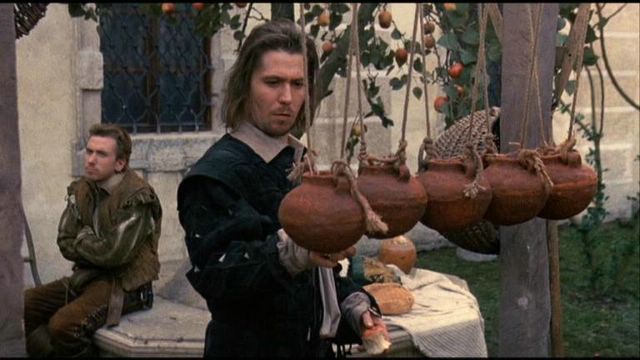
Tim Roth, Gary Oldman, R& G in perpetual immobility Posted by Picasa
8. '>ROSENCRANTZ AND GILDENSTERN ARE DEAD (1990). Then there are films about theatre within theatre. Tom Stoppard directed this film version of his famous play about two minor characters in Hamlet, and what they do when everybody else is watching the Prince of Denmark. The play is a classic, though its echoes of Beckett are now a bit jarring in view of Stoppard's later work. The movie is visually interesting and moves along at a goodly pace, but its chief virtue is the performances of Gary Oldman and Tim Roth, and Richard Dreyfuss as the Player. Oldman and Roth play R & G like a literate Laurel and Hardy, and there are numerous anachronistic sight gags that suggest Stoppard was responsible for that brand of humor in "Shakespeare in Love."

The DVD bonus disk is amazing, featuring an interview with Tom Stoppard of over an hour, and exceptionally revealing (but shorter) interviews with Gary Oldman and Richard Dreyfuss. Trust me, you've never heard actors talk like this in public.

Of course, there are lots of film versions of famous plays, with waves of contemporary Shakespeare still washing over us, but that’s another list. Still it’s worth mentioning here that Gary Oldman said that he and Roth had so much fun being R & G that they rehearsed continually, and in public—they would even do scenes in the pub that they had already shot. Plus, when Mel Gibson did his “Hamlet” they volunteered to play R & G in it, wearing the same costumes as in this movie. Apparently the Gibson folks didn’t get it.

9. '>VANYA ON 42ND STREET (1994). This is another collaboration between Wallace Shawn, Andre Gregory and Louis Malle, the team that created the unique "'>MY DINNER WITH ANDRE" (1981), an apparently spontaneous but in fact scripted conversation that was largely about theatre and its connections to contemporary life.

This time, we watch a group of New York actors gather one morning in an abandoned Ziegfield Follies theatre. They chat, get coffee, and suddenly, seamlessly, their chat becomes Chekov's "Uncle Vanya," and you are utterly hooked. Shawn plays Vanya, and Gregory directs from a script he adapted from David Mamet's very contemporary translation. This group of actors in fact had gathered periodically for years and years to simply work on this play with no thought of performance. Thanks to Malle's intimate camera work, we are privileged witnesses.

And with this, we have come full circle, to a film that is not only about theatre, but is theatre.

Tuesday, July 12, 2005


speed, quickness and lightness Posted by Picasa
From the Basketball Diary

This was the first in many years I didn't watch a single NBA game on TV until the finals, and then only parts of the last three. There's nothing much to watch---not when I've got old tapes of Michael Jordan and those Bulls teams, the Lakers of Shaq and Kobe championships, and even some of the Magic Johnson Lakers. So from time to time I watch them.

But I can't turn off the writer completely, so I do wonder what those announcers are talking about. If you know anything about the game, you know that some of what seems like dumb redundancy really isn't, like "He's got speed and quickness." They really are two different things. Speed means running fast: foot speed. Quickness means reflexes and all kinds of movement--lateral, up and down. It takes quick feet to play tight defense, quick hands to strip the ball or change the shot. You get the idea.

But then there are other habitual expressions that always bother me... The one that comes to mind is "shot attempt." Certain announcers are always talking about shot attempts. How many shot attempts. What I wonder is the difference between a shot attempt and a shot?
A made shot is a score. He shoots, he scores. Not---he executes a shot attempt, the attempt is successful, the shot is off, and it fulfills the requirements of the rules such that two points ensue.

They really should ask me about these things.

Monday, May 23, 2005


Unhand me, aliens! Your hairdryer will give Dale split ends!
Okay, so this has nothing to do with the post below
but it's dull around here without pictures. Posted by Hello
Interim Report

I've recently made the first in what will be a number of changes eventually affecting how I interact with the ever-changing Internet.

It may not seem related, but it is: I cancelled most of my cable television channels. We now have what is called "basic" cable service, the 2 through 13 channels, which consist of local outlets of the old networks, and public service/access channels.

This was partly a protest against the dereliction of the cable news channels, now united in an agenda of fluff and right wing propaganda. Paying more than $30 a month for what else cable TV had to offer was absurd as well as an elective payment for one's own oppression and degradation. We'll miss the Daily Show and the new Monk series, but that's about it.

Frankly if it were practical, I'd have it shut off altogether. The network news---and increasingly, disturbingly, this includes PBS though to a lesser extent so far---are becoming as irrelevant and noxious as cable. It may come to that, but for the moment I am investigating which way to go in the inevitable move away from dial-up Internet service: DSL or cable. As I'm leaning towards cable, I need to keep the minimum service. In either case, the money saved from cable bills will help offset additional one-time expenses for either choice.

Any advice on the DSL versus cable question would be welcome.

A change from my current dial-up account, which has migrated up the food chain as Tidepool was bought out by a slightly bigger fish and then consumed whole by a California-wide whale, will necessitate a new email address and change things for my web page and probably my blogs.

Though I don't know what the changes will be yet, the blogs are unlikely to remain in their current form for much longer. As an interim report on blog traffic, nothing much has changed in terms of ranking. This blog is still one of the least visited. My most visited blog by far is still Soul of Star Trek, and I'll say more about that below.

American Dash is the second most visited, but by about 10% of the number visiting Soul of Star Trek. With only a few exceptions in the past month, there have been fewer than 10 visitors per day, with an eyeball average of about six.

Because AD is updated frequently, these numbers probably indicate readers, whereas for some other blogs, it's clear from the searches that resulted in a hit, that visitors were looking for something else and probably didn't stick around long enough to read anything. That seems to be the case for Shopopolis and Kowincidence (which I regard as a kind of archive anyway.)

I had hopes for Books in Heat in particular, and Shopopolis, as well as my local experiments, the North Coast blogs. But traffic hasn't established any of them. Reviews in Books in Heat are quoted in publisher publicity, and there's sometimes been a nice bump when its address is appended to my reviews in the SF Chronicle (usually from the online link) but that's been about all the notice it's gotten.

I never intended to keep them all going, and so eventually they will be abandoned or fused together somehow.

By contrast, though not by comparison with truly successful blogs, Soul of Star Trek is at least healthy. It rarely receives fewer than 40 visitors a day, and in the past month has exceeded 100 on 10 days, with the one-day high approaching 400. Three times during the month it got more than 100 visitors on 3 successive days, and once it was over 100 for four of five days.

It benefits from links for specific posts from the big Trek boards (Trek Today mostly, but also Trekweb and a couple of similar sites in Europe), plus specific links from smaller blogs and BBS posts. That's when the higher numbers usually occur, although once this month it got over 100 visitors without being mentioned anywhere.

Soul of Star Trek has a healthy number of returning visitors, and an interesting geographical spread. United States visitors normally comprise around 65% of visitors, with reliable contingents from Canada and the UK. But there was a day this month when the second largest number of visitors were from Germany. I continue to be amazed by the geographical variety--really from everywhere in the world, including China.

The Soul of Star Trek blog has its fans as well. Someone with a Harvard address visits a lot and someone in Arizona visits very frequently. There was a day when somebody in San Francisco visited all my blogs. If the logs are to be believed, this person spent the entire day reading them. But how computers register on this system may not be always accurately reflected in the categories of the report.

Soul of Star Trek also gets comments, which none of the other blogs do, except rarely. I suppose it's helped to focus me on the work I've been doing anyway in this area, as I finally may be getting a draft of a publishable book together.

The summer movies have helped expand the subject matter of Soul of Star Trek some, so I'll be writing there about H.G. Wells soon, and I enjoyed doing a long piece on Douglas Adams, which gave me the opportunity to post photos from some of my 60s faves.

A couple of other factors are conspiring to keep me in that neighborhood these days. One of them is the possibility of publishing a book on Star Trek. I am in the weird position of being told by the editors at Pocket Books/Simon and Schuster who are in charge of Star Trek books there, that I am their choice to write the official 40th anniversary of Star Trek book. Unfortunately, the publisher isn't willing to commit to it, because Trek nonfiction hasn't been selling, and Paramount isn't yet focused on the matter.

So it is possible that late this summer I will learn that I have a couple of months to write this book. I've known this for awhile now, so I've gone ahead with writing what could be adapted to this book, or could be a book I would self-publish, through Xlibris probably, around the time of the 40th anniversary next year. Whether it will be positioned as a Star Trek book, or more of a Soul of the Future book, is yet to be determined.

The feedback I've gotten from the Soul of Star Trek blog, as small as it is, has been encouraging. It constitutes the only current encouragement from the outside world. Last year I freelanced for the arts sections of the San Francisco Chronicle and the New York Times, and I did several fairly long client projects for Humboldt State University. So far this year, I haven't gotten any more work from HSU (my contact and champion there left to literally go sailing), and after soliciting a proposal on the new Star Wars, a Times editor apologetically told me that word had come down from on high: no freelance. I heard the same from an editor at the Chronicle. (Although I eventually published a piece on the Star Wars movie in the Chronicle's Insight section.)

So things have been very, very quiet. Yet some work and some royalties and permissions fees has come through, enough so I could concentrate on the Trek/future book and related writing. At a certain point it felt like it was working, and I knew I had to go with the momentum. After all, I've been working on this off and on for at least six years. It feels like something (who knows what) may yet come of it.

Sunday, May 15, 2005


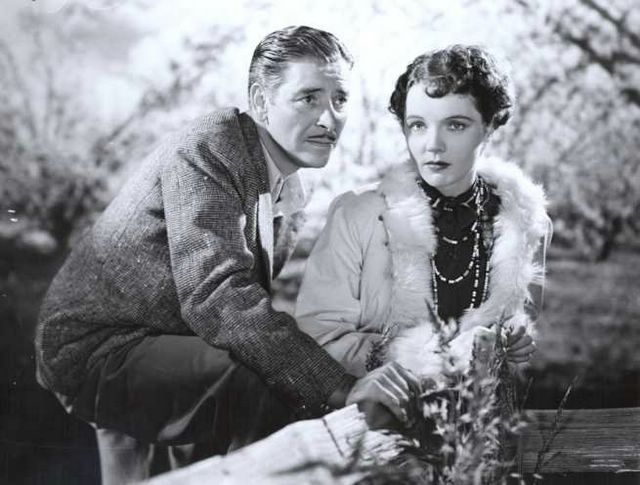
East meets West in "Lost Horizon" Posted by Hello
Lost Horizon Found

When I recently heard a reference to Jane Wyatt in Frank Capra's 1937 film, '>Lost Horizon, it dawned on me that this was a famous film I hadn't seen since I was very young, and then only on television. I had only a hazy memory of it, as somewhat mystical but mostly confusing.

After that, I don't recall it being mentioned much in the company of classic films, or even in references to Capra, his Mr. Smith Goes to Washington, Meet John Doe and the Oscar winning It Happened One Night being the ones usually cited.

So I rented the DVD, which turned out to be a restored version from 1999. The history of this movie would be bizarre even if it wasn't shared with a lot of less remembered films. Capra was the producer as well as director of this epic attempt to film the best selling novel by James Hilton. His rough cut was something like 5 hours long. The first version tested with an audience in Santa Barbara was 3 hours, and was considered a disaster.

With lots of cuts, some reshaping of the narrative and even new scenes shot, the movie was released in Los Angeles and other big cities in 1937 with a running time of 132 minutes. But the version that went out to theatres across the country was considerably shorter, by about 25 minutes. Even at that it was longer than the usual 90 minute movie, and individual theatres cut even more of it.

Then thanks to an offhand reference to Shangri-la by President Roosevelt, it was re-released during World War II, with more cuts for content reasons-taking out questionable references to allies, and too much of that pacifist stuff. (It is rather remarkable that it was made by the director who would soon be fashioning the Why We Fight "documentaries" ---they were actually mostly composed of pieces of Hollywood films---but then these Capra productions probably saved a lot of Italian Americans from internment camps.) By the time the movie got to television in the 50s, which is probably when I saw it, it was pretty much an incomprehensible mess. A plane wreck, snow, Shangri-la, escape, more snow, an avalanche, and a young woman suddenly becoming old. That was about it.

By the early 1970s, there wasn't a good intact negative of any version of the film anywhere. The American Film Institute, and later the UCLA film preservation project, began a series of restorations. The major finds that made the 1999 restoration possible in particular was an intact 132 minute soundtrack, discovered in British film archives. Several prints and dupe negatives of varying length and quality were located and though they were all shorter than 132 minutes (some considerably shorter), they were missing different scenes, and some had scenes the others didn't.

Two versions were particularly notable: a British dupe, shorter than even the 108 minute version but containing scenes no other version had, and a knarly print cut for Canadian TV, dubbed in French. This version had key moments missing from the others, usually within scenes.

The restorers even used some outtakes preserved on a reel shown to film exhibitors at a convention in Ohio before the film's release---in fact, before Capra had finished shooting the movie. With all that put together, they still lacked about seven minutes, but the 1999 restoration uses the complete soundtrack, so still photos are substituted for these minutes (using photos of the scenes where possible.)

Another remarkable fact about this restoration is that in 1999, digital enhancement and repair was still prohibitively expensive, so only a few scenes were given the full digital treatment. Most repair was done by "wet-printing," a technique then new that fills in film scratches with liquid so they fade from the print.

Given all the versions Capra assembled, and the cuts he made at the studio's insistence, it's fruitless to try to establish a definitive version, but this is as close as 25 years of restoration work could come to reproducing "Lost Horizon" as it was seen at its Los Angeles premiere in 1937. Though not quite the clarification that the restored "Metropolis" was a few years ago, it is still quite a revelation.

The film's flaws are perhaps even more clearly exposed. American action actor John Howard was obviously miscast as Ronald Colman's mercurial, weak and prejudiced brother (David Niven was said to be the favorite, but Howard was cast just days before shooting began.) The minor characters, while well acted for the most part, have a certain charm but don't quite jell. This isn't Capra at his characteristic best. Yet at this remove, even these flaws say something memorable.

Today the sight of Shangri-la is not quite as awe-inspiring as it was supposed to be, since it resembles a jumble of Frank Lloyd Wright and a half dozen other styles in a complex that looks like a World's Fair exhibit, or maybe a 1960s housing development crossed with a corporate campus. Some of the doorways and interiors seem borrowed from a Flash Gordon serial.

The idea that the heathens of Tibet need to be taught civilization by a European priest, whose natural superiority they recognize by making him their High Lama, is laughable. Yet none of these flaws, not even Capra's uneasy sentimentality about the idea of Shangri-la, completely distort the timeless power of this film, revealed especially and in some ways, for almost the first time, in this restoration.

The heart of the film is in Colman's wonderful performance, but its soul is in Sam Jaffe's haunting speeches as the High Lama. This was the most controversial part of this movie even while it was being made. Columbia Studios demanded Jaffe be replaced, and his scenes were shot with another actor, before test audiences affirmed Capra's choice of Jaffe's portrayal. Then much of the key scene was shortened and reshot again, after the Santa Barbara preview. (Another character was given some of its exposition, which required more shooting.)

Frank Capra monitored the restoration until his death, and requested that in particular the Lama's scenes be restored. This is in fact this version's great gift. It's remarkable how much of it was cut out in the various versions. Some of the most important lines have no existing footage at all, others only the grainy remains of the Canadian TV dupe.

The view of the world expressed here can be understood as coming from the Great Depression era and after the Great War, during the obvious prelude to another World War, just as the censoring of these scenes would be a product of World War II and the Cold War. But in another sense they are, if not timeless, then of our time as well as theirs.

This is a film worth seeing. If you've seen it in earlier versions, you probably haven't seen the lovely scenes with Ronald Colman and Jane Wyatt inexplicably cut from most versions---and without them the movie really doesn't make that much sense. It's worth seeing for Ronald Colman--"beautiful of face and soul, sensitive to the fragile and gentle, responsive to poetic visions and hard intellect," as Frank Capra describes both the character and the actor in his autobiography.

But if you don't get around to it, here is the best transcription I can offer of the High Lama talking about the meaning and purpose of Shangri-la. It could have been delivered yesterday, or tomorrow.

It came to me in a vision long long ago. I saw all the nations strengthening, not in wisdom but in vulgar passions and the will to destroy. I saw their machine power multiplying, until a single weaponed man might match a whole army. I foresaw a time in which man exalting in the technique of murder would rage so hotly over the world that every book, every treasure will be doomed to destruction.

This vision was so vivid and so real that I determined to gather together all things of beauty and of culture that I could, and preserve them here against the doom toward which the world is rushing.

Look at the world today. Is there anything more pitiful? What madness there is! What blindness! What unintelligent leadership! A scurrying mass of bewildered humanity crashing against each other, propelled by an orgy of greed and brutality. A time must come, my friend, when this orgy will spend itself. When brutality and the lust for power must perish by its own sword.

Against that time is why I avoided death...When that day comes the world may begin to look for a new life. It is my hope they will find it here. Their books and their music, and a way of life based on one simple rule: be kind. When that day comes, it is our home that the brotherly love of Shangri la will spread throughout the world. When the strong have devoured each other, the Christian ethic will at last be fulfilled, and the meek shall inherit the earth."
Ronald Colman and Jane Wyatt in "Lost Horizon" Posted by Hello