Interim Report
I've recently made the first in what will be a number of changes eventually affecting how I interact with the ever-changing Internet.
It may not seem related, but it is: I cancelled most of my cable television channels. We now have what is called "basic" cable service, the 2 through 13 channels, which consist of local outlets of the old networks, and public service/access channels.
This was partly a protest against the dereliction of the cable news channels, now united in an agenda of fluff and right wing propaganda. Paying more than $30 a month for what else cable TV had to offer was absurd as well as an elective payment for one's own oppression and degradation. We'll miss the Daily Show and the new Monk series, but that's about it.
Frankly if it were practical, I'd have it shut off altogether. The network news---and increasingly, disturbingly, this includes PBS though to a lesser extent so far---are becoming as irrelevant and noxious as cable. It may come to that, but for the moment I am investigating which way to go in the inevitable move away from dial-up Internet service: DSL or cable. As I'm leaning towards cable, I need to keep the minimum service. In either case, the money saved from cable bills will help offset additional one-time expenses for either choice.
Any advice on the DSL versus cable question would be welcome.
A change from my current dial-up account, which has migrated up the food chain as Tidepool was bought out by a slightly bigger fish and then consumed whole by a California-wide whale, will necessitate a new email address and change things for my web page and probably my blogs.
Though I don't know what the changes will be yet, the blogs are unlikely to remain in their current form for much longer. As an interim report on blog traffic, nothing much has changed in terms of ranking. This blog is still one of the least visited. My most visited blog by far is still Soul of Star Trek, and I'll say more about that below.
American Dash is the second most visited, but by about 10% of the number visiting Soul of Star Trek. With only a few exceptions in the past month, there have been fewer than 10 visitors per day, with an eyeball average of about six.
Because AD is updated frequently, these numbers probably indicate readers, whereas for some other blogs, it's clear from the searches that resulted in a hit, that visitors were looking for something else and probably didn't stick around long enough to read anything. That seems to be the case for Shopopolis and Kowincidence (which I regard as a kind of archive anyway.)
I had hopes for Books in Heat in particular, and Shopopolis, as well as my local experiments, the North Coast blogs. But traffic hasn't established any of them. Reviews in Books in Heat are quoted in publisher publicity, and there's sometimes been a nice bump when its address is appended to my reviews in the SF Chronicle (usually from the online link) but that's been about all the notice it's gotten.
I never intended to keep them all going, and so eventually they will be abandoned or fused together somehow.
By contrast, though not by comparison with truly successful blogs, Soul of Star Trek is at least healthy. It rarely receives fewer than 40 visitors a day, and in the past month has exceeded 100 on 10 days, with the one-day high approaching 400. Three times during the month it got more than 100 visitors on 3 successive days, and once it was over 100 for four of five days.
It benefits from links for specific posts from the big Trek boards (Trek Today mostly, but also Trekweb and a couple of similar sites in Europe), plus specific links from smaller blogs and BBS posts. That's when the higher numbers usually occur, although once this month it got over 100 visitors without being mentioned anywhere.
Soul of Star Trek has a healthy number of returning visitors, and an interesting geographical spread. United States visitors normally comprise around 65% of visitors, with reliable contingents from Canada and the UK. But there was a day this month when the second largest number of visitors were from Germany. I continue to be amazed by the geographical variety--really from everywhere in the world, including China.
The Soul of Star Trek blog has its fans as well. Someone with a Harvard address visits a lot and someone in Arizona visits very frequently. There was a day when somebody in San Francisco visited all my blogs. If the logs are to be believed, this person spent the entire day reading them. But how computers register on this system may not be always accurately reflected in the categories of the report.
Soul of Star Trek also gets comments, which none of the other blogs do, except rarely. I suppose it's helped to focus me on the work I've been doing anyway in this area, as I finally may be getting a draft of a publishable book together.
The summer movies have helped expand the subject matter of Soul of Star Trek some, so I'll be writing there about H.G. Wells soon, and I enjoyed doing a long piece on Douglas Adams, which gave me the opportunity to post photos from some of my 60s faves.
A couple of other factors are conspiring to keep me in that neighborhood these days. One of them is the possibility of publishing a book on Star Trek. I am in the weird position of being told by the editors at Pocket Books/Simon and Schuster who are in charge of Star Trek books there, that I am their choice to write the official 40th anniversary of Star Trek book. Unfortunately, the publisher isn't willing to commit to it, because Trek nonfiction hasn't been selling, and Paramount isn't yet focused on the matter.
So it is possible that late this summer I will learn that I have a couple of months to write this book. I've known this for awhile now, so I've gone ahead with writing what could be adapted to this book, or could be a book I would self-publish, through Xlibris probably, around the time of the 40th anniversary next year. Whether it will be positioned as a Star Trek book, or more of a Soul of the Future book, is yet to be determined.
The feedback I've gotten from the Soul of Star Trek blog, as small as it is, has been encouraging. It constitutes the only current encouragement from the outside world. Last year I freelanced for the arts sections of the San Francisco Chronicle and the New York Times, and I did several fairly long client projects for Humboldt State University. So far this year, I haven't gotten any more work from HSU (my contact and champion there left to literally go sailing), and after soliciting a proposal on the new Star Wars, a Times editor apologetically told me that word had come down from on high: no freelance. I heard the same from an editor at the Chronicle. (Although I eventually published a piece on the Star Wars movie in the Chronicle's Insight section.)
So things have been very, very quiet. Yet some work and some royalties and permissions fees has come through, enough so I could concentrate on the Trek/future book and related writing. At a certain point it felt like it was working, and I knew I had to go with the momentum. After all, I've been working on this off and on for at least six years. It feels like something (who knows what) may yet come of it.
Monday, May 23, 2005

Sunday, May 15, 2005


Lost Horizon Found
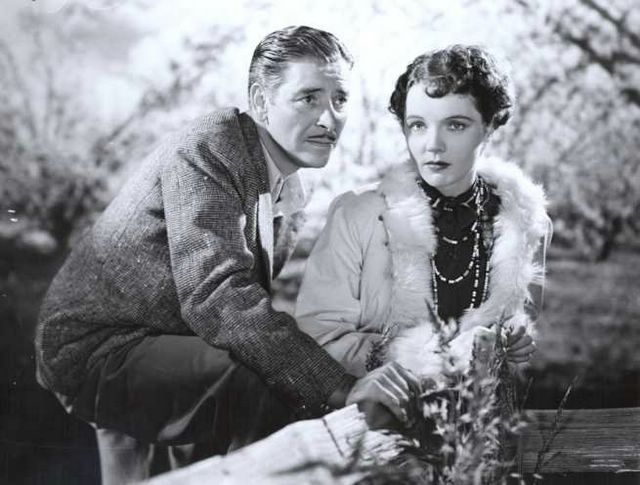
When I recently heard a reference to Jane Wyatt in Frank Capra's 1937 film, '>Lost Horizon, it dawned on me that this was a famous film I hadn't seen since I was very young, and then only on television. I had only a hazy memory of it, as somewhat mystical but mostly confusing.
After that, I don't recall it being mentioned much in the company of classic films, or even in references to Capra, his Mr. Smith Goes to Washington, Meet John Doe and the Oscar winning It Happened One Night being the ones usually cited.
So I rented the DVD, which turned out to be a restored version from 1999. The history of this movie would be bizarre even if it wasn't shared with a lot of less remembered films. Capra was the producer as well as director of this epic attempt to film the best selling novel by James Hilton. His rough cut was something like 5 hours long. The first version tested with an audience in Santa Barbara was 3 hours, and was considered a disaster.
With lots of cuts, some reshaping of the narrative and even new scenes shot, the movie was released in Los Angeles and other big cities in 1937 with a running time of 132 minutes. But the version that went out to theatres across the country was considerably shorter, by about 25 minutes. Even at that it was longer than the usual 90 minute movie, and individual theatres cut even more of it.
Then thanks to an offhand reference to Shangri-la by President Roosevelt, it was re-released during World War II, with more cuts for content reasons-taking out questionable references to allies, and too much of that pacifist stuff. (It is rather remarkable that it was made by the director who would soon be fashioning the Why We Fight "documentaries" ---they were actually mostly composed of pieces of Hollywood films---but then these Capra productions probably saved a lot of Italian Americans from internment camps.) By the time the movie got to television in the 50s, which is probably when I saw it, it was pretty much an incomprehensible mess. A plane wreck, snow, Shangri-la, escape, more snow, an avalanche, and a young woman suddenly becoming old. That was about it.
By the early 1970s, there wasn't a good intact negative of any version of the film anywhere. The American Film Institute, and later the UCLA film preservation project, began a series of restorations. The major finds that made the 1999 restoration possible in particular was an intact 132 minute soundtrack, discovered in British film archives. Several prints and dupe negatives of varying length and quality were located and though they were all shorter than 132 minutes (some considerably shorter), they were missing different scenes, and some had scenes the others didn't.
Two versions were particularly notable: a British dupe, shorter than even the 108 minute version but containing scenes no other version had, and a knarly print cut for Canadian TV, dubbed in French. This version had key moments missing from the others, usually within scenes.
The restorers even used some outtakes preserved on a reel shown to film exhibitors at a convention in Ohio before the film's release---in fact, before Capra had finished shooting the movie. With all that put together, they still lacked about seven minutes, but the 1999 restoration uses the complete soundtrack, so still photos are substituted for these minutes (using photos of the scenes where possible.)
Another remarkable fact about this restoration is that in 1999, digital enhancement and repair was still prohibitively expensive, so only a few scenes were given the full digital treatment. Most repair was done by "wet-printing," a technique then new that fills in film scratches with liquid so they fade from the print.
Given all the versions Capra assembled, and the cuts he made at the studio's insistence, it's fruitless to try to establish a definitive version, but this is as close as 25 years of restoration work could come to reproducing "Lost Horizon" as it was seen at its Los Angeles premiere in 1937. Though not quite the clarification that the restored "Metropolis" was a few years ago, it is still quite a revelation.
The film's flaws are perhaps even more clearly exposed. American action actor John Howard was obviously miscast as Ronald Colman's mercurial, weak and prejudiced brother (David Niven was said to be the favorite, but Howard was cast just days before shooting began.) The minor characters, while well acted for the most part, have a certain charm but don't quite jell. This isn't Capra at his characteristic best. Yet at this remove, even these flaws say something memorable.
Today the sight of Shangri-la is not quite as awe-inspiring as it was supposed to be, since it resembles a jumble of Frank Lloyd Wright and a half dozen other styles in a complex that looks like a World's Fair exhibit, or maybe a 1960s housing development crossed with a corporate campus. Some of the doorways and interiors seem borrowed from a Flash Gordon serial.
The idea that the heathens of Tibet need to be taught civilization by a European priest, whose natural superiority they recognize by making him their High Lama, is laughable. Yet none of these flaws, not even Capra's uneasy sentimentality about the idea of Shangri-la, completely distort the timeless power of this film, revealed especially and in some ways, for almost the first time, in this restoration.
The heart of the film is in Colman's wonderful performance, but its soul is in Sam Jaffe's haunting speeches as the High Lama. This was the most controversial part of this movie even while it was being made. Columbia Studios demanded Jaffe be replaced, and his scenes were shot with another actor, before test audiences affirmed Capra's choice of Jaffe's portrayal. Then much of the key scene was shortened and reshot again, after the Santa Barbara preview. (Another character was given some of its exposition, which required more shooting.)
Frank Capra monitored the restoration until his death, and requested that in particular the Lama's scenes be restored. This is in fact this version's great gift. It's remarkable how much of it was cut out in the various versions. Some of the most important lines have no existing footage at all, others only the grainy remains of the Canadian TV dupe.
The view of the world expressed here can be understood as coming from the Great Depression era and after the Great War, during the obvious prelude to another World War, just as the censoring of these scenes would be a product of World War II and the Cold War. But in another sense they are, if not timeless, then of our time as well as theirs.
This is a film worth seeing. If you've seen it in earlier versions, you probably haven't seen the lovely scenes with Ronald Colman and Jane Wyatt inexplicably cut from most versions---and without them the movie really doesn't make that much sense. It's worth seeing for Ronald Colman--"beautiful of face and soul, sensitive to the fragile and gentle, responsive to poetic visions and hard intellect," as Frank Capra describes both the character and the actor in his autobiography.
But if you don't get around to it, here is the best transcription I can offer of the High Lama talking about the meaning and purpose of Shangri-la. It could have been delivered yesterday, or tomorrow.
It came to me in a vision long long ago. I saw all the nations strengthening, not in wisdom but in vulgar passions and the will to destroy. I saw their machine power multiplying, until a single weaponed man might match a whole army. I foresaw a time in which man exalting in the technique of murder would rage so hotly over the world that every book, every treasure will be doomed to destruction.
This vision was so vivid and so real that I determined to gather together all things of beauty and of culture that I could, and preserve them here against the doom toward which the world is rushing.
Look at the world today. Is there anything more pitiful? What madness there is! What blindness! What unintelligent leadership! A scurrying mass of bewildered humanity crashing against each other, propelled by an orgy of greed and brutality. A time must come, my friend, when this orgy will spend itself. When brutality and the lust for power must perish by its own sword.
Against that time is why I avoided death...When that day comes the world may begin to look for a new life. It is my hope they will find it here. Their books and their music, and a way of life based on one simple rule: be kind. When that day comes, it is our home that the brotherly love of Shangri la will spread throughout the world. When the strong have devoured each other, the Christian ethic will at last be fulfilled, and the meek shall inherit the earth."
When I recently heard a reference to Jane Wyatt in Frank Capra's 1937 film, '>Lost Horizon, it dawned on me that this was a famous film I hadn't seen since I was very young, and then only on television. I had only a hazy memory of it, as somewhat mystical but mostly confusing.
After that, I don't recall it being mentioned much in the company of classic films, or even in references to Capra, his Mr. Smith Goes to Washington, Meet John Doe and the Oscar winning It Happened One Night being the ones usually cited.
So I rented the DVD, which turned out to be a restored version from 1999. The history of this movie would be bizarre even if it wasn't shared with a lot of less remembered films. Capra was the producer as well as director of this epic attempt to film the best selling novel by James Hilton. His rough cut was something like 5 hours long. The first version tested with an audience in Santa Barbara was 3 hours, and was considered a disaster.
With lots of cuts, some reshaping of the narrative and even new scenes shot, the movie was released in Los Angeles and other big cities in 1937 with a running time of 132 minutes. But the version that went out to theatres across the country was considerably shorter, by about 25 minutes. Even at that it was longer than the usual 90 minute movie, and individual theatres cut even more of it.
Then thanks to an offhand reference to Shangri-la by President Roosevelt, it was re-released during World War II, with more cuts for content reasons-taking out questionable references to allies, and too much of that pacifist stuff. (It is rather remarkable that it was made by the director who would soon be fashioning the Why We Fight "documentaries" ---they were actually mostly composed of pieces of Hollywood films---but then these Capra productions probably saved a lot of Italian Americans from internment camps.) By the time the movie got to television in the 50s, which is probably when I saw it, it was pretty much an incomprehensible mess. A plane wreck, snow, Shangri-la, escape, more snow, an avalanche, and a young woman suddenly becoming old. That was about it.
By the early 1970s, there wasn't a good intact negative of any version of the film anywhere. The American Film Institute, and later the UCLA film preservation project, began a series of restorations. The major finds that made the 1999 restoration possible in particular was an intact 132 minute soundtrack, discovered in British film archives. Several prints and dupe negatives of varying length and quality were located and though they were all shorter than 132 minutes (some considerably shorter), they were missing different scenes, and some had scenes the others didn't.
Two versions were particularly notable: a British dupe, shorter than even the 108 minute version but containing scenes no other version had, and a knarly print cut for Canadian TV, dubbed in French. This version had key moments missing from the others, usually within scenes.
The restorers even used some outtakes preserved on a reel shown to film exhibitors at a convention in Ohio before the film's release---in fact, before Capra had finished shooting the movie. With all that put together, they still lacked about seven minutes, but the 1999 restoration uses the complete soundtrack, so still photos are substituted for these minutes (using photos of the scenes where possible.)
Another remarkable fact about this restoration is that in 1999, digital enhancement and repair was still prohibitively expensive, so only a few scenes were given the full digital treatment. Most repair was done by "wet-printing," a technique then new that fills in film scratches with liquid so they fade from the print.
Given all the versions Capra assembled, and the cuts he made at the studio's insistence, it's fruitless to try to establish a definitive version, but this is as close as 25 years of restoration work could come to reproducing "Lost Horizon" as it was seen at its Los Angeles premiere in 1937. Though not quite the clarification that the restored "Metropolis" was a few years ago, it is still quite a revelation.
The film's flaws are perhaps even more clearly exposed. American action actor John Howard was obviously miscast as Ronald Colman's mercurial, weak and prejudiced brother (David Niven was said to be the favorite, but Howard was cast just days before shooting began.) The minor characters, while well acted for the most part, have a certain charm but don't quite jell. This isn't Capra at his characteristic best. Yet at this remove, even these flaws say something memorable.
Today the sight of Shangri-la is not quite as awe-inspiring as it was supposed to be, since it resembles a jumble of Frank Lloyd Wright and a half dozen other styles in a complex that looks like a World's Fair exhibit, or maybe a 1960s housing development crossed with a corporate campus. Some of the doorways and interiors seem borrowed from a Flash Gordon serial.
The idea that the heathens of Tibet need to be taught civilization by a European priest, whose natural superiority they recognize by making him their High Lama, is laughable. Yet none of these flaws, not even Capra's uneasy sentimentality about the idea of Shangri-la, completely distort the timeless power of this film, revealed especially and in some ways, for almost the first time, in this restoration.
The heart of the film is in Colman's wonderful performance, but its soul is in Sam Jaffe's haunting speeches as the High Lama. This was the most controversial part of this movie even while it was being made. Columbia Studios demanded Jaffe be replaced, and his scenes were shot with another actor, before test audiences affirmed Capra's choice of Jaffe's portrayal. Then much of the key scene was shortened and reshot again, after the Santa Barbara preview. (Another character was given some of its exposition, which required more shooting.)
Frank Capra monitored the restoration until his death, and requested that in particular the Lama's scenes be restored. This is in fact this version's great gift. It's remarkable how much of it was cut out in the various versions. Some of the most important lines have no existing footage at all, others only the grainy remains of the Canadian TV dupe.
The view of the world expressed here can be understood as coming from the Great Depression era and after the Great War, during the obvious prelude to another World War, just as the censoring of these scenes would be a product of World War II and the Cold War. But in another sense they are, if not timeless, then of our time as well as theirs.
This is a film worth seeing. If you've seen it in earlier versions, you probably haven't seen the lovely scenes with Ronald Colman and Jane Wyatt inexplicably cut from most versions---and without them the movie really doesn't make that much sense. It's worth seeing for Ronald Colman--"beautiful of face and soul, sensitive to the fragile and gentle, responsive to poetic visions and hard intellect," as Frank Capra describes both the character and the actor in his autobiography.
But if you don't get around to it, here is the best transcription I can offer of the High Lama talking about the meaning and purpose of Shangri-la. It could have been delivered yesterday, or tomorrow.
It came to me in a vision long long ago. I saw all the nations strengthening, not in wisdom but in vulgar passions and the will to destroy. I saw their machine power multiplying, until a single weaponed man might match a whole army. I foresaw a time in which man exalting in the technique of murder would rage so hotly over the world that every book, every treasure will be doomed to destruction.
This vision was so vivid and so real that I determined to gather together all things of beauty and of culture that I could, and preserve them here against the doom toward which the world is rushing.
Look at the world today. Is there anything more pitiful? What madness there is! What blindness! What unintelligent leadership! A scurrying mass of bewildered humanity crashing against each other, propelled by an orgy of greed and brutality. A time must come, my friend, when this orgy will spend itself. When brutality and the lust for power must perish by its own sword.
Against that time is why I avoided death...When that day comes the world may begin to look for a new life. It is my hope they will find it here. Their books and their music, and a way of life based on one simple rule: be kind. When that day comes, it is our home that the brotherly love of Shangri la will spread throughout the world. When the strong have devoured each other, the Christian ethic will at last be fulfilled, and the meek shall inherit the earth."
Thursday, April 21, 2005
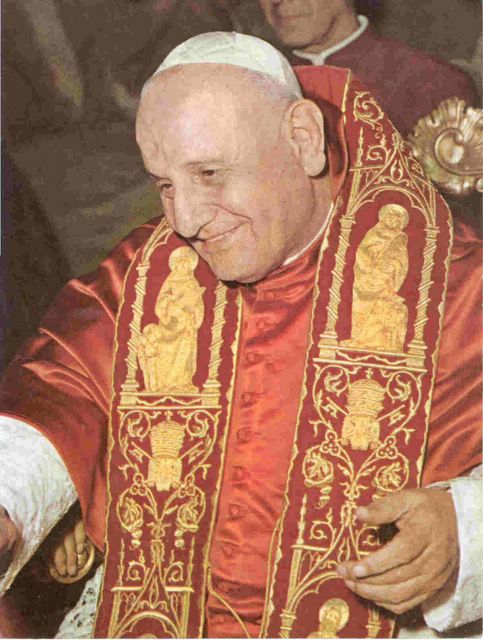
Pope John
All the Pope talk and controversy sent me back to see if I still had a handle on Vatican II and the papacy of Pope John XXIII. I remembered his encyclical "Pacem in Terris" and re-read it for the first time in many years. It was an emotional experience. The language is so pure, and the document is amazing. For as long and strange as this trip has been, I will always be grateful that I came of age in those brief years when Pope John and JFK were there to help form my principles and ideals.
I posted a version of this on Daily Kos, the big southpaw political blog, and discovered in the responses that I wasn't alone in this. One person referred to Pope John simply as "the Sunshine."
Pope John XXIII is associated in many American minds with JFK. John's papacy and Kennedy's presidency occurred at almost exactly the same time. They died within a few months of each other in 1963.
This period also coincides with my years at a Catholic high school, with a faculty comprised almost entirely of nuns and priests. Both Johns were of considerable and sometimes daily interest.
Pope John was a surprise choice when Pope Pius XII died in 1958. He was considered a compromise and caretaker pope, and like the new pope, his age seemed to guarantee a short and therefore inconsequential papacy.
He was Angelo Roncalli, the son of a sharecropper in a small Italian village. In World War I he was drafted into the Italian army and served as a medic and chaplan. At the start of World War II he was the Apostolic (Vatican) Delegate to Turkey and Greece, and saved thousands of Jewish refugees throughout Europe by working with the Jewish underground. He is considered by some Holocaust groups to be a Righteous Gentile.
In 1944 he was appointed Apostolic Nuncio to Paris, and Charles DeGaulle became so fond of him that when Roncalli was named a cardinal in 1953, President DeGaulle claimed an ancient right of French rulers to ceremonially bestow the red hat of the Cardinal himself.
When he became Pope in 1959, he was immediately popular as the people's pope. With his open smile and peasant face, he was an obvious contrast to the formal and aristocratic Pius XII. Pope John Paul II was famous as a world traveler, so it's strange to note that until Pope John XXIII, no pope since 1870 had left Vatican City on official business. John's first foray outside the Vatican was to visit prisoners. He also was the first Pope to reach out to other religions, first by meeting with the Archbishop of Canterbury in 1960, the first such meeting in 400 years.
In the 1960 presidential election, John F. Kennedy was the first Catholic to be nominated by a major party since 1928, when the Democrats nominated Al Smith. (Though Smith lost, some credit his running with moving Italians and other immigrant Catholics to the Democratic party, a process solidified by FDR and the New Deal.) Some of the same charges as helped defeat Smith were raised against Kennedy: that a Catholic would be bound to take orders from the Pope.
Protestant fundamentalists were particularly virulent in their opposition, fearing the collapse of the separation of church and state., and perhaps something else... The Reverend Harvey Springer, "cowboy evangelist of the Rockies," proclaimed: "Let the Romanists move out of America! Did you see the coronation of Big John? [meaning Pope John.] Let's hope we never see the coronation of Little John...How many Catholics came over on the Mayflower? Not one...The Constitution is a Protestant Constitution."
Kennedy confronted the issue by affirming that he would honor his oath as President first, and maintain the separation of church and state. In Rome, Pope John was trying to learn English. When an American bishop told him that Kennedy had a good chance of being elected, John joked with him: "Do not expect me to run a country with a language as difficult as yours."
JFK and John XXIII never met, although as First Lady, Jacqueline Kennedy had a papal audience in Rome. The Wikipedia bio of John preserves the story that the Pope had nervously rehearsed the proper greeting, "Madame, Mrs. Kennedy." But when he saw her he rushed over and cried, "Jackie!"
Vatican II
John XXIII shocked even the inner circle in the Vatican by calling for the Second Vatican Council just a few months after he became Pope. (The first council had been some 90 years before, was cut short by war and had little effect.) There were several years of preparation, and four sessions from 1962 to 1965. Pope John was alive for only one of the sessions. Most of the Council was actually run by his successor, Pope Paul VI.
Most of the Council's work, such as changes in the liturgy that allowed modern languages to be substituted for Latin, affected only Catholics. But the larger ramification was in opening dialogues with those outside the church. It was called an Ecumenical Council, and this was the word we heard the most---ecumenical, which means the whole church, and was interpreted to mean the possible unification of all Christians to some degree, and perhaps beyond that.
Observers from other religions were made part of Vatican II. Pope John's intention was preserved in this quote: "I want to throw open the windows of the Church so that we can see out and the people can see in."
As evidenced in the excerpts below from his encyclical, Pacem in Terris, Pope John based many of his thoughts on natural law, in the manner of Thomas Jefferson, for instance. This was to both include other traditions, and to place Catholicism within a larger context.
Why was the Council so controversial? Conservatives within the church didn't like change. I remember that some of my teachers were enthusiastic, but others kept quiet about the Council. One of my English teachers had high hopes that the Council would end the "Index of Forbidden Books," or at least take off some recognized classics that Catholics were reading away. This was the modernization trend, and together with the rest of the 1960s, it did cause a lot of wrenching change, and sometimes chaos.
For instance, a lot of rules governing religious orders were "liberalized." Just a few years after my graduation, two younger siblings of a classmate told me how much the school had changed. Some of the nuns who had taught me had left their orders altogether (my French teacher, who used to pretend to be scolding me when she read aloud my rather free translations---I just made up funny stories using words reminicent of the French words---showed up at a homecoming game a few years later with flaming red hair.) Others were out of their habits, and living in apartments (my old English teacher got in a tiff with her order over her car allowance). And just as some had feared, discipline had broken down at our old high school. Students were essentially laughing at their teachers, and going outside to get high. So if you're wondering why conservatives get apoplectic over the 60s, this may be a clue.
Personally I'm not sure the folk Mass was an improvement over the Latin I had to learn as an altar boy. But being able to legitimately use local language and music was important to places that had them as vital parts of their cultures, like Africa.
But to me the greatest legacy of Pope John was his final encyclical, "Pacem in Terris" (Peace on Earth). It is to me the greatest liberal document since the UN Declaration of Human Rights. Even today it reads like a Bill of Rights for the world.
I recommend reading the whole thing:
http://www.vatican.va/holy_father/john_xxiii/encyclicals/documents/hf_j-xxiii_enc_11041963_pacem_en.html
But here are some excerpts to give you the flavor, and whet your appetite. (I should point out that although this encyclical doesn't mention abortion, it does reserve the right of the Church to instruct its members on moral issues, thus offering some justification for the current Pope's letter as Prefect of the Congregation to American bishops that essentially read John Kerry out of the Church for his position on choice. But it seems unlikely to me that Pope John would have sanctioned such an extreme and both morally and politically troubling action.)
From Pacem in Terris:
"Any well-regulated and productive association of men in society demands the acceptance of one fundamental principle: that each individual man is truly a person. His is a nature, that is, endowed with intelligence and free will. As such he has rights and duties, which together flow as a direct consequence from his nature. These rights and duties are universal and inviolable, and therefore altogether inalienable.
We must speak of man's rights. Man has the right to live. He has the right to bodily integrity and to the means necessary for the proper development of life, particularly food, clothing, shelter, medical care, rest, and, finally, the necessary social services. In consequence, he has the right to be looked after in the event of ill health; disability stemming from his work; widowhood; old age; enforced unemployment; or whenever through no fault of his own he is deprived of the means of livelihood.
Moreover, man has a natural right to be respected. He has a right to his good name. He has a right to freedom in investigating the truth, and-within the limits of the moral order and the common good-to freedom of speech and publication, and to freedom to pursue whatever profession he may choose. He has the right, also, to be accurately informed about public events.
In the economic sphere, it is evident that a man has the inherent right not only to be given the opportunity to work, but also to be allowed the exercise of personal initiative in the work he does.
The worker is likewise entitled to a wage that is determined in accordance with the precepts of justice. This needs stressing. The amount a worker receives must be sufficient, in proportion to available funds, to allow him and his family a standard of living consistent with human dignity.
Each man should act on his own initiative, conviction, and sense of responsibility, not under the constant pressure of external coercion or enticement. There is nothing human about a society that is welded together by force. Far from encouraging, as it should, the attainment of man's progress and perfection, it is merely an obstacle to his freedom.
Women are gaining an increasing awareness of their natural dignity. Far from being content with a purely passive role or allowing themselves to be regarded as a kind of instrument, they are demanding both in domestic and in public life the rights and duties which belong to them as human persons.
... a regime which governs solely or mainly by means of threats and intimidation or promises of reward, provides men with no effective incentive to work for the common good. And even if it did, it would certainly be offensive to the dignity of free and rational human beings. Authority is before all else a moral force. For this reason the appeal of rulers should be to the individual conscience, to the duty which every man has of voluntarily contributing to the common good. But since all men are equal in natural dignity, no man has the capacity to force internal compliance on another. Only God can do that, for He alone scrutinizes and judges the secret counsels of the heart.
The attainment of the common good is the sole reason for the existence of civil authorities. In working for the common good, therefore, the authorities must obviously respect its nature, and at the same time adjust their legislation to meet the requirements of the given situation.
The common welfare further demands that in their efforts to co-ordinate and protect, and their efforts to promote, the rights of citizens, the civil authorities preserve a delicate balance. An excessive concern for the rights of any particular individuals or groups might well result in the principal advantages of the State being in effect monopolized by these citizens.
Here, then, we have an objective dictated first of all by reason. There is general agreement-or at least there should be-that relations between States, as between individuals, must be regulated not by armed force, but in accordance with the principles of right reason: the principles, that is, of truth, justice and vigorous and sincere co-operation.
Furthermore, relations between States must be regulated by the principle of freedom. This means that no country has the right to take any action that would constitute an unjust oppression of other countries, or an unwarranted interference in their affairs.
The United Nations Organization has the special aim of maintaining and strengthening peace between nations, and of encouraging and assisting friendly relations between them, based on the principles of equality, mutual respect, and extensive cooperation in every field of human endeavor.
A clear proof of the farsightedness of this organization is provided by the Universal Declaration of Human Rights passed by the United Nations General Assembly on December 10, 1948. The preamble of this declaration affirms that the genuine recognition and complete observance of all the rights and freedoms outlined in the declaration is a goal to be sought by all peoples and all nations.
We are, of course, aware that some of the points in the declaration did not meet with unqualified approval in some quarters; and there was justification for this. Nevertheless, We think the document should be considered a step in the right direction, an approach toward the establishment of a juridical and political ordering of the world community. It is a solemn recognition of the personal dignity of every human being; an assertion of everyone's right to be free to seek out the truth, to follow moral principles, discharge the duties imposed by justice, and lead a fully human life. It also recognized other rights connected with these.
What has so far been achieved is insufficient compared with what needs to be done; all men must realize that. Every day provides a more important, a more fitting enterprise to which they must turn their hands-industry, trade unions, professional organizations, insurance, cultrual institutions, the law, politics, medical and recreational facilities, and other such activities. The age in which we live needs all these things. It is an age in which men, having discovered the atom and achieved the breakthrough into outer space, are now exploring other avenues, leading to almost limitless horizons."
All the Pope talk and controversy sent me back to see if I still had a handle on Vatican II and the papacy of Pope John XXIII. I remembered his encyclical "Pacem in Terris" and re-read it for the first time in many years. It was an emotional experience. The language is so pure, and the document is amazing. For as long and strange as this trip has been, I will always be grateful that I came of age in those brief years when Pope John and JFK were there to help form my principles and ideals.
I posted a version of this on Daily Kos, the big southpaw political blog, and discovered in the responses that I wasn't alone in this. One person referred to Pope John simply as "the Sunshine."
Pope John XXIII is associated in many American minds with JFK. John's papacy and Kennedy's presidency occurred at almost exactly the same time. They died within a few months of each other in 1963.
This period also coincides with my years at a Catholic high school, with a faculty comprised almost entirely of nuns and priests. Both Johns were of considerable and sometimes daily interest.
Pope John was a surprise choice when Pope Pius XII died in 1958. He was considered a compromise and caretaker pope, and like the new pope, his age seemed to guarantee a short and therefore inconsequential papacy.
He was Angelo Roncalli, the son of a sharecropper in a small Italian village. In World War I he was drafted into the Italian army and served as a medic and chaplan. At the start of World War II he was the Apostolic (Vatican) Delegate to Turkey and Greece, and saved thousands of Jewish refugees throughout Europe by working with the Jewish underground. He is considered by some Holocaust groups to be a Righteous Gentile.
In 1944 he was appointed Apostolic Nuncio to Paris, and Charles DeGaulle became so fond of him that when Roncalli was named a cardinal in 1953, President DeGaulle claimed an ancient right of French rulers to ceremonially bestow the red hat of the Cardinal himself.
When he became Pope in 1959, he was immediately popular as the people's pope. With his open smile and peasant face, he was an obvious contrast to the formal and aristocratic Pius XII. Pope John Paul II was famous as a world traveler, so it's strange to note that until Pope John XXIII, no pope since 1870 had left Vatican City on official business. John's first foray outside the Vatican was to visit prisoners. He also was the first Pope to reach out to other religions, first by meeting with the Archbishop of Canterbury in 1960, the first such meeting in 400 years.
In the 1960 presidential election, John F. Kennedy was the first Catholic to be nominated by a major party since 1928, when the Democrats nominated Al Smith. (Though Smith lost, some credit his running with moving Italians and other immigrant Catholics to the Democratic party, a process solidified by FDR and the New Deal.) Some of the same charges as helped defeat Smith were raised against Kennedy: that a Catholic would be bound to take orders from the Pope.
Protestant fundamentalists were particularly virulent in their opposition, fearing the collapse of the separation of church and state., and perhaps something else... The Reverend Harvey Springer, "cowboy evangelist of the Rockies," proclaimed: "Let the Romanists move out of America! Did you see the coronation of Big John? [meaning Pope John.] Let's hope we never see the coronation of Little John...How many Catholics came over on the Mayflower? Not one...The Constitution is a Protestant Constitution."
Kennedy confronted the issue by affirming that he would honor his oath as President first, and maintain the separation of church and state. In Rome, Pope John was trying to learn English. When an American bishop told him that Kennedy had a good chance of being elected, John joked with him: "Do not expect me to run a country with a language as difficult as yours."
JFK and John XXIII never met, although as First Lady, Jacqueline Kennedy had a papal audience in Rome. The Wikipedia bio of John preserves the story that the Pope had nervously rehearsed the proper greeting, "Madame, Mrs. Kennedy." But when he saw her he rushed over and cried, "Jackie!"
Vatican II
John XXIII shocked even the inner circle in the Vatican by calling for the Second Vatican Council just a few months after he became Pope. (The first council had been some 90 years before, was cut short by war and had little effect.) There were several years of preparation, and four sessions from 1962 to 1965. Pope John was alive for only one of the sessions. Most of the Council was actually run by his successor, Pope Paul VI.
Most of the Council's work, such as changes in the liturgy that allowed modern languages to be substituted for Latin, affected only Catholics. But the larger ramification was in opening dialogues with those outside the church. It was called an Ecumenical Council, and this was the word we heard the most---ecumenical, which means the whole church, and was interpreted to mean the possible unification of all Christians to some degree, and perhaps beyond that.
Observers from other religions were made part of Vatican II. Pope John's intention was preserved in this quote: "I want to throw open the windows of the Church so that we can see out and the people can see in."
As evidenced in the excerpts below from his encyclical, Pacem in Terris, Pope John based many of his thoughts on natural law, in the manner of Thomas Jefferson, for instance. This was to both include other traditions, and to place Catholicism within a larger context.
Why was the Council so controversial? Conservatives within the church didn't like change. I remember that some of my teachers were enthusiastic, but others kept quiet about the Council. One of my English teachers had high hopes that the Council would end the "Index of Forbidden Books," or at least take off some recognized classics that Catholics were reading away. This was the modernization trend, and together with the rest of the 1960s, it did cause a lot of wrenching change, and sometimes chaos.
For instance, a lot of rules governing religious orders were "liberalized." Just a few years after my graduation, two younger siblings of a classmate told me how much the school had changed. Some of the nuns who had taught me had left their orders altogether (my French teacher, who used to pretend to be scolding me when she read aloud my rather free translations---I just made up funny stories using words reminicent of the French words---showed up at a homecoming game a few years later with flaming red hair.) Others were out of their habits, and living in apartments (my old English teacher got in a tiff with her order over her car allowance). And just as some had feared, discipline had broken down at our old high school. Students were essentially laughing at their teachers, and going outside to get high. So if you're wondering why conservatives get apoplectic over the 60s, this may be a clue.
Personally I'm not sure the folk Mass was an improvement over the Latin I had to learn as an altar boy. But being able to legitimately use local language and music was important to places that had them as vital parts of their cultures, like Africa.
But to me the greatest legacy of Pope John was his final encyclical, "Pacem in Terris" (Peace on Earth). It is to me the greatest liberal document since the UN Declaration of Human Rights. Even today it reads like a Bill of Rights for the world.
I recommend reading the whole thing:
http://www.vatican.va/holy_father/john_xxiii/encyclicals/documents/hf_j-xxiii_enc_11041963_pacem_en.html
But here are some excerpts to give you the flavor, and whet your appetite. (I should point out that although this encyclical doesn't mention abortion, it does reserve the right of the Church to instruct its members on moral issues, thus offering some justification for the current Pope's letter as Prefect of the Congregation to American bishops that essentially read John Kerry out of the Church for his position on choice. But it seems unlikely to me that Pope John would have sanctioned such an extreme and both morally and politically troubling action.)
From Pacem in Terris:
"Any well-regulated and productive association of men in society demands the acceptance of one fundamental principle: that each individual man is truly a person. His is a nature, that is, endowed with intelligence and free will. As such he has rights and duties, which together flow as a direct consequence from his nature. These rights and duties are universal and inviolable, and therefore altogether inalienable.
We must speak of man's rights. Man has the right to live. He has the right to bodily integrity and to the means necessary for the proper development of life, particularly food, clothing, shelter, medical care, rest, and, finally, the necessary social services. In consequence, he has the right to be looked after in the event of ill health; disability stemming from his work; widowhood; old age; enforced unemployment; or whenever through no fault of his own he is deprived of the means of livelihood.
Moreover, man has a natural right to be respected. He has a right to his good name. He has a right to freedom in investigating the truth, and-within the limits of the moral order and the common good-to freedom of speech and publication, and to freedom to pursue whatever profession he may choose. He has the right, also, to be accurately informed about public events.
In the economic sphere, it is evident that a man has the inherent right not only to be given the opportunity to work, but also to be allowed the exercise of personal initiative in the work he does.
The worker is likewise entitled to a wage that is determined in accordance with the precepts of justice. This needs stressing. The amount a worker receives must be sufficient, in proportion to available funds, to allow him and his family a standard of living consistent with human dignity.
Each man should act on his own initiative, conviction, and sense of responsibility, not under the constant pressure of external coercion or enticement. There is nothing human about a society that is welded together by force. Far from encouraging, as it should, the attainment of man's progress and perfection, it is merely an obstacle to his freedom.
Women are gaining an increasing awareness of their natural dignity. Far from being content with a purely passive role or allowing themselves to be regarded as a kind of instrument, they are demanding both in domestic and in public life the rights and duties which belong to them as human persons.
... a regime which governs solely or mainly by means of threats and intimidation or promises of reward, provides men with no effective incentive to work for the common good. And even if it did, it would certainly be offensive to the dignity of free and rational human beings. Authority is before all else a moral force. For this reason the appeal of rulers should be to the individual conscience, to the duty which every man has of voluntarily contributing to the common good. But since all men are equal in natural dignity, no man has the capacity to force internal compliance on another. Only God can do that, for He alone scrutinizes and judges the secret counsels of the heart.
The attainment of the common good is the sole reason for the existence of civil authorities. In working for the common good, therefore, the authorities must obviously respect its nature, and at the same time adjust their legislation to meet the requirements of the given situation.
The common welfare further demands that in their efforts to co-ordinate and protect, and their efforts to promote, the rights of citizens, the civil authorities preserve a delicate balance. An excessive concern for the rights of any particular individuals or groups might well result in the principal advantages of the State being in effect monopolized by these citizens.
Here, then, we have an objective dictated first of all by reason. There is general agreement-or at least there should be-that relations between States, as between individuals, must be regulated not by armed force, but in accordance with the principles of right reason: the principles, that is, of truth, justice and vigorous and sincere co-operation.
Furthermore, relations between States must be regulated by the principle of freedom. This means that no country has the right to take any action that would constitute an unjust oppression of other countries, or an unwarranted interference in their affairs.
The United Nations Organization has the special aim of maintaining and strengthening peace between nations, and of encouraging and assisting friendly relations between them, based on the principles of equality, mutual respect, and extensive cooperation in every field of human endeavor.
A clear proof of the farsightedness of this organization is provided by the Universal Declaration of Human Rights passed by the United Nations General Assembly on December 10, 1948. The preamble of this declaration affirms that the genuine recognition and complete observance of all the rights and freedoms outlined in the declaration is a goal to be sought by all peoples and all nations.
We are, of course, aware that some of the points in the declaration did not meet with unqualified approval in some quarters; and there was justification for this. Nevertheless, We think the document should be considered a step in the right direction, an approach toward the establishment of a juridical and political ordering of the world community. It is a solemn recognition of the personal dignity of every human being; an assertion of everyone's right to be free to seek out the truth, to follow moral principles, discharge the duties imposed by justice, and lead a fully human life. It also recognized other rights connected with these.
What has so far been achieved is insufficient compared with what needs to be done; all men must realize that. Every day provides a more important, a more fitting enterprise to which they must turn their hands-industry, trade unions, professional organizations, insurance, cultrual institutions, the law, politics, medical and recreational facilities, and other such activities. The age in which we live needs all these things. It is an age in which men, having discovered the atom and achieved the breakthrough into outer space, are now exploring other avenues, leading to almost limitless horizons."
Monday, April 11, 2005
Bonus Track!
This little piece was a rejoinder to a column in the local Eureka Reporter, and was published there as a Guest Column. I'd just give you the url except it has an annoying typo that this version doesn't. Discerning readers in this space won't be surprised by the opinions, but I couldn't let a chance go by to say Something Nice about one of the few new things in the world I actually like.
Unlike Wendy Butler, I love the bonus features on DVD. If I didn't, I just wouldn't watch them. Sometimes they are even the main reason I rent or buy a DVD movie, apart from the image quality, especially if I've already got it on tape.
Bonus features typically include short documentaries related to the film, a commentary track for the movie itself, and scenes that weren't in the theatrical release version, either reintegrated into the film, or by themselves. They are all hit or miss, of course, but they often add new layers to the experience of the movie.
The documentaries I often like best are retrospective interviews with directors and actors years after release, when they can put their efforts in perspective, and they can say things that maybe they couldn't before. But I also like to know how movies are made. I enjoy learning about the process.
Commentary tracks can be maddening, especially when the voices don't bother talking about what you're watching, and what you'd like to know. The worst I'm come across recently is "Spiderman II." The director (Sam Raimi) is cueing the star (Tobey Maguire) to talk solemnly about how he learns his lines while I'd like to know why they kept that scene with the neighbor bringing Peter Parker a piece of pie is the movie. It's also nearly impossible to follow both commentary and movie, even when you select for subtitles (which I usually do). But fortunately there's scene selection, pause, review---and fast-forward.
But much of the time, the commentary is enlightening (between descriptions of how effects shots were done, George Lucas describes a surprisingly serious intent for the Star Wars cycle: "how a democracy becomes a dictatorship, and a good person becomes a bad person") or it's just entertaining (counting the number of times that director Roland Emmerich says "this is one of my favorite scenes" during "The Day After Tomorrow.")
Sometimes the commentaries are even better than that. The dialogue between writer/director Nancy Meyers and actor Jack Nicholson on the DVD of "Something's Gotta Give" is hilarious, and a master class in film acting as well. So not only is this movie worth repeating, so is the commentary.
If DVDs have done nothing else, they proven how stupid movie studios can be in editing scenes out of movies just to make them shorter. They leave gaping holes in the story and make the actors look dumb, just so they can have more showings to confuse more people. But without the need to sell more tickets on opening weekend at the multiplex, DVDs can restore the scenes that at least give the movie a chance to make sense. That's more of a restoration than a bonus.
The bonus scenes work best when they actually put them back where they belong in the movie (and the commentary track can tip you off to this). Sometimes when they're offered as "deleted scenes," you wonder what the filmmakers were thinking when they deleted them. I remember several of the deleted scenes from the second Harry Potter movie better than I do a lot of the scenes that are in it. They tended to be mood pieces, like Harry and his owl sitting on a hill high above the landscape, but the movie needed some quiet moments, some beauty that evokes magic.
Selecting imaginative and high quality bonus features, delivering smart and honest commentaries, are becoming part of the DVD. package. I look forward to more.
Oddly or not, while nursing the cold I thought I'd avoided for this year, I watched a lot of DVD over the weekend, including bonuses. I even played some of the Harry Potter games (scored two goals in Quidditch, too, even in my weakened condition.) After hearing Star Trek's Dan Curry call the 1938 Erroll Flynn Adventures of Robin Hood the best adventure movie of all time, I thought I'd see it again with that in mind. It came with a film scholar's commentary, pretty informative, and a bonus disk, not too impressive except for a terrific long feature on the history of Technicolor (seems the name came from MIT, where the inventor went to school).
What I missed in the commentary but what I saw in the film was historical context: the Depression and already ravaged Europe of 1937-8. The scenes of Robin showing Maid Marion the plight of the poor was reminicent of similiar scenes in Sullivan's Travels and My Man Godfrey. Also, the scholar mentioned that in the earliest Robin Hood legends he was a trickster, and a figure in the May festival. What he failed to note was that in this film, Robin forcing the nobles to exchange clothing with the poor reproduced the Lord of Misrule reversals of those festivals. It was neat to see that the final sword battle between Flynn and Sherlock Holmes was as exciting as I remembered it as a kid, watching it on TV, probably in black and white.
This little piece was a rejoinder to a column in the local Eureka Reporter, and was published there as a Guest Column. I'd just give you the url except it has an annoying typo that this version doesn't. Discerning readers in this space won't be surprised by the opinions, but I couldn't let a chance go by to say Something Nice about one of the few new things in the world I actually like.
Unlike Wendy Butler, I love the bonus features on DVD. If I didn't, I just wouldn't watch them. Sometimes they are even the main reason I rent or buy a DVD movie, apart from the image quality, especially if I've already got it on tape.
Bonus features typically include short documentaries related to the film, a commentary track for the movie itself, and scenes that weren't in the theatrical release version, either reintegrated into the film, or by themselves. They are all hit or miss, of course, but they often add new layers to the experience of the movie.
The documentaries I often like best are retrospective interviews with directors and actors years after release, when they can put their efforts in perspective, and they can say things that maybe they couldn't before. But I also like to know how movies are made. I enjoy learning about the process.
Commentary tracks can be maddening, especially when the voices don't bother talking about what you're watching, and what you'd like to know. The worst I'm come across recently is "Spiderman II." The director (Sam Raimi) is cueing the star (Tobey Maguire) to talk solemnly about how he learns his lines while I'd like to know why they kept that scene with the neighbor bringing Peter Parker a piece of pie is the movie. It's also nearly impossible to follow both commentary and movie, even when you select for subtitles (which I usually do). But fortunately there's scene selection, pause, review---and fast-forward.
But much of the time, the commentary is enlightening (between descriptions of how effects shots were done, George Lucas describes a surprisingly serious intent for the Star Wars cycle: "how a democracy becomes a dictatorship, and a good person becomes a bad person") or it's just entertaining (counting the number of times that director Roland Emmerich says "this is one of my favorite scenes" during "The Day After Tomorrow.")
Sometimes the commentaries are even better than that. The dialogue between writer/director Nancy Meyers and actor Jack Nicholson on the DVD of "Something's Gotta Give" is hilarious, and a master class in film acting as well. So not only is this movie worth repeating, so is the commentary.
If DVDs have done nothing else, they proven how stupid movie studios can be in editing scenes out of movies just to make them shorter. They leave gaping holes in the story and make the actors look dumb, just so they can have more showings to confuse more people. But without the need to sell more tickets on opening weekend at the multiplex, DVDs can restore the scenes that at least give the movie a chance to make sense. That's more of a restoration than a bonus.
The bonus scenes work best when they actually put them back where they belong in the movie (and the commentary track can tip you off to this). Sometimes when they're offered as "deleted scenes," you wonder what the filmmakers were thinking when they deleted them. I remember several of the deleted scenes from the second Harry Potter movie better than I do a lot of the scenes that are in it. They tended to be mood pieces, like Harry and his owl sitting on a hill high above the landscape, but the movie needed some quiet moments, some beauty that evokes magic.
Selecting imaginative and high quality bonus features, delivering smart and honest commentaries, are becoming part of the DVD. package. I look forward to more.
Oddly or not, while nursing the cold I thought I'd avoided for this year, I watched a lot of DVD over the weekend, including bonuses. I even played some of the Harry Potter games (scored two goals in Quidditch, too, even in my weakened condition.) After hearing Star Trek's Dan Curry call the 1938 Erroll Flynn Adventures of Robin Hood the best adventure movie of all time, I thought I'd see it again with that in mind. It came with a film scholar's commentary, pretty informative, and a bonus disk, not too impressive except for a terrific long feature on the history of Technicolor (seems the name came from MIT, where the inventor went to school).
What I missed in the commentary but what I saw in the film was historical context: the Depression and already ravaged Europe of 1937-8. The scenes of Robin showing Maid Marion the plight of the poor was reminicent of similiar scenes in Sullivan's Travels and My Man Godfrey. Also, the scholar mentioned that in the earliest Robin Hood legends he was a trickster, and a figure in the May festival. What he failed to note was that in this film, Robin forcing the nobles to exchange clothing with the poor reproduced the Lord of Misrule reversals of those festivals. It was neat to see that the final sword battle between Flynn and Sherlock Holmes was as exciting as I remembered it as a kid, watching it on TV, probably in black and white.
Monday, April 04, 2005
How I Solve CRIME!
During the school year, Margaret likes to watch a little television to unwind before she sleeps. We generally watch either a half hour (which means The Daily Show) or one of the hour shows I tape for these occasions. These days they are: Boston Legal, Numbers, American Dreams, The West Wing, three Law & Orders (all but the Special Crimes Unit) and when it has new shows, Monk.
Most of those shows turn out to be crime shows, partly because most of the shows on TV are crime shows, when they aren't just a crime against humanity. We steer a course between my curmurgeonness (I have still never seen a 'reality show' nor used a cell phone) and Margaret's desire not to have nightmares (which leaves out certain crime shows.) We tend towards the whodunit variety. I have consequently become adept at solving the crimes or at least figuring out who the key people are, generally before halftime.
How do I do it? I'll tell you my secret. No, it's not learning to "think like a criminal." At least, not the kind of criminal the shows are about. No, the secret is to think like a TV writer.
The writers have less than 40 minutes to give you the wrong impression, the false clues and the innocent suspects, while slipping in somebody who really did it, or knows who did, or is the key to finding who did. That's not a lot of time. There aren't a lot of false clues or a lot of people who won't turn out to be the killer, etc.
How about CLUES? Yes, very important. And what are they? Well, motive and opportunity and all that are important, but the biggest clue is generally casting. If you recognize the actor as a current or past heavyweight (for few Law & Orders go by without my recognizing an actor I've actually met in a small part) in a seemingly innocuous one-scene role...probably not so innocuous.
Casting comes into play with physical attributes and how the actor plays the character. Cause you know the actor knows, and he or she has got to play it. Is the innocent guy too innocent looking, and the guilty guys too obviously guilty? Does the superficially innocent bystander have a little too ingratiating a manner, and a little shiftiness in his glance? You'll be seeing him again, being chased by the FBI.
Of course, TV writers almost always cheat, at least a little. There is always something, even if it's too add drama to a scene or exposition, that doesn't make sense. Sometimes they spend so much time building false motives and tearing them down, that the real killer has a flimsy motive at best, if you find out what it is. But then, it's only 40 minutes. And since I taped it, I didn't even have to deal with the commercials. Sometimes crime does pay.
During the school year, Margaret likes to watch a little television to unwind before she sleeps. We generally watch either a half hour (which means The Daily Show) or one of the hour shows I tape for these occasions. These days they are: Boston Legal, Numbers, American Dreams, The West Wing, three Law & Orders (all but the Special Crimes Unit) and when it has new shows, Monk.
Most of those shows turn out to be crime shows, partly because most of the shows on TV are crime shows, when they aren't just a crime against humanity. We steer a course between my curmurgeonness (I have still never seen a 'reality show' nor used a cell phone) and Margaret's desire not to have nightmares (which leaves out certain crime shows.) We tend towards the whodunit variety. I have consequently become adept at solving the crimes or at least figuring out who the key people are, generally before halftime.
How do I do it? I'll tell you my secret. No, it's not learning to "think like a criminal." At least, not the kind of criminal the shows are about. No, the secret is to think like a TV writer.
The writers have less than 40 minutes to give you the wrong impression, the false clues and the innocent suspects, while slipping in somebody who really did it, or knows who did, or is the key to finding who did. That's not a lot of time. There aren't a lot of false clues or a lot of people who won't turn out to be the killer, etc.
How about CLUES? Yes, very important. And what are they? Well, motive and opportunity and all that are important, but the biggest clue is generally casting. If you recognize the actor as a current or past heavyweight (for few Law & Orders go by without my recognizing an actor I've actually met in a small part) in a seemingly innocuous one-scene role...probably not so innocuous.
Casting comes into play with physical attributes and how the actor plays the character. Cause you know the actor knows, and he or she has got to play it. Is the innocent guy too innocent looking, and the guilty guys too obviously guilty? Does the superficially innocent bystander have a little too ingratiating a manner, and a little shiftiness in his glance? You'll be seeing him again, being chased by the FBI.
Of course, TV writers almost always cheat, at least a little. There is always something, even if it's too add drama to a scene or exposition, that doesn't make sense. Sometimes they spend so much time building false motives and tearing them down, that the real killer has a flimsy motive at best, if you find out what it is. But then, it's only 40 minutes. And since I taped it, I didn't even have to deal with the commercials. Sometimes crime does pay.
Sunday, February 13, 2005

It was Twenty Years Ago Today
Twenty years ago this February, my book The Malling of America was first published. "It's a famous book," Michael McClure said to me when I interviewed him last year. "It's a famous title," I said, and though that's more accurate, the content has maintained a presence over decades. Untold classloads of students have had to cope with a chapter on "Kids in the Mall" that has been reprinted in dozens of scholastic readers over these two decades, one of which arrived in the mail today. It continues to provide a little income--- and it is still a little amazed to find itself between the same covers with Thoreau, Shakespeare, Leslie Marmon Silko, Jim Harrison and James Baldwin.
The paperback edition of The Malling of America that I updated, edited and published through Xlibris in 2002 continues to sell a few copies each month. I just got my latest royalty check. I don't want to boast but it's in the mid two figures. Getting it back into print became a personal necessity, and the experience of doing so summoned up raw memories surrounding the book's publication that I shaped in several new chapters I added. Though not much response to those chapters has gotten back to me, I hoped they would open a window to the processes---the quite different processes---of writing and publishing, which are imbued with so many illusions.
That these illusions persist in 2005 is evidenced by a recent article in the Columbia Journalism Review, by a first-time nonfiction book author whose eyes were opened to the realities of publishing today. As much as I thought I knew already, I learned even more from this piece, which you can find here.
For one thing, I learned that the relationships of authors, agents and editors has, let's say "evolved." It used to be that agents were the writer's advocate, and editors were the customers, but basically it was editors who dealt with content. Today it's apparently the agents who deal with content, working with prospective authors to shape proposals, before any editor gets involved.
So it's no wonder that prospective authors spend more time and energy writing proposals. It's unpaid work, done with only what resources they can muster for research, so almost all non-celebrity authors are otherwise employed. I've written several books worth of proposals over the past twenty years, all seduction and no experience. Everyone knows that the book is discovered in the act of writing it, but nobody much is willing to invest in that anymore.
Unless of course you are a celebrity, which means a defined and apparently established market (though the quantities of celebrity-authored books in the remainder bins belies that assumption in many cases.)
I continue to think up book ideas, which I sometimes worry about: could it be my version of Tourette's syndrome?
Book advances also seem to be slipping into inconsequence (again, for non-celebs), which leads me to place this ad before you all:
AUTHOR FOR HIRE to busy celebrities in all fields, as well as to freaked-out editors with a deadline and an unpublishable manuscript. I write, I edit, I work to perfection and deadline. I've got the skills, you've got the money: let's talk. Nonfiction, fiction, Mr. In-Between, I can do it all. HAVE LAPTOP, WILL TRAVEL. Email: bilko@tidepool.com
* * *
Much of my writing these days goes into these blogs (even if published first elsewhere.) They present different challenges, and besides, unlike some writers, I enjoy reading my own writing. (And yes, it has occurred to me that this might not be a good thing.)
Very recently, however, I installed invisible counters on my various blogs---they count the number of "hits" and visitors, and give some other general information (not names or addresses or anything.) After only a week or so, I have detected some patterns.
By far my most popular blog, with the "greatest hits," has been Soul of Star Trek, with several hundred visitors in the span of a few days. It's also my most international blog, with visitors from Canada, UK, Sweden, Switzerland, Australia, Singapore, Japan, Indonesia, Poland, Italy, France, Germany and Namibia so far, as well as from all regions of the US (including Shawnee Mission, Kansas.)
Next in traffic is my newest and most local, This North Coast Place. Most of the traffic is from the North Coast of California, as is appropriate, but since a recent post describes a community forum here in Arcata conducted by members of the Humboldt State University geology department on the recent South Asia earthquake and tsunami and its lessons for our locality (there are many),there have been several visitors from Indonesia.
The portal and political blog, American Dash, the one on which I post every day, is in the mid-range, with this one, Blue Voice, getting fewer hits. I haven't sent out my group emails in awhile, not wanting to contribute to in-box clutter, but I suspect there's a lot of people who haven't yet gotten in the habit of bookmarking and visiting sites regularly.
I will probably be making changes in response. For example, Kowincidence got some early hits, so I've added "Numbers" (which was here, and still is, down there before the Cat Blogging gets started.) It's clear that some hits are the result of searches for something else, and the visit is just long enough to demonstrate that this isn't what is being searched for. I suspect that's been the case especially for Shopopolis. But I can't account for many others. They're just the mystery of the Internet, and of people using it.
My book review blog, Books in Heat, is the first to be mentioned in a print newspaper and their website (at the end of my SF Chronicle book review) and also the first to be quoted. So far it is also in the mid-range of hits. The last two reviews I posted were of new books, and I emailed the publicity directors of the presses. The morning after the most recent, I noted hits from both the city where the publisher is, and the city where the author lives. Maybe that blog is my way of honoring the process of writing and publishing. Mostly of writing.
Twenty years ago this February, my book The Malling of America was first published. "It's a famous book," Michael McClure said to me when I interviewed him last year. "It's a famous title," I said, and though that's more accurate, the content has maintained a presence over decades. Untold classloads of students have had to cope with a chapter on "Kids in the Mall" that has been reprinted in dozens of scholastic readers over these two decades, one of which arrived in the mail today. It continues to provide a little income--- and it is still a little amazed to find itself between the same covers with Thoreau, Shakespeare, Leslie Marmon Silko, Jim Harrison and James Baldwin.
The paperback edition of The Malling of America that I updated, edited and published through Xlibris in 2002 continues to sell a few copies each month. I just got my latest royalty check. I don't want to boast but it's in the mid two figures. Getting it back into print became a personal necessity, and the experience of doing so summoned up raw memories surrounding the book's publication that I shaped in several new chapters I added. Though not much response to those chapters has gotten back to me, I hoped they would open a window to the processes---the quite different processes---of writing and publishing, which are imbued with so many illusions.
That these illusions persist in 2005 is evidenced by a recent article in the Columbia Journalism Review, by a first-time nonfiction book author whose eyes were opened to the realities of publishing today. As much as I thought I knew already, I learned even more from this piece, which you can find here.
For one thing, I learned that the relationships of authors, agents and editors has, let's say "evolved." It used to be that agents were the writer's advocate, and editors were the customers, but basically it was editors who dealt with content. Today it's apparently the agents who deal with content, working with prospective authors to shape proposals, before any editor gets involved.
So it's no wonder that prospective authors spend more time and energy writing proposals. It's unpaid work, done with only what resources they can muster for research, so almost all non-celebrity authors are otherwise employed. I've written several books worth of proposals over the past twenty years, all seduction and no experience. Everyone knows that the book is discovered in the act of writing it, but nobody much is willing to invest in that anymore.
Unless of course you are a celebrity, which means a defined and apparently established market (though the quantities of celebrity-authored books in the remainder bins belies that assumption in many cases.)
I continue to think up book ideas, which I sometimes worry about: could it be my version of Tourette's syndrome?
Book advances also seem to be slipping into inconsequence (again, for non-celebs), which leads me to place this ad before you all:
AUTHOR FOR HIRE to busy celebrities in all fields, as well as to freaked-out editors with a deadline and an unpublishable manuscript. I write, I edit, I work to perfection and deadline. I've got the skills, you've got the money: let's talk. Nonfiction, fiction, Mr. In-Between, I can do it all. HAVE LAPTOP, WILL TRAVEL. Email: bilko@tidepool.com
* * *
Much of my writing these days goes into these blogs (even if published first elsewhere.) They present different challenges, and besides, unlike some writers, I enjoy reading my own writing. (And yes, it has occurred to me that this might not be a good thing.)
Very recently, however, I installed invisible counters on my various blogs---they count the number of "hits" and visitors, and give some other general information (not names or addresses or anything.) After only a week or so, I have detected some patterns.
By far my most popular blog, with the "greatest hits," has been Soul of Star Trek, with several hundred visitors in the span of a few days. It's also my most international blog, with visitors from Canada, UK, Sweden, Switzerland, Australia, Singapore, Japan, Indonesia, Poland, Italy, France, Germany and Namibia so far, as well as from all regions of the US (including Shawnee Mission, Kansas.)
Next in traffic is my newest and most local, This North Coast Place. Most of the traffic is from the North Coast of California, as is appropriate, but since a recent post describes a community forum here in Arcata conducted by members of the Humboldt State University geology department on the recent South Asia earthquake and tsunami and its lessons for our locality (there are many),there have been several visitors from Indonesia.
The portal and political blog, American Dash, the one on which I post every day, is in the mid-range, with this one, Blue Voice, getting fewer hits. I haven't sent out my group emails in awhile, not wanting to contribute to in-box clutter, but I suspect there's a lot of people who haven't yet gotten in the habit of bookmarking and visiting sites regularly.
I will probably be making changes in response. For example, Kowincidence got some early hits, so I've added "Numbers" (which was here, and still is, down there before the Cat Blogging gets started.) It's clear that some hits are the result of searches for something else, and the visit is just long enough to demonstrate that this isn't what is being searched for. I suspect that's been the case especially for Shopopolis. But I can't account for many others. They're just the mystery of the Internet, and of people using it.
My book review blog, Books in Heat, is the first to be mentioned in a print newspaper and their website (at the end of my SF Chronicle book review) and also the first to be quoted. So far it is also in the mid-range of hits. The last two reviews I posted were of new books, and I emailed the publicity directors of the presses. The morning after the most recent, I noted hits from both the city where the publisher is, and the city where the author lives. Maybe that blog is my way of honoring the process of writing and publishing. Mostly of writing.
The Short Story of A Long Sentence
Margaret was reading my book review in the SF Chronicle today and remarked that she especially liked a particular sentence. When she was finished reading, I asked her which sentence it was. It's this long one, she said, and started reading it aloud. I smiled, partly because when I re-read the review a little earlier, I noticed it, too.
I'd written the review several weeks ago, and this was the first time I revisited it. The review is of Simon Singh's book on cosmological history, THE BIG BANG. Here's the sentence: "Singh dramatizes the process of observations that raise questions about established theories that solve those problems but suggest new ones, all in a long chain of surmises and surprises, flashes of imagination and long cold nights nursing mountain-top telescopes, accomplished by the men and the less heralded women who had little in common but a talent, an insight or an obsession that led to a new piece that fits into the great puzzle."
I re-read the sentence when it was published, remembered what I was trying to do, and felt that I'd done it. That's usually the end of it. But Margaret had noticed it so I told her what I'd been up to: the sentence attempts to mirror what it's about: the "long chain." It's one of those sly games played at the keyboard late at night, the first pleasure of which is to pull it off, and the second, that people may like the sentence without knowing why. The music of it has to work, and it summarizes a great deal of what's in the book, but the journalistic thing to do would be to slice it into smaller pieces. But to make this work on another level was the fun of it.
I try similiar tricks pretty often. But they almost always remain my secret. It's nice to see one have its effect once in awhile.
Margaret was reading my book review in the SF Chronicle today and remarked that she especially liked a particular sentence. When she was finished reading, I asked her which sentence it was. It's this long one, she said, and started reading it aloud. I smiled, partly because when I re-read the review a little earlier, I noticed it, too.
I'd written the review several weeks ago, and this was the first time I revisited it. The review is of Simon Singh's book on cosmological history, THE BIG BANG. Here's the sentence: "Singh dramatizes the process of observations that raise questions about established theories that solve those problems but suggest new ones, all in a long chain of surmises and surprises, flashes of imagination and long cold nights nursing mountain-top telescopes, accomplished by the men and the less heralded women who had little in common but a talent, an insight or an obsession that led to a new piece that fits into the great puzzle."
I re-read the sentence when it was published, remembered what I was trying to do, and felt that I'd done it. That's usually the end of it. But Margaret had noticed it so I told her what I'd been up to: the sentence attempts to mirror what it's about: the "long chain." It's one of those sly games played at the keyboard late at night, the first pleasure of which is to pull it off, and the second, that people may like the sentence without knowing why. The music of it has to work, and it summarizes a great deal of what's in the book, but the journalistic thing to do would be to slice it into smaller pieces. But to make this work on another level was the fun of it.
I try similiar tricks pretty often. But they almost always remain my secret. It's nice to see one have its effect once in awhile.
Friday, February 11, 2005

From Arthur Miller's autobiography, Timebends:
"It would strike me years later how many male writers had fathers who had actually failed or whom the sons had perceived as failures. Fitzgerald, Faulkner, Hemingway (his father was a suicide), Thomas Wolfe, Steinbeck, Poe, Whitman, Melville and Hawthorne, Chekhov and Dostoyevsky and Strindberg-the list is too long to consign the phenomenon to idiosyncratic accident. As different as these writers are, they share an ambition to create a new cosmology, not merely to describe the visible world around them. If they could, they would devise a new order of perception that would make the world all new, as seen through their eyes."
"But the first church is in the skull, and there the gods face in two directions."
"Until I began to write plays my frustration with this doubleness of reality was terrible, but once I could impersonate all conflicts on a third plane, the plane of art, I was able to enjoy my power-even if a twinge of shame continued to accompany the plays into the world."
"Dramaturgy was the physics of the arts, the one that failed when it lied and succeeded when it cut to the first principles of human life."
"Science was reason's triumph, we had been so pridefully taught, the defeat of the Beast. But what happened when the Beast learned science?"
[commenting on Sinatra singing for Kennedy, then later for Reagan, as if he were royalty and the presidents come and go] "Could this signify that the business of America was not business, as an innocent Calvin Coolidge had said, but show business, symbolic display, the triumph at last of metaphor over reality and the domination of the performer with his pure and pointless charm?"
"We had come to prize and celebrate in our art disconnection for its own sake, but this was not at all the same as tearing apart the givens of experience in order to recreate a fresh unity that would inform us newly about our lives. Our surrealism was naturalism disguised, and as incapable of projecting alternatives to what we were doing and why as naturalism had always been."
"It was more and more difficult to imagine in the last quarter of the century the naked selfness of a free human being speaking with no acknowledged interest except his own truth."
"It would strike me years later how many male writers had fathers who had actually failed or whom the sons had perceived as failures. Fitzgerald, Faulkner, Hemingway (his father was a suicide), Thomas Wolfe, Steinbeck, Poe, Whitman, Melville and Hawthorne, Chekhov and Dostoyevsky and Strindberg-the list is too long to consign the phenomenon to idiosyncratic accident. As different as these writers are, they share an ambition to create a new cosmology, not merely to describe the visible world around them. If they could, they would devise a new order of perception that would make the world all new, as seen through their eyes."
"But the first church is in the skull, and there the gods face in two directions."
"Until I began to write plays my frustration with this doubleness of reality was terrible, but once I could impersonate all conflicts on a third plane, the plane of art, I was able to enjoy my power-even if a twinge of shame continued to accompany the plays into the world."
"Dramaturgy was the physics of the arts, the one that failed when it lied and succeeded when it cut to the first principles of human life."
"Science was reason's triumph, we had been so pridefully taught, the defeat of the Beast. But what happened when the Beast learned science?"
[commenting on Sinatra singing for Kennedy, then later for Reagan, as if he were royalty and the presidents come and go] "Could this signify that the business of America was not business, as an innocent Calvin Coolidge had said, but show business, symbolic display, the triumph at last of metaphor over reality and the domination of the performer with his pure and pointless charm?"
"We had come to prize and celebrate in our art disconnection for its own sake, but this was not at all the same as tearing apart the givens of experience in order to recreate a fresh unity that would inform us newly about our lives. Our surrealism was naturalism disguised, and as incapable of projecting alternatives to what we were doing and why as naturalism had always been."
"It was more and more difficult to imagine in the last quarter of the century the naked selfness of a free human being speaking with no acknowledged interest except his own truth."
Thursday, February 10, 2005
Numbers
I'm not very good at numbers. (All the math genes in the Severini line went to my cousin Tom.) But I've been thinking about them a lot these past few days. We are so used to seeing huge numbers---$80 billion more for Iraq, $25 million a year for a baseball star---that we judge them only in relation to other huge numbers.
But what really is a billion? Or a trillion? Or even a paltry million?
Everybody's favorite number is, how much do they make? Rueben Mark, CEO of Colgate-Palmolive, got $148 million last year, compared to "only" $75 million for Michael Dell of Dell computers. How does that compare with what you make? With what you spend, or can even conceive of spending? With what you need?
When we get to the sums bandied about concerning corporate and especially government spending applied to public policy questions, then the relative values become even more revealing, and important. But we hardly ever look at numbers that way.
I was inspired to do so by an actor. Not Rob Morrow, the erstwhile Dr. Fleishman who stars in a new police procedural called "Numbers." No, it was Sharon Stone.
As many know by now, Sharon Stone, the blond woman actor most famous for steamy movie scenes, attended a panel discussion at the World Economic Forum in Switzerland last week. The panelists had been talking about world poverty for an hour or so, when a UN official mentioned that 150,000 African children die of malaria each month, principally because they don't have mosquito nets protecting their beds.
Sharon Stone suddenly stood up, pledged $10,000 to buy bed nets, and challenged others in the audience to pony up. The chair of the panel, Republican House Leader Bill Frist reportedly tried several times to shut her up. But she persisted. And in five minutes, she had raised one million dollars.
There were a couple of even more important number in the Associated Press story about this incident. It said that the nets, pretreated to protect against malaria-carrying mosquitoes, cost $7 each. They last as long as five years.
Now, everyone is fascinated with the idea of raising a million dollars in five minutes. But in politics and public policy, we are also used to thinking of a million dollars as not buying very much. It won't buy you a 30 second ad for very long in very many markets. It bought only 1/40th of an Inaugural celebration this year.
But according to my calculator (which comes from the Dollar Store, and has never before had to work with figures anywhere near this large), one million dollars will buy almost 143,000 bed nets. With volume discount, let's say 150,000.
So in five minutes, Sharon Stone and her partners gave the grim reaper a month off, when it comes to African children and malaria. 150,000 children protected not just for one month but for 60 months, or five years.
Think about ad buys during the campaign. I saw reference to one: for 13 spots on TV stations in 100 markets, nearly $57 million. Four million a spot. For each million, 150,000 lives by buying bed nets in Africa. For $57 million, nearly 32 years of grim reaper vacation for children in Africa dying for lack of these nets. If you look at in terms of numbers of kids times years of protection, it's more like 160 years.
Now let's look at some numbers for the Iraq war. I saw one report that figures the U.S. military spending in Iraq at $1 billion a week. A few days later, an article by George McGovern stated that the U.S. is spending $5 billion a week in Iraq, so that's a billion a day, with weekends off.
In his article, McGovern talked about how that money could be better used: a billion for tsunami relief, a billion for Iraq reconstruction, one for veterans' benefits, one devoted to ending world hunger, the last one to the national debt.
But notice McGovern is still talking about billions. What could Sharon Stone do with a billion? A billion is one thousand times one million. $1 billion would buy one million five hundred thousand mosquito nets. That is very close to the number of African children who die of malaria each year.
I looked up a few other numbers. I didn't note all the sources, but they all seemed reputable and they are all easily found with a Google search. There are 500,000 new cases of childhood blindness each year, 70% to 90% of it in the developing world. 75% of global blindness can be prevented or cured. Less than half the children stricken with blindness survive to adulthood. The average life expectancy is about four years. Others say that because blindness is related to illnesses and poor nutrition, half don't make it beyond one year.
Vitamin A deficiency is a major cause in 70% of those half million children going blind every year. A single dose of Vitamin A costs $0.05 US. I don't know how many doses it takes, but let's say we want to buy a dose a day for all of those half million kids. That's about $10 million a year.
$10 million is 1/100th of what the U.S. spends on military operations in Iraq in one week, or maybe it's closer to in one day.
Vitamin A deficiency as well as other causes are implicated in blindness caused by glaucoma. No one seems to know the number of children affected, but it is a significant proportion of the total. Like other causes of blindness, most cases are in the developing world.
The Himalayan Cataract Project has performed more than 25,000 cataract surgeries to restore sight since 1994. The cost of each surgery, including intraocular lenses, is $12 US.
One million dollars buys more than 83,000 cataract surgeries.
One billion dollars buys 83 million.
I read yesterday that the market is booming for houses costing one million dollars or more. It is possible that some people reading this have a net worth that approaches a million dollars. Maybe a lot more. But thinking about numbers, I tried to figure out what I've made in my lifetime, and my father, and his father. I conclude that the three of us, through roughly the past 75 to 100 years, likely did not make more than a half million dollars combined. But my math is shaky and over that kind of time you probably need to figure it using some sort of constant dollar. So double it, to be safe.
One hundred years of working = 83,000 cataract surgeries=1/150th of the CEO of Colgate's annual salary=1/1000th of what the U.S. spends in Iraq in one day.
No wonder I have trouble with numbers.
Here are a few more, from a forthcoming book by Jeffrey D. Sachs, special advisor to the UN Secretary General on global poverty. To meet the basic needs of all the poor in the world until 2015 (including medical needs) would cost about $80 billion per year. After that, with adequate planning, poverty would be over.
$80 billion is the amount just requested as a supplementary appropriation for military needs in Iraq, for this year.
Sachs figures that not just one country but 22 countries pony up to pay it, so the US contribution would be a fraction of $80 billion.
A committee of 22 wealthy nations has set a target of devoting 0.7% of their annual income of more than twenty trillion dollars (a trillion is one thousand billions) to eradicate poverty. Sachs estimates they can do it with 0.6%, given the rest of the program he outlines.
Now let's return for a moment to the U.S., to California, where the bill for "custodial care" in a Kaiser Permanente hospital is $3,200 a day. That's not counting medicines or treatment, though meals are presumably included. (Which, by the way was not true at least until recently for soldiers wounded in Iraq sent to stateside hospitals; they were billed for meals.)
I saw that room price quoted in a story about a woman who was checked into the psychiatric wing of a Kaiser hospital and refused to leave a week later when told there was nothing wrong with her. She is 84 and says she was kidnapped and lost her place in her rest home. She won't leave the hospital until they find her a new rest home. She's been there a year. Her bill so far is $1.1 million.
100 years of work= not quite one year custodial care in a Kaiser hospital. But of course for the CEO of Colgate, it's maybe three days work.
Health, by the way, correlates with income. The higher, the better, and vice versa. Gee, I wonder why.
Now there's debate on proposals to gut Social Security in order to allow investment schemes, which is upping the ante into beyond the bogglesphere. A modest estimate of the cost, by one of the proponents no less (VP Cheney) is $758 billion initially and then "trillions after that." Trillions? A slightly less conservative estimate is $1 trillion to start, and $3.5 trillion after that. And there are people who think it would cost a lot more than that.
Except that the world doesn't seem to have a lot more than that. And I get the feeling that not even that will stop them.
So what does all this add up to? For me, it's a series of eye-openers. We tend to talk in categories. When we talk about government spending, it's in billions. Baseball player salaries, in millions. Car prices, tens of thousands, etc. And we compare within categories.
To a certain extent, this is reasonable. There are lots of zeroes at the end of a federal budget line, but then there are lots of zeroes at the end of the line of people served, or at the end of prices of each item paid for (like attack helicopters and smart missiles.)
And so when you're talking about hundreds of billions, it seems reasonable that accounting problems would mean that you lose track of nine billion dollars, as has happened in Iraq.
But the ease with which our tongues move from the M word to the B word to the T word can distort reality, and can hide questions of value, as in, what do we value? And what does it really cost?
Personally I can't quite understand how someone can be paid one hundred million a year (100x1000x1000), and someone else, in the same company perhaps, be paid 10x 1000. How do they get away with it?
How do they get away with burning 1000x a million dollars a day (or a week), and a total of some $10 billion going to Halliburton (10x1000x1,000,000) on a war that 60% of the public paying for it doesn't want?
The nuns were probably right about me, that I couldn't buckle down to do arithmetic because I had my head in the clouds. But at this point I have to conclude that I can't hold a candle to the fantasy life of the people who toss these numbers around.
Those are the numbers that filled my head last week. What were yours?
P.S. a Daily Kos contributor called baba durag added this: Suppose you were born with a billion dollars to your name. And suppose you lived to be 100 years old. If you spent $10,000 every day of your entire life, you would still have almost 3/4 of the money left. And that's if you kept your billion in the basement. Even a modest savings account interest would just about ensure that you could live a full and very rich life and never need to touch the principal, the one billion. Maybe there is no free lunch. But for some people, there are lots of free banquets.
I'm not very good at numbers. (All the math genes in the Severini line went to my cousin Tom.) But I've been thinking about them a lot these past few days. We are so used to seeing huge numbers---$80 billion more for Iraq, $25 million a year for a baseball star---that we judge them only in relation to other huge numbers.
But what really is a billion? Or a trillion? Or even a paltry million?
Everybody's favorite number is, how much do they make? Rueben Mark, CEO of Colgate-Palmolive, got $148 million last year, compared to "only" $75 million for Michael Dell of Dell computers. How does that compare with what you make? With what you spend, or can even conceive of spending? With what you need?
When we get to the sums bandied about concerning corporate and especially government spending applied to public policy questions, then the relative values become even more revealing, and important. But we hardly ever look at numbers that way.
I was inspired to do so by an actor. Not Rob Morrow, the erstwhile Dr. Fleishman who stars in a new police procedural called "Numbers." No, it was Sharon Stone.
As many know by now, Sharon Stone, the blond woman actor most famous for steamy movie scenes, attended a panel discussion at the World Economic Forum in Switzerland last week. The panelists had been talking about world poverty for an hour or so, when a UN official mentioned that 150,000 African children die of malaria each month, principally because they don't have mosquito nets protecting their beds.
Sharon Stone suddenly stood up, pledged $10,000 to buy bed nets, and challenged others in the audience to pony up. The chair of the panel, Republican House Leader Bill Frist reportedly tried several times to shut her up. But she persisted. And in five minutes, she had raised one million dollars.
There were a couple of even more important number in the Associated Press story about this incident. It said that the nets, pretreated to protect against malaria-carrying mosquitoes, cost $7 each. They last as long as five years.
Now, everyone is fascinated with the idea of raising a million dollars in five minutes. But in politics and public policy, we are also used to thinking of a million dollars as not buying very much. It won't buy you a 30 second ad for very long in very many markets. It bought only 1/40th of an Inaugural celebration this year.
But according to my calculator (which comes from the Dollar Store, and has never before had to work with figures anywhere near this large), one million dollars will buy almost 143,000 bed nets. With volume discount, let's say 150,000.
So in five minutes, Sharon Stone and her partners gave the grim reaper a month off, when it comes to African children and malaria. 150,000 children protected not just for one month but for 60 months, or five years.
Think about ad buys during the campaign. I saw reference to one: for 13 spots on TV stations in 100 markets, nearly $57 million. Four million a spot. For each million, 150,000 lives by buying bed nets in Africa. For $57 million, nearly 32 years of grim reaper vacation for children in Africa dying for lack of these nets. If you look at in terms of numbers of kids times years of protection, it's more like 160 years.
Now let's look at some numbers for the Iraq war. I saw one report that figures the U.S. military spending in Iraq at $1 billion a week. A few days later, an article by George McGovern stated that the U.S. is spending $5 billion a week in Iraq, so that's a billion a day, with weekends off.
In his article, McGovern talked about how that money could be better used: a billion for tsunami relief, a billion for Iraq reconstruction, one for veterans' benefits, one devoted to ending world hunger, the last one to the national debt.
But notice McGovern is still talking about billions. What could Sharon Stone do with a billion? A billion is one thousand times one million. $1 billion would buy one million five hundred thousand mosquito nets. That is very close to the number of African children who die of malaria each year.
I looked up a few other numbers. I didn't note all the sources, but they all seemed reputable and they are all easily found with a Google search. There are 500,000 new cases of childhood blindness each year, 70% to 90% of it in the developing world. 75% of global blindness can be prevented or cured. Less than half the children stricken with blindness survive to adulthood. The average life expectancy is about four years. Others say that because blindness is related to illnesses and poor nutrition, half don't make it beyond one year.
Vitamin A deficiency is a major cause in 70% of those half million children going blind every year. A single dose of Vitamin A costs $0.05 US. I don't know how many doses it takes, but let's say we want to buy a dose a day for all of those half million kids. That's about $10 million a year.
$10 million is 1/100th of what the U.S. spends on military operations in Iraq in one week, or maybe it's closer to in one day.
Vitamin A deficiency as well as other causes are implicated in blindness caused by glaucoma. No one seems to know the number of children affected, but it is a significant proportion of the total. Like other causes of blindness, most cases are in the developing world.
The Himalayan Cataract Project has performed more than 25,000 cataract surgeries to restore sight since 1994. The cost of each surgery, including intraocular lenses, is $12 US.
One million dollars buys more than 83,000 cataract surgeries.
One billion dollars buys 83 million.
I read yesterday that the market is booming for houses costing one million dollars or more. It is possible that some people reading this have a net worth that approaches a million dollars. Maybe a lot more. But thinking about numbers, I tried to figure out what I've made in my lifetime, and my father, and his father. I conclude that the three of us, through roughly the past 75 to 100 years, likely did not make more than a half million dollars combined. But my math is shaky and over that kind of time you probably need to figure it using some sort of constant dollar. So double it, to be safe.
One hundred years of working = 83,000 cataract surgeries=1/150th of the CEO of Colgate's annual salary=1/1000th of what the U.S. spends in Iraq in one day.
No wonder I have trouble with numbers.
Here are a few more, from a forthcoming book by Jeffrey D. Sachs, special advisor to the UN Secretary General on global poverty. To meet the basic needs of all the poor in the world until 2015 (including medical needs) would cost about $80 billion per year. After that, with adequate planning, poverty would be over.
$80 billion is the amount just requested as a supplementary appropriation for military needs in Iraq, for this year.
Sachs figures that not just one country but 22 countries pony up to pay it, so the US contribution would be a fraction of $80 billion.
A committee of 22 wealthy nations has set a target of devoting 0.7% of their annual income of more than twenty trillion dollars (a trillion is one thousand billions) to eradicate poverty. Sachs estimates they can do it with 0.6%, given the rest of the program he outlines.
Now let's return for a moment to the U.S., to California, where the bill for "custodial care" in a Kaiser Permanente hospital is $3,200 a day. That's not counting medicines or treatment, though meals are presumably included. (Which, by the way was not true at least until recently for soldiers wounded in Iraq sent to stateside hospitals; they were billed for meals.)
I saw that room price quoted in a story about a woman who was checked into the psychiatric wing of a Kaiser hospital and refused to leave a week later when told there was nothing wrong with her. She is 84 and says she was kidnapped and lost her place in her rest home. She won't leave the hospital until they find her a new rest home. She's been there a year. Her bill so far is $1.1 million.
100 years of work= not quite one year custodial care in a Kaiser hospital. But of course for the CEO of Colgate, it's maybe three days work.
Health, by the way, correlates with income. The higher, the better, and vice versa. Gee, I wonder why.
Now there's debate on proposals to gut Social Security in order to allow investment schemes, which is upping the ante into beyond the bogglesphere. A modest estimate of the cost, by one of the proponents no less (VP Cheney) is $758 billion initially and then "trillions after that." Trillions? A slightly less conservative estimate is $1 trillion to start, and $3.5 trillion after that. And there are people who think it would cost a lot more than that.
Except that the world doesn't seem to have a lot more than that. And I get the feeling that not even that will stop them.
So what does all this add up to? For me, it's a series of eye-openers. We tend to talk in categories. When we talk about government spending, it's in billions. Baseball player salaries, in millions. Car prices, tens of thousands, etc. And we compare within categories.
To a certain extent, this is reasonable. There are lots of zeroes at the end of a federal budget line, but then there are lots of zeroes at the end of the line of people served, or at the end of prices of each item paid for (like attack helicopters and smart missiles.)
And so when you're talking about hundreds of billions, it seems reasonable that accounting problems would mean that you lose track of nine billion dollars, as has happened in Iraq.
But the ease with which our tongues move from the M word to the B word to the T word can distort reality, and can hide questions of value, as in, what do we value? And what does it really cost?
Personally I can't quite understand how someone can be paid one hundred million a year (100x1000x1000), and someone else, in the same company perhaps, be paid 10x 1000. How do they get away with it?
How do they get away with burning 1000x a million dollars a day (or a week), and a total of some $10 billion going to Halliburton (10x1000x1,000,000) on a war that 60% of the public paying for it doesn't want?
The nuns were probably right about me, that I couldn't buckle down to do arithmetic because I had my head in the clouds. But at this point I have to conclude that I can't hold a candle to the fantasy life of the people who toss these numbers around.
Those are the numbers that filled my head last week. What were yours?
P.S. a Daily Kos contributor called baba durag added this: Suppose you were born with a billion dollars to your name. And suppose you lived to be 100 years old. If you spent $10,000 every day of your entire life, you would still have almost 3/4 of the money left. And that's if you kept your billion in the basement. Even a modest savings account interest would just about ensure that you could live a full and very rich life and never need to touch the principal, the one billion. Maybe there is no free lunch. But for some people, there are lots of free banquets.
Monday, February 07, 2005


Thursday, January 20, 2005

Wednesday, January 12, 2005

Steel City in Exile
Come on, tell the truth: you've missed the sports stories at good old Blue Voice.
The story linked below about the Pittsburgh Steelers is in the New York Times---a story like the ones written twenty years ago, one of them by me---talking about what its sports teams represent to an economically hard-pressed Pittsburgh with an uncertain future.
The main difference I detect is that this economic bleeding has gone on for so long, or in any event recurred, that the Pittsburgh Post Gazette regularly publishes stories and photos about Pittsburghers in exile, members of Steelers Nation. They also publish lists sports bars all other the country where Steelers fans gather. There are none closer to me than San Francisco, but there are at least four down there, including one called Pittsburgh's Pub.
I guess I'm one of those exiles. I have fond memories of the city, which was a great place to live in many ways. There aren't many cities in the U.S. that are more, well, livable (it was voted such around the time I wrote my story.)
As for the Steelers, this could really be their year. They should down the New York Jets with authority this weekend. Their likely toughest opponent would be the NE Patriots. Even though they beat them once this year, the Patriots are a tested playoff team. But you can't bet against the Steelers with any confidence this year. And they are awfully fun to watch.
We've been waiting for this year since 1980. I loved this story (although the guy who was more interested in the Steelers prospects than his diagnosis of lung cancer gave me a little pause...)
The New York Times > Sports > Pro Football > Pittsburgh: A Big Happy Company Town
Come on, tell the truth: you've missed the sports stories at good old Blue Voice.
The story linked below about the Pittsburgh Steelers is in the New York Times---a story like the ones written twenty years ago, one of them by me---talking about what its sports teams represent to an economically hard-pressed Pittsburgh with an uncertain future.
The main difference I detect is that this economic bleeding has gone on for so long, or in any event recurred, that the Pittsburgh Post Gazette regularly publishes stories and photos about Pittsburghers in exile, members of Steelers Nation. They also publish lists sports bars all other the country where Steelers fans gather. There are none closer to me than San Francisco, but there are at least four down there, including one called Pittsburgh's Pub.
I guess I'm one of those exiles. I have fond memories of the city, which was a great place to live in many ways. There aren't many cities in the U.S. that are more, well, livable (it was voted such around the time I wrote my story.)
As for the Steelers, this could really be their year. They should down the New York Jets with authority this weekend. Their likely toughest opponent would be the NE Patriots. Even though they beat them once this year, the Patriots are a tested playoff team. But you can't bet against the Steelers with any confidence this year. And they are awfully fun to watch.
We've been waiting for this year since 1980. I loved this story (although the guy who was more interested in the Steelers prospects than his diagnosis of lung cancer gave me a little pause...)
The New York Times > Sports > Pro Football > Pittsburgh: A Big Happy Company Town
Sunday, January 02, 2005

The Year Ends
The year ends in winter, in the time of sleep and stories. What will be the stories of 2004?
I pause to look back at a pretty full year of my stories, beginning in the San Francisco Chronicle with "Buddha by the Bay" in January and the Wiyot vigil story in February. Then two highly contrasting multi-book review essays (one on a series based on dialogues between the Dalai Lama and scientists, the other on several books on war and terrorism) and 3 or 4 other reviews in the Chronicle Sunday Book Review in '04 (after 10 or so in 2003 and 7 or 8 in '02) and a couple of Sunday Insight pieces (not as many as in 03 but more than '02). The year also included an op-ed in the Los Angeles Times and was capped this late summer with a feature in the New York Times, page 1 of the Arts section. A long piece in News from Native California, and a pretty interesting interview article in the Humbolt State University alumni magazine in the fall, with a short piece in Native Peoples and for a British magazine on Buddhism awaiting publication shortly.
So together with lots of blogwords and unpublished pieces, a short play, revision of a long one, some fiction and even a poem or two, and of course the perennial book proposals, it was a year of some volume. I'm basically proud of the work, happy to have gotten compliments on some of it, particularly by those directly involved in the stories (you know, like Michael McClure on the Buddhism story, and Leonard Nimoy on the Star Trek piece in the Times.)
Yet so far all my published jabber hasn't materially changed how '05 begins. I had hoped that my run of work in five separate sections of the SF Chronicle might get me an invitation to draw a salary, but none was forthcoming---even when I asked. Word from inside was that the Chron is chronically overextended financially and saddled with some contracts they wish they could drop (sort of like the 49ers) and the morale among even those who are salaried is low. (The joke was, I'm told, that when a meeting was called to discuss the low morale, most people were too depressed to show up.) Last week I was told there is no freelance budget at all, except I guess for book reviews and maybe Insight. So no more Chronicling. I still have some hopes involving the NY Times and (separately) Star Trek.
I'm finding that blogging is a lot of fun but way too time consuming, so I may have to lower the volume there if I'm going to get projects accomplished that may wind up being legacies of a kind. The only kind I'll leave, I suppose. I will be working this month and for several months forward on launching and maintaining the This North Coast Place blog, my Cultural Trust project. But like most January firsts, the new year is entirely free of recognizable income-generators.
As for the stories we share, not many good ones, eh? The Tragedy of November, the tsunami of December. And hereabouts the loss this summer of our beloved Tess the cat, who I still think about and miss every day, usually at bedtime. Sometimes when I got into bed, she would sit on my chest to be petted into such a state of bliss that she didn't want to move when I was ready to turn over on my stomach to sleep, so if I turned very slowly and carefully, she just sort of rode the move, and wound up on the other side, on my back, where she would sleep.
Prior to the Tragedy of November, I got involved in politics again this year in a haphazard way. A couple of speeches on behalf of Kerry, one to the county Democrats, one where I found myself debating an actual presidential candidate, the Green Party's David Cobb (who lives nearby in Eureka.) Elected as a Kerry delegate to the national convention, but couldn't afford to go. Then there's the "Fresh Start" saga, which still lacks definitive information. Still, it was a weird rush to see the Democratic candidate speaking behind the words I pleaded that his campaign adopt as their slogan. I read that one of Kerry's official consultants made $5 million in the campaign. That's about $5 million and fifty dollars more than I made.
Then at the very end of August, my first Star Trek convention since 1975. I met Gene Roddenberry at the first one, and at this one, Nichelle Nichols introduced me to Neil Armstrong, and I shook hands with the first human to set foot on another world. So now I've shaken hands with JFK, Roberto Clemente and Neil Armstrong. Not bad.
I worked on several projects for Humboldt State University this year, which felt like a good match of my skills and interests with their needs and purpose. I can imagine myself on the right university campus.
Margaret had a busy but pretty good year, becoming Ombudsperson at HSU, seeing a couple of her plays performed, adding to her skills and knowledge in various ways. Her children are healthy, as are my sisters and their children and grandchild, and so are we. Whatever else '05 brings, we hope that much stays the same.
The year ends in winter, in the time of sleep and stories. What will be the stories of 2004?
I pause to look back at a pretty full year of my stories, beginning in the San Francisco Chronicle with "Buddha by the Bay" in January and the Wiyot vigil story in February. Then two highly contrasting multi-book review essays (one on a series based on dialogues between the Dalai Lama and scientists, the other on several books on war and terrorism) and 3 or 4 other reviews in the Chronicle Sunday Book Review in '04 (after 10 or so in 2003 and 7 or 8 in '02) and a couple of Sunday Insight pieces (not as many as in 03 but more than '02). The year also included an op-ed in the Los Angeles Times and was capped this late summer with a feature in the New York Times, page 1 of the Arts section. A long piece in News from Native California, and a pretty interesting interview article in the Humbolt State University alumni magazine in the fall, with a short piece in Native Peoples and for a British magazine on Buddhism awaiting publication shortly.
So together with lots of blogwords and unpublished pieces, a short play, revision of a long one, some fiction and even a poem or two, and of course the perennial book proposals, it was a year of some volume. I'm basically proud of the work, happy to have gotten compliments on some of it, particularly by those directly involved in the stories (you know, like Michael McClure on the Buddhism story, and Leonard Nimoy on the Star Trek piece in the Times.)
Yet so far all my published jabber hasn't materially changed how '05 begins. I had hoped that my run of work in five separate sections of the SF Chronicle might get me an invitation to draw a salary, but none was forthcoming---even when I asked. Word from inside was that the Chron is chronically overextended financially and saddled with some contracts they wish they could drop (sort of like the 49ers) and the morale among even those who are salaried is low. (The joke was, I'm told, that when a meeting was called to discuss the low morale, most people were too depressed to show up.) Last week I was told there is no freelance budget at all, except I guess for book reviews and maybe Insight. So no more Chronicling. I still have some hopes involving the NY Times and (separately) Star Trek.
I'm finding that blogging is a lot of fun but way too time consuming, so I may have to lower the volume there if I'm going to get projects accomplished that may wind up being legacies of a kind. The only kind I'll leave, I suppose. I will be working this month and for several months forward on launching and maintaining the This North Coast Place blog, my Cultural Trust project. But like most January firsts, the new year is entirely free of recognizable income-generators.
As for the stories we share, not many good ones, eh? The Tragedy of November, the tsunami of December. And hereabouts the loss this summer of our beloved Tess the cat, who I still think about and miss every day, usually at bedtime. Sometimes when I got into bed, she would sit on my chest to be petted into such a state of bliss that she didn't want to move when I was ready to turn over on my stomach to sleep, so if I turned very slowly and carefully, she just sort of rode the move, and wound up on the other side, on my back, where she would sleep.
Prior to the Tragedy of November, I got involved in politics again this year in a haphazard way. A couple of speeches on behalf of Kerry, one to the county Democrats, one where I found myself debating an actual presidential candidate, the Green Party's David Cobb (who lives nearby in Eureka.) Elected as a Kerry delegate to the national convention, but couldn't afford to go. Then there's the "Fresh Start" saga, which still lacks definitive information. Still, it was a weird rush to see the Democratic candidate speaking behind the words I pleaded that his campaign adopt as their slogan. I read that one of Kerry's official consultants made $5 million in the campaign. That's about $5 million and fifty dollars more than I made.
Then at the very end of August, my first Star Trek convention since 1975. I met Gene Roddenberry at the first one, and at this one, Nichelle Nichols introduced me to Neil Armstrong, and I shook hands with the first human to set foot on another world. So now I've shaken hands with JFK, Roberto Clemente and Neil Armstrong. Not bad.
I worked on several projects for Humboldt State University this year, which felt like a good match of my skills and interests with their needs and purpose. I can imagine myself on the right university campus.
Margaret had a busy but pretty good year, becoming Ombudsperson at HSU, seeing a couple of her plays performed, adding to her skills and knowledge in various ways. Her children are healthy, as are my sisters and their children and grandchild, and so are we. Whatever else '05 brings, we hope that much stays the same.

Filmed Grace
We seem to see a lot of movies during these late December into January weeks. Not a lot compared to what I used to see (at one point in my life, about 10 a week) but compared to the rest of the year. It's partly due to Margaret's vacation from school, so our viewing time at night gets extended from the usual one hour, and partly because we had movie cards for the local cinema, and the films have to be seen within the calendar year ending on December 31.
It's also partly due to the fact that I no longer feel bound to see lots of movies when they first come out, for real or imagined professional reasons, as I once did. I also don't like as many movies, possibly because they aren't as good. As for the better foreign and independent films, I don't often find their subjects (young love, tortured relationships) as worth dwelling on as I might have in the past. You know, been there, done that, don't remind me.
But I can still be persuaded by a big bag of popcorn, so we started at the Minor Theatre by seeing "Sideways," probably the most relentlessly anti-Hollywood-film ever made. It's the story of very unattractive people (except for one, Virginia Madsen, who I had a feeling was a talented actor even in her youthful bloom when all she had to do--- and all she was allowed to do-- was to be stunningly beautiful). They wear very unattractive clothes, go to unattractive places (as well as attractive places photographed to look unattractive) and do unattractive things.
It's an intelligent film, a pretty well told story, and of course, with very "real" characters, which I guess was the point. So yes, the anxious, jilted teacher desperate for his break as a writer, and the washed-up actor who still takes an actor's point of view on life, are pretty dead-on, and in the case of the writer, quite uncomfortably so. But not only don't I want to see a movie so relentlessly ugly, I would really hate to live those ugly lives in that ugly world. None of them have the slightest sense of style. They are aesthetically underprivileged. Surrounded and imbued by such slovenliness, they can't help but be miserable. And I can't help but be miserable watching them. The fact that this is very recognizable and realistic is exactly zero compensation. Between "Sideways" and, say, "Shall We Dance" (the Fred Astaire version), there has to be some ground to live on.
We then did several nights of DVDs, which I selected from a depressing and depleted field at the video store. The only thing they seemed to have in common was that we hadn't seen them. But they turned out to have several common threads running through at least two. "Cold Mountain" (Nicole Kidman, Jude Law, Renee Zellweger who won best supporting actress Oscar, directed by Anthony Minghella) and "Malena" (from 2000, directed by Giuseppe Tornatore, of "Cinema Paradiso" fame) concerned women waiting for their men at war in dangerous communities. "Cold Mountain" and "Beyond Borders" (Angelina Jolie) involved women in love with men they hardly knew, and whose single conjugation produced a child that survived one of the dead parents.
They were all quite good, if also quite long, and with too much graphic violence for Margaret. The directing was excellent, and the cinematography and music were exceptional for all three. I came away with greater admiration for the actors I knew of, and for the Italian actors I hadn't seen before in "Malena" (which at times seemed like an Italian version of a Truffaut film.) Angelina Jolie is another actor known primarily for her beauty who always seemed to me to have some substance (and the same could be said of Jude Law, actually), and she was not only quite good in "Beyond Borders," but it was a fine commitment at this point in her career to do a feature film which showcased the worldwide human tragedies-the starvation, devastating illness, homelessness and violence---caused by warring. Then to see the Civil War devastation in "Cold Mountain," and see how little has changed except the scope. Nicole Kidman also strikes me as a brave actor with special skills and versatility who perhaps doesn't get as much credit for that as does, say, Renee Z.
I've said this before, perhaps in this blog, but I am a huge fan of DVDs. Not only is the picture and sound so much better for me, but I love the commentaries, the interviews and documentaries. "Cold Mountain" included a concert of music and readings. So much so that while Margaret went off to use her last film on the movie card, I stayed home to watch DVDs of movies I was screening for a couple of projects I'm working on. Alone, I watch the movie with the audio commentary and subtitles. I don't get everything of anything that way, but enough of something. I was asked by the New York Times for ideas on how to cover the upcoming Episode III of the Star Wars saga, so I watched the DVDs of I and II (which both were somewhat different from the theatrical releases.) “The Phantom Menace” DVD has a remarkable documentary on the making of that film: not the usual after-the-fact summary that looks like an extended trailer, but film shot as the movie was being made. In some ways it’s better than the movie it is about. My favorite line in the whole DVD package was from George Lucas. He was listening to someone explain that if they used one process it would cost “only” about a million dollars more than another process. George shook his head sagely and in a quiet voice he said, “A million saved is a million earned.” I often say that myself.
One of these films (for a different project) didn't have commentaries, but watching the 1950s George Pal version of "War of the Worlds" was pretty remarkable anyway, because I watched it on my laptop and listened through earphones. I saw that movie when it first came out, and several times since, but I heard more this time than ever, if only the carefully layered background chatter.
But the unquestioned hit of the vacation watching so far has to be not a movie, not a DVD movie, not a DVD movie about a DVD movie, but a television series on DVD: Northern Exposure.
It’s hard to believe but Northern Exposure had its first run at the same time as Twin Peaks, and Star Trek The Next Generation (NE and Next Gen were both nominated for Emmys as best dramatic series the same year). Seeing the first season on DVD reminded me of how my Jungian education more or less began with Northern Exposure and Next Gen. And that Northern Exposure was the first TV series to take Native contemporary life seriously (as seriously as any other kind of life, that is), at a time I was first exploring it.
It was also on at the time that Margaret and I met. So we got the DVDs of the eight first season episodes (it started as a midseason replacement.) The DVDs themselves are unadorned; just a few deleted scenes besides the episodes, but the episodes (great color and sound, and of course no commercials) are enough. If this wasn’t the greatest TV series ever, it has to be in the top 5, absolutely the top 10. We just started watching season 2, with more interesting deleted scenes, too. But there are only 7 more episodes on these DVDs. There were more than 100 over 5 years, so we’re hoping the DVD elves are hard at work.
On New Year's Eve we watched Mickey Lemle's documentary on Ram Das, "Fierce Grace." It was both a sobering and inspiring way to mark the end of one more year, since it deals not only with the life of a leader of My Generation, but how this spiritual leader had to learn to cope with the effects of a stroke. And there was wily old Huston "Mr. Comparative Religion" Smith, as respectable as they come these days, talking about his LSD trips. And Wavy Gravy, being wavy. And all those sixties and seventies kids, dancing around in circles and looking ecstatic, likely with a little help from their friendly drugs. And then all those 21st century people---old ones, young ones, very young ones---dancing around in circles to various sweet versions of Hare Krishna music, looking ecstatic. But now they've earned it. It's clearly beautiful now, so maybe we can let ourselves recognize: maybe it really was beautiful then, too, after all.
We seem to see a lot of movies during these late December into January weeks. Not a lot compared to what I used to see (at one point in my life, about 10 a week) but compared to the rest of the year. It's partly due to Margaret's vacation from school, so our viewing time at night gets extended from the usual one hour, and partly because we had movie cards for the local cinema, and the films have to be seen within the calendar year ending on December 31.
It's also partly due to the fact that I no longer feel bound to see lots of movies when they first come out, for real or imagined professional reasons, as I once did. I also don't like as many movies, possibly because they aren't as good. As for the better foreign and independent films, I don't often find their subjects (young love, tortured relationships) as worth dwelling on as I might have in the past. You know, been there, done that, don't remind me.
But I can still be persuaded by a big bag of popcorn, so we started at the Minor Theatre by seeing "Sideways," probably the most relentlessly anti-Hollywood-film ever made. It's the story of very unattractive people (except for one, Virginia Madsen, who I had a feeling was a talented actor even in her youthful bloom when all she had to do--- and all she was allowed to do-- was to be stunningly beautiful). They wear very unattractive clothes, go to unattractive places (as well as attractive places photographed to look unattractive) and do unattractive things.
It's an intelligent film, a pretty well told story, and of course, with very "real" characters, which I guess was the point. So yes, the anxious, jilted teacher desperate for his break as a writer, and the washed-up actor who still takes an actor's point of view on life, are pretty dead-on, and in the case of the writer, quite uncomfortably so. But not only don't I want to see a movie so relentlessly ugly, I would really hate to live those ugly lives in that ugly world. None of them have the slightest sense of style. They are aesthetically underprivileged. Surrounded and imbued by such slovenliness, they can't help but be miserable. And I can't help but be miserable watching them. The fact that this is very recognizable and realistic is exactly zero compensation. Between "Sideways" and, say, "Shall We Dance" (the Fred Astaire version), there has to be some ground to live on.
We then did several nights of DVDs, which I selected from a depressing and depleted field at the video store. The only thing they seemed to have in common was that we hadn't seen them. But they turned out to have several common threads running through at least two. "Cold Mountain" (Nicole Kidman, Jude Law, Renee Zellweger who won best supporting actress Oscar, directed by Anthony Minghella) and "Malena" (from 2000, directed by Giuseppe Tornatore, of "Cinema Paradiso" fame) concerned women waiting for their men at war in dangerous communities. "Cold Mountain" and "Beyond Borders" (Angelina Jolie) involved women in love with men they hardly knew, and whose single conjugation produced a child that survived one of the dead parents.
They were all quite good, if also quite long, and with too much graphic violence for Margaret. The directing was excellent, and the cinematography and music were exceptional for all three. I came away with greater admiration for the actors I knew of, and for the Italian actors I hadn't seen before in "Malena" (which at times seemed like an Italian version of a Truffaut film.) Angelina Jolie is another actor known primarily for her beauty who always seemed to me to have some substance (and the same could be said of Jude Law, actually), and she was not only quite good in "Beyond Borders," but it was a fine commitment at this point in her career to do a feature film which showcased the worldwide human tragedies-the starvation, devastating illness, homelessness and violence---caused by warring. Then to see the Civil War devastation in "Cold Mountain," and see how little has changed except the scope. Nicole Kidman also strikes me as a brave actor with special skills and versatility who perhaps doesn't get as much credit for that as does, say, Renee Z.
I've said this before, perhaps in this blog, but I am a huge fan of DVDs. Not only is the picture and sound so much better for me, but I love the commentaries, the interviews and documentaries. "Cold Mountain" included a concert of music and readings. So much so that while Margaret went off to use her last film on the movie card, I stayed home to watch DVDs of movies I was screening for a couple of projects I'm working on. Alone, I watch the movie with the audio commentary and subtitles. I don't get everything of anything that way, but enough of something. I was asked by the New York Times for ideas on how to cover the upcoming Episode III of the Star Wars saga, so I watched the DVDs of I and II (which both were somewhat different from the theatrical releases.) “The Phantom Menace” DVD has a remarkable documentary on the making of that film: not the usual after-the-fact summary that looks like an extended trailer, but film shot as the movie was being made. In some ways it’s better than the movie it is about. My favorite line in the whole DVD package was from George Lucas. He was listening to someone explain that if they used one process it would cost “only” about a million dollars more than another process. George shook his head sagely and in a quiet voice he said, “A million saved is a million earned.” I often say that myself.
One of these films (for a different project) didn't have commentaries, but watching the 1950s George Pal version of "War of the Worlds" was pretty remarkable anyway, because I watched it on my laptop and listened through earphones. I saw that movie when it first came out, and several times since, but I heard more this time than ever, if only the carefully layered background chatter.
But the unquestioned hit of the vacation watching so far has to be not a movie, not a DVD movie, not a DVD movie about a DVD movie, but a television series on DVD: Northern Exposure.
It’s hard to believe but Northern Exposure had its first run at the same time as Twin Peaks, and Star Trek The Next Generation (NE and Next Gen were both nominated for Emmys as best dramatic series the same year). Seeing the first season on DVD reminded me of how my Jungian education more or less began with Northern Exposure and Next Gen. And that Northern Exposure was the first TV series to take Native contemporary life seriously (as seriously as any other kind of life, that is), at a time I was first exploring it.
It was also on at the time that Margaret and I met. So we got the DVDs of the eight first season episodes (it started as a midseason replacement.) The DVDs themselves are unadorned; just a few deleted scenes besides the episodes, but the episodes (great color and sound, and of course no commercials) are enough. If this wasn’t the greatest TV series ever, it has to be in the top 5, absolutely the top 10. We just started watching season 2, with more interesting deleted scenes, too. But there are only 7 more episodes on these DVDs. There were more than 100 over 5 years, so we’re hoping the DVD elves are hard at work.
On New Year's Eve we watched Mickey Lemle's documentary on Ram Das, "Fierce Grace." It was both a sobering and inspiring way to mark the end of one more year, since it deals not only with the life of a leader of My Generation, but how this spiritual leader had to learn to cope with the effects of a stroke. And there was wily old Huston "Mr. Comparative Religion" Smith, as respectable as they come these days, talking about his LSD trips. And Wavy Gravy, being wavy. And all those sixties and seventies kids, dancing around in circles and looking ecstatic, likely with a little help from their friendly drugs. And then all those 21st century people---old ones, young ones, very young ones---dancing around in circles to various sweet versions of Hare Krishna music, looking ecstatic. But now they've earned it. It's clearly beautiful now, so maybe we can let ourselves recognize: maybe it really was beautiful then, too, after all.
Sunday, December 19, 2004

Postcard from the Dead Novel Office
The impulse to play elder in the last post was prompted by a number of things, but this is one of them: some comments by Paul Theroux in a review of a biography of Graham Greene in the New York Times Book Review from October, which emerged from the pile in recent weeks.
"It is impossible now for any American under the age of 60 or so to comprehend the literary world that existed in the two decades after World War II, and especially the magic that fiction writers exerted upon the public."
It was the first time that the phrase "60 or so" seemed to apply. The "two decades" would mean until 1966, say. At age 20, I'd had maybe five years of absorbing that magic, which included novelists from earlier in the century (Joyce, Sinclair Lewis, Hemingway, Faulkner, Fitzgerald, Virginia Woolf, Kafka), plus more recent novelists (Mailer, Bellow, Styron, Roth, Updike, Flannery O'Connor) as well as giants of the 19th and 18th centuries. That after several years of falling regularly under the spell of novels, good and not so good, starting with the likes of Joe Archibald and John R. Tunis (boys sports), "Franklin W. Dixon" (Hardy Boys mysteries) and science fiction by Milton Lesser, Richard Marsten and Robert Heinlein (one of Heinlein's---Have Space Suit---Will Travel, I reread recently with great pleasure.)
The magic continued for my generation later in the 1960s, well into the age of movies and television, with Kurt Vonnegut, Joseph Heller, Doris Lessing, Ralph Ellison,Walker Percy, Malamud, John Barth, etc. as well as Kerouac, Henry Miller and William Burroughs, the underground of the 50s. Then Gabriel Garcia Marquez opened a new window of magic and mystique.
Novelists were important at least to me for most of my life. Theroux suggests that their mystique was at least partly due to their relative invisibility. Even into the 1960s, except for jacket photos, the occasional photos in magazines and very occasional television interviews, they were the distant magicians behind the words.
Some of these writers "who enjoyed that sort of fame as conspicuous absentees...have lived on into this age of intrusion," he writes, "where publishers conspire with bookstores to bully writers into the open and make them part of the selling mechanism."
"Invisible, they were the more powerful for seeming forever everywhere. These writers bewitched the imaginations of those of us who grew up in that period of glamour and solitude, and who wished to be writers ourselves."
That sounds familiar. My imagination was bewitched, and I wished to be a novelist. The mystique was part of it; the mystique of James Joyce, for example, was very strong, and Richard Ellman's biography of him traveled with me in the 60s, as near and dear as a bedside Bible.
I guess I am surprised to read how antique this apparently is. I know that the age of reading and writing is supposedly over, due to new media. But my dreams of writing novels coexisted with dreams of writing songs and plays and screenplays. I identified with Fitzgerald, but also with the Beatles and Dylan, and then Truffaut and Godard and Richard Lester . In fact my great dream as I left college was to produce a novel-in-a-box: a real print novel, accompanied by related recorded music and visuals, perhaps even a little movie, described in the novel. The kind of thing that these days is quite possible. (The closest I actually came was as co-editor of my college literary magazine. Our final issue in 1968 was a magazine-in-an-envelope: a print magazine of fiction and poems, two vinyl records, and 8x11 photographs and reproductions of student artworks.)
The novel remained vital in my life for many years, as I added heroes like Pynchon, DeLillo, Calvino, Kundera... In the 1990s I discovered Native American fiction, and so added Leslie Marmon Silko, Linda Hogan, Louise Erdrich, Thomas King and others. Though I read other contemporary novelists of various nationalities, the American Jim Harrison was the one that stuck.
And there are many more novelists I admire for what they say about literature and what they've done to keep literature vital, even if I am not particularly absorbed by their novels. (I might even like their short fiction better.) There are also many new novelists I've read with pleasure and admiration, but they don't mean the same thing to me, perhaps because they are younger.
I believed in the novel as the quintessential literary form, so full of potential that nearly every culture on earth has produced at least one great novel and great novelist. I used to quote with relish the statement of Marquez I found in an interview: "Some say the novel is dead. But it is not the novel. It is they who are dead."
Now the literary novel does seem tangential. It seems the greater energy and moment is going into genre fiction, such as detective novels and science fiction. It's not that the writing has declined so much in quality, but perhaps in scope. I don't know really. But I don't think it is entirely to be blamed on other media.
The lack of time to read, perhaps, though reading is still important to some people. I remember listening to a woman in an adult education class whose home life was so noisy and frenzied that she had to go outside and read in her car. But she did.
There is perhaps more to Theroux's point than a comment on mystique, which he suggests declines with exposure. The real mystique of the novelist is in creating the magic in the novel that we as readers recognize, because we were spellbound.
But something has undoubtedly happened at just about the time that novelists (along with other writers) felt they had to be part of the promotional machinery. The way books are sold has damaged the novel somehow, perhaps by placing it in the same category as promoting movies and TV shows, as well as soap and prescription drugs. Movies require huge promotion because they must make great amounts of money, because they cost great amounts of money. Novels don't cost very much really. Just a decent and somewhat secure life for the novelist, which wouldn't pay for the special effects in a cheap horror movie. Maybe not even the catering.
Novels still supply movies and television with stories, and even when they do, the novels can themselves be unlike the movie, or any movie. Novels can still be novels. They can still bring the multidimensional news.
But even though novelists must do the bookstore signings and the morning radio shows, they don't have all that much celebrity (except perhaps in the bookish cities like New York, San Francisco, Seattle and Portland.) Perhaps they are sinking back into the obscurity that nurtures mystique. And maybe you won't have to be pushing 60 to want to be a novelist like them.
The impulse to play elder in the last post was prompted by a number of things, but this is one of them: some comments by Paul Theroux in a review of a biography of Graham Greene in the New York Times Book Review from October, which emerged from the pile in recent weeks.
"It is impossible now for any American under the age of 60 or so to comprehend the literary world that existed in the two decades after World War II, and especially the magic that fiction writers exerted upon the public."
It was the first time that the phrase "60 or so" seemed to apply. The "two decades" would mean until 1966, say. At age 20, I'd had maybe five years of absorbing that magic, which included novelists from earlier in the century (Joyce, Sinclair Lewis, Hemingway, Faulkner, Fitzgerald, Virginia Woolf, Kafka), plus more recent novelists (Mailer, Bellow, Styron, Roth, Updike, Flannery O'Connor) as well as giants of the 19th and 18th centuries. That after several years of falling regularly under the spell of novels, good and not so good, starting with the likes of Joe Archibald and John R. Tunis (boys sports), "Franklin W. Dixon" (Hardy Boys mysteries) and science fiction by Milton Lesser, Richard Marsten and Robert Heinlein (one of Heinlein's---Have Space Suit---Will Travel, I reread recently with great pleasure.)
The magic continued for my generation later in the 1960s, well into the age of movies and television, with Kurt Vonnegut, Joseph Heller, Doris Lessing, Ralph Ellison,Walker Percy, Malamud, John Barth, etc. as well as Kerouac, Henry Miller and William Burroughs, the underground of the 50s. Then Gabriel Garcia Marquez opened a new window of magic and mystique.
Novelists were important at least to me for most of my life. Theroux suggests that their mystique was at least partly due to their relative invisibility. Even into the 1960s, except for jacket photos, the occasional photos in magazines and very occasional television interviews, they were the distant magicians behind the words.
Some of these writers "who enjoyed that sort of fame as conspicuous absentees...have lived on into this age of intrusion," he writes, "where publishers conspire with bookstores to bully writers into the open and make them part of the selling mechanism."
"Invisible, they were the more powerful for seeming forever everywhere. These writers bewitched the imaginations of those of us who grew up in that period of glamour and solitude, and who wished to be writers ourselves."
That sounds familiar. My imagination was bewitched, and I wished to be a novelist. The mystique was part of it; the mystique of James Joyce, for example, was very strong, and Richard Ellman's biography of him traveled with me in the 60s, as near and dear as a bedside Bible.
I guess I am surprised to read how antique this apparently is. I know that the age of reading and writing is supposedly over, due to new media. But my dreams of writing novels coexisted with dreams of writing songs and plays and screenplays. I identified with Fitzgerald, but also with the Beatles and Dylan, and then Truffaut and Godard and Richard Lester . In fact my great dream as I left college was to produce a novel-in-a-box: a real print novel, accompanied by related recorded music and visuals, perhaps even a little movie, described in the novel. The kind of thing that these days is quite possible. (The closest I actually came was as co-editor of my college literary magazine. Our final issue in 1968 was a magazine-in-an-envelope: a print magazine of fiction and poems, two vinyl records, and 8x11 photographs and reproductions of student artworks.)
The novel remained vital in my life for many years, as I added heroes like Pynchon, DeLillo, Calvino, Kundera... In the 1990s I discovered Native American fiction, and so added Leslie Marmon Silko, Linda Hogan, Louise Erdrich, Thomas King and others. Though I read other contemporary novelists of various nationalities, the American Jim Harrison was the one that stuck.
And there are many more novelists I admire for what they say about literature and what they've done to keep literature vital, even if I am not particularly absorbed by their novels. (I might even like their short fiction better.) There are also many new novelists I've read with pleasure and admiration, but they don't mean the same thing to me, perhaps because they are younger.
I believed in the novel as the quintessential literary form, so full of potential that nearly every culture on earth has produced at least one great novel and great novelist. I used to quote with relish the statement of Marquez I found in an interview: "Some say the novel is dead. But it is not the novel. It is they who are dead."
Now the literary novel does seem tangential. It seems the greater energy and moment is going into genre fiction, such as detective novels and science fiction. It's not that the writing has declined so much in quality, but perhaps in scope. I don't know really. But I don't think it is entirely to be blamed on other media.
The lack of time to read, perhaps, though reading is still important to some people. I remember listening to a woman in an adult education class whose home life was so noisy and frenzied that she had to go outside and read in her car. But she did.
There is perhaps more to Theroux's point than a comment on mystique, which he suggests declines with exposure. The real mystique of the novelist is in creating the magic in the novel that we as readers recognize, because we were spellbound.
But something has undoubtedly happened at just about the time that novelists (along with other writers) felt they had to be part of the promotional machinery. The way books are sold has damaged the novel somehow, perhaps by placing it in the same category as promoting movies and TV shows, as well as soap and prescription drugs. Movies require huge promotion because they must make great amounts of money, because they cost great amounts of money. Novels don't cost very much really. Just a decent and somewhat secure life for the novelist, which wouldn't pay for the special effects in a cheap horror movie. Maybe not even the catering.
Novels still supply movies and television with stories, and even when they do, the novels can themselves be unlike the movie, or any movie. Novels can still be novels. They can still bring the multidimensional news.
But even though novelists must do the bookstore signings and the morning radio shows, they don't have all that much celebrity (except perhaps in the bookish cities like New York, San Francisco, Seattle and Portland.) Perhaps they are sinking back into the obscurity that nurtures mystique. And maybe you won't have to be pushing 60 to want to be a novelist like them.
Friday, December 17, 2004
Say Kids, What Time Is It?
Winter solstice is icumen in. Story time.
Have I said this before? You know at my age...at my age we repeat ourselves. Sure, short-term memory. But at my age repeating it until you get it right seems more important than something else new and goony.
Yes you start out being Howdy Doody and you end up looking like Mr. Bluster. And if Clarabell is your hero the whole time---you don't have any idea what I'm talking about, do you? Gather the kids around for another story by the Old Ranger. (No, not the Lone Ranger. I know the difference, thanks. Do you? )
It's nice to fill this with allusions almost nobody will get. Or is that the cynicism of age? Yeah, the good old days. They had Joyce and Pound. We had Neil Simon and that King fella. Sherman King was it? Bernard? I can't remember. Wrote those long spooky books I never read. Liked a couple of the movies though. That one with Anthony Hopkins. No, not that one. Hearts in Atlantis, yeah, that was it. Where was I? Was I rambling?
Stephen, that's it. Stephen King.
So, kids, let me pass on the fruits of my experience. Ready? It won't take long, believe me.
1. To stay warm in the cold, wear a scarf and a hat. Coats are good, but the essentials to feeling warm are a scarf and a hat. The French have been on to this for some time.
2. The best thing you can do for your day is to drink a full glass of water first thing in the morning. You'll live longer.
3. The best thing you can do for your car is to let it warm up a few minutes before you drive it. Your car will live longer.
4. Now we're in the neighborhood of bitter lessons. Let's not stay here too long, okay? Success in the world entirely depends on the enthusiasm of others. Especially others with power, which means either the right other at the right time, or lots and lots of others voting for you with money (or I suppose votes, if that's your thing.) A very hard lesson, I assure you. For an introvert, even harder.
That's about it. Or anyway, all that I can remember at the moment.
So now is the winter of our discontent, or to quote that other poet, it's not dark yet, but it's getting there. I suppose this so-called civilization has been simultaneously falling apart and reaching for new heights for a long time, but the reaching part seems to be losing out to the falling apart part. This last election may signal the fast stage decline, like a falling object looks to be floating down until it's a few feet off the ground and then, whoosh, womp. I'm trying not to project my personal prospects on the world, but as bad as they might be, they don't look so bad alongside this country's. At least it's unlikely I'll wind up killing a lot of innocent people.
Just before I left Pittsburgh---I've told you this one, right?---well, listen to it again. Just before I left Pittsburgh I was selling about half of my record collection to a used record dealer (probably should have sold the other half, too. My record player doesn't work, and new ones are now luxury items.) The dealer was about my age. One of those 60s type rock albums must have inspired some mention of global heating, the environment going to hell, fundamentalist fascism, nuclear annihilation or maybe all of them. Anyway he said something like, well, looks like by the time the shit hits the fan we'll be gone.
I laughed. I'd made the same damn calculation. Yeah, the world is ending but probably not till mid 21st century, by which time I will have lived my life in relative freedom and prosperity, with fish still in the ocean,a few trees left in a few forests and some air somewhat fit to breath.
Well, thanks to GW Bush and his hypnotic evil laying a numb pall of "partial-birth abortion" and "reality TV" (two expressions that are as completely nonsensical as privatized social security) upon the land, which in my worst nightmare I couldn't have imagined in 1996, it's all speeding up. (Actually that's not quite true. I imagined it in 1989, in a novel that not only predicted somebody very much like Bush in the White House, but also a national siege protected by something I called Homeguard. An unpublished novel naturally.)
The apocalypse coming up fast, by design apparently, so no time for horsing around. Time to pony up. Time for horseshit until the cows come home, and the chickens come home to roost. Funny about those farm metaphors and barnyard epithets, or epitaphs as my spell check wants me to say, when none of us have been on a farm since childhood. Because there aren't any. But then, they're in the Bible, so very contemporary. The earth is 6,000 years old, haven't you heard? What I don't understand is why they don't also insist it's flat and the center of the universe, which is also in the Bible.
Where was I? I've got one more thing to say to you kids. What the hell are you doing? You've got an insane immoral war going on! You've got this toxic moron in the White House who is sinking you into terminal debt to profit his fat ass pals. Now you've got voting rights being taken away from African Americans, as well as others, right out there in the broad daylight of Ohio, not to mention Florida and Pennsylvania and so on, and not a peep.
I'd like to think My Generation would have made all the noise we did even if we weren't being drafted. Some of us were marching for Civil Rights before the draft entered into the equation on the war. But maybe we would have given up before we did, which was when we were exhausted. Then the world got disco and it's been downhill from there. Anyway, we only made so much noise because we were a big big generation. The noisemakers were a small percentage, at least until the early 70s, but impressive in numbers.
But you guys. All I see on the political blogs is, why isn't Kerry doing something about this! Why isn't Clinton! What would Oprah do? And I tell them: forget about daddy. Everybody's looking for daddy to do it for them, and daddy can never do enough. Daddy Kerry issues a statement, then why doesn't he sue in court? Daddy Kerry sues in court, then why doesn't he go on TV?
You can't count on daddy politician or mommy officeholder or daddy media star or mommy talk show host. The kids have to do it themselves. Again. We did.
If there is a grassroots effort, then leaders have to take notice. Political leaders are never the first to commit. JFK knew the Democrats would lose the South for generations if they supported Civil Rights. It took 300,000 of us marching on Washington in 1963 to provide political cover and to convince the world that the time had truly come.
It was a test of leadership. LBJ failed it in 1968 when we marched on the Pentagon. Nixon failed it in 1971 when we marched behind John Kerry and Nixon circled the buses around the White House. But JFK invited the leaders of the 1962 march to the White House that very day. Then he took the chance.
New leaders emerge from that kind of movement. If you've got smart people who can talk, new media voices emerge, too. There's so much on these blogs about people power and net power. But they're still looking for daddy.
I said some of this on one of those political blogs. Somebody's comment agreed with me, said taking it to the streets is the thing to do, now if only somebody like Jesse Jackson would get behind it... Uh huh. I think I'll go back to talking to myself on my own blog.
All those marches against the war in Iraq didn't stop anything, but they did change the debate in the Democratic primaries. But since the election a shell-shocked quiescence has settled over the land. Maybe it's finals week, I don't know. But daddy isn't going to do it for you. And by the way, neither is granddad. Although being one sounds like it could be fun.
Winter solstice is icumen in. Story time.
Have I said this before? You know at my age...at my age we repeat ourselves. Sure, short-term memory. But at my age repeating it until you get it right seems more important than something else new and goony.
Yes you start out being Howdy Doody and you end up looking like Mr. Bluster. And if Clarabell is your hero the whole time---you don't have any idea what I'm talking about, do you? Gather the kids around for another story by the Old Ranger. (No, not the Lone Ranger. I know the difference, thanks. Do you? )
It's nice to fill this with allusions almost nobody will get. Or is that the cynicism of age? Yeah, the good old days. They had Joyce and Pound. We had Neil Simon and that King fella. Sherman King was it? Bernard? I can't remember. Wrote those long spooky books I never read. Liked a couple of the movies though. That one with Anthony Hopkins. No, not that one. Hearts in Atlantis, yeah, that was it. Where was I? Was I rambling?
Stephen, that's it. Stephen King.
So, kids, let me pass on the fruits of my experience. Ready? It won't take long, believe me.
1. To stay warm in the cold, wear a scarf and a hat. Coats are good, but the essentials to feeling warm are a scarf and a hat. The French have been on to this for some time.
2. The best thing you can do for your day is to drink a full glass of water first thing in the morning. You'll live longer.
3. The best thing you can do for your car is to let it warm up a few minutes before you drive it. Your car will live longer.
4. Now we're in the neighborhood of bitter lessons. Let's not stay here too long, okay? Success in the world entirely depends on the enthusiasm of others. Especially others with power, which means either the right other at the right time, or lots and lots of others voting for you with money (or I suppose votes, if that's your thing.) A very hard lesson, I assure you. For an introvert, even harder.
That's about it. Or anyway, all that I can remember at the moment.
So now is the winter of our discontent, or to quote that other poet, it's not dark yet, but it's getting there. I suppose this so-called civilization has been simultaneously falling apart and reaching for new heights for a long time, but the reaching part seems to be losing out to the falling apart part. This last election may signal the fast stage decline, like a falling object looks to be floating down until it's a few feet off the ground and then, whoosh, womp. I'm trying not to project my personal prospects on the world, but as bad as they might be, they don't look so bad alongside this country's. At least it's unlikely I'll wind up killing a lot of innocent people.
Just before I left Pittsburgh---I've told you this one, right?---well, listen to it again. Just before I left Pittsburgh I was selling about half of my record collection to a used record dealer (probably should have sold the other half, too. My record player doesn't work, and new ones are now luxury items.) The dealer was about my age. One of those 60s type rock albums must have inspired some mention of global heating, the environment going to hell, fundamentalist fascism, nuclear annihilation or maybe all of them. Anyway he said something like, well, looks like by the time the shit hits the fan we'll be gone.
I laughed. I'd made the same damn calculation. Yeah, the world is ending but probably not till mid 21st century, by which time I will have lived my life in relative freedom and prosperity, with fish still in the ocean,a few trees left in a few forests and some air somewhat fit to breath.
Well, thanks to GW Bush and his hypnotic evil laying a numb pall of "partial-birth abortion" and "reality TV" (two expressions that are as completely nonsensical as privatized social security) upon the land, which in my worst nightmare I couldn't have imagined in 1996, it's all speeding up. (Actually that's not quite true. I imagined it in 1989, in a novel that not only predicted somebody very much like Bush in the White House, but also a national siege protected by something I called Homeguard. An unpublished novel naturally.)
The apocalypse coming up fast, by design apparently, so no time for horsing around. Time to pony up. Time for horseshit until the cows come home, and the chickens come home to roost. Funny about those farm metaphors and barnyard epithets, or epitaphs as my spell check wants me to say, when none of us have been on a farm since childhood. Because there aren't any. But then, they're in the Bible, so very contemporary. The earth is 6,000 years old, haven't you heard? What I don't understand is why they don't also insist it's flat and the center of the universe, which is also in the Bible.
Where was I? I've got one more thing to say to you kids. What the hell are you doing? You've got an insane immoral war going on! You've got this toxic moron in the White House who is sinking you into terminal debt to profit his fat ass pals. Now you've got voting rights being taken away from African Americans, as well as others, right out there in the broad daylight of Ohio, not to mention Florida and Pennsylvania and so on, and not a peep.
I'd like to think My Generation would have made all the noise we did even if we weren't being drafted. Some of us were marching for Civil Rights before the draft entered into the equation on the war. But maybe we would have given up before we did, which was when we were exhausted. Then the world got disco and it's been downhill from there. Anyway, we only made so much noise because we were a big big generation. The noisemakers were a small percentage, at least until the early 70s, but impressive in numbers.
But you guys. All I see on the political blogs is, why isn't Kerry doing something about this! Why isn't Clinton! What would Oprah do? And I tell them: forget about daddy. Everybody's looking for daddy to do it for them, and daddy can never do enough. Daddy Kerry issues a statement, then why doesn't he sue in court? Daddy Kerry sues in court, then why doesn't he go on TV?
You can't count on daddy politician or mommy officeholder or daddy media star or mommy talk show host. The kids have to do it themselves. Again. We did.
If there is a grassroots effort, then leaders have to take notice. Political leaders are never the first to commit. JFK knew the Democrats would lose the South for generations if they supported Civil Rights. It took 300,000 of us marching on Washington in 1963 to provide political cover and to convince the world that the time had truly come.
It was a test of leadership. LBJ failed it in 1968 when we marched on the Pentagon. Nixon failed it in 1971 when we marched behind John Kerry and Nixon circled the buses around the White House. But JFK invited the leaders of the 1962 march to the White House that very day. Then he took the chance.
New leaders emerge from that kind of movement. If you've got smart people who can talk, new media voices emerge, too. There's so much on these blogs about people power and net power. But they're still looking for daddy.
I said some of this on one of those political blogs. Somebody's comment agreed with me, said taking it to the streets is the thing to do, now if only somebody like Jesse Jackson would get behind it... Uh huh. I think I'll go back to talking to myself on my own blog.
All those marches against the war in Iraq didn't stop anything, but they did change the debate in the Democratic primaries. But since the election a shell-shocked quiescence has settled over the land. Maybe it's finals week, I don't know. But daddy isn't going to do it for you. And by the way, neither is granddad. Although being one sounds like it could be fun.
Friday, November 26, 2004
I've recently confirmed that my memo on why the Kerry campaign should adopt the slogan, "A Fresh Start," was forwarded to the upper echelons of the Kerry campaign by a person of importance known to them, in June. More than that I don't know yet, but I'm intrigued. My high level contact has promised to find out more.
The reason I bring this up is---well, check out the Kerry photo below.
The reason I bring this up is---well, check out the Kerry photo below.
Monday, November 15, 2004
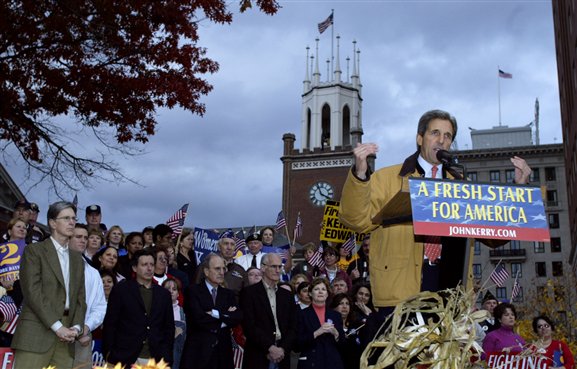

Subscribe to:
Posts (Atom)